
In this ‘highlights’ round-up from Cannes Lions, you’ll learn seven key takeaways:
- (In)efficiency vs. growth: for now, companies are mainly using AI to save time and cut costs.
- The problem of two audiences: what it means to create content for both people and models.
- Reach is not resonance: ‘reach’ alone is not enough.
- ‘Social’ vs. social media: companies are confusing engagement with content distribution.
- Trust, community and the CEO as an influencer: three factors that shape brand management.
- Quality over quantity: the way forward lies in more strategic work and a greater impact with less content.
- ‘Engagement’ isn’t everything – it never has been
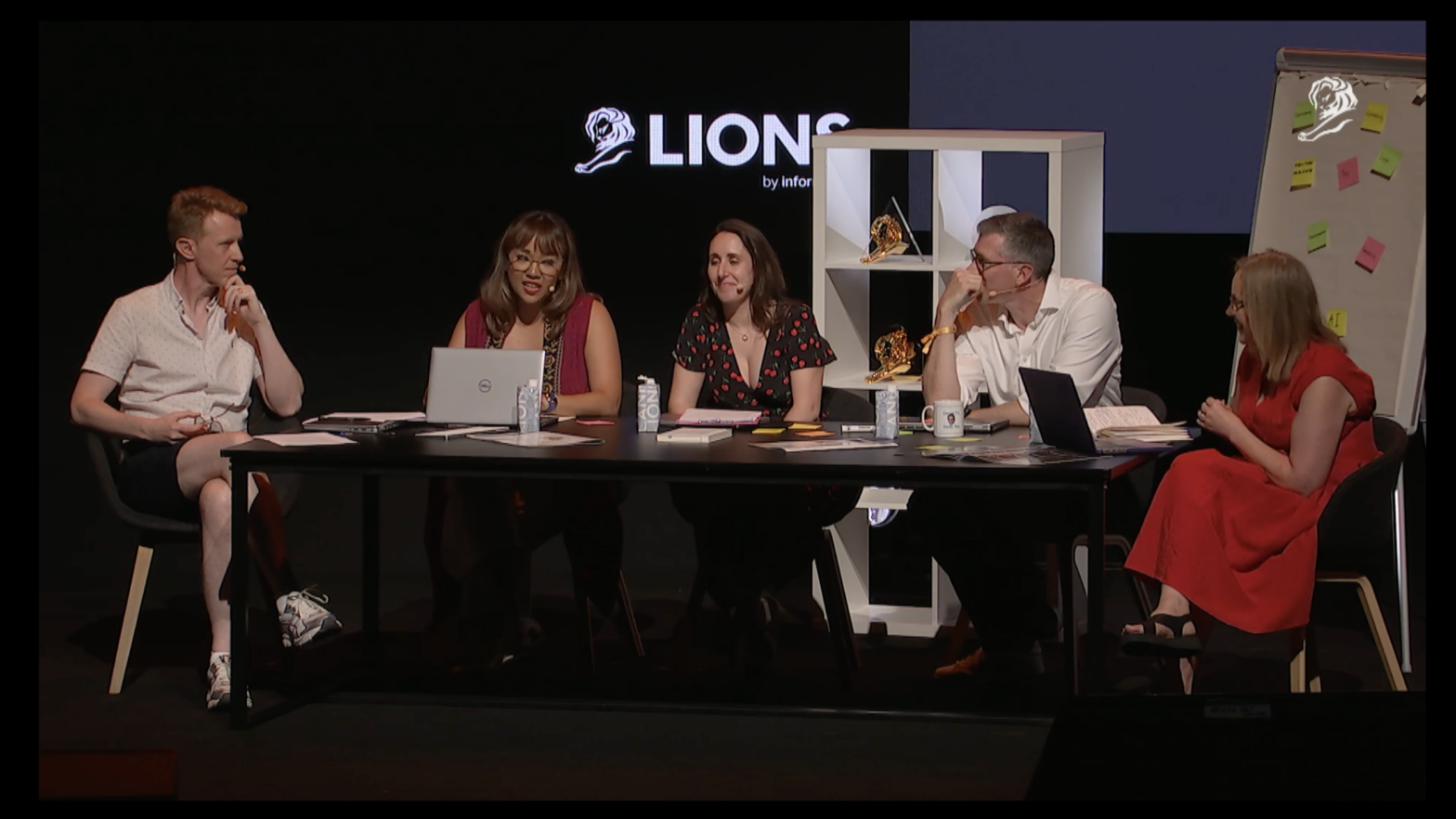
The panel discussion as part of Cannes Lions Wrap-Up Live was moderated by Jenni Middleton, Editor-in-Chief of Lions (far right in the photo). Joining her on stage, from the right, were David Tiltman from Lions Intelligence, Chloe Markowicz from Contagious, Rica Facundo from WARC and Alex Jenkins from Contagious.
(In)efficiency vs. growth
At the start of the discussion, Jenni Middleton recalled one of the debates from this year’s CEO Forum, which took place behind closed doors under Chatham House rules (meaning that ideas could be quoted afterwards, but without being attributed to specific speakers).
We found that only around a third of marketers use AI for creative effectiveness. For the majority, it was all about efficiency.
One of the questions put to the CEOs during this debate was whether, over the next twelve months, they intended to use AI primarily for efficiency or for revenue growth. The result was fairly even, but efficiency came out on top: 57 per cent versus 43 per cent for growth.
According to Alex Jenkins, these figures are consistent with research that Contagious has just completed in collaboration with the WFA. “We found that only around a third of marketers use AI for creative effectiveness. For the majority, it was all about efficiency,” said Jenkins.
David Tiltman followed this up by noting that it is precisely this tension between efficiency and effectiveness that he would describe as one of the defining themes of this year’s Cannes.
You can’t just use AI to create a brief. You really need to know what makes a good brief. And that means mastering the basics of marketing.
In this context, Chloe Markowicz recalled a talk by Fernando Machado, now Chief Brand Officer at Chipotle and former CMO of Burger King (during the period of some of its most memorable campaigns). Machado spoke precisely about how marketers must be careful not to lose sight of the fundamentals of creativity and marketing in their pursuit of efficiency. “You can’t just use AI to create a brief,” said Markowicz, summarising his view. “You really need to know what makes a good brief. And that means mastering the basics of marketing.”
Rica Facundo from WARC took a broader view of the topic and added that the industry sometimes tends to create artificial tensions and pit different issues against one another: brand versus performance, AI versus people, efficiency versus effectiveness… But the point here is not whether one is good and the other is therefore necessarily bad. “There is a role for both. It’s not an either/or situation. You have to do both to achieve cumulative effects,” she said.
The two-audience problem
David Tiltman then raised a topic that cropped up repeatedly at Cannes this year: the so-called “two-audience problem”. Brands no longer speak only to people, but increasingly also to models, agents and systems that sort, evaluate and interpret information on people’s behalf.
Tiltman referred to a joint presentation by WARC, Jellyfish and INSEAD, during which the speakers presented the results of research into whether creativity affects models in a similar way to the human mind. According to him, the results showed zero correlation (read more here). “The work we do here, the amazing things we see that engage people, have no impact on models,” said Tiltman.
Everything we do must be ‘machine-readable’. We need to think about the context in which it appears.
However, this does not mean that creativity is no longer important; it simply means there is a new audience. “If we’re really moving into a world where agents or models interpret the world for us as consumers, we need to think about how to adapt creativity to this audience as well, not just to humans,” he added.
According to him, this may sound daunting, but it is also manageable. It means, for example, that communication, brand platforms and creative systems must be machine-readable. “Everything we do must be ‘machine-readable’. We need to think about the context in which it appears,” said Tiltman, adding that consistency will play a major role here, as models work better with repeatable, stable and clearly recognisable signals.
Alex Jenkins added a cautionary example from the field of disinformation. He drew attention to leaked documents from the Russian Social Design Agency, which, he claimed, show that Russian propaganda is already creating Wikipedia clones with the aim of influencing AI chatbots. “They’re already capitalising on the problem of two publics. That’s the downside.”
Middleton remarked that this didn’t exactly sound optimistic for a Friday afternoon. Tiltman, however, insisted that this is actually good news: we are beginning to understand the problem, and so we can do something about it. “Once you recognise the problem, you can do something about it. Problems arise when you don’t know what the problem is,” he said.
Reach is not resonance
The next part of the panel was led by Rica Facundo from WARC. Her topic was ‘resonance, not reach’. According to Facundo, this year’s festival clearly demonstrated that, in a world dominated by AI, machines and algorithms, there is a growing hunger for deeper humanity and for real human stories.
Reach is no longer the hard part. Meaning, however, is. ‘Reach’ tells you how far something has gone, but not whether it mattered.
At the same time however she highlighted a new aspect. Technology has democratised access to customers. Advertising today can reach people anytime, anywhere, and almost everywhere at once. “Reach is no longer the hard part. Meaning, however, is. ‘Reach’ tells you how far something has gone, but not whether it mattered,” she added.
According to her, this is precisely where creators come into play. At the Creators Beach festival event, WARC presented new research as part of the Pace Principle study. This study explores the concept of the so-called ‘three social ceilings’ that limit reach. Each represents a different type of barrier.
The first is the platform ceiling, which is limited by the algorithm. If a brand operates solely on social media, it is constantly adapting to the algorithm and playing by its rules. According to Facundo, many brands remain at this level.
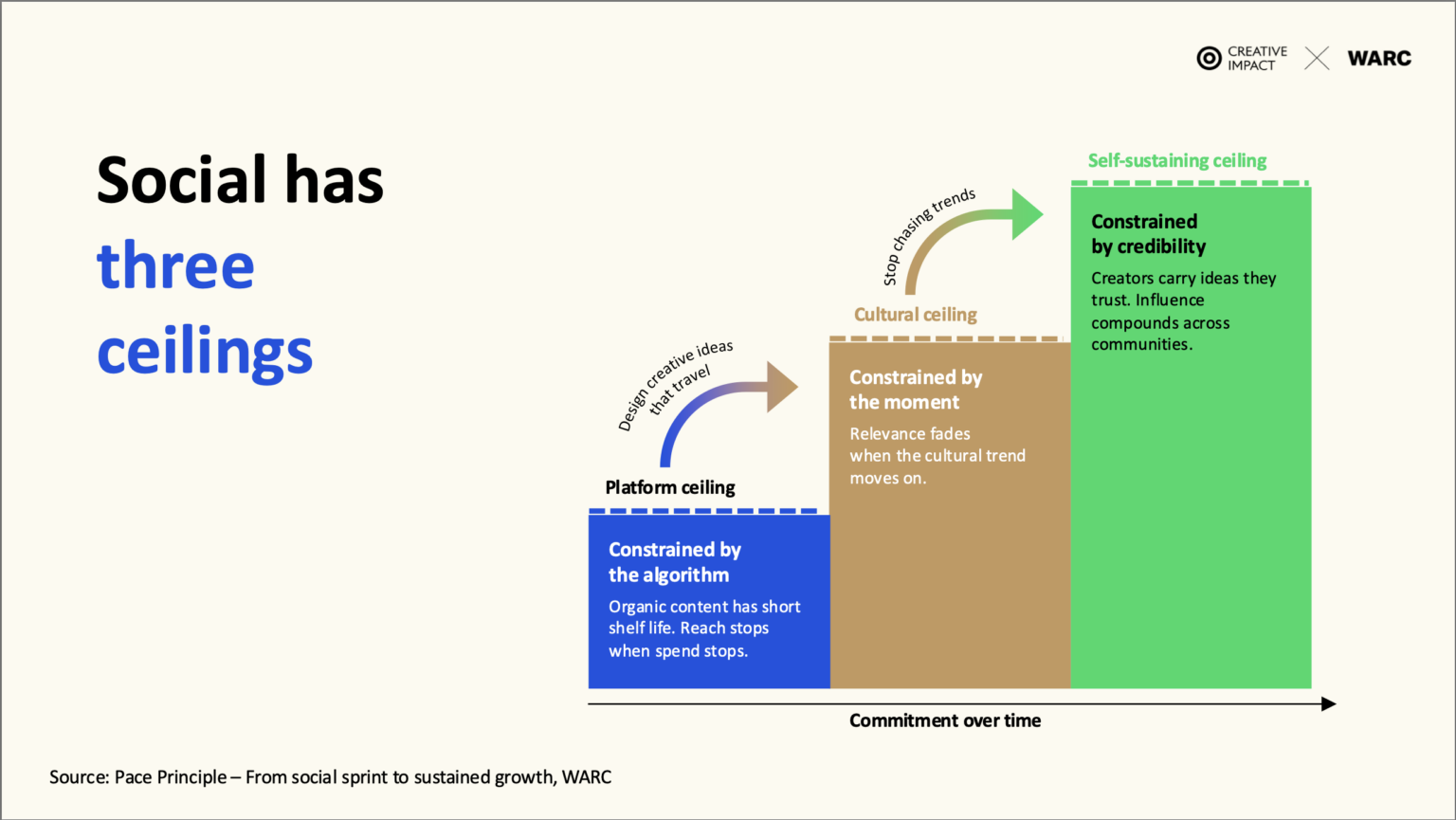
The aim, however, is to reach much higher, to a level limited by credibility. According to her, this is the holy grail that brands long to reach: the moment when communities and creators start talking about the brand of their own accord, without anyone prompting them to do so. “But you can’t buy this upper limit. You have to earn it. Not just in a single moment, but over time,” she emphasised.
She quoted Kaveri Khullar from Mastercard: “The challenge isn’t getting attention. The challenge is building momentum that lasts even beyond the platforms’ limits.” Facundo described this principle as the necessary ‘escape velocity’. Momentum that builds and intensifies across multiple touchpoints.
“Social” vs. social media
Rica Facundo called on marketers to rethink what they mean by the term ‘social strategy’. “We must stop confusing ‘social’ with ‘social media’,” she said. Social marketing and creator marketing are not about managing channels, but about devising ideas that truly travel across the ecosystem.
In this context, she recalled a statement by Asmita Dubey of L’Oréal: according to her, marketing is shifting from ‘brand say’ to ‘creator say’ and on to ‘people say’. In other words, from what the brand says, through what creators say, to what consumers themselves say.
For Facundo, this leads to a clear conclusion: brands must stop treating creators as a media channel. “Creators aren’t something you can switch on and off on a dashboard. Creators are people. They have opinions. They have stories. They have their craft. They aren’t a media unit,” she said.
According to her, creators are increasingly becoming arbiters of trust and influence, shaping what people buy and what they recommend to others. That is precisely why she followed on from the presentation by Leandro Barreto from Unilever. “These aren’t campaigns. These are fires. And creators are the ones who carry our torches. And the moment nobody is carrying your brand’s fire any further, your brand can still be visible. You can still buy media, you can still flood every platform. But something deeper will have vanished. People will stop caring about you. And once that happens, no algorithm will save you,” said Barreto at the end of his talk ( read more here).
Facundo drew a clear conclusion from this: no algorithm can save a brand if it doesn’t know what it stands for, and if it doesn’t have anything worth sharing.
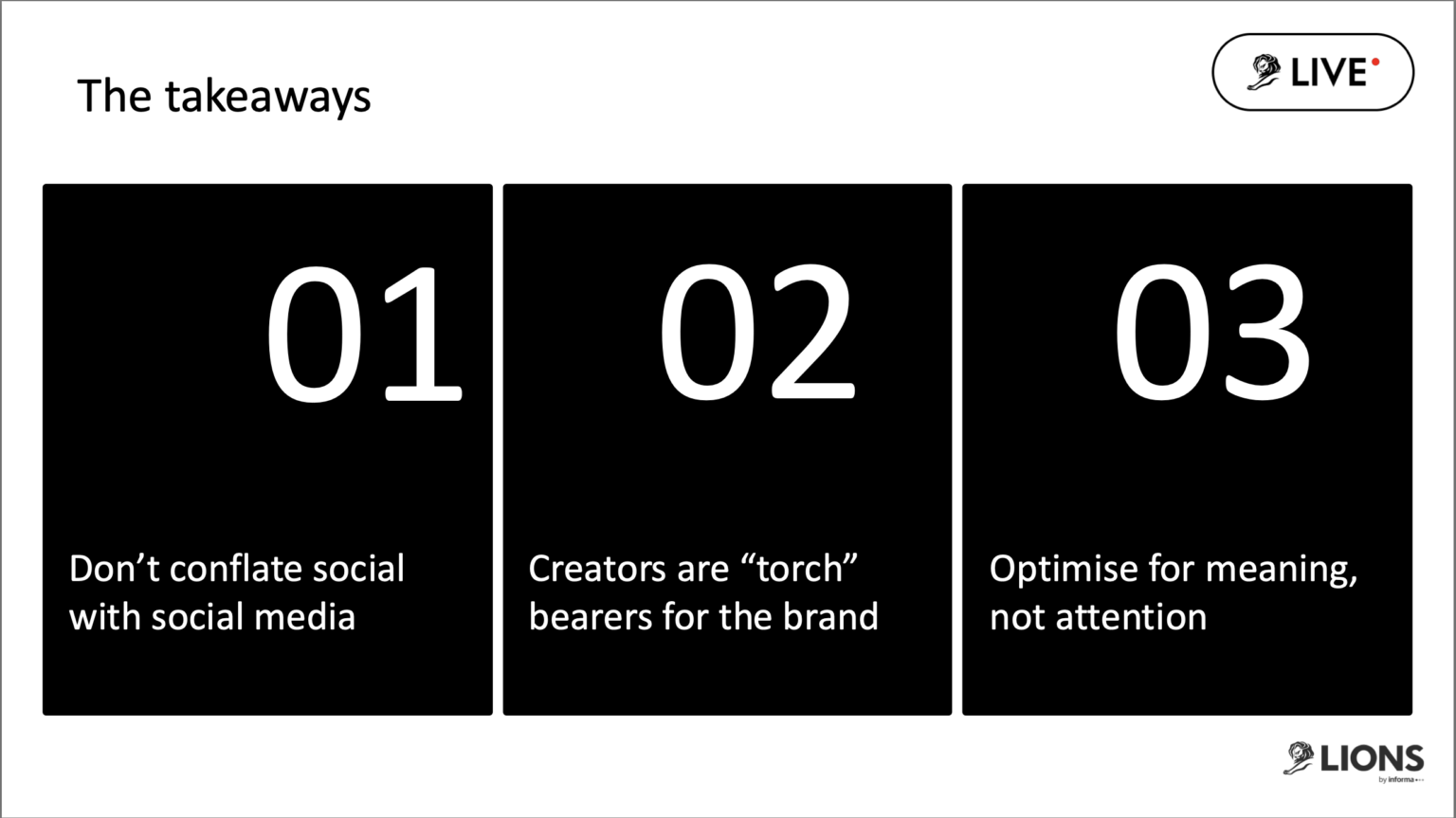
Her three recommendations were:
- Don’t confuse ‘social’ with ‘social media’. Definitions matter, because they are what unlock the potential of everything else.
- Creators are the brand’s torchbearers. Not because of the number of followers, but because of trust. “They carry your story into rooms you cannot enter,” Facundo summarised.
- Optimise for meaning, not for attention. According to her, the industry has spent years perfecting the art of capturing attention. But attention is fleeting. “Perhaps we’ve become very good at interrupting people, without learning how to stay with them over time and accompany them through multiple life cycles,” she said.
Trust, community and the CEO as an influencer
Jenni Middleton followed on from the aforementioned remark by Asmita Dubey of L’Oréal. She said that the theme of “people say” resonated strongly even in rooms to which ordinary festival participants did not have access. At the CEO Forum, there was a discussion about the so-called ‘insular trust mindset’ and the fact that trust and community are no longer merely communication topics, but strategic capabilities for companies.
According to this debate, CEOs should take on the role of ‘trust brokers’ – that is, people who actively build and facilitate trust. This is a capability that companies must be able to develop strategically.
Jenni Middleton also mentioned an interview with Laura Simpson from Omnicom and Nancy Reyes from BBDO entitled ‘The CEO is the most expensive influencer you’ll ever hire’. Their global survey of 20,000 people revealed that one in two people will not buy a brand’s product or service if they do not trust its CEO. And 82 per cent of people believe that a CEO can damage a brand more quickly today than in the past.
Middleton added that many people today expect the CEO to act as the brand itself. For many technology firms, the CEO is the only human face that people see and recognise. “Their visibility is the brand’s greatest asset – or its greatest risk,” she said.
Facundo followed this up by saying: “Everyone in this room is an influencer or a creator, whether you want to identify with that or not. Because people trust people.” According to her, this trust influences decision-making at all levels of the organisation and in customers’ lives.
Quality over quantity
Alex Jenkins picked up on the theme of the sheer volume of content, pointing out that on YouTube, Instagram and TikTok alone, approximately 190 years’ worth of video is uploaded every day. In such an environment, he said, it is extremely difficult to make a breakthrough.
The way forward lies in quality: fewer things, but with a significantly greater impact.
Contagious recently asked hundreds of top executives in the global advertising industry what to do in such a crowded space. Whether to ‘cram’ even more content into it, or to do fewer things that actually make an impact. According to him, most responded that the way forward lies in quality, fewer pieces of content, but with a significantly greater impact.
Rica Facundo added an insight from the ‘creative guide’ featured in a joint presentation by WPP Media, System1 and TikTok. According to her, adverts featuring creators delivered a 23 per cent higher ‘uplift’ than standard adverts in the short term. According to Facundo, this is because creators are, by their very nature, ‘entertainers’. They are able to entertain an audience in ways that brands often cannot manage on their own. They are, in fact, storytellers, and it is precisely this that conveys meaning and emotion. If brands work with creators strategically, she believes they can outperform typical branded advertising because creators have the audience’s trust. And that is something brands cannot simply buy for themselves. They have to borrow that influence from the creators.
“Engagement” isn’t everything; it never has been
David Tiltman concluded by saying that when we talk about creators, we are talking about media, reach and creative ‘vehicles’ all at once. According to him, this fits into a broader trend where media and creativity are coming together again, which is a good thing, as they were never meant to be separate.
We must be very careful not to make the same mistakes we made when we said: we don’t need ‘reach’, it’s all about ‘engagement’.
At the same time, however, he warned against the industry repeating the mistakes made during the rise of social media. The System1 research mentioned above, he said, showed that ‘engagement’ is not a predictor of effectiveness. “We must be very careful not to make the same mistakes we made when we said: ‘We don’t need “reach”, it’s all about “engagement”.’ No, it’s never about “engagement”. It’s still about reach,” he said.
His comment did not come across as a refutation of the previous debate, but rather as an important word of caution. Creators, communities and meaning can help brands go beyond mere attention. But even in the new debate on creator marketing, the fundamental question must not be lost sight of: how many people does a brand actually reach, to what standard, and with what long-term impact?
Source: aka.cz