

What you will find in the article
- Television news remains a trusted source during major events.
- Young people turn to established news organisations for reliable information.
- UK research rates broadcast news highly for accuracy and impartiality.
- Professional journalism and fact-checking help counter disinformation and AI-generated manipulation.
Research shows that television news continues to occupy an important position in today’s media landscape, where disinformation is rife. Particularly when major events unfold, we turn to established news brands. Simply catching the first report to appear on social media is not enough: we want to know what actually happened. We want to know whether the information is accurate, who has confirmed it, what is known about the event and what remains unclear. It is at precisely such moments that the value of trustworthy journalism becomes most apparent. Its role is not merely to deliver information as quickly as possible, but also to verify its accuracy, place events in context and help the public distinguish fact from speculation.
In this respect, television news remains an important part of the media landscape. Although growing numbers of people obtain information through digital platforms, research suggests that the way we access news does not necessarily reflect which sources we genuinely trust.
When it really matters, young people turn to traditional news outlets
This apparent paradox was highlighted by Nic Newman, a researcher at the Reuters Institute for the Study of Journalism at the University of Oxford, during a panel discussion hosted by Channel 4 and the Royal Television Society in January 2025.
The discussion explored Generation Z’s relationship with news and how traditional media organisations can earn the trust of younger audiences. Newman pointed out that everyday news consumption and the search for information when major events unfold represent two distinct patterns of media behaviour. He noted that when major events occur, young people, faced with something such as a terrorist attack, turn to established news organisations such as the BBC or Channel 4 News. In their day-to-day news consumption, however, their interest in particular topics or trust in certain individuals may play a greater role.
This distinction is significant. Social media may be where people first hear about an event. When they need more reliable information or a deeper understanding of the wider context, however, they may seek out a news organisation whose work they know and trust. Newman’s observations serve as a reminder that accessibility and credibility are not the same thing. The source people encounter most frequently is not necessarily the one whose reporting they give the greatest weight.
Television news retains its lead in trust
The importance of professional broadcast media is also borne out by the latest UK research, News Consumption in the UK 2026, published in September 2026. Its findings show that television and radio news in the UK are generally rated more highly for trustworthiness, accuracy and impartiality than news accessed through online platforms.
Particularly revealing findings emerged from supplementary research conducted following the local and other regional elections held in Great Britain in May 2026. Traditional television and radio news sources were generally rated more highly for accuracy, trustworthiness and impartiality than political advertising or election-related content on social media. The BBC’s main television news bulletin was the most widely used individual source of election news. These findings demonstrate that professional news organisations continue to play an important role when people need reliable information about major events in public life.
A similar conclusion was highlighted by Ian Macrae, Director of Market Intelligence at Ofcom, the UK’s independent regulator for the media and electronic communications sectors. Presenting the research findings, Macrae noted that, although people are discovering news in ever more diverse ways, they remain discerning about which sources they trust, particularly at important moments such as elections. It is precisely this ability to deliver reliable information that Macrae identifies as central to the role of public service news brands.
The UK findings thus provide a compelling illustration of how growing use of digital platforms does not necessarily translate into a corresponding increase in trust in the news content they carry.
Truth requires verification. And verification requires professionals
The credibility of television news takes on particular significance in light of advances in generative artificial intelligence and the growing volume of manipulative content.
These risks were highlighted by Noel Curran, Director General of the European Broadcasting Union (EBU), in his opinion piece Truth in the Balance: Defending Democracy in the Intelligent Age, published in January 2025. Curran points out that the digital environment enables information to spread at extraordinary speed, but also allows falsehoods and deliberate attempts at manipulation to proliferate just as rapidly. Moreover, algorithms can favour content that provokes strong emotions and fuels conflict, even though its popularity is by no means a guarantee of its accuracy.
He pays particular attention to the role of professional news organisations and the importance of information verification. ‘Public service media are not the sole guardians of truth,’ Curran acknowledges, while emphasising that their role in society is becoming increasingly important. In particular, he highlights investment in professional journalism and dedicated fact-checking teams. Among the examples he cites are Germany’s ARD Faktenfinder, Belgium’s RTBF Faky and the UK’s BBC Verify.
The very existence of these teams illustrates the important distinction between simply publishing information and practising professional journalism.
Impartiality still matters – and audiences expect it
A commitment to impartiality is another essential prerequisite for trustworthy journalism. In a social media environment where strongly opinionated content attracts considerable attention, however, the question arises as to whether the public still wants impartial news.
An illuminating answer comes from Professor Rasmus Kleis Nielsen, one of the authors of the Reuters Institute’s Digital News Report 2026. In his analysis, Can Public Demand for Impartial News Survive Platforms and Polarisation?, he examined what kind of news people actually prefer.
Findings from the 48 media markets surveyed revealed that 45% of respondents prefer news sources that do not take a particular point of view. By contrast, 22% prefer news from sources that share their own views, while 15% favour sources that challenge them. What is particularly striking is that the preference for impartial news persists despite the growing polarisation of public debate.
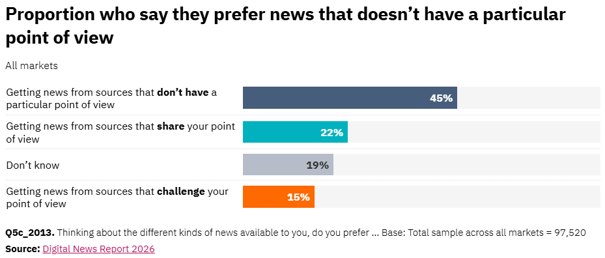
Nielsen draws attention to an important distinction between the voices that are most visible in public debate and the preferences of a broader section of the audience. People who favour opinionated news that aligns with their own views tend to be particularly active in online discussions, frequently sharing and commenting on news stories and displaying a greater interest in politics. Their views may therefore have a prominence in the digital sphere that is disproportionate to their representation in the wider population. According to Nielsen, the findings demonstrate that a commitment to impartiality remains an important value for a substantial proportion of the public.
For television news, this is a significant insight. Professional newsrooms committed to factual and impartial reporting are responding to the expectations of a substantial part of their audience, rather than merely adhering to a traditional notion of what journalism should be.
How is young people’s trust in journalists and news organisations changing?
The credibility of journalism is not solely a matter of professional standards. The way audiences perceive the source of the information itself also plays a significant role. This evolving relationship was highlighted by Rachel Botsman, an expert on trust in the digital age and author of Who Can You Trust?, during the discussion hosted by Channel 4 and the Royal Television Society in January 2025.
According to Rachel Botsman, traditional hierarchies of trust are undergoing a transformation: institutional standing or expert status alone no longer automatically confers trust, yet personal and institutional trust can reinforce one another. She argues that young people do not automatically trust someone simply because they speak on behalf of an established organisation. The way that person communicates, their perceived authenticity and the sense of personal connection they establish may all be important factors.
At the same time, however, Rachel Botsman drew attention to a surprising observation: in her view, younger people actually place greater trust in traditional media institutions than older generations do. The growing importance of journalists’ personal credibility need not, therefore, come at the expense of trust in the institutions they represent. On the contrary, the two forms of trust can be mutually reinforcing. ‘It works best when the two come together,’ Rachel Botsman remarked during the discussion about the relationship between trust in individuals and trust in media organisations.
This perspective is particularly relevant to television news. Television news presenters, reporters and foreign correspondents are the human faces of news organisations. Their professionalism, the way they explain events and their ability to communicate clearly can all shape viewers’ perceptions of the work of the news organisation as a whole.
At the same time, a journalist’s personal credibility cannot be a substitute for rigorous verification and editorial accountability. It is precisely the combination of a trusted individual and the professional infrastructure of a newsroom that may offer traditional television news a way to connect with generations who obtain most of their information through digital platforms.
The Czech paradox: low overall trust in news, stronger trust in individual brands
The Czech findings of the international Digital News Report 2026 also offer an interesting perspective on the credibility of journalism. According to the report, just 31% of Czech respondents trust most news most of the time. Overall trust in news thus remains relatively low. However, alongside the figures for overall trust in news, the Czech Republic chapter of the report, authored by media researcher Václav Štětka of European University Viadrina, also presents trust ratings for individual news brands. These suggest that low levels of trust in news as a whole do not necessarily translate into equally low levels of trust in every individual media organisation. Established news brands may therefore enjoy a stronger relationship with their audiences than overall levels of trust in news alone might suggest.
According to the findings of the Digital News Report 2026, Czech Television’s news output is regarded as trustworthy by 59% of respondents. Commercial television news brands also command the trust of Czech respondents. CNN Prima NEWS achieves a trust rating of 57%, while TV Nova stands at 48%. CNN Prima NEWS thus enjoys a level of trust very similar to that of the public service broadcaster Czech Television, with the two-percentage-point difference between the brands not being statistically significant.
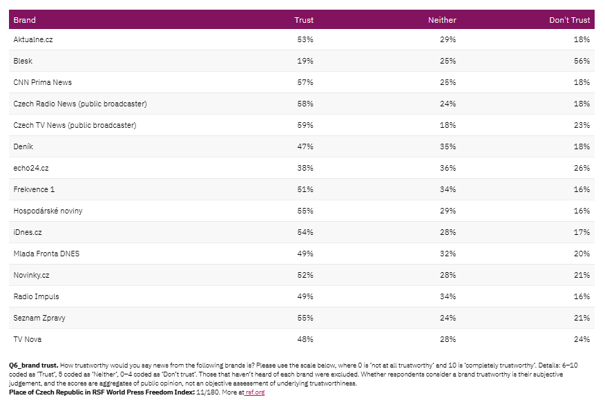 Source: Reuters Institute, Digital News Report 2026
The survey measured trust in individual news brands on an 11-point scale from 0 to 10, with scores of 6 to 10 being classified as an indication of trust. Only respondents familiar with the brand in question were included in the results. The figures therefore reflect respondents’ subjective assessments of the credibility of individual news brands across platforms, rather than an objective evaluation of the quality of their television news programmes.
The importance of credibility in today’s information environment was also emphasised in connection with the research findings by Martin Švehlák, Director of News and Current Affairs at CNN Prima NEWS. ‘The world has entered a new era of fake news and an endless stream of artificially generated content,’ he warned, stressing that he regards credibility as an essential prerequisite for delivering relevant and verified news.
The findings thus demonstrate that trust among the Czech public is not confined to public service news provision. Commercial television news brands also occupy an important position, serving as trusted sources of information for a substantial proportion of respondents familiar with them.
Trust is earned through daily practice, not declarations
The experts thus agree on one fundamental point: the credibility of professional journalism cannot be taken for granted. Nic Newman reminds us that established news organisations remain important sources of information when major events unfold. Noel Curran emphasises the need for fact-checking and professional journalism. Rasmus Kleis Nielsen demonstrates that the public continues to value a commitment to impartiality. Rachel Botsman highlights the importance of journalists’ personal credibility and their relationship with audiences. Meanwhile, the Czech Republic chapter of the Digital News Report 2026, authored by Václav Štětka, demonstrates the importance of considering trust ratings for individual media brands when assessing trust in news.
Each of these perspectives sheds light on a different aspect of trustworthy television journalism. What they have in common, however, is the conviction that trust cannot be earned simply on the strength of an established name. It must be continually reaffirmed through accuracy, professionalism, transparency and the responsible handling of information.
At a time when news circulates through an ever-expanding range of channels and its origins are not always apparent, the ability to deliver verified, accessible information may be of exceptional value. For television journalism, it represents one of its greatest strengths – one that must be carefully nurtured over time.