

What you will find in the article
- Television matches influencer marketing’s ROI while generating far greater sales volumes
- TV advertising delivers strong profits and can sustain larger budgets
- Television storytelling and credibility help build lasting brand value
- More video content does not necessarily mean greater value for brands
Do content creators sell more than television? That is the impression one might take away from a study by a team at Seoul National University, published in the Korean Management Review in February 2026. In this particular case, influencer marketing delivered a significantly higher long-term return on investment than either television or online advertising. There is, however, a catch. The research drew on data from a single cosmetics company, so its findings cannot automatically be generalised to the advertising market as a whole.
Research on a larger scale, however, paints a more nuanced picture. Emanuele Landi makes this point in his article Do Creators Really Sell More Than TV?, published on TVREV in November 2026. A high return on investment, after all, does not necessarily translate into high sales volumes.
Television sells. And it sells at scale
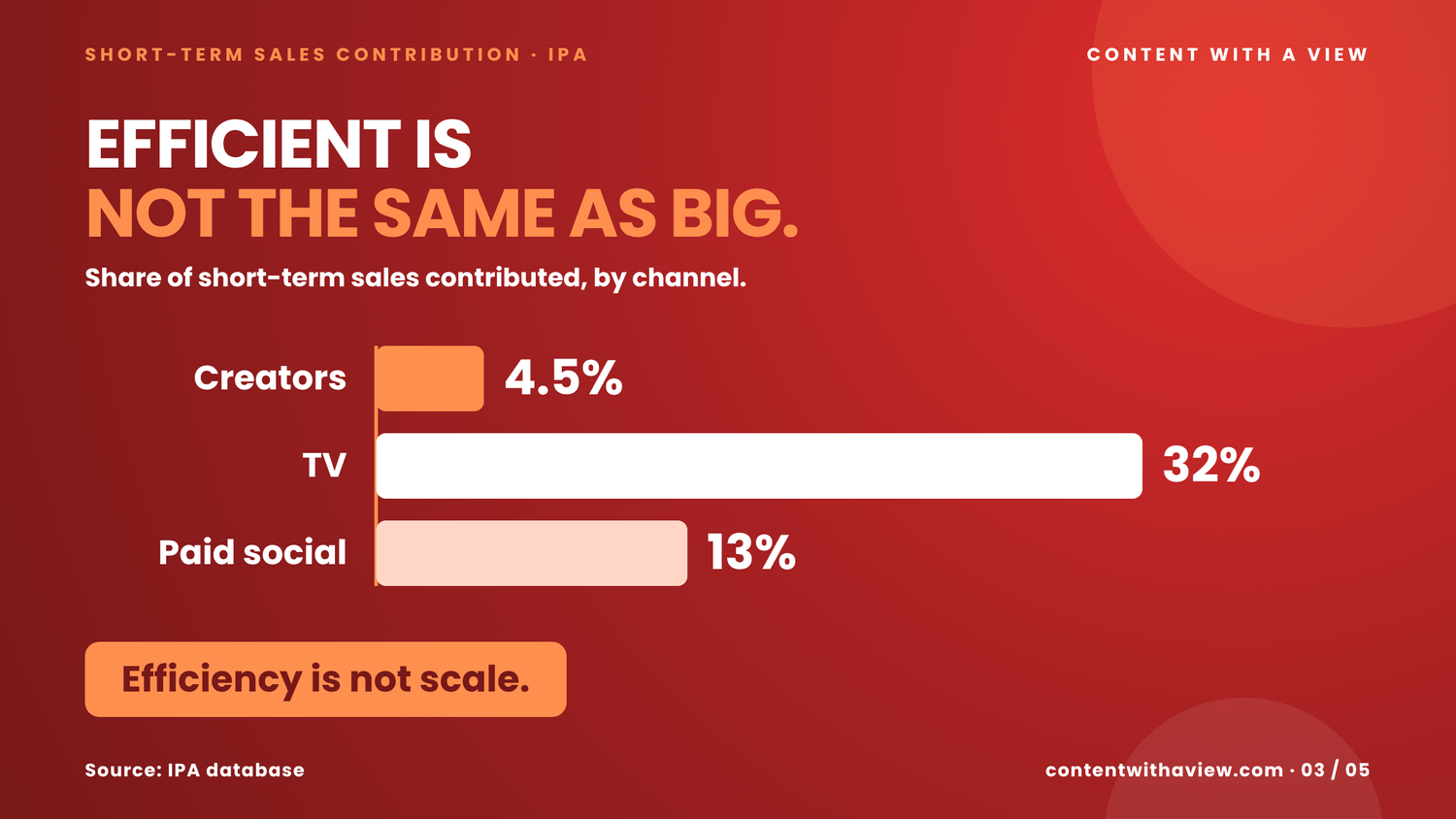
Research conducted in 2025 by the UK’s Institute of Practitioners in Advertising (IPA) examined influencer marketing as one segment of the creator economy. An analysis of 59 UK campaigns found that the short-term returns on investment from influencer marketing and linear television were virtually identical. With the average across all media studied indexed at 100, influencer marketing scored 99 and linear television 97. When it comes to sales volumes, however, the picture is markedly different. Across the campaigns analysed, influencer marketing accounted for 4.5% of the short-term sales impact generated by advertising, compared with 32% for linear television.
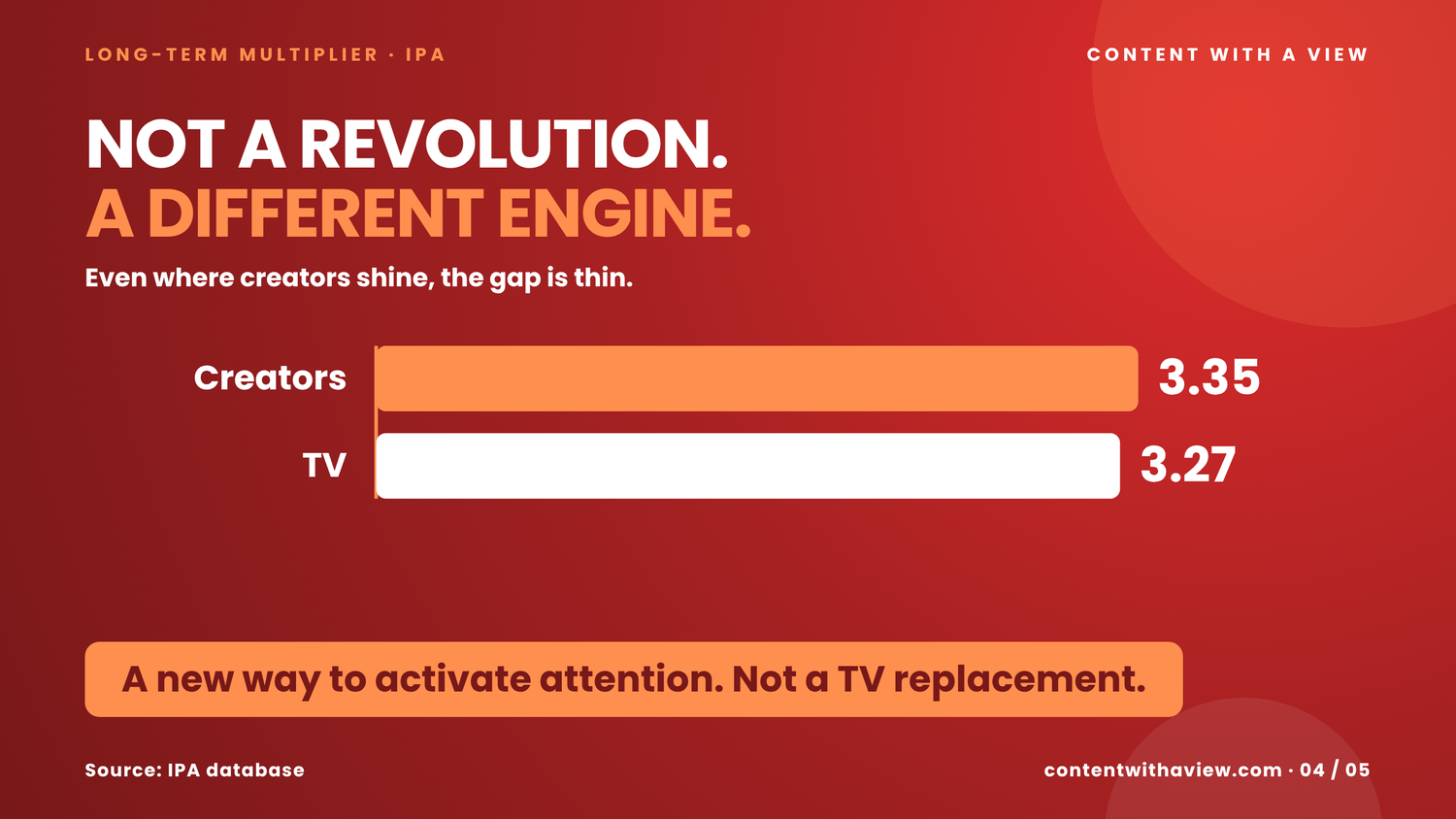
The two channels also achieve similar long-term multipliers, which express the ratio of total advertising impact to its short-term impact. The multiplier stands at 3.35 for influencer marketing and 3.27 for linear television. This comparison is based on a smaller sample of 18 UK campaigns.
Influencer marketing can therefore be highly effective. But comparable returns on investment do not mean comparable sales volumes. The difference also reflects the level of investment in each medium. The ability to make effective use of substantial advertising budgets and deliver results at scale is one of television’s greatest strengths.
This is borne out by Profit Ability 2, an econometric study commissioned by Thinkbox and conducted in 2024 by Ebiquity, EssenceMediacom, Gain Theory, Mindshare and Wavemaker UK. In the dataset analysed, television advertising accounted for 54.7% of all advertising-generated profit, despite representing 43.6% of advertising investment. Every pound invested in television advertising (including advertising on broadcaster video-on-demand services, or BVOD) generated an average of £5.61 in profit before media costs over a period of up to two years. The equivalent figure for online video was £3.86. The study also found that television had the highest saturation point of all the media examined. In other words, it can accommodate larger advertising budgets while continuing to deliver profitable returns on incremental investment.
Television, then, not only helps build brands over the long term but also delivers immediate commercial results. And it does so at scale.
Visibility alone is not enough
The creator economy is a reminder of just how important it is to build lasting relationships with audiences. Successful creators have a distinctive voice, earn their audience’s trust and give their followers a reason to keep coming back.
Through a paid partnership, a brand can tap into the trust a creator has earned from their audience. Yet consumers may not develop an equally strong connection with the brand itself. As Emanuele Landi points out, traditional media face a similar challenge. Buying attention alone is no guarantee of long-term brand value.
The findings of The Science of Desire, a global study unveiled by Havas in June 2026, are particularly telling. The research covered more than 87,500 respondents and over 2,400 brands across ten markets. It found that 84% of brands fall into what is known as the zone of consumer indifference.

Yet brands that are more desirable to consumers, as measured by Havas’s methodology, achieve 2.4 times the long-term growth.
A brand needs to give consumers a reason to remember it, grow fond of it and choose it time and again. Television has powerful tools at its disposal to achieve this: the ability to tell stories, evoke emotions, reach large audiences and build trust.
Recent data from the Czech Republic also highlight the credibility of television advertising. According to the ViewTube CEE by WPP Media study, whose findings were published by MediaGuru on 24 November 2026, 47% of Czech television viewers consider TV advertising trustworthy. The figure stands at 24% among YouTube users and 18% among social media users. What is more, consumers perceive brands that advertise on television as large and successful. This is despite finding television advertising more intrusive than advertising on the other video platforms in the comparison.
Trust is an asset that cannot be captured by view counts or engagement figures alone.
Not all video is created equal
The creator economy has opened up the media market to new players. Generative AI offers further ways to speed up content creation and reduce production costs. Yet more content does not necessarily mean more value for brands. As the supply of audiovisual content grows, quality, originality and professional production values become increasingly important. Equally important is the environment in which consumers encounter advertising.
The UK study Context Effects was commissioned by Thinkbox and conducted in 2024 by Map The Territory and Tapestry Research. Its findings showed that advertising within professionally produced content was 60% more memorable than advertising within non-professionally produced content. Viewers were also 44% more likely to trust it.
The screen itself matters, too. According to the same research, advertising was 60% more memorable when viewed on a television set than on a smartphone or tablet.
Of course, professionally produced content is not the exclusive preserve of broadcasters. Independent creators are equally capable of producing audiovisual content of exceptional quality. On social platforms, however, professional productions sit alongside content of widely varying quality. In television, by contrast, professional production and editorial standards are integral to the way the medium operates.
Television advertisers are therefore buying more than audience impressions. They are also investing in the quality of the environment in which their brand appears.
Brand safety cannot be taken for granted
As the volume of audiovisual content grows, so does the importance of brand safety – protecting brands from association with inappropriate content that could damage their reputation. Television offers advertisers a more predictable environment. An identifiable broadcaster is accountable for its programming, and content is subject to professional editorial and production processes. In the Czech Republic, broadcasting is governed by legislation and overseen by the Council for Radio and Television Broadcasting. Broadcasters also have reputations of their own to protect over the long term.
Online platforms are also subject to regulation, but their responsibilities for the content they carry differ from those of broadcasters. Content on social platforms is generated by vast numbers of users, and algorithms play a major role in determining how it is distributed. Inappropriate content may not be identified and removed until after it has been published.
When brands work directly with content creators, the creator’s personality also comes into play. A brand gains access to the creator’s audience and can benefit from their credibility. At the same time, however, it exposes itself to risks associated with the creator’s public conduct and reputation.
Transparency in commercial communications is another important consideration. In 2024, the European Commission and national consumer protection authorities published the findings of a screening of posts by 576 influencers. Of the influencers screened, 97% had published commercial content, but only 20% consistently identified it as advertising.
In television broadcasting, by contrast, advertising must by law be readily recognisable and clearly distinguishable from the rest of the broadcast. Television thus offers brands a professional, more predictable advertising environment that helps mitigate reputational risk.
When the digital world starts to look more like television
The evolution of today’s media landscape presents an intriguing paradox. While the debate continues over whether content creators will replace television, social platforms themselves are moving closer to the television model.
Instagram is a case in point. In June 2026, Meta announced the expansion of its Instagram app for television sets and said it was exploring longer videos and episodic formats. The principles on which television has long been built are therefore far from losing their relevance. On the contrary, they are inspiring new players in the media market.
Broadcasters, meanwhile, already have what many newcomers are still striving to build: professional production infrastructure, established formats, their own content brands and enduring relationships with viewers. They also have a wealth of storytelling experience.
Television’s value extends well beyond mass reach. It creates shared experiences, gives rise to cultural phenomena and sparks conversations that resonate across society. It allows brands to become part of these stories through spot advertising, sponsorship, product placement or long-term content partnerships.
As a major producer of professional audiovisual content, the television industry can play an active role in shaping the creator economy and capitalise on the opportunities it presents.
In an age of content abundance, media that can offer more than attention alone are becoming increasingly valuable. Television combines the ability to deliver commercial results at scale with credibility, high-quality content and a brand-safe advertising environment. It is precisely this combination that makes television so powerful.
Source: tvrev.com