

What you will find in the article
- Czechs believe they can spot a deepfake, but most do not know what the term means
- Fraudsters use AI to mimic the voices and identities of individuals and companies
- Vodafone Verify analyses suspicious photographs, videos, messages and documents
- The app provides a probability-based assessment, not a guarantee of the content’s authenticity
One photograph and approximately fifteen seconds of voice recording. According to Maty Boháček, co-founder of the technology company Synhawk and a researcher at Stanford University, that is all it takes today to create a convincing digital doppelgänger. This doppelgänger can then speak in your voice, look like you and say things you have never said. “Six or seven years ago, the idea that it would be possible to ‘clone’ anyone in this way was more like science fiction,” Boháček recalled. Today, he says, such technologies handle the Czech language very well and, with increasing amounts of reference material, are able to mimic a person’s individual manner of speech.
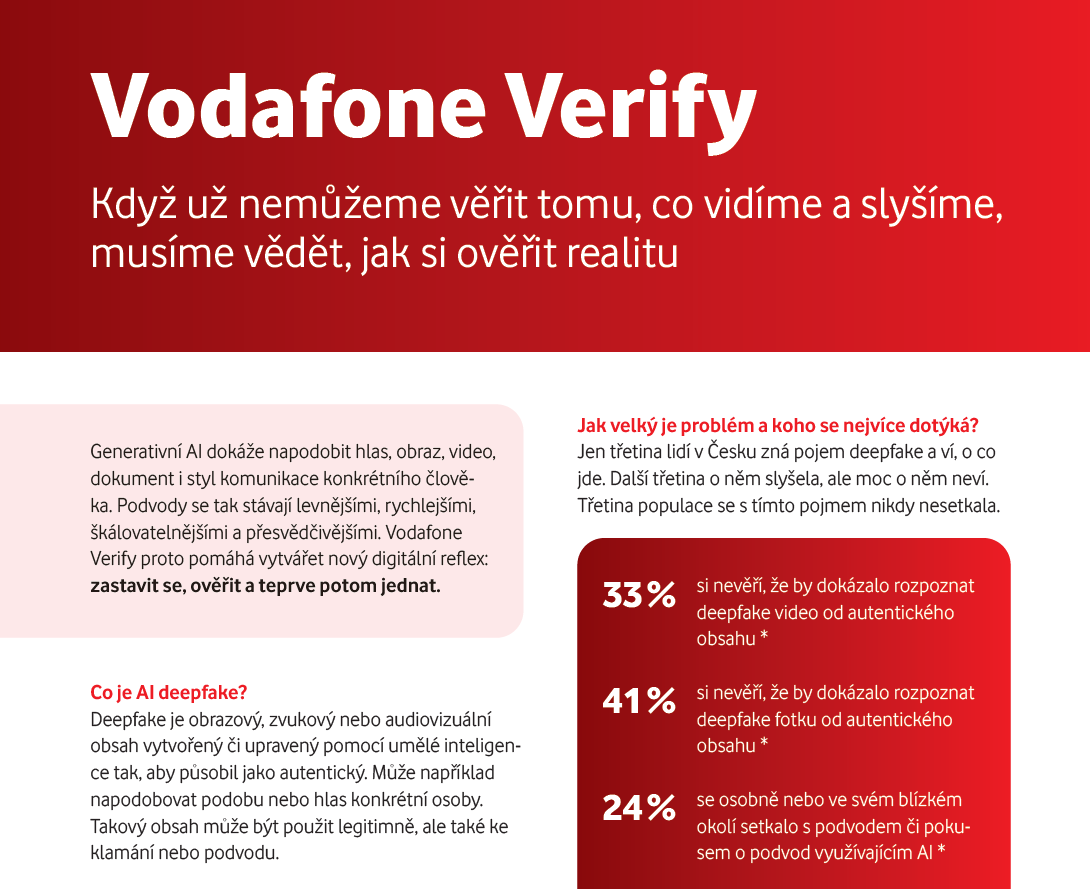
The public is fairly confident in its ability to spot digital forgeries. According to a September survey by Ipsos for Vodafone, 56 per cent of people believe they would be able to recognise a deepfake video. When it comes to photographs, 47 per cent are confident, whilst for documents the figure drops to just 32 per cent of those surveyed.
Only one-third of Czechs are familiar with the term ‘deepfake’. Another third have heard of it but do not fully understand it, and the remaining third have not yet encountered it. Young people express the greatest confidence. In the 18 to 26 age group, 80 per cent of respondents are confident they could recognise a deepfake video, whilst among those aged 54 to 65, the figure is only 42 per cent. “When trying to spot a deepfake, people most often rely on various small details that don’t quite add up, such as unnatural elements in the image or an incorrect number of fingers. However, creators are becoming increasingly sophisticated, and it is getting harder and harder to spot a deepfake based on these signs,” explained Tereza Horáková, a research specialist at Ipsos.
Fraudsters do not just target individuals
According to the survey, 24 per cent of Czechs have personally encountered a scam using artificial intelligence, or have seen one in their immediate circle. A further 86 per cent expect such attacks to increase over the next two years. However, the risk does not only affect ordinary internet users; fraudsters are also increasingly targeting businesses, for example through fake invoices, requests to change bank account details or voice messages impersonating senior managers.
Thirty-one per cent of companies have encountered fraudulent requests for payment or changes to bank details involving identity impersonation, whilst a further 22 per cent have encountered fake documents or invoices created or altered using AI. Nevertheless, only 31 per cent of companies consider themselves well-prepared to deal with such attacks. Only six per cent of companies use specialised tools to detect deepfake content. According to the expert, there are no significant differences between small businesses and large corporations when it comes to assessing their own preparedness. Whilst larger organisations are more likely to train staff and implement security procedures, they also have to protect a much larger number of people.
Vodafone aims to teach users how to verify
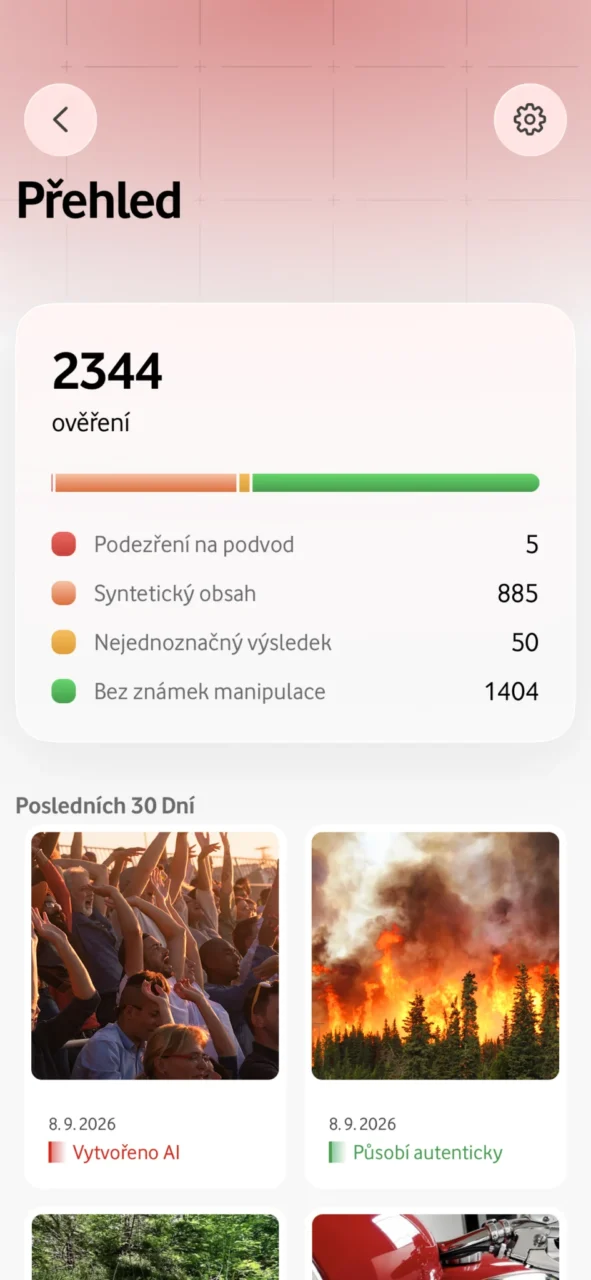
Vodafone is responding to the growing risk with a new app called Verify, developed in collaboration with Synhawk. Users can upload suspicious photos, videos, voice messages, text messages or documents to the app. The service then analyses risk indicators and provides a probabilistic assessment of whether the content may have been created or altered using AI.
Petr Roháček, Vodafone’s ICT product manager, demonstrated an example of a voice message from an alleged colleague who asked for a work plan to be sent, including a budget and campaign deadlines. After analysis, the app flagged that it was a synthetic voice. “It’s not a magic shield that will protect you 100 per cent of the time,” Roháček pointed out. According to him, the essence of the service is to create a window of opportunity to verify information between receiving a suspicious message and taking any subsequent action. For example, if an unusual request comes from a colleague, it is a good idea to confirm it via another communication channel.
The Vodafone Verify app will be available from 22 October for Android and iOS. It will be included in the package for selected tariffs; others will be able to purchase it for 59 crowns a month, excluding VAT. In 2027, Vodafone plans to add protection directly within the mobile network, as well as a tool that will alert users to suspicious participants in online meetings.
Detection alone is not definitive proof of the authenticity or inauthenticity of content – the result provides a further guide for decision-making, not a substitute for human judgement.
A new digital reflex: pause and verify
According to a Vodafone Foundation survey of people aged 60 and over, 38 per cent of respondents fear they would not be able to recognise a fake voice or video created using AI. Furthermore, a quarter of them had never even heard of such scams before. Vodafone is therefore basing the service on a simple principle: pause, verify and only then act. At a time when a person’s voice, appearance or identity can be convincingly imitated in a matter of minutes, the company believes that verification is becoming a new fundamental habit in digital communication.
Vodafone Verify will be available for Android and iOS from 22 October, but it will not be free for everyone.
We recently wrote about O2, which offers its customers a virtual advisor called ‘Grandma Alenka’, who is also designed to help determine what is real.

Source: mam.cz