

What you will find in the article
- YouTube, dm and Lidl are among the brands closest to Czech consumers’ hearts
- Brand awareness is rising slightly, whilst emotional connection remains stable
- In the long term, Foodora, O2 and Bageterie Boulevard are gaining ground
- Older brands are performing better than newer ones; Czech origin does not confer an advantage
On average, Czech consumers recognise 64 per cent of the brands tested, one percentage point more than a year ago. However, they consider only 13 per cent of these to be close to them – that is, emotionally relevant – the same as in the previous year. This is according to the regular Brand Success study by the research agency Ipsos, which assessed 332 brands across 37 categories. Low brand awareness is a barrier, but building awareness alone is not enough: to succeed when consumers are making a choice, a brand must be among the relevant ones. “Building brand awareness is not the ultimate goal, but a gateway that is very important,” explained Michal Štěpánek from Ipsos.
This year’s ranking of the most familiar brands is led by YouTube, ahead of dm and Lidl. dm has newly entered the top three, with YouTube replacing Lidl. The other brands in the TOP 10 also remain largely unchanged, with Visa, Mastercard, Jar, Kofola, Dr. Max, Facebook and, from the newly added category of large online retailers, Alza also featuring.
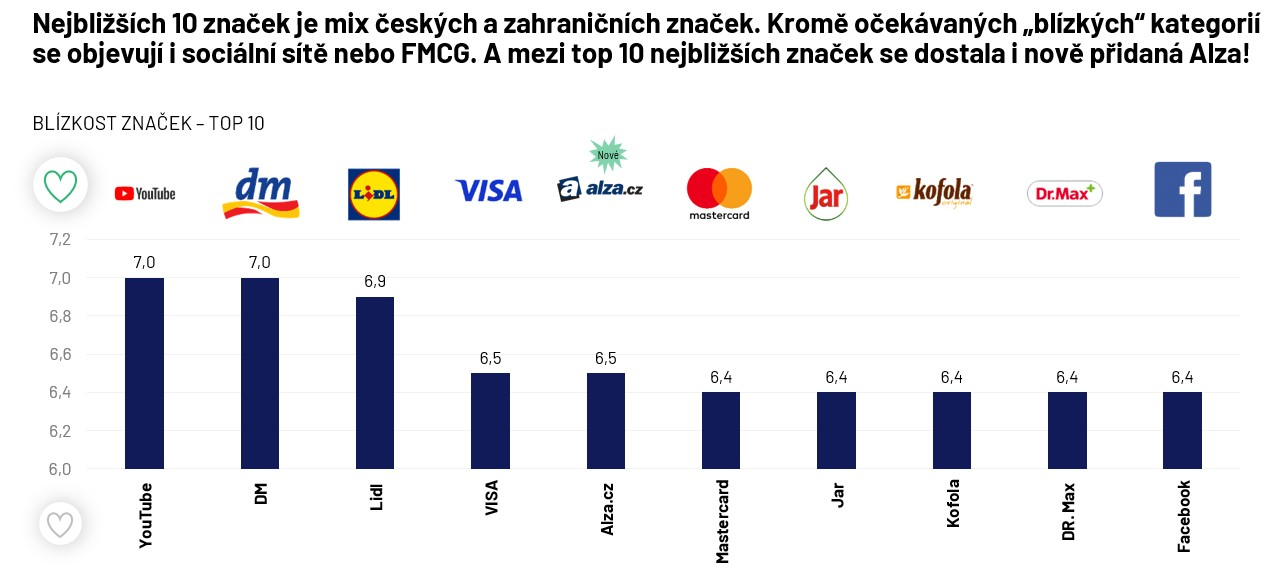 Q: How close is this brand to you personally?, sample: 400 respondents per brand; Source: Ipsos, Brand Success 2026
In terms of categories, people feel closest to supermarkets, credit cards and chemists – areas characterised by frequent use and low barriers to entry. At the opposite end of the spectrum are gambling and tobacco products. Health and sports drinks also show a lower level of connection; according to Ipsos, there is currently a lack of strong, established brands in this sector.
Air Bank is the strongest bank, Dr. Max leads the way in pharmacies, and IKEA in home furnishings. O2 has overtaken T-Mobile in mobile services.
Top brands by category
- Supermarkets: Lidl, Kaufland, Albert
- Financial services and cards: Visa, Mastercard, Air Bank
- Pharmacies: Dr. Max, Benu, Lékárna.cz
- Sportswear, footwear and clothing: Nike, Adidas, Deichman
- Mineral water, soft drinks, energy drinks: Kofola, Mattoni, Magnesia
- DIY: OBI, Hornbach, Baumax
- Home furnishings: Ikea, Jysk, Sconto
- Household cleaning products: Jar, Savo, Cif
- Telecommunications: O2, T-Mobile, Vodafone
- Mobile phones: Samsung, Google, Xiaomi
- Major online retailers: Alza, Allegro, Temu
Growth in brand affinity is primarily linked to whether a brand can respond to changes in society and expand its use into other categories or consumer situations. Expectations also play an important role. Positive associations increase the likelihood that a brand will be included in a consumer’s shortlist. According to Štěpánek, the consumer is, to a certain extent, a ‘co-creator of the experience’ – if they expect a product not to suit them, this also influences their subsequent evaluation.
Brands associated with digital life are improving
Among the brands for which Ipsos has recorded an increase in brand affinity over a three-year period are, in particular , Foodora, O2 and Bageterie Boulevard. Respondents most frequently associate brand improvements with the product or service itself, followed by price and promotions.
According to the research, categories that fit into current lifestyles and daily routines and offer convenience, speed or a simpler way of using services have particular growth potential. Consequently, sectors such as food delivery and streaming services – which rely on digital consumption of content and services – are showing strong growth.
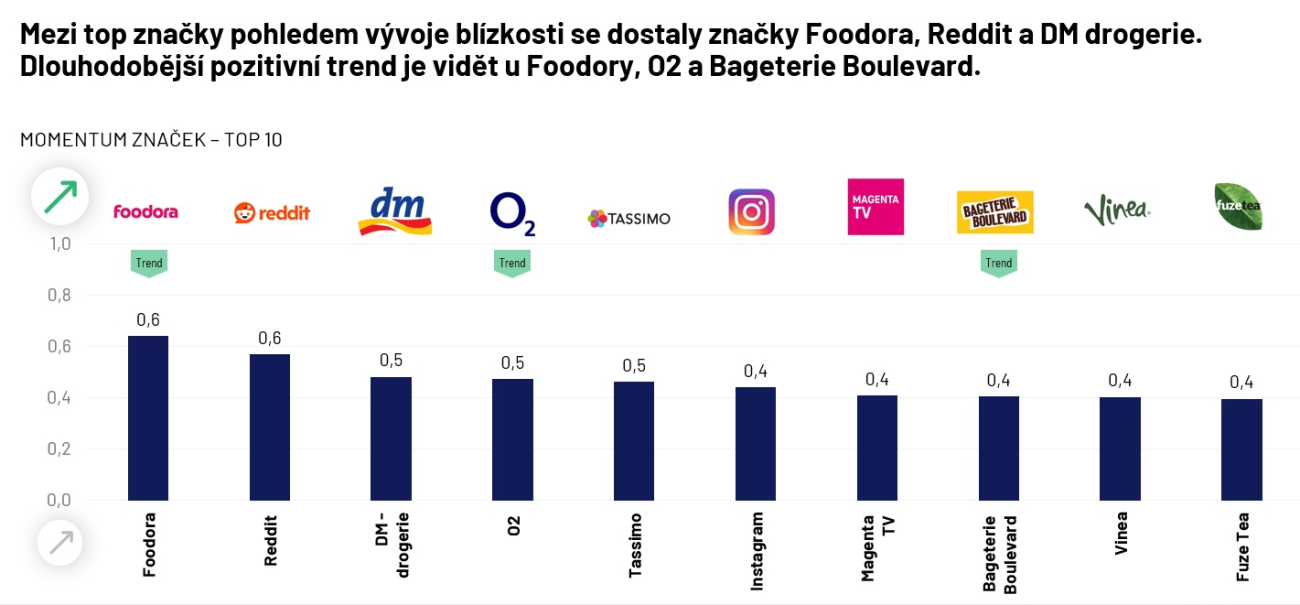 Q: How close do you personally feel to this brand?, sample: 400 respondents per brand. Change in affinity compared with 2025; trend = upward trend since 2024; Source: Ipsos, Brand Success 2026
Older brands are performing better than younger ones
The research also shows that a brand’s age alone is not a barrier to growth. Brands established before 1900 achieve an average affinity score of 3.3, whilst for brands founded after 1950 the figure is 3.4, and for brands established after 2021 it stands at around 2.2. Among the older brands, Škoda, Albert, Mattoni, Globus and Coca-Cola are among the closest. “The results show that older brands have managed to innovate and adapt to changing circumstances,” said Štěpánek.
At the same time, the research does not confirm any advantage of Czech origin. Czech and foreign brands show the same score in terms of perceived closeness.
About the Brand Success survey
Ipsos measures emotional affinity towards brands on a scale from 0 to 10. Each of the brands surveyed was rated by 400 respondents, each of whom was given a randomly selected set of 50 brands. This year’s research also included five new categories, including the online market and AI models.
Source: mediaguru.cz