

What you will find in the article
- Internet TV has captured almost 60 per cent of the market; Oneplay has influenced its development.
- Almost three million subscribers use pay-TV, with part of the growth attributable to a new method of counting.
- Satellite and cable TV have been losing customers for some time.
- Operators are increasingly selling television as part of bundles with internet and mobile services.
- DVB-T2 covers almost the whole of the Czech Republic; the number of households with an aerial is not yet known.
In its new Report on the Development of the Electronic Communications Market, the ČTÚ has, for the first time, included watching television via apps without a set-top box – known as OTT – within the category of internet television (IPTV). The reason for this is the launch of the Oneplay service on 10 March last year, which combined the O2 TV pay-TV service with the Voyo.cz online video library. Because of this change, last year’s figures cannot be directly compared with those of previous years.
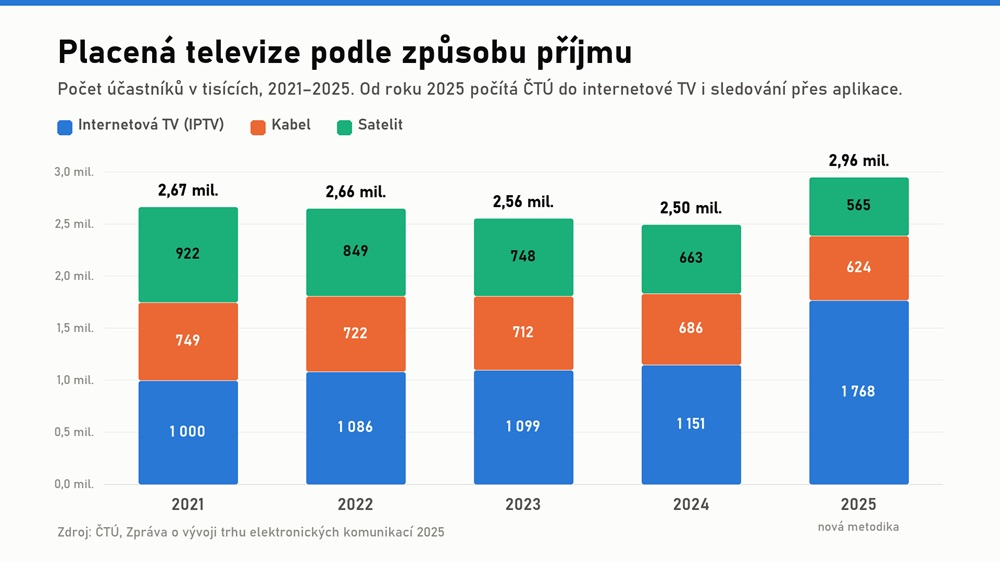
At the end of 2025, almost three million people in the Czech Republic had pay-TV, specifically 2.957 million subscribers, 18.3 per cent more than a year earlier. However, according to the authority, a large part of this increase is due precisely to the new method of calculation. The largest pay-TV brands on the market, alongside Oneplay (Nova), include Vodafone TV, Canal+ (Skylink) and Magenta TV (T-Mobile), whilst Telly and SledováníTV, for example, also report higher figures.
Internet TV has taken over the media market
1.768 million subscribers watched pay-TV via the internet, accounting for 59.8 per cent of the market. In 2024, the figure stood at 1.151 million, and in 2021 it was around one million. However, this figure does not include everyone who pays for television via the internet. A further approximately 575,000 subscribers are held by companies that are not telecoms operators, and the Czech Telecommunications Office (ČTÚ) identified them through direct surveys.
At the same time, internet TV generates the most revenue for operators. In 2025, they earned over 7.35 billion crowns from broadcasting via the internet, compared with 1.07 billion crowns from cable TV and 1.01 billion crowns from satellite TV. In the case of T-Mobile, satellite TV is being phased out; Canal+ will soon rebrand Skylink into the group’s own portfolio. Details will be revealed next week at an official event for journalists.
 Source: ČTÚ Source: ČTÚ
Satellite and cable TV continue to lose ground
Satellite and cable together account for roughly 40 per cent of pay-TV subscribers and have been in decline for some time. Satellite TV had over 565,000 subscribers in 2025, whilst in 2021 there were over 921,000. Cable TV had just under 624,000 subscribers last year, compared with nearly 749,000 in 2021.
The three largest pay-TV providers together account for 73.4 per cent of the market. According to the Czech Telecommunications Office, O2 further increased its lead and Vodafone strengthened its position significantly, mainly thanks to its cable network. The satellite provider Canal+ Luxembourg, also known as Skylink, has over half a million subscribers, whilst T-Mobile and SledovaniTV each have over 100,000. Specifically, according to the operator’s officially published results, Magenta TV had just under 330,000 subscribers in the first half of 2026.
Television as a standard part of packages
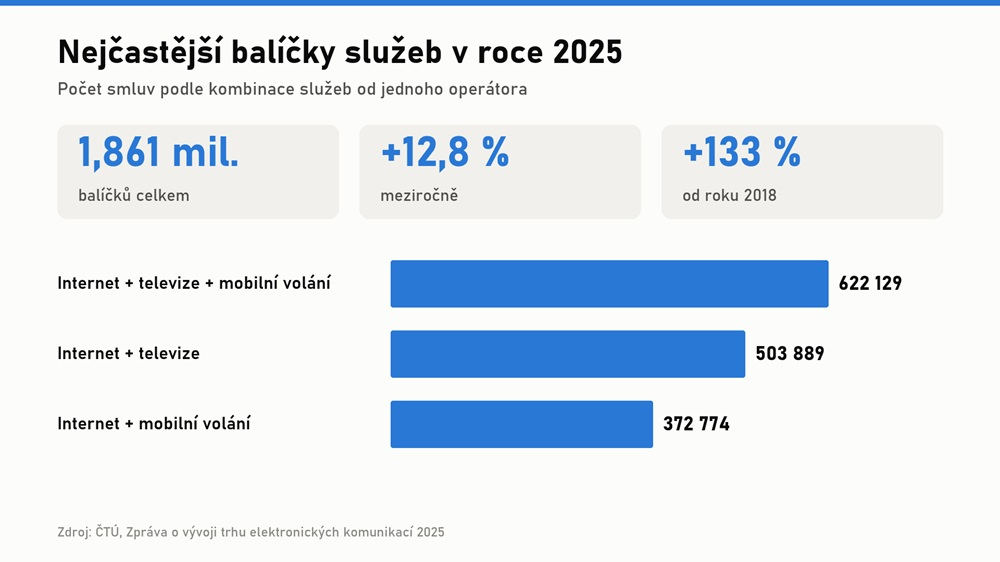
People are increasingly buying multiple services from a single operator at the same time. There were 1.861 million such bundles last year, 12.8 per cent more than the previous year. Between 2018 and 2025, their number increased by 133 per cent. Fixed-line internet is included in 88 per cent of bundles, television in 77.4 per cent, and mobile services in 68.3 per cent. People most commonly combine home broadband, television and mobile calls; there were over 622,000 such contracts.
This is followed by broadband with television (almost 504,000) and broadband with mobile calls (almost 373,000). According to the Czech Telecommunications Office (ČTÚ), the Oneplay service from O2 (now Nova), Magenta TV and Vodafone TV contribute significantly to this trend, as operators offer these alongside mobile services and broadband.
 Source: ČTÚ
 Source: ČTÚ
The number of bundles will continue to grow
As recently as 2018, two-service bundles were still the most common. From 2020 onwards, demand for them was on a par with that for three-service bundles, which have been the most common since 2024. In its forecast up to 2028, the authority expects the total number of bundles to rise by approximately 38 per cent compared with 2025. The number of two-service bundles is expected to increase by a third, whilst three-service bundles are expected to rise by almost half.
The authority expects operators to also offer television to customers who currently only have internet and mobile services with them. According to the ČTÚ, new fibre-optic networks and 5G network coverage should help expand the offering beyond major cities. O2 recently announced on its website that it is renaming its basic internet-only ‘Oneplay ’ package to ‘Oneplay Mini’. According to an official statement from the operator, customers had come to expect from the previous name that they were receiving a full-featured service, including Oneplay Originals.
Terrestrial television? We’ll have to wait for the data
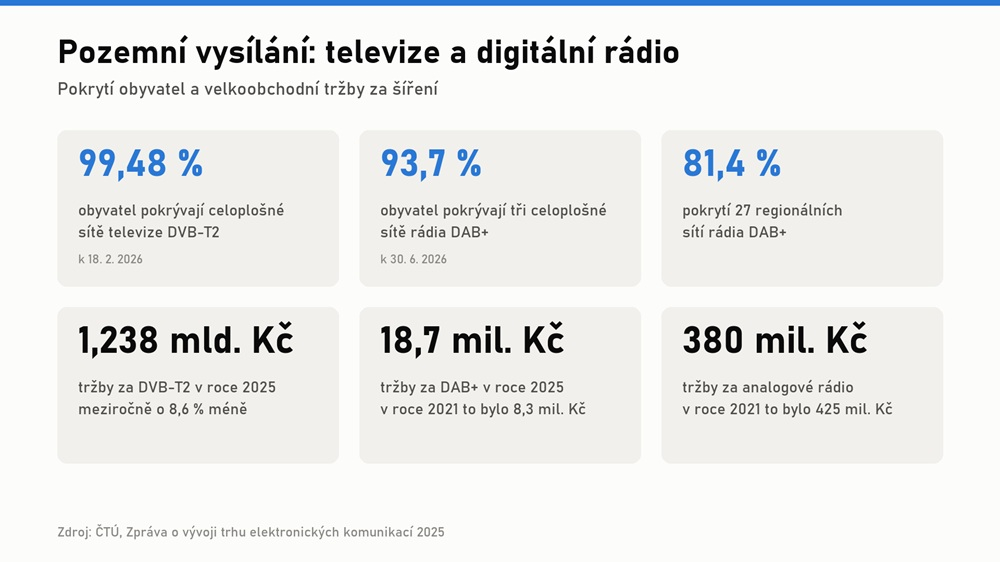
As of 18 February this year, the nationwide DVB-T2 digital terrestrial broadcasting networks covered a total of 99.48 per cent of the population, i.e. almost every resident of the Czech Republic. Wholesale revenue from their operation fell by 8.6 per cent last year to 1.238 billion crowns. This once again confirms that the influence of pay-TV on our market is growing year on year. By way of comparison, revenue from DAB+ digital radio broadcasting reached just under 19 million crowns and has more than doubled in two years.
The Czech Telecommunications Office’s (ČTÚ) documents do not yet specify how many households actually receive television via an aerial. According to Tereza Meravá, a spokesperson for the Czech Telecommunications Office, the results of a further survey are still being processed and are expected to be published within a few weeks. There are four nationwide DVB-T2 networks operating in the Czech Republic, three of which are operated or technically managed by České Radiokomunikace, whilst the fourth belongs to Digital Broadcasting. There should be approximately 15 regional multiplexes operating in the Czech Republic, though the actual number is higher as some networks have already ceased operations.
Source: mediaguru.cz