


Media professionals are not the audience they plan for. In its fourth Ad Nation study, TV industry trade body thinktv Canada found a wide gap between professionals’ media habits and those of the public, alongside substantial overestimates of Canadians’ use of digital platforms.
Professionals overestimate public use of digital platforms
Streaming services and digital tools are more widely used by professionals than by the public. Ad Nation examined whether the industry recognises that difference or assumes everyone else behaves in a similar way. It compared both groups’ reported media use and checked professionals’ estimates of public use against consumers’ answers and found big disparities. For example:
- TikTok: professionals estimated that 89% of the public had used it in the previous month. Reported use was 30% among the public and 49% among professionals, leaving a gap of 59 percentage points between the estimate and public responses.
- Netflix: professionals estimated public use at 92%. Reported use was 58% among the public and 87% among professionals.
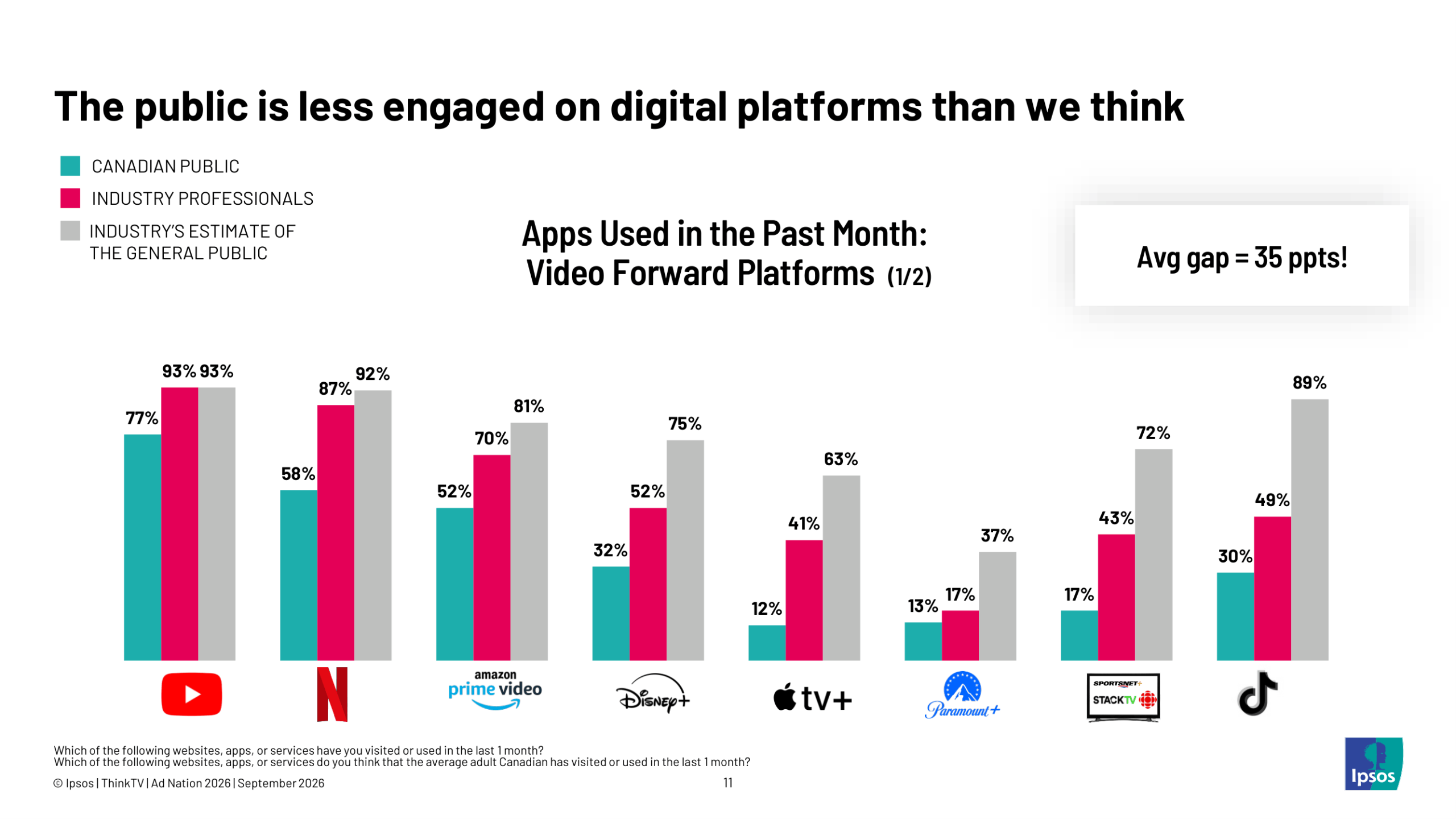
Professionals use both services more than the public does, yet their estimates of public use are higher still. Their expectations suggest a much more digitally active audience than the one described by consumers themselves.
Those assumptions could affect which platforms appear worth including in a media plan. A service that feels widely used in the industry may have a smaller presence in the target audience’s lives. Establishing how many of those users can actually be reached with advertising remains a separate planning question.
Consumers favour TV for ads they like and brands they discover
Respondents chose the medium where they were most likely to find advertising they liked. They also identified where they were most likely to find ads that drew their attention to an unfamiliar product, brand or service:
- Advertising they like: 33% of public respondents selected TV and 15% selected social media. Professionals put social media ahead, at 40%, compared with 21% for TV.
- Discovering unfamiliar products, brands or services: 26% of the public selected TV and 21% selected social media. Among professionals, 49% selected social media and 9% selected TV.
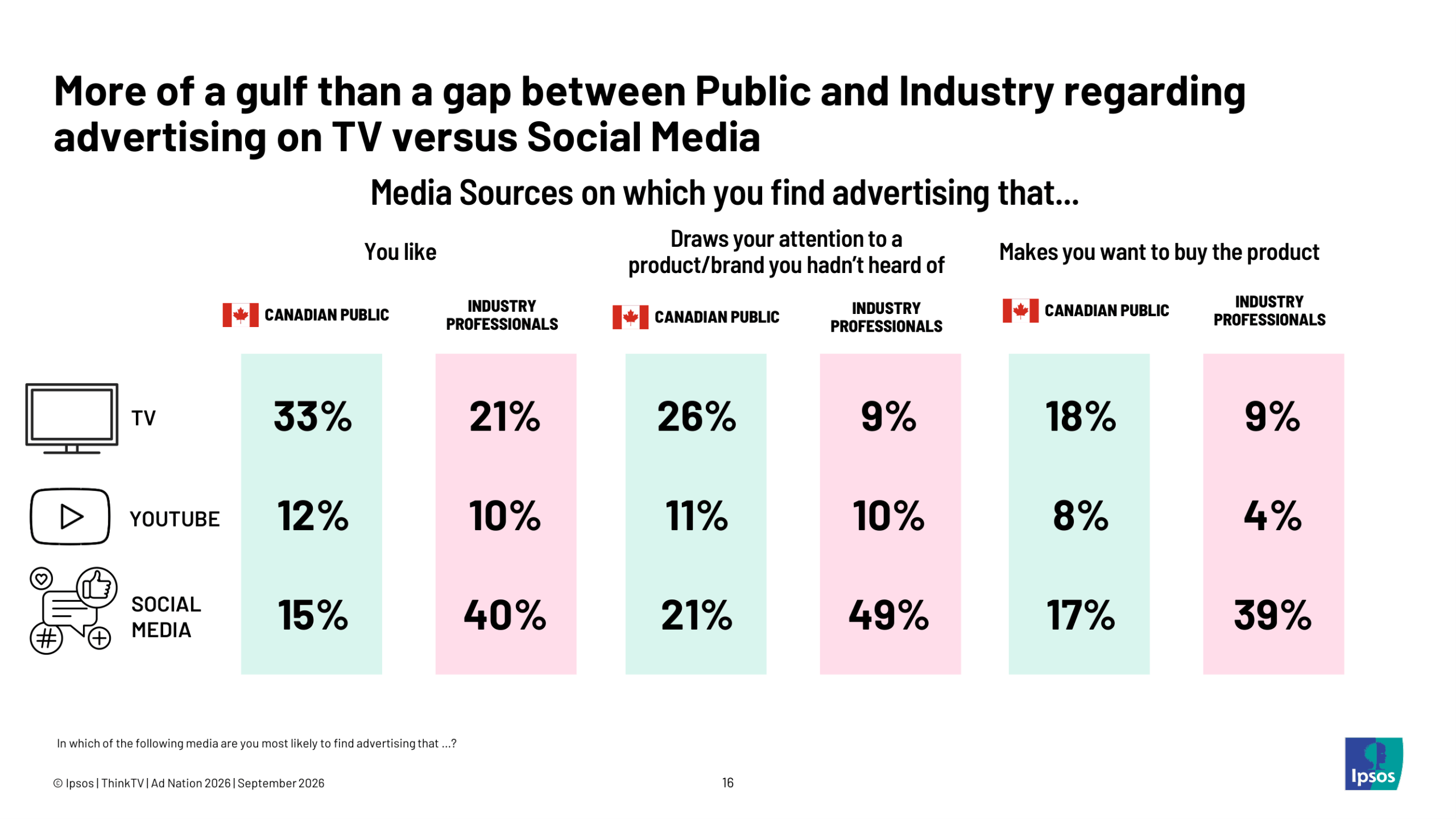
Consumers place TV first on both questions, while professionals favour social media. The professionals surveyed have a different personal response from the consumers they want to reach. Relying on their own preferences when judging a medium risks giving too little weight to TV when assessing how to introduce a brand.
TV here includes paid TV subscriptions, TV apps and streaming services. These answers concern how people perceive advertising across those environments; discovery refers specifically to drawing attention to something unfamiliar.
We are not our audience. Our preferences are not consumer insights. That may be one of the most important takeaways from Ad Nation 2026.
Matt McGowan, Chair of the Board, thinktv Canada
Both groups recognise TV for memory, emotion and trust
The industry’s preference for social advertising on liking and discovery sits alongside positive perceptions of TV on other questions. Consumers and professionals both associate TV with memorable, emotional and trustworthy advertising:
- Memory: 35% of public respondents selected TV for advertising that sticks in their memory, compared with 12% each for social media and YouTube. Among professionals, 45% selected TV.
- Emotion: 29% of the public selected TV for advertising that makes them feel emotional, compared with 12% each for social media and YouTube. Among professionals, 53% selected TV.
- Trust: 23% of the public selected TV for advertising they trust, compared with 6% for social media and 8% for YouTube. Professionals also favoured TV over social media, at 32% versus 6%.
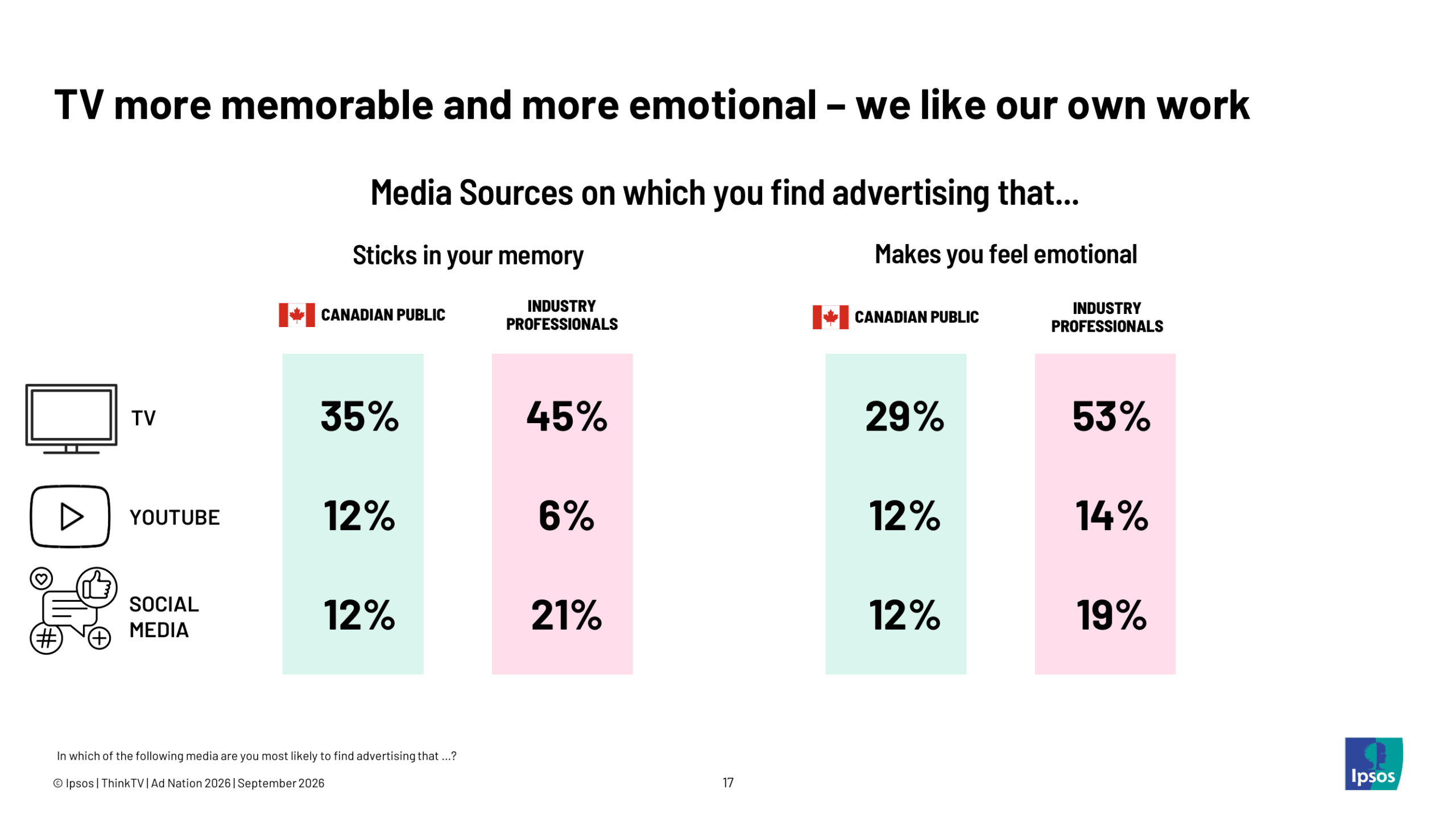
Professionals recognise TV’s strengths in memory, emotion and trust. Consumers also give it the lead over social media on advertising they like and discovering unfamiliar brands. The audience’s responses therefore describe a broader appeal for TV advertising than professionals’ own preferences on those two questions suggest.
The study questions the use of personal media habits as a guide to the wider public. thinktv’s conclusion is direct: “We are not the audience.” It calls on professionals to step outside their media bubbles, be wary of unintended biases, and base planning decisions on evidence about Canadians’ behaviour and preferences.
About the research: Ipsos conducted the research in summer 2026 with 600 members of the public outside marketing and media, and 174 industry professionals drawn from Canadian Marketing Association members, all aged 18-59.
Source: egta.com
OTHER CASE STUDIES
PREMIUM VIDEO AND YOUTUBE: THE VAB MEASURES THE CTV ATTENTION GAP
30. 10. 2026Premium Video impressions consistently outperform YouTube across the key behaviours that make an impression more valuable,…
THINKTV CANADA PUTS MEDIA PLANNING ASSUMPTIONS TO THE TEST
27. 10. 2026Media professionals are not the audience they plan for. In its fourth Ad Nation study, TV…

CHANNEL 4 SALES TURNS EXISTING TV ADS INTO ENHANCED STREAMING FORMATS
2. 10. 2026Channel 4 Sales launched Enhance in June 2026, the broadcaster’s new suite of CTV streaming ad…
MFE ADVERTISING: SCALING AI-POWERED CONTEXTUAL ADVERTISING ACROSS EUROPE
28. 9. 2026From Spain to Italy, MFE Advertising is using AI and HbbTV to make programme context an…

HOW DPG MEDIA TURNS THE BACKSTAGE OF A PRIME-TIME MUSIC SHOW INTO A RETAIL ENGINE
17. 8. 2026In a category where retailers typically compete on price and visibility, Albert Heijn, the supermarket retailer,…

AN IMMERSIVE CANAL+ BRAND SOLUTIONS COLLABORATION FOR SKIN-CARE BRANDS WITH SENSITIVE STORIES TO TELL
26. 6. 2026CANAL+ BRAND SOLUTIONS and its in-house studio LA FACTORY created “Marquer l’Invisible” for Avène, linking Cicalfate+…

M6 UNLIMITED TESTS AI SPOT CREATION FOR SMALLER TV AND STREAMING ADVERTISERS
22. 5. 2026M6 Unlimited is testing a simpler route into TV and streaming for SMEs and new advertisers…
THE TV ADVERTISING PARADOX, A THINKTV NEW ZEALAND CASE STUDY (2/2)
22. 5. 2026ThinkTV New Zealand built its campaign around the contradiction that linear TV was being called obsolete…

A BIG-SCREEN STUDY FINDS STRONGER ATTENTION ON TV4 PLAY THAN ON YOUTUBE
24. 4. 2026TV4 just launched its third attention study, comparing the viewing experience on its streaming service (TV4…
THE TV ADVERTISING PARADOX, A THINKTV NEW ZEALAND CASE STUDY (1/2)
24. 4. 2026In late 2024, ThinkTV New Zealand, under the leadership of Jacqueline Freeman, GM Communications, undertook a…

AD EMISSIONS MEASUREMENT: LESSONS FROM THE FINNISH MARKET
31. 3. 2026Finland’s commercial TV broadcasters spent the past year developing a carbon emissions measurement framework for linear…
A NEW WAY FOR FRANCETV PUBLICITÉ TO SELL CONTEXTUAL VIDEO ADVERTISING
27. 3. 2026FranceTV Publicité (FTP), the advertising sales house for French public television, has introduced Context.IA into its…