
The story of the irritable ogre Shrek, who is forced to set out on a journey to rescue Princess Fiona, has just celebrated its 25th anniversary. At first glance, it was a fairy tale; in reality, however, the film worked as a clever parody of classic fairy-tale conventions and, at the same time, a satire of the animated productions of the day, especially the style associated with The Walt Disney Company.
It was precisely the ironic humour, wealth of pop-culture references and subversion of traditional fairy-tale stereotypes that helped make the film such an extraordinary success. Shrek stood out sharply from the animated hits of the period — the main character was not a handsome prince but a disagreeable ogre, the princess was not a defenceless victim, and the romantic story was full of self-irony. The film won audiences over because it worked for both children and adults. Children enjoyed the adventurous fairy tale, while adults recognised the film references, satire and more subtle humour.
The film achieved huge commercial success. With a budget of around USD 60 million, it grossed almost USD 490 million worldwide and became one of the highest-grossing animated films of its time. In doing so, it significantly strengthened DreamWorks’ position against the then-dominant Disney and Pixar studios. When Shrek 2 was released three years later, the popularity of the series reached new heights. The critically acclaimed sequel, with worldwide box-office takings exceeding USD 900 million, easily surpassed the revenues of the first film. Shrek also entered film awards history. Not only did it win the very first Academy Award for Best Animated Feature — the category was introduced by the Academy that year — but it also succeeded at the BAFTAs, won several Annie Awards and, many years later, was even added to the US National Film Registry as a culturally significant work.
Shrek as a marketing phenomenon
The success of Shrek not only changed the world of animation; it also had a major impact on modern marketing. DreamWorks Animation quickly understood that Shrek was not just a film character, but a strong cultural brand that could be linked with food, toys, fashion and digital entertainment. The first film in 2001 was already accompanied by a massive advertising campaign built around the slogan “Think Green”, which used Shrek’s characteristic green colour across virtually every possible product. The studio invested USD 45 million in the campaign.
One of the best-known collaborations was the campaign by Heinz, which launched a special green ketchup called “EZ Squirt Blastin’ Green”. Children quite literally fell in love with the new product. Heinz’s ketchup is still described today as one of the most iconic film marketing collaborations of the early 21st century.
Video: Heinz EZ Squirt Car Commercial
As for fast-food chains, which usually manage to ride the wave of every major film hit successfully, the first two films — Shrek from 2001 and Shrek 2 from 2004 — were primarily associated with Burger King.
Video: Burger King Shrek Commercial 2001
The history of McDonald’s partnership with Shrek began only later, when McDonald’s and DreamWorks Animation announced a two-year global marketing partnership in July 2005. The collaboration between DreamWorks and McDonald’s was highly significant from a business perspective. Shortly before that, McDonald’s had ended its long-standing exclusive partnership with Disney, and Shrek became one of the first major animated projects to replace that cooperation. For DreamWorks, this meant enormous global visibility and confirmation that Shrek could compete with the biggest Disney brands.
The first film within this partnership was Shrek the Third in 2007. When the film was released, McDonald’s launched a global promotion in more than one hundred countries. The campaign included classic Happy Meal promotions, collectable toys, themed glasses, advertising spots and online games. The campaign was interesting because the brand tried to connect Shrek with the promotion of healthier eating for children — Happy Meals featured more apple snacks, milk and salads.
Video: Shrek the Third (2007) McDonald’s Commercial (US)
This strategy, however, attracted criticism. Organisations focused on child protection pointed out that Shrek was mainly being used to promote unhealthy foods and sweets. Critics argued that film characters have too strong an influence on child consumers and that associations with fast food or confectionery encourage unhealthy habits. As The Guardian wrote, the campaign came at a time when new rules were being introduced for television advertising of unhealthy foods aimed at children. According to critics, McDonald’s may not have formally broken the rules, but it used Shrek to bring children into its restaurants. McDonald’s, by contrast, argued that it was promoting more responsible choices and that a large proportion of Happy Meal items met Ofcom’s nutritional criteria at the time.
The “Think Green” strategy also included an eight-week campaign by Baskin-Robbins in 2001. As part of the campaign, the company offered special products such as “Shrek Swirl” sherbet, a “Hot Sludge Sundae” with gummy worms, green-styled desserts, themed packaging and special in-store decorations.
Video: Baskin Robbins Shrek blue swamp fizz 2001 Commercial
The Baskin-Robbins campaign linked to the premiere of Shrek 2 in 2004 had even more punch and was more sophisticated than the campaign for the first Shrek. While in 2001 Baskin-Robbins mainly drew on the aesthetics of swamps, slime and the colour green, for the sequel the brand worked with the entire expanded world of characters and the fairy-tale universe.
Video: Baskin Robbins Shrek 2 Ears Commercial 2004
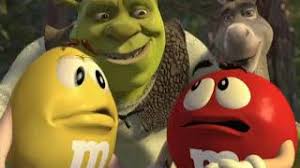
Other major brands also joined the promotional push. Mars Incorporated, for example, sold “ogre” versions of M&M’s.
Video: M&M's - The Kiss (2004, USA)
Skittles offered special flavours inspired by the world of Shrek. PepsiCo used characters from the series on packaging for Sierra Mist drinks, and HP organised online photography competitions thematically linked with the film. Kellogg’s and Nestlé also used the Shrek theme in advertising for their cereals. General Mills likewise turned to the film several times for its Cheerios cereals, focusing specifically on the mischievous Donkey in the following spot:
Video: GeneralMills ShrekForeverAfter
The American brand Dial Soap, which produces soaps, body washes and hand sanitisers and belongs to Henkel AG & Co., also took advantage of a marketing collaboration with DreamWorks and released a humorous advert in connection with the launch of Shrek 2. In the Dial Soap advert, Shrek pulls a lump of green earwax out of his ear and places it on the sink. A moment later, however, Donkey mistakes it for hair gel:
Video: 2004 - Shrek 2 Dial Body Wash and Hand Soap Commercial
Among more recent adverts, we can mention, for example, the campaign by cosmetics brand Lush, which launched a viral Shrek-inspired campaign in 2024. The campaign included bath bombs, face masks and products designed in the style of Shrek’s swamp — with a green, “muddy” aesthetic and a humorous fairy-tale visual style.
Video: By Night One Way, By Day Another Body Spray: LUSH x Shrek
The perfect cross-promotion strategy
The Shrek franchise became one of the biggest marketing phenomena of the early 21st century. DreamWorks created an extensive system of partnerships around the series, thanks to which characters and motifs from the film appeared practically everywhere — from cereal boxes and restaurants to advertising spots and internet competitions. The biggest boom came in connection with Shrek and Shrek 2. When development and production began on the follow-up to the success of the big green hit Shrek from 2001, a huge global marketing machine was set in motion. From the very beginning, it was clear that the commercial goals of the project would be extraordinarily ambitious. The digital part of the campaign was supported by HP and Activision through online competitions, interactive activities and video games inspired by the film.
Part of the success lay in the fact that DreamWorks managed to connect all partners into a unified marketing strategy, in which individual brands supported the film while also benefiting from its popularity. The campaign was extremely successful commercially and is still regarded today as one of the most striking examples of a Hollywood cross-promotion strategy.
A new Shrek 5 on the horizon
The good news is that the animated series is set to receive another sequel. Shrek 5 was originally scheduled to premiere in summer 2026, but according to more recent information, the release of the new film has been postponed several times and is currently expected in 2027. DreamWorks, however, is already launching massive marketing activity. For example, AMC Theatres has introduced a new limited-edition collectable popcorn bucket inspired by Shrek. The design resembles the iconic outhouse from Shrek’s swamp and was created to mark the 25th anniversary of the first film’s release in cinemas. The campaign quickly attracted attention on social media thanks to its humorous and nostalgic execution. The special popcorn bucket went on sale in May 2026 alongside the return of Shrek to US cinemas. The entire activity also supports renewed interest in the brand ahead of the upcoming film Shrek 5.
Video: New Shrek Popcorn Bucket revealed by AMC Theatres
According to Eddie Murphy, who voiced Donkey in the Shrek film series, a “Donkey spin-off” is planned. Work on it is expected to begin after the completion of Shrek 5. DreamWorks has not yet officially confirmed the film in a separate press release. The information comes primarily from Eddie Murphy during promotional interviews. This means the project is very likely real, but it may still change.
One thing, however, is certain: both the upcoming Shrek 5 and any potential Donkey spin-off will bring a new wave of advertising and marketing campaigns. The Shrek brand remains one of the best-known and most distinctive animated franchises, appealing not only to children but also to the generation of adult viewers who grew up with the films. It is precisely this combination of nostalgia, humour and strong pop-cultural identity that makes Shrek an attractive brand for collaborations with fashion, cosmetics, food and entertainment companies.