

What you will find in the article:
- New Zealand media habits are stabilizing after years of change.
- Total TV daily reach is 63%, slightly higher than global platforms.
- Linear television viewing time increased during prime time hours.
- Smart TV access among respondents rose to 61% in 2026.
- Local content remains culturally significant for New Zealand audiences.
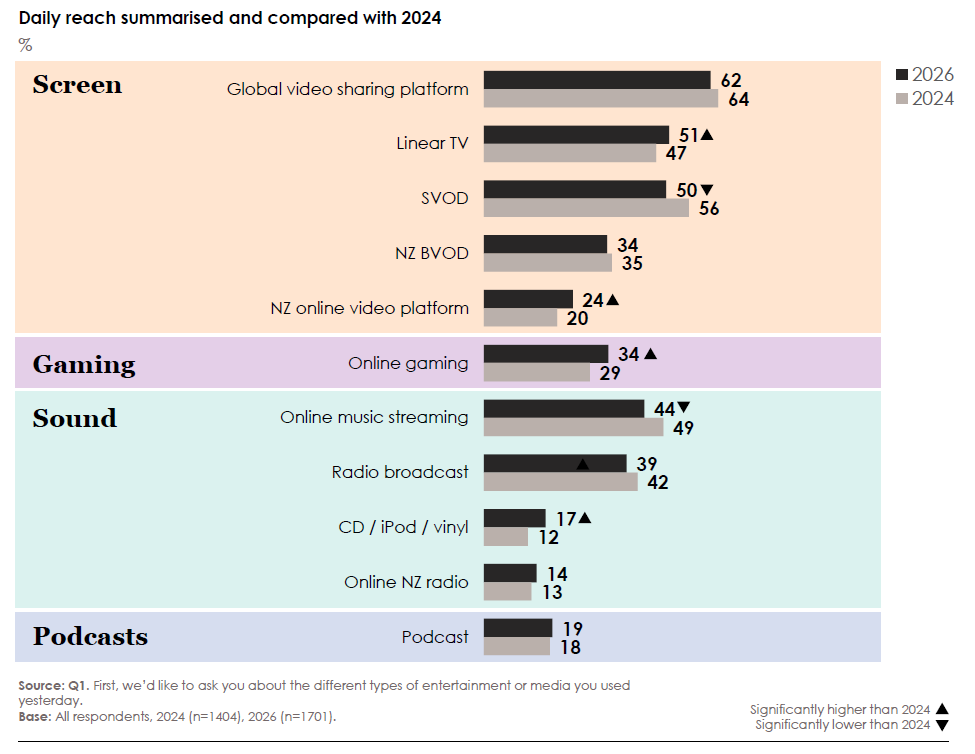
Research by NZ On Air, entitled Where Are The Audiences? 2026, found that Total TV, combining linear television with New Zealand BVOD services, reached 63% of New Zealanders each day. This narrowly exceeded global video-sharing platforms, which reached 62%. Linear television alone had a daily reach of 51%, moving ahead of subscription video-on-demand (SVOD) services, which reached 50% of the population.
Verian surveyed 1,701 New Zealand residents aged 15 and over. Interviews were conducted online and by phone, with the results weighted by age, gender, region, ethnicity and interview day to reflect the structure of the adult population.
Slower shifts
The findings suggest that the major shift towards streaming seen in the first part of the past decade has slowed.
Established and newer services increasingly coexist rather than replace one another. At the same time, pressure on household budgets is encouraging audiences to make more deliberate decisions about which subscriptions they retain.
Daily reach for global video-sharing platforms fell from 64% in 2024 to 62%. Linear television, by contrast, rose from 47% to 51%, while SVOD services declined from 56% to 50%.
 Source: Where Are the Audiences? 2026
Online gaming increased from 29% to 34%. Online music streaming moved in the opposite direction, falling from 49% to 44%, while broadcast radio slipped from 42% to 39%.
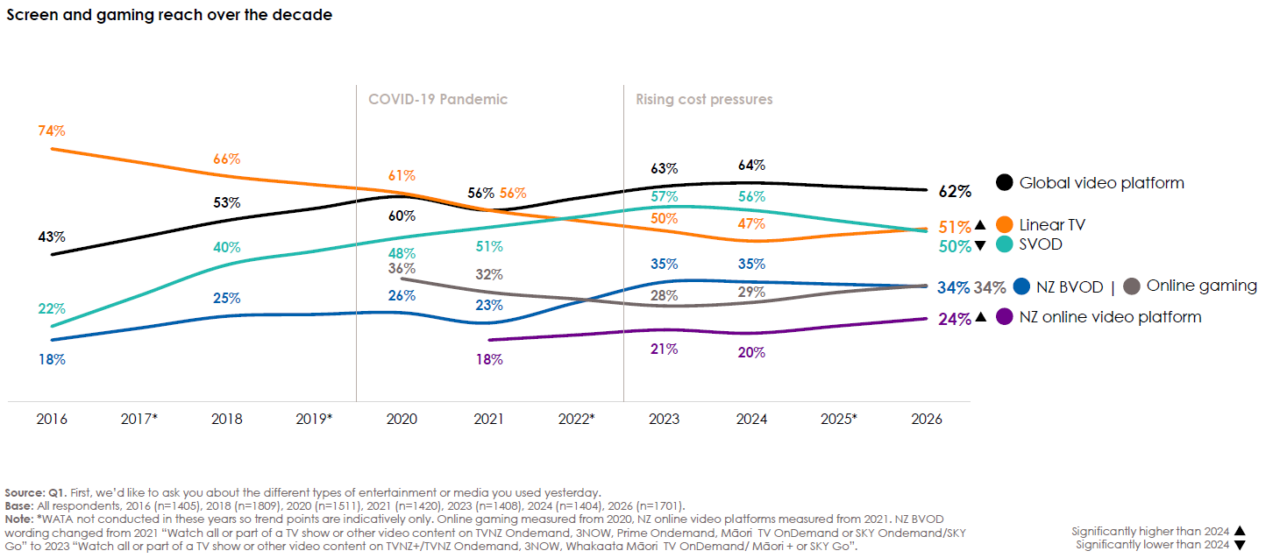
Longer-term data shows the scale of the earlier transformation in media behaviour. Daily reach for linear television fell from 74% in 2016 to 51% in 2026, while global video platforms climbed from 43% to 62%. More recent results, however, suggest that these trends are beginning to flatten.
 Source: Where Are the Audiences? 2026
At the same time, the figures suggest that the television ecosystem has stabilised. Daily reach for Total TV stood at 65% in 2021 and 63% in 2023, before falling to 60% in 2024 and returning to 63% in 2026. The study describes this development as a relatively stable television environment despite broader shifts between paid and free media services.
Viewing and listening time
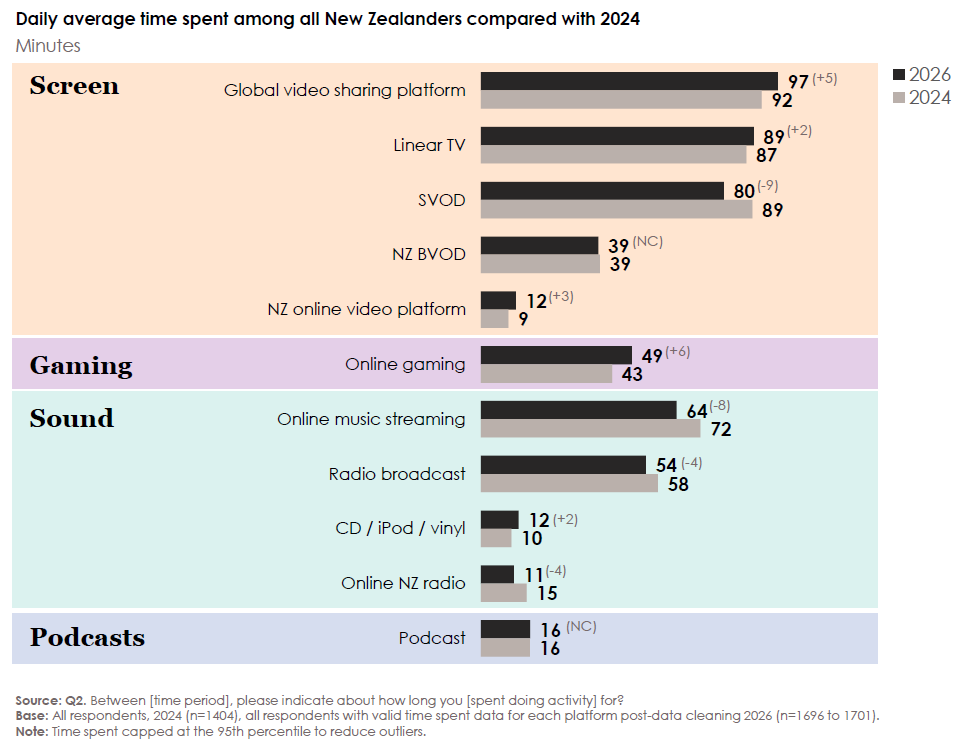
Television retained the largest share of total daily viewing time. Total TV accounted for an average of 128 minutes of viewing per day among New Zealanders. This was followed by global video-sharing platforms at 97 minutes, linear television at 89 minutes and SVOD at 80 minutes.
Television's strength is particularly evident during prime time. Between 6:00 pm and 10:30 pm, linear television reach increased from 37% in 2024 to 41% in 2026. Total TV, combining linear television with New Zealand BVOD services, rose from 49% to 52% over the same time period. The study therefore shows that during the hours when viewing is traditionally at its highest, television is not only maintaining its position but has strengthened it compared with 2024.
Online music streaming averaged 64 minutes per day, broadcast radio 54 minutes and online gaming 49 minutes.
Changes in time spent with individual media also point to weaker use of subscription services. Average SVOD viewing time fell by nine minutes compared with 2024, while time spent streaming music declined by eight minutes. Global video-sharing platforms, by contrast, gained five minutes and online gaming six minutes.
 Source: Where Are the Audiences? 2026
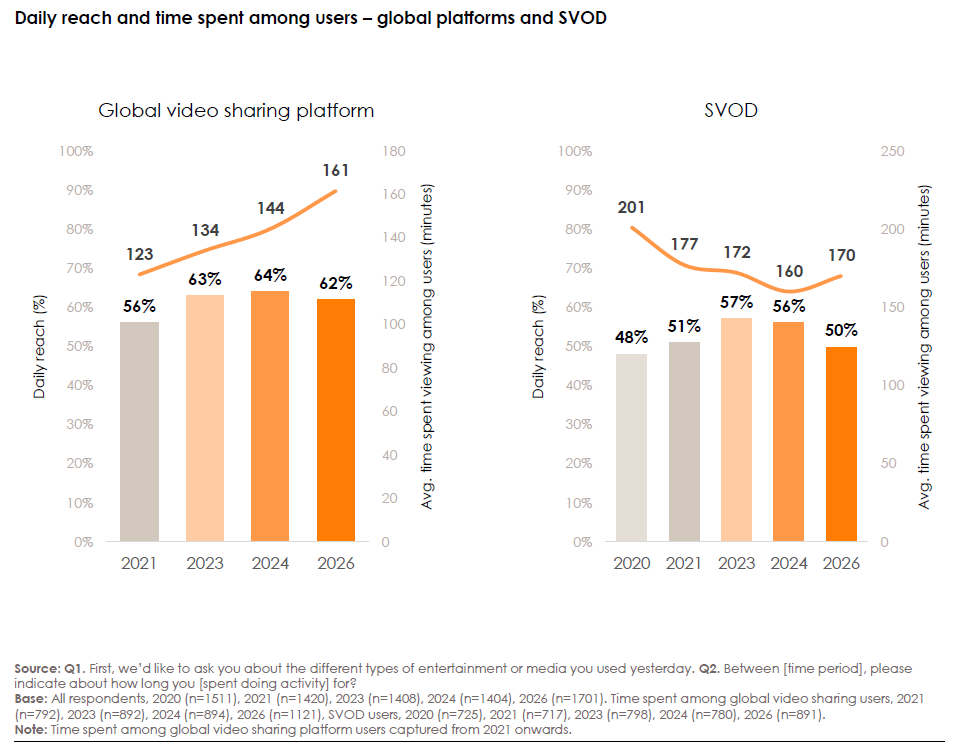
However, users who have remained with certain services are spending more time on them. Users of global video platforms spent an average of 161 minutes per day using them, up from 144 minutes in 2024. SVOD users averaged 170 minutes per day, an increase from 160 minutes.
 Source: Where Are the Audiences? 2026
Viewing intensity among television viewers themselves also remains high. People who watch linear television spend an average of 185 minutes per day with it, or more than three hours. Among users of New Zealand BVOD services, the average is 123 minutes per day. The data therefore shows that television combines broad reach with high viewing intensity among its audience.
Platform choices
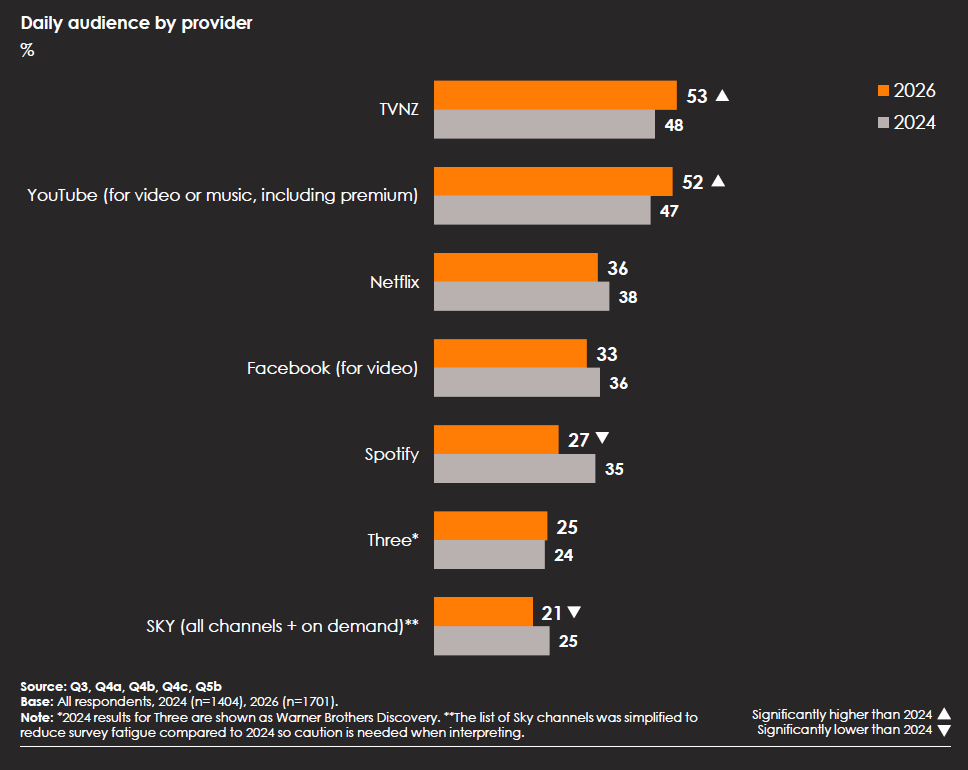
TVNZ and YouTube had the largest daily audiences among the individual providers measured. TVNZ reached 53% of New Zealanders each day, up from 48% in 2024. YouTube, including both video and music use, reached 52%, compared with 47% two years earlier.
 Source: Where Are the Audiences? 2026
Netflix followed at 36%, Facebook video at 33% and Spotify at 27%. Three reached 25% and Sky services 21%.
Netflix remained the largest SVOD service, but its reach continued to decline. Daily use fell from 38% in 2024 and 42% in 2023 to 36%. Disney+ reached 11%, Amazon Prime 10% and Neon 6%.
Spotify recorded a similar decline. Its daily audience fell from 35% in 2024 to 27%. YouTube used for music reached 20%, Apple Music 4% and iHeartRadio 3%.
The importance of the television screen is also supported by trends in device access. A total of 61% of respondents have access to a connected or smart TV, up from 53% in 2023. The growing penetration of smart TVs is also creating stronger conditions for the television screen to be used not only for traditional broadcasting but also for streaming and on-demand services.
Local content
The research also examined attitudes towards television and music produced in New Zealand. Almost half of respondents, 49%, said they had watched a New Zealand-made programme within the previous couple of weeks. Older audiences showed stronger preferences for news, current affairs and factual programming, while younger viewers leaned more towards comedy and other entertainment genres.
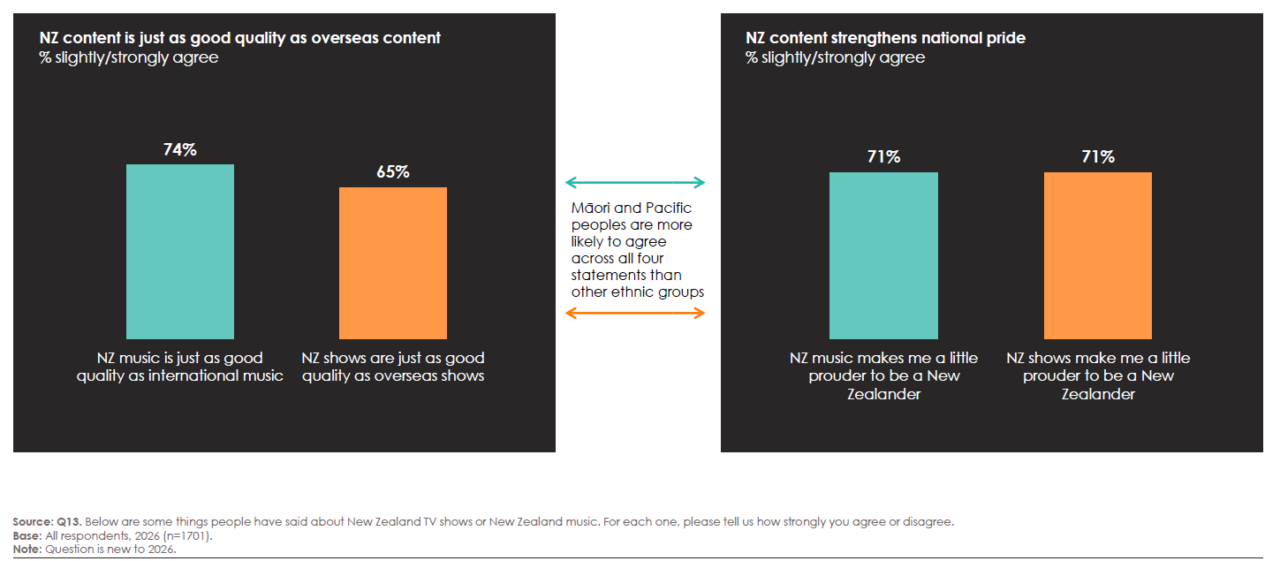
Local content retains strong cultural significance. A total of 81% of respondents said they liked seeing New Zealand faces and places in programmes. Seventy-one per cent said New Zealand programmes made them a little prouder to be New Zealanders, while 65% considered local programmes to be as good as overseas productions.
 Source: Where Are the Audiences? 2026
For music, 74% of respondents agreed that New Zealand music was as good as international music. A total of 37% said they actively sought out New Zealand music, while 41% said they would listen to more of it if it appeared on their streaming service.
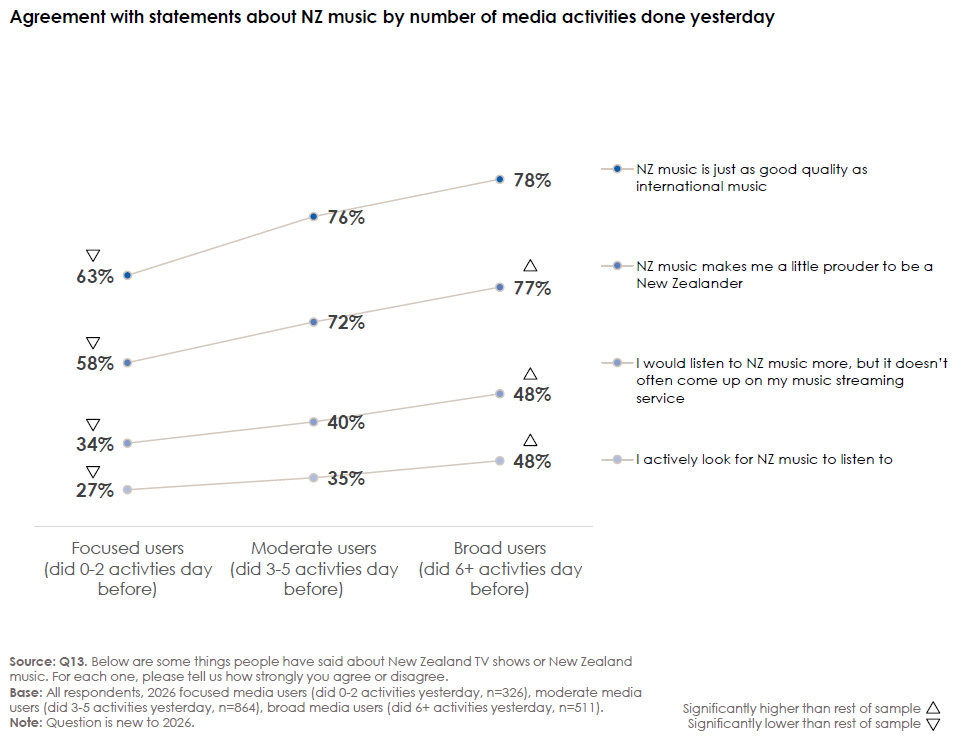
People with broader media habits were also more likely to value local content. Among respondents who had used six or more different types of media activity during the previous day, 78% considered New Zealand music comparable in quality with international music and 48% said they actively sought it out.
 Source: Where Are the Audiences? 2026
The study's findings therefore suggest that, after years of rapid change, the New Zealand media market is entering a more stable phase. Television continues to hold a very strong position, both in terms of reach and the amount of time people devote to it, while increasingly overlapping with on-demand and streaming services. Rather than pointing to the decline of television, the data reflects a shift in the way television and video content is consumed.
Source: futurefive.co.nz, nzonair.govt.nz