

What you will find in the article:
- Study focuses on emotional advertising and its effectiveness.
- Emotional engagement increases purchase intent and advertising recall.
- Positive emotions significantly enhance advertising impact on television.
- Finding the right emotional balance is crucial for viewer engagement.
- Strong audio branding and storytelling amplify emotional responses.
The study presentation and accompanying charts are available to download from screenforce.de.
In recent decades, researchers studying advertising effectiveness have focused primarily on attention. This was prompted by significant changes in the market resulting from increasing levels of distraction and the shortening amount of time for which audiences engage with advertising messages, journalist Cathrin Hegner explained during an online Screenforce event. Peter Field, however, had already examined the negative effects of an absence of emotion in advertising in earlier research, quantifying the cost of dull advertising.
“Having explored audience attention in depth over recent years, we are now dedicating an entire study to the creative side of advertising for the first time. This gives advertisers clear recommendations on how to deliberately strengthen consumers’ emotional engagement and increase the effectiveness of their campaigns. Emotion should be at the heart of every campaign: it attracts attention, encourages positive associations and increases a brand’s relevance at the very moment consumers are ready to make a purchase,” said Malte Hildebrandt, Managing Director of Screenforce.
 Source: Screenforce.de
Following its studies Track the Success in 2021, Mapping the Moods in 2022, Mapping the Impact in 2023 and Into the Wild in 2024, Eye Square’s latest study, Follow the Feelings – Emotional Advertising as an Effectiveness Booster, is the fifth in the series. It focuses on the emotional component of advertising within broadcasters’ high-quality environments. Previous studies had already shown that the high levels of attention paid to television and broadcasters’ media libraries have a significant impact on advertising recall. The latest findings are based on an analysis of 48 emotions experienced while watching advertisements, conducted using artificial intelligence and Hume AI recognition technology.
“Advertising success is not determined by individual emotions, but by finding the golden mean—something that is engaging without overwhelming the viewer,” explains Marvin Vogt of Eye Square.
Emotional engagement increases purchase intent
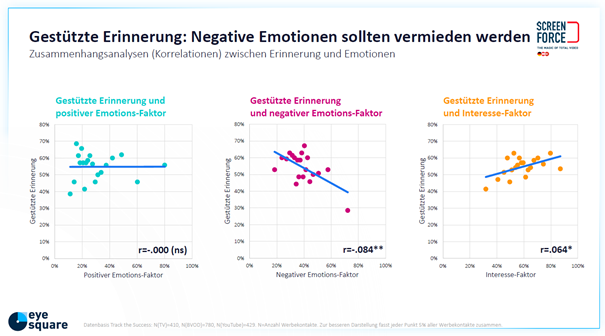
An exploratory factor analysis identified 31 relevant emotions from the original set of 48. These can be divided into positive and negative emotions, as well as emotional engagement. While positive emotions are not particularly important for prompted advertising awareness, the greatest effect is achieved through interest generated by emotional involvement. Negative emotions, by contrast, lead to shorter viewing times and consequently lower levels of attention. Viewers’ avoidance behaviour can reduce viewing time by as much as five seconds. This is also reflected in weaker purchase intent. Positive emotions or emotional engagement are crucial to generating purchase intent.
 Source: Screenforce.de
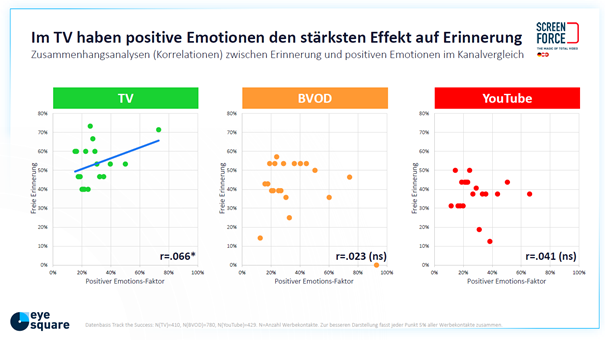
Within broadcasters’ controlled environments, positive emotions produce significantly stronger effects than on platforms such as YouTube. The same applies to purchase intent: when viewers experience positive emotions, purchase intent is significantly higher on television than on Alphabet’s platform, where there is a strong aversion to advertising.
“Emotions are even more important on television and have a substantially greater effect than on YouTube,” Stefan Schönherr of Eye Square summarises.
 Source: Screenforce.de
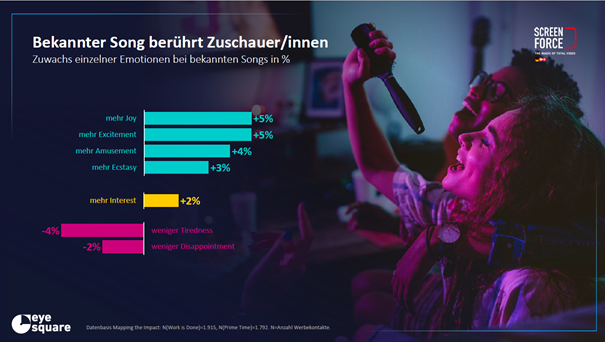
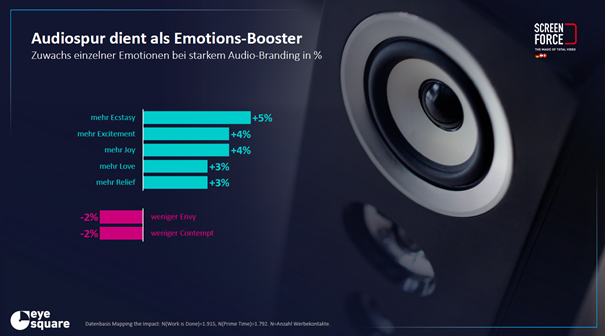
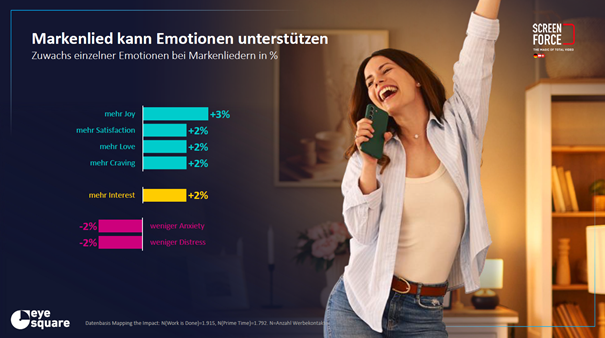
Positive emotions help individual commercials stand out within an advertising break and increase attention. The audience’s state of mind when consuming broadcast content also has a beneficial effect: early evening and prime time have been confirmed as the optimum environments in which advertising messages can reach audiences emotionally. Strong audio branding is an effective tool for reinforcing positive emotions. Familiar songs appeal to viewers and increase their interest, as do well-crafted stories, likeable protagonists and humour.
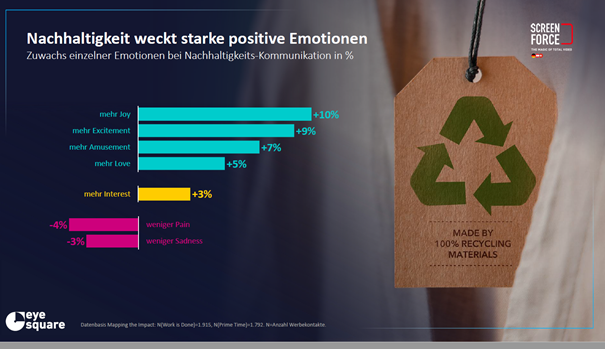
Sustainability, as a socially relevant topic, also generates strong positive emotions. Certificates and quality seals, by contrast, have little rational nature, only a limited influence on emotional impact.
 Source: Screenforce.de
„Good commercials allow people to immerse themselves in the story,” says Vogt.
Overview of the key research findings
There is a clear link between emotional responses and advertising effectiveness. Emotionally engaging viewers particularly benefits advertising recall, people’s liking of an advertisement and, above all, purchase intent—the advertising KPI that is the most difficult to influence.
- Finding the right level is crucial. Too little emotion is perceived as dull, while too much can confuse and overwhelm viewers. The optimum level lies somewhere in the middle—at approximately 22 elicited emotions.
- The type of emotion also matters. Emotions associated with the “engagement” factor—such as interest, fascination, admiration and appreciation—show a particularly strong relationship with advertising recall and purchase intent.
- The more negatively viewers respond to a commercial, the less likely they are to remember it. There is a direct connection with attention: people do not look at things they dislike. Negative emotions should therefore be consistently avoided.
- Strong audio branding acts as an emotional amplifier. A familiar song is one example.
- Storytelling encourages emotional engagement. Identification with likeable protagonists has a particularly strong multiplier effect. Humour also works extremely well. Anything that draws viewers into the story pays off.
- Sustainability has a significant positive influence on emotions. It is easier to make a purchase with a clear conscience.
- Positive emotions have a particularly strong effect on television. Their impact is especially pronounced on a large screen, when viewers are relaxing in the comfort of their own homes.
- The viewer’s state of mind is also important. Emotional advertising is not always the best approach. During the day, when there are more distractions and less attention is paid to the screen, emotional commercials have greater difficulty reaching viewers. The same applies late in the evening, when people begin to feel tired and find it more difficult to engage with emotional stories. Emotional narratives have the greatest chance of success between 6 pm and 10 pm.
Source: screenforce.at