
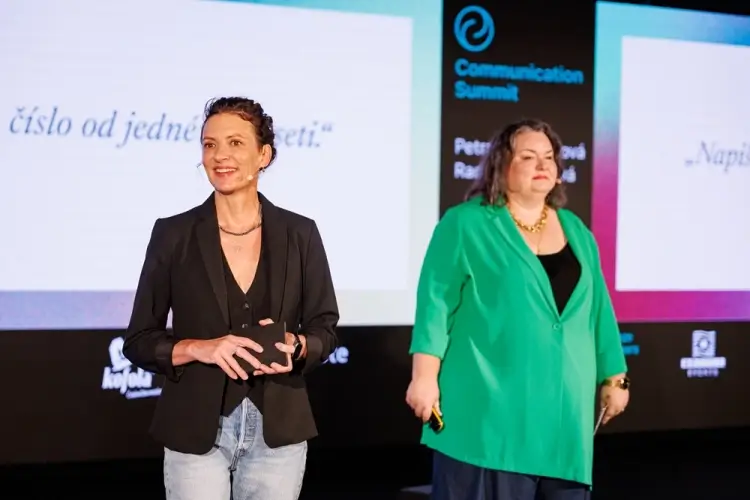
Artificial intelligence tools allow virtually anyone to create content, but creation and creativity are not the same thing. “We have confused creativity with creation. Anyone can create today thanks to these tools, but is that creativity? I don’t think so,” said Petra Jankovičová, President of the Association of Communication Agencies (AKA), at this year’s Communication Summit, organised last week by Blue Events. Together with AKA’s Executive Director Radana Čechová, they opened up a topic that ran through a significant part of the discussions on how the use of artificial intelligence tools is affecting the communications sector and what it means for its future development.
It is an illusion to instruct language intelligence tools to look for ideas and think that this will result in brilliant creativity. The actual creative process consists of up to seven steps, from defining the objective through gathering insights to implementation and evaluation. AI can be an aid in this process, but if humans allow themselves to be sidelined, they will not achieve exceptional results. “AI can help us produce certain things more easily. But it won’t take responsibility for the idea we choose,” they emphasised. Based on existing research, they demonstrated that AI tools tend to produce similar outputs and, as a whole, thus produce mediocrity, which reduces the chances of standing out in the battle for attention. “Research shows that the responses of language models are more similar to one another than the responses of different people. In other words: the more the industry relies on the same tools, the more uniform the resulting content will be. At a time when attention is the greatest of commodities, uniformity is fatal,” explained Radana Čechová.
They also mentioned the concept of “thinkslop”, a state of mind where we hand over our thinking to AI even before we’ve set the task ourselves. This weakens our understanding of the problem and, as the speakers emphasised, robs us of the joy of solving it. “It has never been easier to create something. And it has never been easier to create something that truly matters,” they remarked, illustrating how the rise of AI tools is impacting advertising communication.
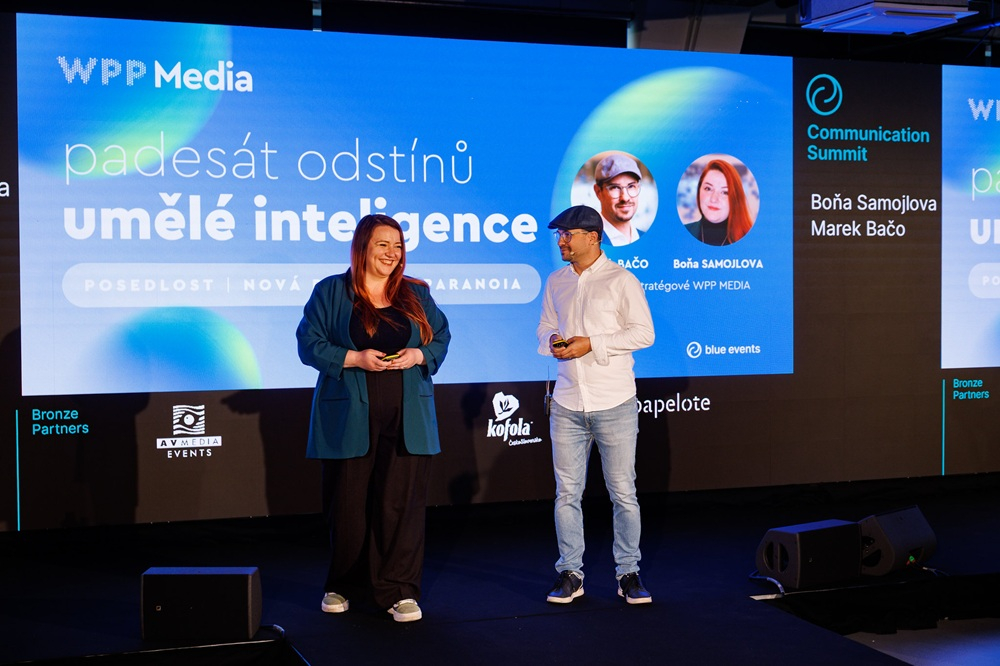 Boňa Samojlova and Marek Bačo at the Communication Summit 2026. Photo: Jiří Šeda; Source: Blue Events
Fear of cognitive surrender
Boňa Samojlova and Marek Bačo from WPP Media note that marketing practice is increasingly operating in an environment of extremes, where on the one hand industry professionals are obsessed with new developments, whilst on the other they are paralysed by paranoia and fear of what new technologies will bring. “But reality has 50 shades and is more complex,” they explained.
The marketing environment is one of the areas where AI is used significantly more intensively than in most other professions. According to some estimates, marketers work with artificial intelligence tools several times more frequently than the general population. This is precisely why they should be aware not only of the benefits but also of the potential negative impacts.
One of the risks is so-called cognitive offloading, i.e. transferring mental effort to machines. AI can save 70 to 80 per cent of the work involved in searching for information, creating texts or analysing data. At the same time, however, there is a risk that people will increasingly fail to engage their own critical thinking and decision-making skills.
In connection with AI, there is therefore increasing talk of ‘System 3’, they noted, referring to the work of Daniel Kahneman, who distinguishes between fast intuitive thinking (System 1) and slow analytical thinking (System 2). Artificial intelligence, however, creates a new layer that offers immediate answers and solutions, forming a notional System 3. “If we start using artificial intelligence without sufficient oversight, it could lead to a state that some experts refer to as cognitive surrender. This is a situation where we get used to bypassing our own thinking and rely on AI as an autopilot rather than a helper,” they explained.
Another risk is the fact that AI can reinforce existing echo chambers. Algorithms often work with data and patterns that present users with content closely aligned with their preferences. Rather than broadening perspectives, this can actually reinforce certain extreme positions or distorted views.
Despite all the risks, artificial intelligence remains a powerful tool. The key is to learn to use it judiciously, select appropriate tools for specific tasks, and retain the ability to exercise critical judgement. “Marketing has always been primarily about understanding people, their motivations and emotions. AI can support this process, but it should not replace it. This makes it all the more important in the future to develop human talent, creativity and the ability to think independently,” they said.
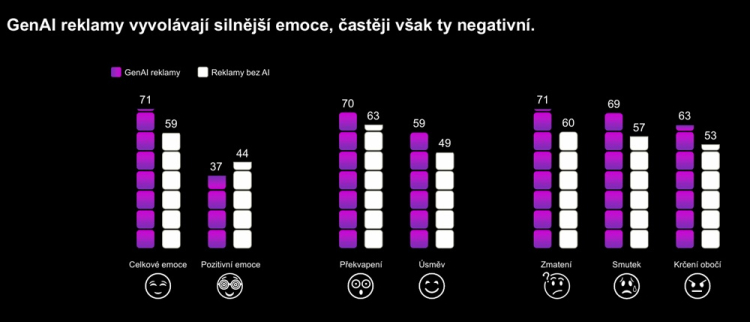 From Kantar research presented by Věra Šídlová at the Communication Summit; Source: Blue Events
AI adverts evoke more negative emotions
The way in which artificial intelligence tools are used in advertising influences how they are perceived, Věra Šídlová explained, drawing on data from the research agency Kantar. “When the use of AI is too obvious, more than a third of adverts fail. Conversely, creative use can yield up to 40% better results,” she said.
Brand association is also lower (40%) for ads clearly created using AI than for traditional adverts (62%) or for AI-generated ads where the AI is not recognisable (61%). According to current data, AI-generated adverts evoke stronger emotions, though more often negative ones. These include, for example, confusion, sadness or frowning. On the other hand, they can evoke more surprise or smiles than traditional adverts.
The fact that the extent and manner of AI involvement is crucial to the overall perception of an advert and its success is also confirmed by the positive reception of the O2 campaign featuring the virtual grandmother Alenka. A study of the 60 most memorable adverts of 2025, conducted by Ipsos, showed that Czech audiences are most drawn to authentic stories, humour and themes reflecting everyday life. It is precisely thanks to this combination of humanity, empathy and an original creative idea that the O2 advert ranked among the most successful campaigns of the year and won in the ‘empathy and closeness’ and ‘creative idea’ categories. As O2’s Marketing Director David Daneš noted at the Communication Summit, Alenka the grandmother, fighting against cyber scammers, is known thanks to the advert—in which AI played a key role— and awareness that O2 protects against cyberattacks has risen by eleven percentage points year-on-year thanks to the campaign.
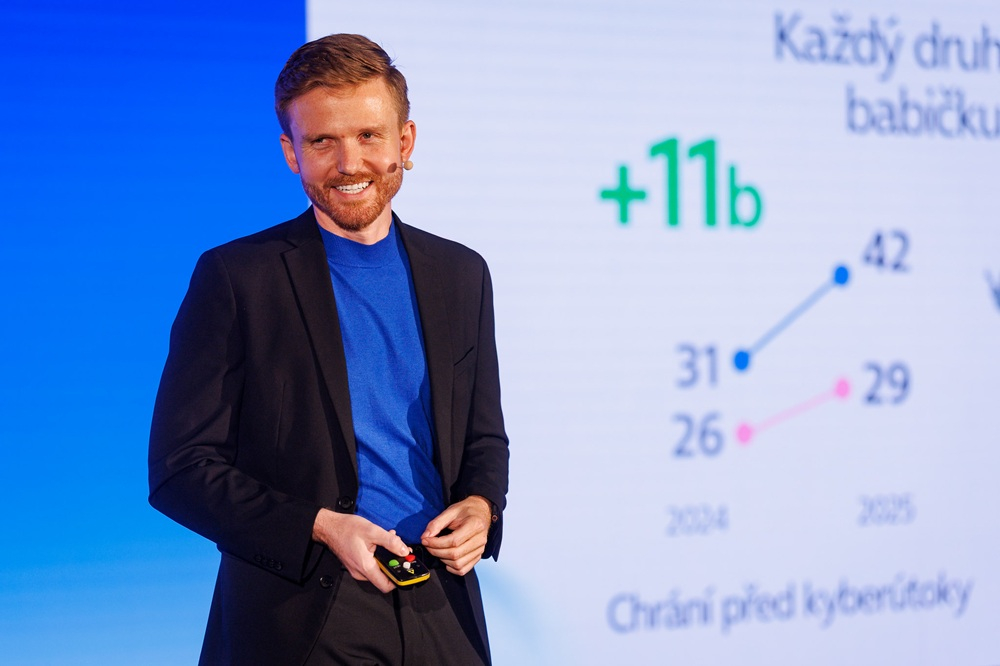 David Daneš at the Communication Summit. Photo: Jiří Šeda; Source: Blue Events
Information overload and decision fatigue
Zuzana Moudrá from Cheil highlighted decision overload and fatigue from constant choice. When searching for products today, users have to choose between hundreds or even thousands of options, which is extremely exhausting. That is why, in her view, the brands that succeed are those that give people the feeling they no longer need to make any further decisions. “The future of communication is not more communication. The future lies in building a brand communication system that makes decision-making easier for people,” she emphasised.
She interspersed her presentation with a quote from Herbert Simon from 1971: “The abundance of information means a poverty of attention for its recipients,” using it to illustrate the current situation, adding that this is precisely the situation that has arisen in today’s world (not just in advertising). “New technologies have added possibilities, but they haven’t given us certainty. 43% of people feel overwhelmed by the options when they want to buy a product they don’t purchase regularly. That’s why, when they feel overwhelmed, almost 70% of the population goes the tried-and-tested route. Almost a fifth choose a brand they know, and just under half rely on reviews from someone who has experience with it. Only 12% ask AI,” she explained. People don’t turn to AI, but to what they know and trust. And the more confusing the range of options, the higher the percentage of those who reach for the familiar. This is reported by almost 60% of shoppers.
“Almost half the market is actively stressed by decision-making. The answer lies in simplicity and connected communication. The best brands are able to build a better system around their customers’ needs,” she advised on how to tackle information overload.
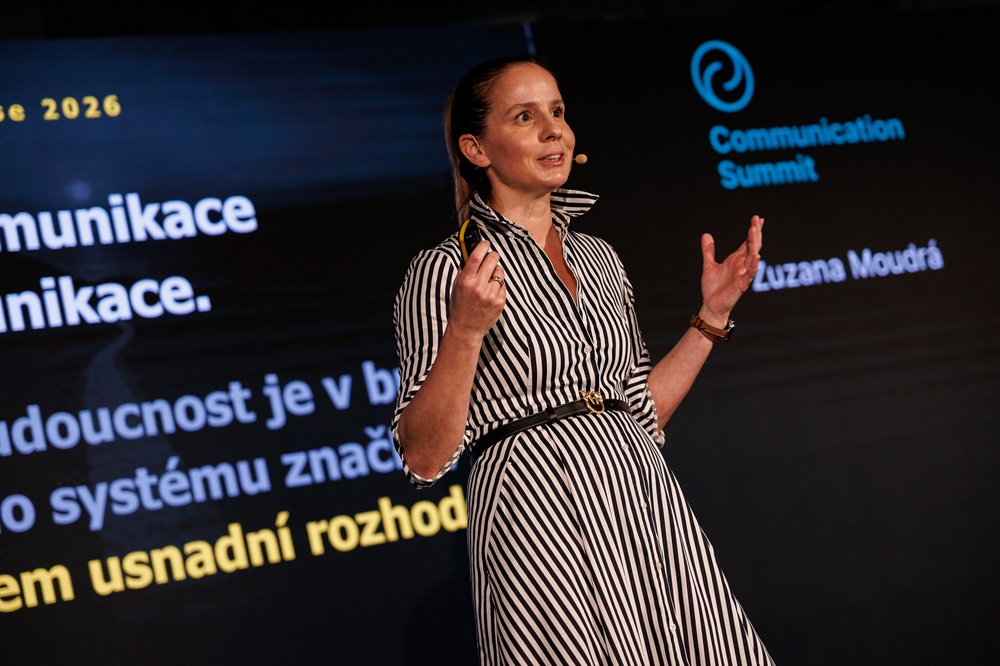 Zuzana Moudrá at the Communication Summit 2026. Photo: Jiří Šeda; Source: Blue Events
This year’s Communication Summit took place at the Pragovka building in Prague. Katie Delahaye Paine was the keynote speaker. You can read the text of her speech here.
 Communication Summit 2026. Photo: Jiří Šeda; Source: Blue Events
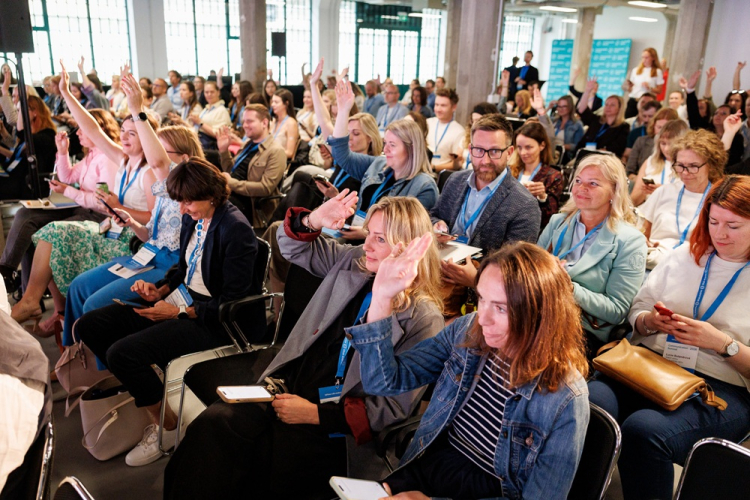 Communication Summit 2026. Photo: Jiří Šeda; Source: Blue Events
Source: mediaguru.cz