

John Lewis & Partners was founded in 1864 as a small drapery shop on Oxford Street in London, and from the very beginning, it built its communication on trust and fairness toward customers. The business grew quickly and was rebuilt into a larger department store in the 1880s.
In its early years, advertising was limited mainly to newspaper ads and shop signs that emphasised the quality of the goods and transparent pricing. At the turn of the nineteenth and twentieth centuries, the company began to work more systematically with visual advertising, catalogues, and printed leaflets, all of which had an informative rather than showy character. A decisive influence on the company’s communication style came from John Spedan Lewis, who promoted the idea that advertising should serve the customers rather than manipulate them. This approach was also reflected in the famous pricing slogan “Never Knowingly Undersold,” which became one of the longest-running advertising principles in British retail.
In the 1920s, with the creation of the John Lewis Partnership, advertising became increasingly focused on the brand’s values — honesty, quality, and a long-term relationship with customers. During the interwar period and after the Second World War, the company relied mainly on print and later radio, while avoiding aggressive sales messaging. For a long time, John Lewis advertising was more functional and informative than emotional.
 John Lewis department store on Oxford Street (1936); Source: express.co.uk
It was only in the second half of the twentieth century, with the arrival of television, that the brand gradually began to discover the power of visual storytelling. And its early principles — an emphasis on trust, restraint, and respect for the audience — became the foundation on which the famous tradition of John Lewis Christmas advertising would later be built.
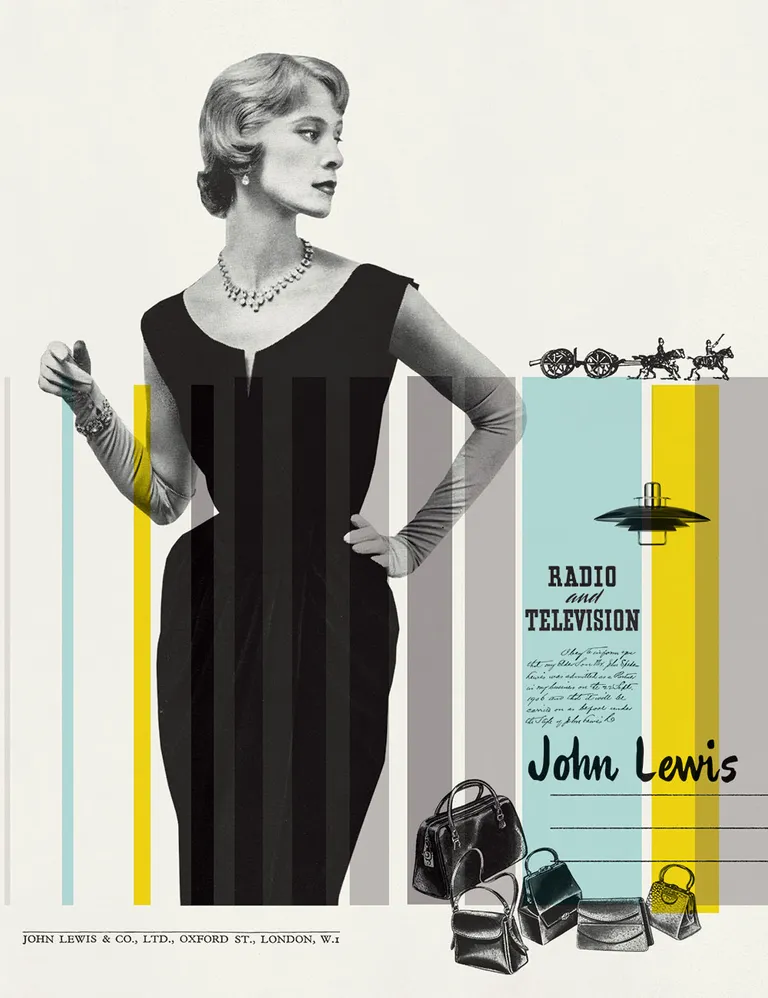 John Lewis advertising material from the 1950s; Source: TBC
The early beginnings of Christmas advertising
John Lewis’s Christmas communication gradually underwent a fundamental transformation that reflects the development of advertising as a field. In the first decades of its existence, the brand treated Christmas primarily as a sales season, not as an opportunity for brand building. Christmas catalogues, print advertisements, and decorated shop windows served mainly to guide customers through the range of products on offer and to support the sale of Christmas gifts. Communication was functional, rational, and strongly product-oriented. This approach did not change even during the twentieth century. Media channels expanded to include radio and later television, but John Lewis remained very restrained when it came to using emotion and storytelling. Its advertising was meant to inform, not to move people emotionally. Christmas was presented as a season of good shopping, quality, and fair prices, which corresponded to the values of the partnership and to the philosophy of John Spedan Lewis.
The shift to emotional advertising
The turning point did not come until the turn of the millennium, when British retail began to change significantly as a result of intensifying competition, media fragmentation, and the growing need for brand differentiation. John Lewis felt this pressure and therefore decided to shift its Christmas communication away from a purely commercial function toward building an emotional relationship with customers. The year 2007 and the television spot “The Shadow,” created by Saatchi & Saatchi, which at the time handled the brand’s main advertising communication, therefore did not represent a surprising change of direction so much as the logical culmination of the brand’s long-standing values. And from that moment on, Christmas at John Lewis definitively changed from a catalogue format into a narrative ritual.
Video: John Lewis – The Shadow (2007)
The first Christmas ad that truly touched viewers’ hearts, however, was not until the 2011 campaign “The Long Wait.” By then, the brand was already working with adam&eveDDB, which today can proudly claim to have shaped the distinctive Christmas signature of John Lewis. In the 2011 ad, directed by Dougal Wilson, a young boy is shown desperately waiting for Christmas to arrive, much like countless other children. The viewer naturally assumes that he is waiting for his own presents, but when Christmas morning finally comes, it turns out that he has actually been eager for the day when he can give a gift to his parents. The emotional story, combined with a cover version of “Please, Please, Please, Let Me Get What I Want” by The Smiths, sparked widespread discussion and was warmly received by audiences.
Video: John Lewis – The Long Wait (2011)
Emotion remained John Lewis’s Christmas trump card in 2012 as well. In the spot “The Journey,” a snowman crosses mountains and motorways to reach a store and buy his snow-girl a scarf to keep her warm. The soundtrack was a cover version of “The Power of Love” by Frankie Goes to Hollywood, performed by Gabrielle Aplin.
Video: John Lewis – The Journey (2012)
John Lewis’s 2013 Christmas campaign, “The Bear and the Hare,” marked another step forward in the storytelling style of the brand’s holiday advertising. The animated story of the friendship between a bear and a hare was met with an exceptionally positive response from both the public and critics. The hare comes up with the perfect Christmas gift for the bear, who has settled down for hibernation — an alarm clock that will allow him to wake up and experience Christmas. The charming story is underscored by a cover version of “Somewhere Only We Know” by Keane, performed by Lily Allen.
Video: John Lewis – The Bear and the Hare (2013)
The formula worked, so the brand stuck with adorable animals in 2014 as well. The touching ad “Monty the Penguin” tells the story of a little boy and his friend Monty, a penguin who wants to find love at Christmas. Sam notices that Monty is sad because he is missing a companion, and he decides to help him. On Christmas Eve, he gives him a gift — a plush penguin named Mabel. It is the perfect scene for the ad’s central message: that the greatest joy comes not from the gift itself, but from understanding the wishes and needs of the person receiving it. The musical backdrop was “Real Love” by John Lennon, performed by Tom Odell.
Video: John Lewis – Monty the Penguin (2014)
In 2015, John Lewis came up with a Christmas campaign that ranks among the most moving ever. The television ad “Man on the Moon” tells the story of a little girl who, through her telescope, discovers a lonely elderly man living on the moon. Lily decides to send him a telescope on Christmas Eve by tying it to a cluster of balloons, so that he can at least symbolically feel closer to other people. The ad’s message is built on a simple idea: the most valuable gift is to let someone know that you are thinking of them. The campaign also had a strong social dimension — in cooperation with the charity initiative Age UK, it drew attention to the issue of loneliness among older people, which is felt especially strongly at Christmas. This was the first time John Lewis openly linked a Christmas ad with an urgent social issue. The atmosphere of the spot was enhanced by a cover version of “Half the World Away”, performed by the Norwegian singer Aurora. The ad was met with an exceptionally positive response from the public and critics alike, confirming that John Lewis Christmas campaigns function not only as marketing but also as a means of social reflection.
Video: John Lewis – Man on the Moon (2015)
In the following two years, John Lewis returned to a lighter, more playful style in its Christmas campaigns. In 2016, it introduced “Buster the Boxer,” a conscious departure from the heart-wrenching sentiment of previous years. The story follows Buster the dog, who watches with mounting envy as woodland animals enjoy a family trampoline at night. On Christmas morning, he finally gets his chance and joyfully claims his dream gift for himself. The spot, ending with the slogan “Gifts that everyone will love,” amused audiences and showed that a John Lewis Christmas ad could work even without tears — although some viewers did miss the stronger emotional impact.
A year later, the brand returned to gentler emotions with “Moz the Monster.” The ad tells the story of a little boy named Joe and his nighttime friend Moz, a blue monster who keeps him company during sleepless nights. When Moz realises that Joe needs peaceful sleep, he leaves him a night-light under the Christmas tree. The spot, accompanied by the line “For gifts that brighten their world,” was received by consumers as sweet and kind, although it did not achieve the iconic status of some of the earlier campaigns.
The 2018 campaign, whose main figure was Elton John, generated a great deal of attention — albeit a mixed response. Titled “The Boy & the Piano,” it became one of the most talked-about campaigns of the decade and provoked sharply polarised reactions. The ad, with its emotional, retrospective story tracing Elton John’s life journey from childhood to fame, attracted millions of online views within its first few days. However, some viewers reacted critically. Some felt that the ad functioned more as a promotion for Elton John than as a traditional John Lewis Christmas story, and they missed the typical focus on “ordinary people” and universal emotion. From the brand’s point of view, the campaign was seen as a strategic experiment that, on the one hand, brought exceptional media attention and reached a new audience, but on the other hand, weakened the sense of a “collective Christmas story” that John Lewis supporters had come to expect.
Video: John Lewis – The Boy and the Piano (2018)
Among the best-received campaigns was “Edgar the Dragon” from 2019, which introduced a humorous element to the festive season through the story of a dragon learning to control his fiery breath. The ad was the first joint project with John Lewis’s partner chain Waitrose.
Video: John Lewis – Edgar the Dragon (2019)
The 2020 Christmas campaign “Give A Little Love” responded to the extraordinary atmosphere of the pandemic year and, instead of offering one grand narrative, presented a mosaic composed of small acts of kindness. Short animated and live-action scenes show how ordinary thoughtfulness, help, or sharing can trigger a positive chain reaction. The ad’s format reflected the less extravagant reality of Christmas at the time. A prominent role in the spot was also played by the song “A Little Love” by Celeste, written specifically for the campaign. Incidentally, the song climbed all the way to the top of the UK charts after its release. Audiences and critics mostly received the ad very positively, praising its optimism, sensitive tone, and ability to respond to the social mood without unnecessary pathos.
When something ends, something new begins
Another two years passed. After the campaigns “The Unexpected Guest” (2021) and “The Beginner” (2022), 2023 saw the brand move to a new agency. The reason for ending the decade-long partnership with adam&eveDDB was not dissatisfaction with the creative quality, but a fundamental shift in the brand’s business and communication strategy.
According to trade media, John Lewis had long been under pressure to improve performance, deal with declining profits, and redefine its role in the market, especially in the context of rising living costs and changing consumer behaviour. Marketing experts also pointed out that the Christmas ads from the later years of the adam&eveDDB era were often perceived as cultural events, but with a weaker connection to the John Lewis brand itself and its product offering. The move to Saatchi & Saatchi was intended to bring communication back closer to the company’s values, without the brand completely giving up its emotional dimension. The agency change was thus understood as both a symbolic and a strategic restart — an attempt to rebalance emotion and commerce, storytelling and sales reality.
The first tangible result of this new phase was the Christmas ad “The Snapper: The Perfect Tree,” which follows the story of a little boy named Alfie. He buys a seed at the market, believing it will grow into the “perfect Christmas tree.” But once planted, the seed unexpectedly grows into a giant carnivorous plant, which Alfie names Snapper. The touching spot closes with the slogan “Let your traditions grow,” emphasising that Christmas traditions can be new and unusual and still bring joy.
Video: John Lewis – The Perfect Tree (2023)
The ad provoked mixed responses. Many viewers found it entertaining, original, and playful, seeing it as a welcome lightening of traditional Christmas sentimentality. Others, however, regarded it as less “Christmassy” than previous campaigns and argued that the carnivorous plant itself did not feel particularly traditional or festive. According to expert evaluations, however, it ranked among the most effective John Lewis Christmas campaigns ever.
The 2024 Christmas campaign, “The Gifting Hour,” in turn offered a gentle story about Sally, who wants to find the perfect gift for her sister. She runs through a clothes rack and embarks on a journey through childhood memories of growing up with her sister. Richard Ashcroft, former frontman of The Verve, contributed his song “Sonnet” from the album Acoustic Hymns to the commercial. The two-minute ad ends with the slogan: “The secret to finding the perfect gift? Knowing where to look.”
And this year’s Christmas ad? It truly succeeded. The Christmas campaign “Where Love Lives” presents a beautifully human story about the relationship between a father and son. The story takes place in the family home during Christmas, and its pivotal moment comes in the form of a vinyl record, a gift that stirs powerful memories of the father’s youth. At that moment, music becomes a bridge between generations and a way of expressing emotions that sometimes cannot be put into words. The ad features the iconic 1990s track “Where Love Lives.” Compared with earlier campaigns, this spot is more understated and focuses on ordinary family moments that many people encounter in everyday life. With this approach, John Lewis consciously returns to authentic emotion and reminds us that the true value of gifts does not lie in their price but in what they are able to express.
Video: John Lewis – Where Love Lives (2025)
And what comes next?
John Lewis and its Christmas campaigns belong to the Advent season as inseparably as the first Christmas carol on the radio. Its Christmas ads have long since become an annual event that viewers wait for, assess, compare with previous years, and debate passionately. Every new spot is placed under intense scrutiny. These audience expectations are proof of the powerful position the brand has built for itself. What began as a commercial message gradually became a Christmas ritual that helps shape the mood of the entire season. The future, therefore, will not be about surpassing last year’s hit at any cost, but rather about finding new ways to tell stories that feel close to people and touch their hearts. And all we can do is look forward to seeing what the brand comes up with next year.