

According to the ResSolution Group survey, most Czechs have come across an advert created using AI, but only a minority are confident in recognising it, and a significant proportion of the public are unsure on this issue. The survey was conducted on a sample of 8,000 respondents from the Czech internet population aged 15 and over.
The data shows that 6 out of 10 Czechs have encountered an advertisement in recent months that they believe was created using artificial intelligence. However, only 28% are certain of this, whilst a further 32% have this impression but cannot confirm it. Roughly 11% of respondents stated that they had not encountered AI advertising, and 28% do not know. According to the authors of the research, AI advertising is thus becoming part of the mainstream, yet at the same time remains difficult for a large section of the audience to identify.
Significant differences emerge across generations. Among people aged 15–24, 55% report having experienced AI advertising, whilst among seniors over 65, the figure is just 14%. Older respondents are also more likely to admit that they are unsure whether they have encountered this type of advertising at all. A similar trend is evident in the ability to recognise such advertising. Only 30% of Czechs believe they could identify AI advertising always or in most cases, whilst 26% do not believe they can and 44% admit they can only recognise it sometimes.
Confidence in recognising AI advertising drops significantly with age. Whilst 67% of young people aged 15–24 are confident, this figure falls to 43% in the 25–34 age group, and uncertainty prevails among older age groups. Slight differences are also evident between the sexes. Men are more likely to express confidence in recognising AI advertising, whereas women are more likely to state that they can only identify it in some cases.
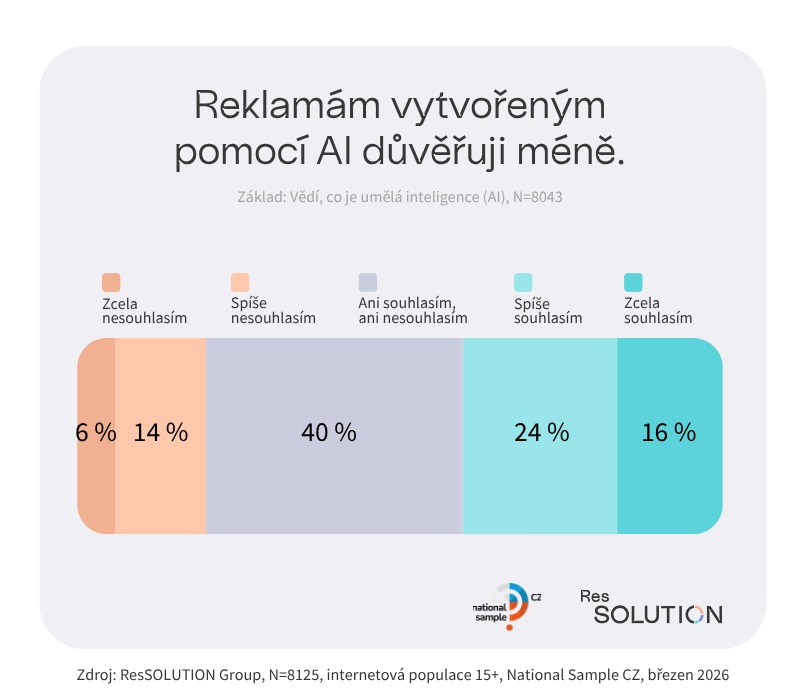
The survey also shows that AI advertising is testing trust in brands. Four in ten Czechs state that they trust AI-generated adverts less than traditional ones. A further 40% remain neutral on this point, whilst 20% disagree with this statement. The highest level of distrust is found among the youngest generation (aged 15–24), where 58% of respondents express it. This attitude weakens slightly with age, and differences also emerge between the sexes, with women showing slightly higher distrust (42%) than men (38%).
However, the use of AI does not automatically mean a negative impact on the brand. Only a third (32%) of Czechs agree that the use of artificial intelligence in advertising reduces their interest in a given brand. Once again, this mainly concerns the youngest groups (15–24 years: 47%; 25–34 years: 35%), whilst interest decreases amongst those aged 35 and over
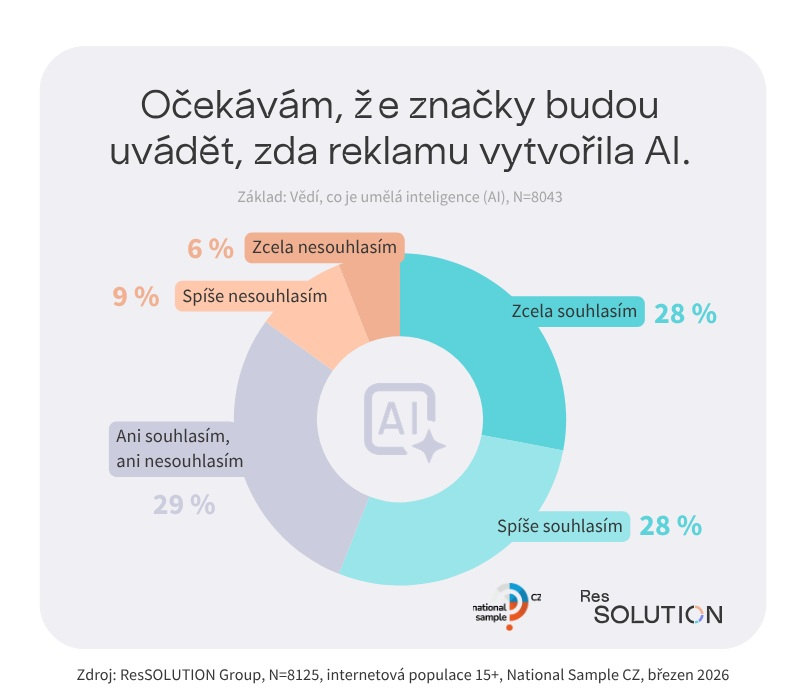
More than half of Czechs (56%) expect brands to state whether an advert was created using artificial intelligence. 29% remain neutral on this point, and only a small proportion (15%) do not expect transparent labelling. Age-related differences are also reflected in this area. Younger respondents express stronger expectations of transparency; 61% of those aged 15–24 expect it. In the remaining age groups, however, the downward trend does not intensify, and the proportion of those who expect AI advertising to be labelled remains consistently above 50%.
The results thus show that AI advertising in itself is not a major issue for Czechs. How transparently brands communicate about it will be crucial to its acceptance. “AI will continue to grow in advertising. The key challenge for brands will therefore not only be how to use it, but how to communicate about it,” says Anna Tvrská, Senior Research Manager at ResSolution Group.
Source: mediaguru.cz