

What you will find in the article:
- Key principles for effective advertising include emotional impact and brand recognition.
- Creative quality significantly influences advertising effectiveness and returns.
- Large brands benefit from greater mental and physical availability.
- Emotion in advertising must connect with the brand for effectiveness.
- Pricing strategies should prioritize customer psychology over finance department insights.
Ritson repeatedly stresses that modern marketing has become too narrowly focused on communications, campaigns and creative executions. In reality, advertising is only one part of a broader system comprising product, price, distribution and communications. “Marketing is Canada. Advertising is Toronto. It’s not even Toronto. It’s Winnipeg,” he said. This metaphor encapsulates his central argument: although advertising is important, it is nowhere near as important as most marketers believe. According to Ritson, creative accounts for only half of advertising effectiveness. Media accounts for the other half. What matters is how much a company spends, where that expenditure is directed, the quality of the media used and how effectively the various channels work together.
An opening reflection: pricing and product value
According to Ritson, companies have made an enormous mistake over recent decades by handing responsibility for pricing to finance departments. Although such departments understand how to work with costs, they do not understand customer psychology or how people actually perceive prices. “You’re losing billions of dollars because you let the finance guys in your company set the price and they know f**k all about it,” he said.
Even more important than pricing, in his view, is the product. He illustrated this using the example of Canadian singer Shania Twain. In a documentary about her career, various commentators attempt to explain her success through her life story or marketing. Her manager, however, puts it very simply: “The average CD, it’s got ten tracks, it’s got two hits. Shania’s CD, it’s got ten tracks, it’s got nine hits.” According to Ritson, this simple explanation captures the essence of marketing better than anything else. A strong product can succeed even with average communications, whereas not even the finest advertising creative can rescue a poor product in the long term.
Factors contributing to advertising effectiveness
Turning to the main subject of his presentation, Ritson drew on the work of statistician Paul Dyson, who analysed hundreds of advertising campaigns to understand why some advertisements generate enormous returns while others have virtually no effect. His work resulted in the well-known Advertising Profitability Table, which is now used by many advertising professionals.
Ritson pointed out that the single biggest factor influencing advertising effectiveness is the size of the brand. Large brands have greater mental and physical availability, which produces a stronger effect. However, brand size is something that a company can do very little to change in the short term. The creative quality of the advertising is therefore far more important from a practical perspective.
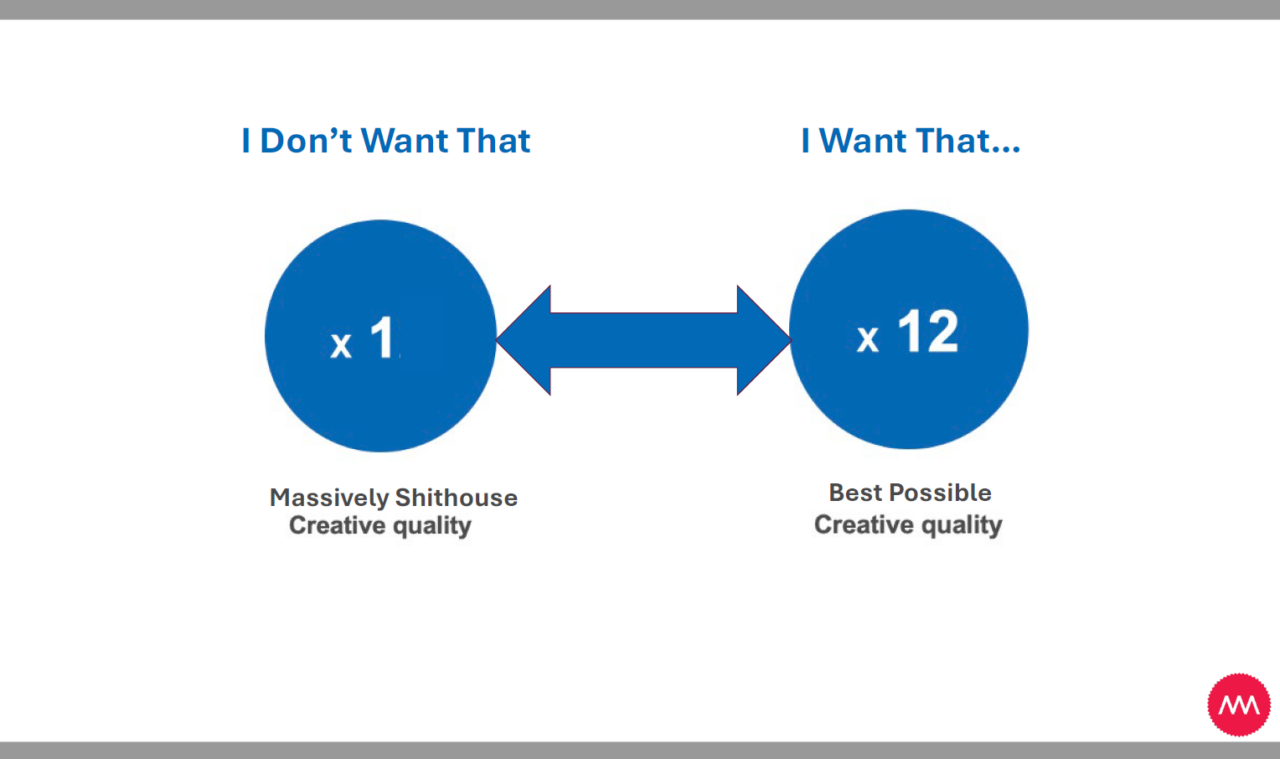
According to Dyson, the difference between the best and worst advertisements for the same brand can be as much as twelvefold. How did he arrive at this figure? He did not compare different companies or different budgets. Instead, he compared individual advertisements for the same brand. In other words, the media, budget and strategy remained the same. The only thing that changed was the creative execution.
 Source: Thinktv.ca
But how can this much sought-after twelvefold improvement be achieved? The three main factors contributing to success are:
- The ability to evoke emotion;
- Instant brand recognition; and
- Consistency and the ability of the advertising to work over the long term.
1. Emotion
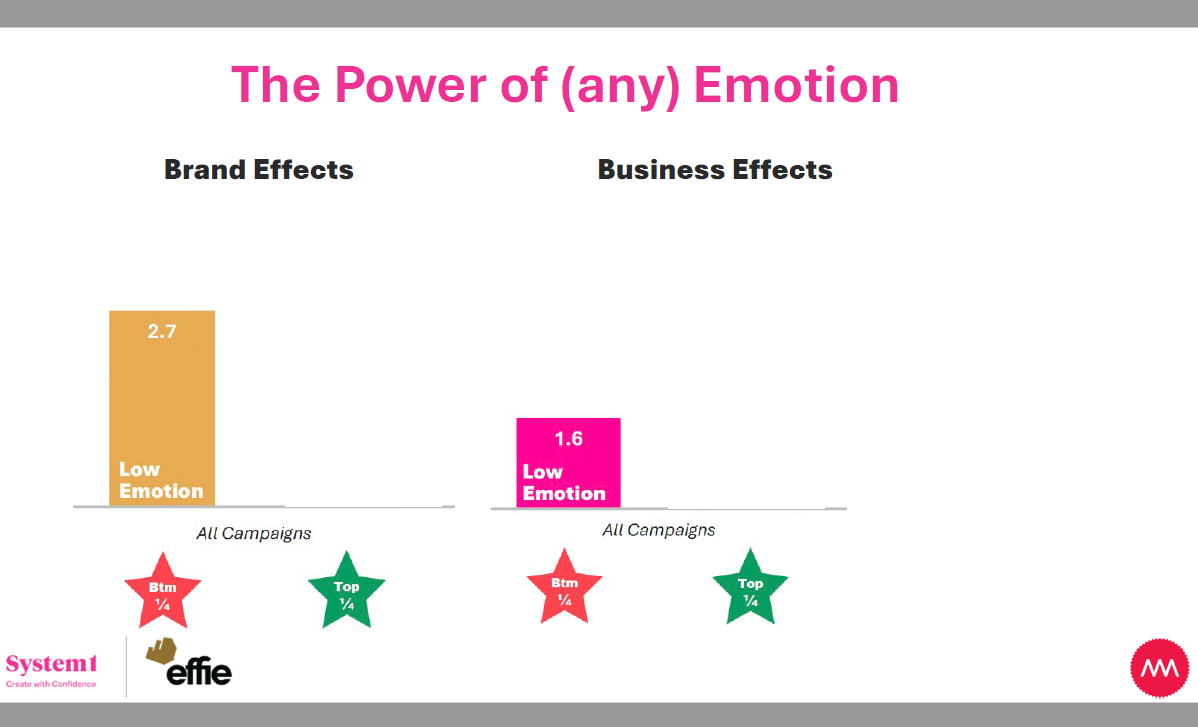
According to Ritson, advertising must first and foremost make customers feel something. Importantly, emotion need not always make people sentimental or moved. Advertising can also work if it is startling the consumer, making them frustrated, anxious or even disgusted. What matters is that the advertisement is not emotionally empty. The greatest enemy of advertising is not a negative consumer reaction, but indifference. As an example of highly emotional advertising, Ritson presented Android’s commercial featuring various animals, which generates a strong emotional response from audiences.
Video: Android Friends Furever (2015)
The main reason emotions are so important relates to the way people perceive brands. Marketers tend to assume that customers follow and care about their brands with a similar level of intensity to their own. In reality, most people pay very little attention to brands. Consumers have thousands of brands in their minds and devote only a few seconds a year to each one. Advertising must therefore capture their attention in the first place—and emotion is the most effective way to do so.
 Source: Thinktv.ca
2. Brand recognition
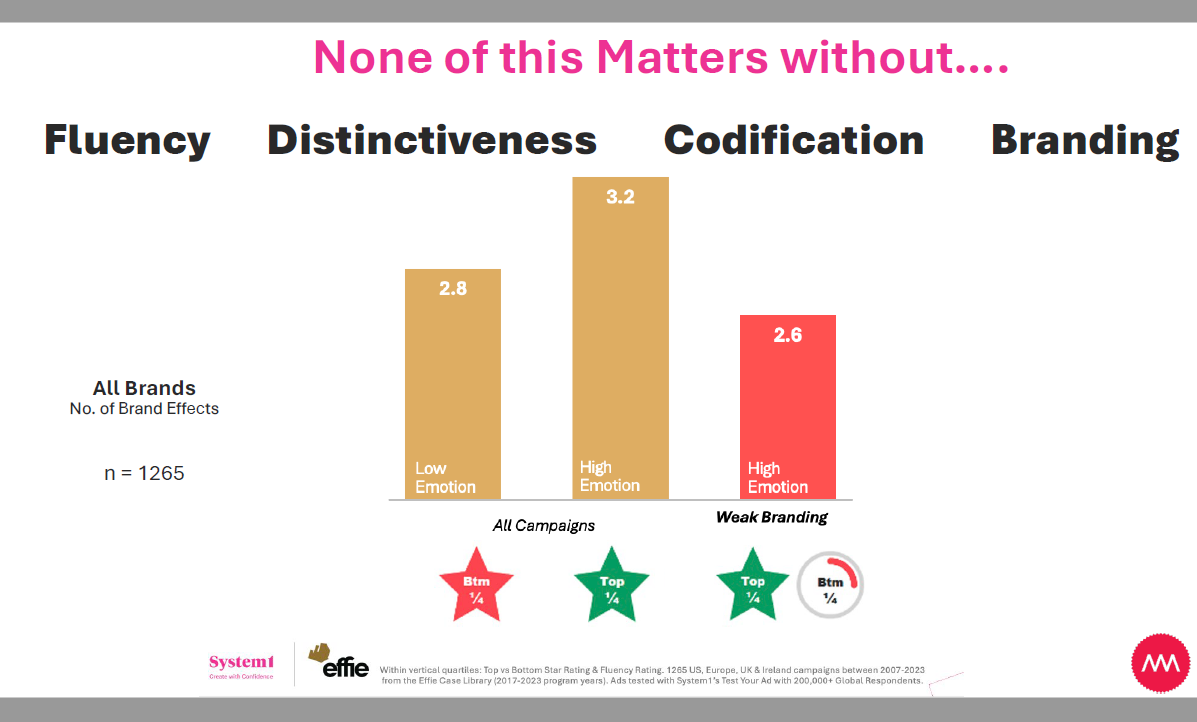
At the same time, Ritson warns that emotion alone is not enough. Much modern advertising may entertain or move people, but it fails to connect those emotions with the brand. The audience then remembers the advertisement rather than the advertiser. “Now, let’s be clear, that was a s**t ad,” he said of the Android commercial. “It was an emotional ad, but it was a s**t ad because it failes the other test of creative. And the other test of creative is, do they know who the ad is for? And the answer for that ad is no. It’s the ad with the monkey in it.”
According to Ritson, this is the result of excessive creative subtlety. Advertisements today often function like short films: they build a story, tension and a punchline, but the brand frequently appears only at the very end. Consumers, however, do not give advertisements their full attention. They do not watch every detail closely and spend most of the advertising break thinking about something entirely different. If the brand is not clearly present from the beginning and throughout the advertisement, the audience simply will not connect the advertisement with that particular brand. Yet a brand’s ability to be distinctive and stand out is one of the fundamental requirements for success.
 Source: Thinktv.ca
Marketing is full of different terms for this: fluency, codification, branding and distinctiveness. However, all of these concepts refer to the same thing—the advertisement’s ability to signal instantly which brand it belongs to. Emotion without strong brand identification loses much of its effect. Advertising must therefore evoke emotion, but it must also be clear from the very beginning which brand is being advertised.
 Source: Thinktv.ca
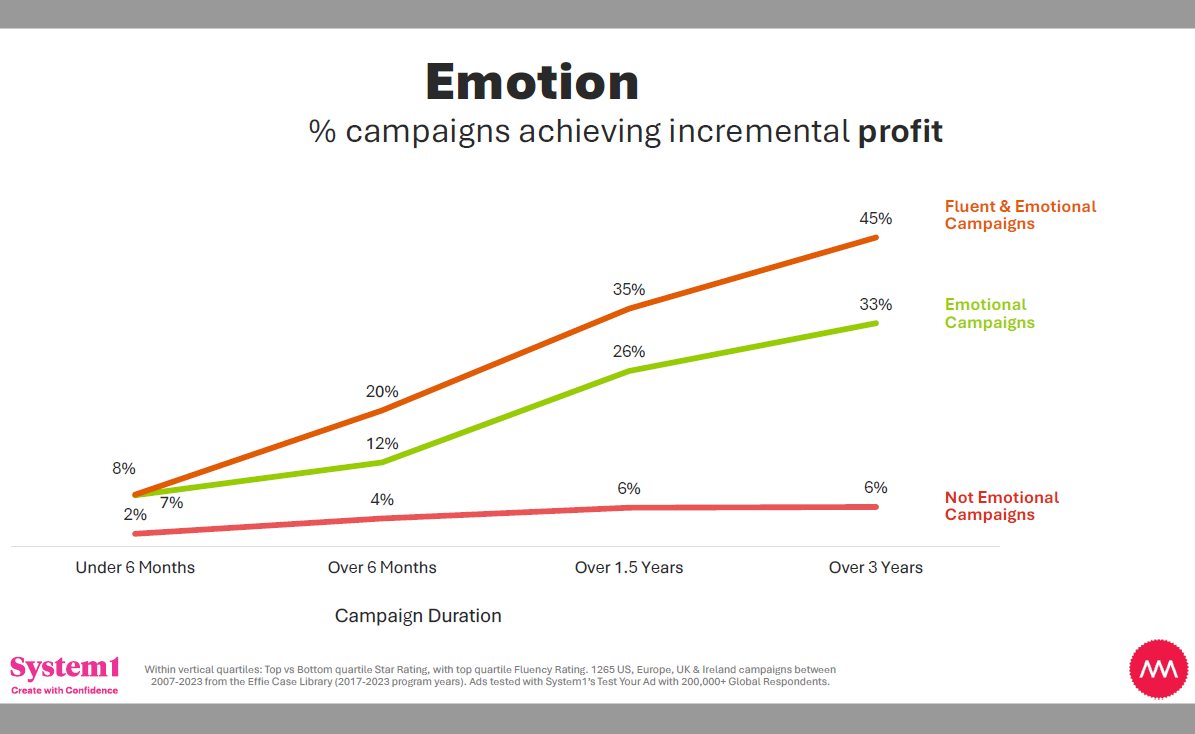
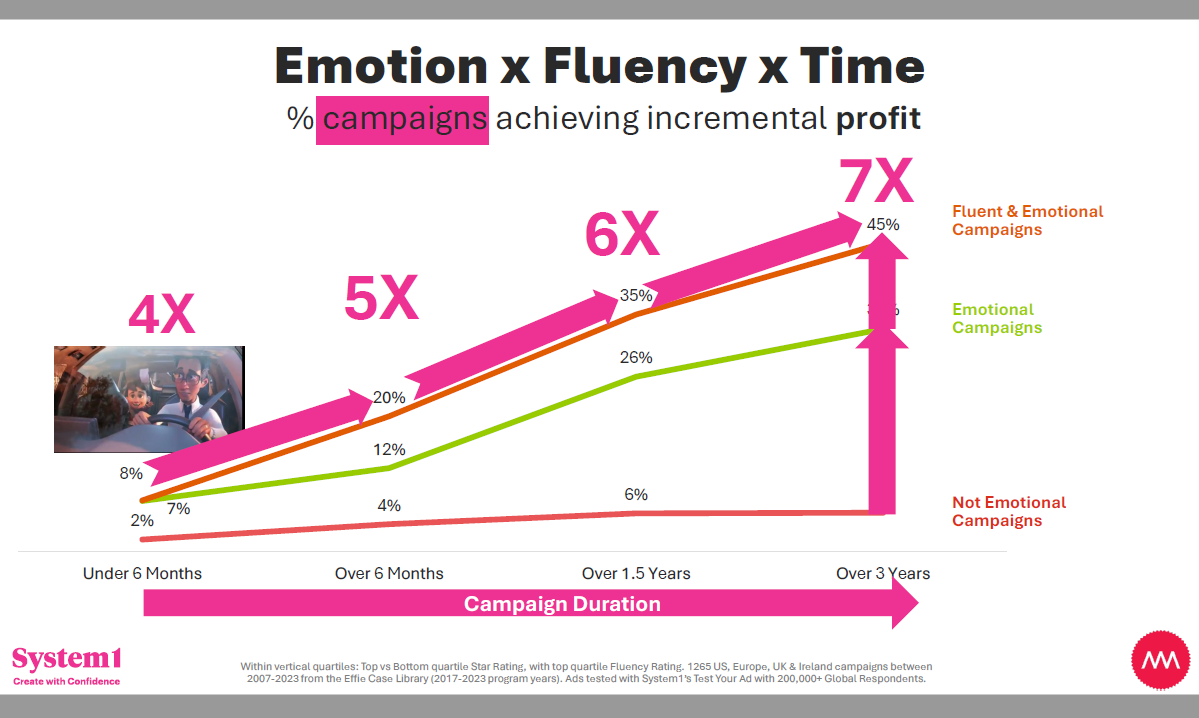
The chart above illustrates the synergy between emotion and brand recognition. It is the combination of these two factors that dramatically increases a campaign’s likelihood of being profitable.
As an example of an advertisement that achieves both, Ritson presented a Toyota commercial.
Video: Toyotathon: The Journey
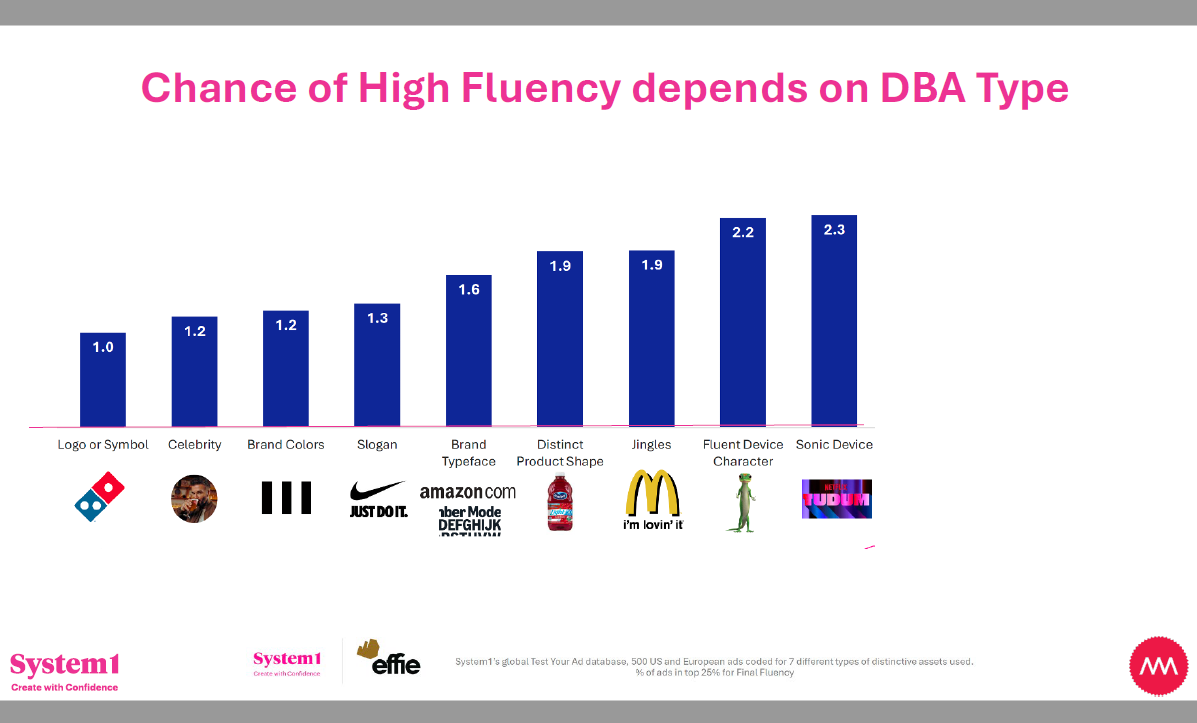
The logo appears approximately seven times in the advertisement. However, the logo is not the only desirable brand asset. Other assets may work even better. In addition to the logo, distinctive brand elements that help build recognition include colours, slogans, typography, mascots, characteristic product shapes and audio cues. According to Ritson, sound assets are among the most powerful tools for building a brand’s memory structures.
 Source: Thinktv.ca
He also believes that the frequency with which these assets are used plays an important role. Ritson refers to the “rule of seven”, according to which brand assets should appear approximately seven times within a single advertisement to create a strong association in the audience’s memory.
It is also important to distinguish between two stages of working with brand assets. When selecting its assets, a brand should be disciplined and use only a limited number of genuinely strong elements. Once it has decided which assets to use, however, it should deploy them extensively and, above all, consistently throughout its communications. According to Ritson, there is virtually no risk of “overbranding” an advertisement. Weak brand identification is a much greater problem than excessively strong identification.
3. Time
According to Ritson, one of the most important principles of effective advertising is time—specifically, consistency and the long-term use of good creative work. Most marketers today withdraw advertisements too soon because they themselves become bored with them. The audience, however, may barely have noticed the advertisement by that point. Marketers spend many hours every day working with a brand, whereas the average consumer pays it only minimal attention. This creates a false sense of advertising “wear-out” that, in reality, exists largely in the minds of people within the company.
Research shows that good advertising does not become less effective over time. On the contrary, its impact grows. If an advertisement is emotionally powerful and firmly connected to the brand through distinctive brand assets, using it over the long term dramatically increases the likelihood of profitability. An advertisement that runs for several months or years builds memory structures, brand awareness and mental availability far more effectively than a constant succession of new campaigns.
 Source: Thinktv.ca
Television is not losing its power
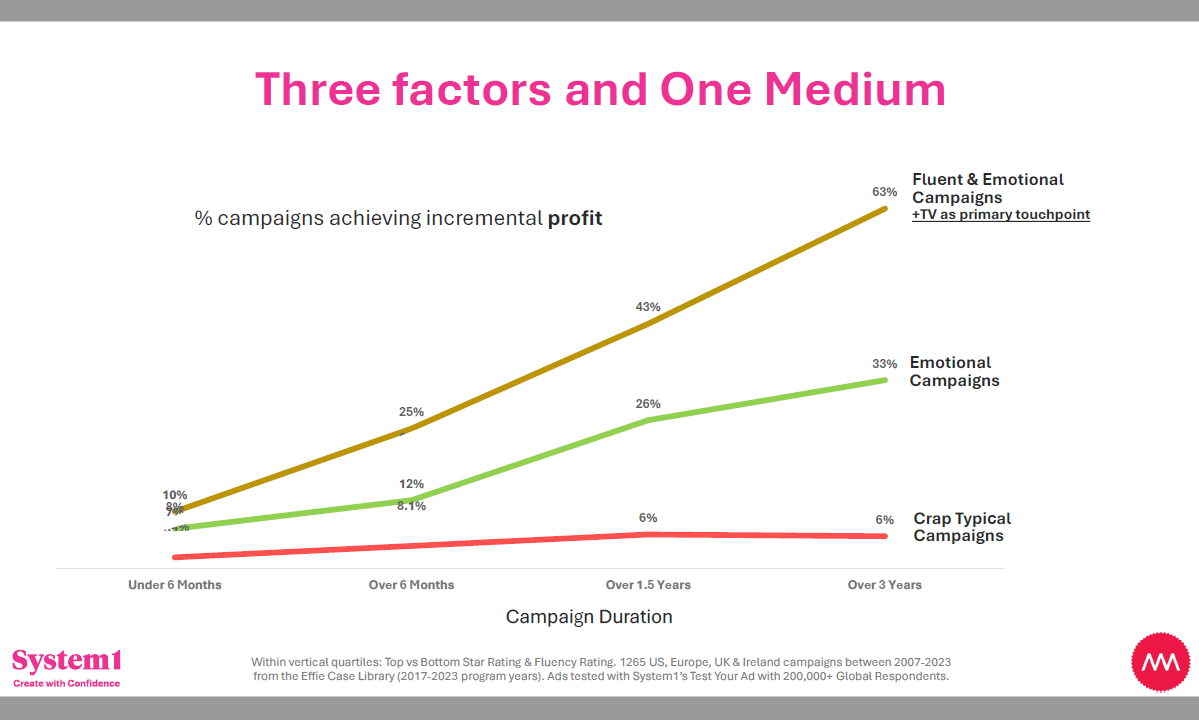
At the end of his presentation, Ritson returned to television as an advertising medium and challenged the widespread view that it has lost its relevance. According to him, television has a unique ability to combine broad reach, emotional impact and the long-term development of a brand’s mental availability.
Importantly, however, television is not enough on its own. Its power becomes apparent only when a brand applies the right advertising principles: emotion, clear recognition and long-term consistency.
 Source: Thinktv.ca
Television can then amplify these effects and help the brand build a stronger position in consumers’ minds. According to Ritson, marketers should not underestimate television’s role or its true impact.
“If I was going to do really good advertising and recommend what you should do, I would tell you four things. I would tell you to make it emotional. I would tell you to codify the s**t out of it. I would tell you to run those good ads for two to three years, and I would tell you to run them on television, because the data says that’s the way to build stronger brands,” Mark Ritson concluded.
Source: tinktv.ca