
What you will find in the article:
- Mozart's image and music are widely used in advertising.
- He symbolizes genius, originality, and European culture.
- Various commercials feature Mozart in humorous and absurd contexts.
- Mozart's music is employed for its elegance and recognition.
- Controversial claims about his mental health are discussed.
There is no reliable historical evidence to support the claim sometimes made that Mozart was “mad”. His letters do reveal a fondness for puns, nonsensical wordplay, erotic allusions and occasionally inappropriate, coarse humour, but this was not necessarily a sign of mental illness. Retrospective attempts to diagnose Mozart with Tourette syndrome, ADHD, a personality disorder or bipolar disorder remain controversial because they are based solely on incomplete historical evidence. One thing is certain: Wolfgang Amadeus Mozart was an extraordinary talent who astonished Europe from childhood and, during his short life, created a body of work that has lost none of its power in more than two centuries. Mozart’s name has become synonymous with genius, originality and musical perfection – an exceptional reputation that advertising continues to borrow to this day.
For creatives, Mozart is an exceptionally useful cultural symbol. His name is associated with genius, virtuosity, early success, European culture, elegance and a touch of eccentricity. Moreover, only a few easily recognisable attributes are needed to identify him: a pale-coloured wig, period costume, a piano, sheet music or a few bars of a familiar musical work. Mozart is also considerably more versatile than many other composers. He can be presented as an eminent classical master, but also as a cheeky young rebel, an absent-minded genius, a pleasure-loving artist, a child prodigy or a comic character.
Television adverts featuring Mozart
One of the earliest adverts to feature Wolfgang Amadeus Mozart was a 2001 Austrian commercial for Mirabell Mozartkugel chocolates, in which Mozart was played by Olympic downhill skiing champion Franz Klammer. He is caught travelling without a ticket on public transport in Salzburg. Instead of a ticket, he offers the inspector a Mozartkugel chocolate from a box of Mirabell chocolates. Once he puts the chocolate in his mouth, however, a magical transformation into Mozart begins. Several photographs from the campaign have survived and can be viewed in this photo gallery.
Another early example is an advertising film made in 2002 for the Belgian radio station Klara. The film formed part of a broader series and was deliberately set in a cemetery, drawing on the theme of death. The campaign’s central message was that classical music and Mozart were still alive. This idea was reinforced by the print execution Mozart Is Not Dead, which the agency released later that year. The advert addressed the most common criticism of classical music – that it is dead and belongs to the past – by placing it literally in a setting associated with death. The absurd contrast was intended to prove precisely the opposite. The entire television and cinema campaign won a Gold Clio Award in the TV/Cinema Campaign category in 2003.
Belgian brand Croky Chips used Mozart in a campaign celebrating its 40th anniversary. The film Mozart was released in April 2006 and created by the Brussels agency Mortierbrigade. The surviving copy shows Mozart in a wig and period costume sitting at a piano. The historical scene is then interrupted by a huge red parrot – Croky’s mascot – carrying a packet of crisps. The joke comes from the utterly incongruous combination of an elegant salon, a famous composer and a garish mascot. Mozart, as an icon of classical music, becomes the centrepiece of a perfectly absurd situation.
Video: Croky – Mozart
French telephone directory enquiries service Le Numéro also turned to the famous composer. Its Mozart commercial formed part of an extensive campaign directed by French actor and filmmaker Maurice Barthélémy. The characters 118 and 218, who give Mozart the idea for the famous opening theme of the first movement of his Symphony No. 40 in G minor, K. 550, were played by comedians Sören Prévost and Pascal Vincent, known from the comedy group Les Robins des Bois. Mozart was played by Benjamin Bur, who lists the role in his professional CV. The campaign’s main objective was to make a difficult-to-remember six-digit number familiar to the French public. On 3 April 2006, the original directory enquiries number, 12, ceased operating and was replaced by a range of competing numbers beginning with 118. The brand therefore needed people to remember 118 218 automatically above all the alternatives.
Mozart’s melody was ideally suited to this purpose: it was widely known, instantly recognisable and had a short rhythmic motif that could be humorously linked to the spoken numbers “118, 218”. The advert also continued the central approach of the wider campaign, which used music, repetition, striking costumes and absurd situations as mnemonic devices for the telephone number. A total of 25 different commercials from this advertising saga were broadcast between 2 November 2005 and 2 June 2006.
Video: Pub 118 218 – Mozart advert
Mozart does not even have to appear in an advert to be present in it. One example is the 2018 American commercial “Kitty Mozart”, which promoted Amazon Fire TV and the ability to control apps using voice commands through Alexa. In the commercial, a man is watching a video of a cat playing an electronic keyboard, but a football match is about to begin. His friend therefore asks Alexa to open the FOX Sports GO app, and the “feline Mozart” has to make way for the sports broadcast. The advert’s title alludes to Mozart’s reputation as a musical genius, although the cat has no wig, period costume or any other attributes associated with the composer. Nor does the commercial feature any particular work by Mozart. It is simply a humorous verbal reference used to describe an exceptionally musical cat.
Ice-cream brand Magnum released a three-minute film entitled “Mozart by Magnum” in 2022. The advertising film was created to launch the Magnum Remix product range. It features a new arrangement of the first movement of Symphony No. 25 in G minor, K. 183 and combines live-action and animated sequences. Mozart is portrayed as a sensuous, vain man struggling with creative block. A malfunctioning piano key symbolically draws him into the instrument, where he finds himself in a psychedelic world of his own imagination and gradually discovers a musical solution. The film was a demanding production. Its live-action foundation was combined with extensive animation and a newly commissioned orchestral recording. Rather than attempting to reconstruct a particular historical event, the film created an imaginary visualisation of the composer’s mind. It premiered on 29 July 2022 in Mozart’s birthplace in Salzburg and became part of a temporary exhibition. The exhibition also included a letter Mozart wrote to his father on 3 July 1778, in which he describes visiting the Palais-Royal in Paris after a successful concert and treating himself to a good ice cream. This authentic detail provided the brand with a connection between the composer and its product. The campaign encompassed the film itself, digital communications, social media, outdoor advertising and the temporary exhibition at Mozart’s birthplace.
Video: Magnum Ice Cream – Mozart – A Tribute from One Classic to Another
Adverts inspired by Mozart’s music
Classical music traditionally lends a product an aura of prestige, sophistication and high quality. Mozart’s work offers a wide range of moods – from lightness and playfulness to elegance, tenderness, tension and a sense of fate. His melodies are also instantly recognisable and can establish an atmosphere and emphasise the character of the advertised product within seconds. This is why they appear in adverts for cars, watches, airlines, food, sports footwear and modern technology.
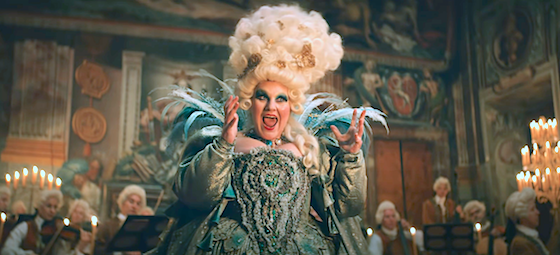
For example, as part of its global “A Voice Is All You Need” campaign promoting the Alexa voice assistant, Amazon released a commercial entitled “Opera” in 2020. In the middle of a theatrical scene in which an opera singer, performing the role of the Queen of the Night, sings the famous aria from Mozart’s The Magic Flute, a man suddenly appears relaxing on a sun lounger. After the voice command “play something more fun”, the opera is replaced by Donna Summer’s dance track I Feel Love. The advert’s humour rests on the clash between elevated classical music and the casual preference of a modern listener. At the same time, Mozart’s music clearly demonstrates how easily Alexa can change not only the track but the entire atmosphere within seconds. The 2020 commercial was created by Droga5 London, directed by Andreas Nilsson and produced by Biscuit Filmworks.
Video: Amazon Alexa – Opera
Fast-food chain McDonald’s borrowed part of the Lacrimosa from Mozart’s Requiem and used it in at least two television adverts. The camera follows customers in slow motion, while the monumental choral music turns an ordinary visit to the restaurant into an almost fateful experience. It is precisely the disparity between the grandeur of the mournful composition and the everyday fast-food setting that creates the commercials’ principal comic effect.
Video: McDonald’s – Lacrimosa
In 2007, the Lacrimosa also appeared in an American advert for Air Jordan XX2 basketball shoes. The commercial, entitled “Take Over”, was created by Wieden+Kennedy. It depicts the final seconds of a secondary-school basketball match: a player gains possession of the ball and completes a rapid move with a slam dunk. The figures are filmed as dark silhouettes, while the slow-motion action is accompanied by Mozart’s choir, lending the sporting moment an almost ceremonial solemnity.
Video: Jordan XX2
One of the most sophisticated adverts based on Mozart’s music was a 2007 Spanish campaign for the Audi S3. The car drives along a street, using flexible rods attached to its front to strike rows of glass bottles containing different quantities of water. The bottles are tuned so that the car plays the Turkish March from Piano Sonata No. 11 in A major, K. 331. As the car’s speed increases, the melody also accelerates, and the film culminates in the slogan: “New Audi S3. 265 HP. In crescendo.” The campaign was created by DDB Barcelona. Producing the commercial required technical trials to calculate the fill levels and positioning of several hundred bottles, as well as the speed of the car.
Video: Audi – In Crescendo
The 2013 global Big Cola “Think Big” campaign included a commercial entitled “Animal Orchestra”. It tells the story of a zookeeper who dreams of becoming a conductor and therefore trains an orchestra composed of animals. The result is an animal performance of the first movement of Mozart’s serenade Eine kleine Nachtmusik. The campaign was created by Saatchi & Saatchi Thailand, and the film was intended for more than 20 countries. It was filmed in Africa and, according to the case study, genuine animal sounds were used to create the soundtrack.
Video: Big Cola – Animal Orchestra
Mozart as a recipe for advertising success
Mozart is far more than a musical icon or a piece of historical decoration in advertising. Some of the campaigns that have drawn on his personality or music have achieved considerable creative and commercial success. The French advertising series for the 118 218 directory enquiries service, which included the Mozart commercial, won the Effie France Grand Prix in 2006. Eight months after its launch, the campaign had achieved unaided awareness of 75%; 118 218 was the first brand and service recalled spontaneously by 47% of respondents; and the service had secured a 45% market share. The Belgian campaign for Klara radio, which humorously demonstrated that Mozart and classical music were not dead, won a Gold Clio Award for its television and cinema campaign in 2003. The Opera commercial featuring the Queen of the Night aria was also part of an Amazon Alexa series that won a Silver British Arrow. The success of these campaigns demonstrates that Mozart’s legacy can deliver not only instant recognition and media attention but, when handled imaginatively, can also help a brand win awards, become more memorable and achieve measurable commercial results.