


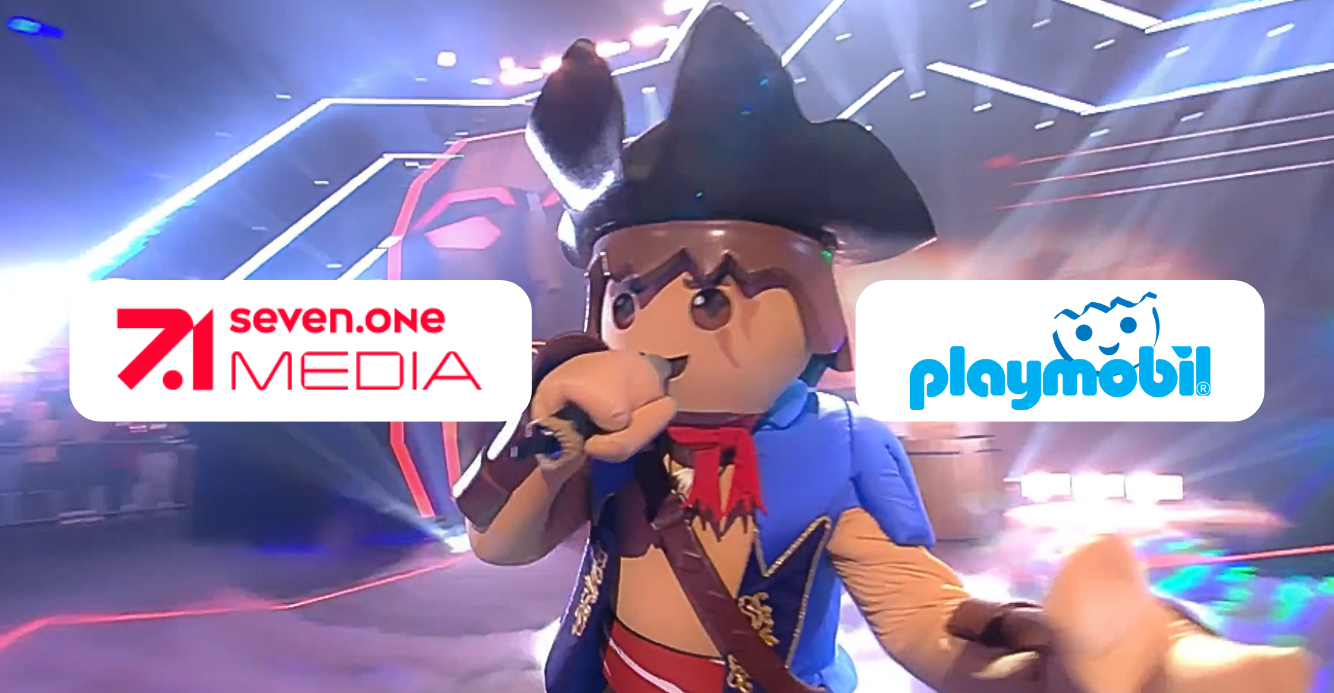
ProSieben and Joyn broke new creative ground with The Masked Singer Germany, transforming traditional product placement into something unprecedented. Seven.One Media worked with Playmobil to create a partnership where the brand did not just sponsor the program or place products within it – instead, the brand became a competing character. The Playmobil Pirate mask sang, performed, and competed alongside celebrities in one of Germany’s most-watched entertainment shows.
This creative approach represented a fundamental departure from conventional product placement, where brands typically appear as props or background elements. ProSieben and Joyn put Playmobil center stage – literally. The character maintained its iconic design while fully participating in the show’s drama, creating a format-native placement that was surprising, playful, and completely aligned with the show’s fantasy universe. Unlike traditional advertising that interrupts content, or standard product placement that passively appears in scenes, Seven.One Media’s integration actively contributed to the show’s entertainment value.
Campaign objectives
Seven.One Media’s creative approach turned conventional advertising on its head by making Playmobil the entertainment itself rather than an interruption to it. Working closely with the production team, they designed the Playmobil Pirate in authentic brand style as a natural extension of The Masked Singer’s whimsical world – a character that performed on stage, generated emotional moments, interacted with panelists and audiences, and created genuine suspense about its identity and competition journey, all while targeting adults aged 18-49.
The campaign proved that the most creative advertising does not feel like advertising at all – it feels like a natural, engaging part of the content that audiences actively want to watch and share.
Creative minds
Seven.One Media’s brand integration team played a crucial creative role, coordinating between the editorial team, production unit, and client needs while linking internal units like marketing, licensing, and PR.
This creative collaboration between Seven.One Entertainment Group, Seven.One Media, Seven.One AdFactory GmbH, Playmobil, Mindshare GmbH, and Endemol Shine GmbH demonstrated how sales houses can drive innovative creative solutions that transcend traditional advertising boundaries.
Campaign video
ProSieben and Joyn extended the creative execution beyond the on-screen performance through a 360-degree approach including TV spots, digital videos, and social media content across their platforms that reinforced the character’s journey and deepened audience engagement. But critically, the in-show integration itself was so credible and natural that viewers did not perceive it as advertising – they perceived it as entertainment.

The creative brilliance lay in the boldness of Seven.One Media’s concept: no one could predict whether audiences would embrace a branded character competing alongside celebrities, or how long the Pirate would survive in the competition. This uncertainty was part of what made it special – Seven.One Media and Playmobil took a creative risk together that paid off spectacularly. The Playmobil Pirate’s seamless integration into the show’s fantasy atmosphere created strong emotional impact, culminating in the character reaching second place on stage and becoming the “audience favorite” masked singer.
The creative approach delivered remarkable results. Placement recall among regular viewers reached 61%, with 77% rating the integration as fitting for the show and 73% perceiving it as credible – proving that the creative execution successfully transformed advertising into entertainment. The Relevant Set increased from 84% to 87% overall, reaching 92% among viewers who remembered the placement.
The campaign reached 10.6 million cumulative TV viewers over six prime-time shows, with an average market share of 8.2% (E14-59). Digital video content achieved 9.1 million views, with approximately 170,000 social interactions. The Pirate’s on-stage performance secured second place and the title of “audience favorite.”
Despite Playmobil’s already high baseline metrics, the creative integration generated measurable improvements in brand relevance and purchase intent, demonstrating that innovative, format-native integrations create stronger impact than conventional advertising or standard product placement.
Source: egta.com
OTHER CASE STUDIES

HOW DPG MEDIA TURNS THE BACKSTAGE OF A PRIME-TIME MUSIC SHOW INTO A RETAIL ENGINE
17. 8. 2026In a category where retailers typically compete on price and visibility, Albert Heijn, the supermarket retailer,…
AN IMMERSIVE CANAL+ BRAND SOLUTIONS COLLABORATION FOR SKIN-CARE BRANDS WITH SENSITIVE STORIES TO TELL
26. 6. 2026CANAL+ BRAND SOLUTIONS and its in-house studio LA FACTORY created “Marquer l’Invisible” for Avène, linking Cicalfate+…

M6 UNLIMITED TESTS AI SPOT CREATION FOR SMALLER TV AND STREAMING ADVERTISERS
22. 5. 2026M6 Unlimited is testing a simpler route into TV and streaming for SMEs and new advertisers…
THE TV ADVERTISING PARADOX, A THINKTV NEW ZEALAND CASE STUDY (2/2)
22. 5. 2026ThinkTV New Zealand built its campaign around the contradiction that linear TV was being called obsolete…

A BIG-SCREEN STUDY FINDS STRONGER ATTENTION ON TV4 PLAY THAN ON YOUTUBE
24. 4. 2026TV4 just launched its third attention study, comparing the viewing experience on its streaming service (TV4…
THE TV ADVERTISING PARADOX, A THINKTV NEW ZEALAND CASE STUDY (1/2)
24. 4. 2026In late 2024, ThinkTV New Zealand, under the leadership of Jacqueline Freeman, GM Communications, undertook a…
AD EMISSIONS MEASUREMENT: LESSONS FROM THE FINNISH MARKET
31. 3. 2026Finland’s commercial TV broadcasters spent the past year developing a carbon emissions measurement framework for linear…
A NEW WAY FOR FRANCETV PUBLICITÉ TO SELL CONTEXTUAL VIDEO ADVERTISING
27. 3. 2026FranceTV Publicité (FTP), the advertising sales house for French public television, has introduced Context.IA into its…
BUILDING A SHOPPABLE, ATTENTION-READY CTV OFFER: THE BIG BROTHER CONTEXTUAL CASE
26. 3. 2026In 2025, Paramount Australia, in partnership with FreeWheel and egta, hosted a webinar outlining a forward-looking…
GLOBO CREATES HOME SCREEN PROMINENCE FOR FREE-TO-AIR TV ON SMART TVS
26. 2. 2026Globo, Brazil’s largest commercial TV group, is rolling out DTV+, a next-generation free-to-air TV standard designed…

THE VISUAL TRANSFER EFFECT: HOW SOUND BUILDS BRANDS
24. 2. 2026In collaboration with neuro-marketing agency Unravel, Talpa Media has produced the scientific proof that audio does…

RMB TURNS QR CODE VOTING INTO A SHARED VIEWING MOMENT THAT STRENGTHS BRAND IMAGE FOR SPRITE AND DELI CHOC
24. 2. 2026Campaign objectives The chocolate snack Deli Choc and soft drink Sprite brands worked with RMB to…