


In this week’s egtabite we take a look at Belgium DPG Media’s online video platform, VTM GO. By employing eye-tracking, physiological measures, and qualitative inputs, DPG put its platform to the test against YouTube by assessing viewers’ attention and ad acceptance. In summary, the research study revealed that VTM GO obtains a higher level of attention to content than YouTube, and ads receive much higher attention and are better accepted.
VTM GO is a free video platform that allows viewers to enjoy Flemish and international TV shows, movies, and kids’ content, live or time shifted. Launched in 2019, the award-winning BVOD service gets 14.5 million views every month, with viewers enjoying on average 45 minutes of content per day, mostly young adults and families. On a monthly basis, over 600 thousand users login to the platform, providing DPG Media with a vast amount of data which enables targeted ads while guaranteeing 100% viewability, brand safety, audibility, and completion rate in a full-screen environment.
The first eye-tracking study of its kind
DPG Media was curious to know if these high standards are reflected in important parameters such as attention and ad acceptance. To conduct the research, DPG Media joined forces with Profacts, an independent research agency. For the first time in the Flemish region of Belgium, eye-tracking was used to measure viewers’ attention while watching VOD content.
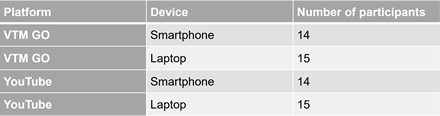
In total, 58 participants consumed self-selected videos in a natural setting, i.e. a living room, watching either VTM GO or YouTube on a smartphone or a laptop. The group was split as follows:
To track the eye movements, participants wore eye-tracking glasses, providing information on what, when, and for how long they watched. Participants were also equipped with a heart rate monitor, retrieving physiological data on how the viewers reacted to ad content. The measurements are an indicator of the stress level and hence the ad acceptance of the viewers. Lastly, to collect qualitative inputs, researchers surveyed the participants both directly after viewing and via e-mail three days later.
A higher level of attention
The importance of content quality was evident from the study’s results. While YouTube was more commonly consumed spontaneously, viewers decided in advance what to watch on VTM GO (72%) more often than on YouTube (52%). This aligned with the assessment on attention level, with VTM GO content capturing a higher level of attention (87%) compared to YouTube (78%).
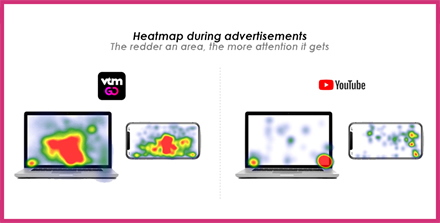
The difference between the two platforms was even starker for ad consumption. The eye-tracking analysis showed that advertisements attracted attention 66% of the time on VTM GO, over 60% more than on YouTube (41% of the time). On smartphones specifically, ad attention on VTM GO peaked at 74%. Furthermore, heat maps visualised how YouTube viewers remarkably often fixated their eyes on the ‘skip ad’ button, while participants watching VTM GO looked at the ad itself.
“Attention is necessary for the proper processing of advertisements. That processing is in turn essential for things such as ad recall, brand recall, and message recall, which in turn influence awareness, consideration, preference, and ultimately purchase intent. In other words, attention is equal to impact,” Bernd Strauven, Digital Researcher at DPG Media, says in a recent blog post outlining the key results of the study.
Ads accepted in a relaxed environment on VTM GO
The survey also confirmed the notion that viewers’ acceptance towards ads on BVOD platforms, such as VTM GO, is higher than on YouTube. Ads on VTM GO disturbed participants 47% less than ads on YouTube.
Results from the heart rate monitoring demonstrated much more relaxed viewing on VTM GO than on YouTube, both when viewing content and ads. In fact, ads on YouTube had a strong negative impact on participants’ stress levels, indicating increased irritation. The stress levels were 139% higher during YouTube ads than VTM GO ads. This irritation was further expressed by participants during the follow-up surveys, where some considered YouTube ads to be disturbing and that they always wait for the ‘skip ad’ button to appear.
TV content preferred over other
One of DPG Media’s key conclusions from the research is that advertising simply fits much better within a BVOD platform than other online video platforms. BVOD viewers seek long-form, high-quality content, often the very same that is available on linear TV. They thus expect ads and accept them, in the same manners as they do while watching linear. The relaxed, lean-back experience of TV is also extended to BVOD consumption, making the audience more receptive to advertising messages.
You can learn more about DPG Media’s research study here.
OTHER CASE STUDIES
AN IMMERSIVE CANAL+ BRAND SOLUTIONS COLLABORATION FOR SKIN-CARE BRANDS WITH SENSITIVE STORIES TO TELL
26. 6. 2026CANAL+ BRAND SOLUTIONS and its in-house studio LA FACTORY created “Marquer l’Invisible” for Avène, linking Cicalfate+…

M6 UNLIMITED TESTS AI SPOT CREATION FOR SMALLER TV AND STREAMING ADVERTISERS
22. 5. 2026M6 Unlimited is testing a simpler route into TV and streaming for SMEs and new advertisers…
THE TV ADVERTISING PARADOX, A THINKTV NEW ZEALAND CASE STUDY (2/2)
22. 5. 2026ThinkTV New Zealand built its campaign around the contradiction that linear TV was being called obsolete…

A BIG-SCREEN STUDY FINDS STRONGER ATTENTION ON TV4 PLAY THAN ON YOUTUBE
24. 4. 2026TV4 just launched its third attention study, comparing the viewing experience on its streaming service (TV4…
THE TV ADVERTISING PARADOX, A THINKTV NEW ZEALAND CASE STUDY (1/2)
24. 4. 2026In late 2024, ThinkTV New Zealand, under the leadership of Jacqueline Freeman, GM Communications, undertook a…
AD EMISSIONS MEASUREMENT: LESSONS FROM THE FINNISH MARKET
31. 3. 2026Finland’s commercial TV broadcasters spent the past year developing a carbon emissions measurement framework for linear…

A NEW WAY FOR FRANCETV PUBLICITÉ TO SELL CONTEXTUAL VIDEO ADVERTISING
27. 3. 2026FranceTV Publicité (FTP), the advertising sales house for French public television, has introduced Context.IA into its…
BUILDING A SHOPPABLE, ATTENTION-READY CTV OFFER: THE BIG BROTHER CONTEXTUAL CASE
26. 3. 2026In 2025, Paramount Australia, in partnership with FreeWheel and egta, hosted a webinar outlining a forward-looking…

GLOBO CREATES HOME SCREEN PROMINENCE FOR FREE-TO-AIR TV ON SMART TVS
26. 2. 2026Globo, Brazil’s largest commercial TV group, is rolling out DTV+, a next-generation free-to-air TV standard designed…
THE VISUAL TRANSFER EFFECT: HOW SOUND BUILDS BRANDS
24. 2. 2026In collaboration with neuro-marketing agency Unravel, Talpa Media has produced the scientific proof that audio does…

RMB TURNS QR CODE VOTING INTO A SHARED VIEWING MOMENT THAT STRENGTHS BRAND IMAGE FOR SPRITE AND DELI CHOC
24. 2. 2026Campaign objectives The chocolate snack Deli Choc and soft drink Sprite brands worked with RMB to…
CANADIAN SUPERSTAR ANDREW PHUNG HELPS VIA RAIL CHALLENGE CAR CONVENIENCE ASSUMPTIONS WITH LONG-FORM STORYTELLING ACROSS CBC’S TV ECOSYSTEM
24. 2. 2026Campaign objectives VIA Rail, the company operating Canada’s national passenger rail service, combined a new product…