

What you will find in the article:
- Building mental availability is a key strength of television.
- New data explores TV's short- and long-term marketing effects.
- Seven.One Media developed a model to analyze TV's short-term impact.
- Television can boost website traffic and sales performance effectively.
- Research shows TV advertising can lead to significant incremental revenue.
There is never any shortage of optimistic claims – and usually no shortage of people willing to challenge them. The same applies when TV advertising sales houses highlight the website traffic generated by linear television, or when an advertiser reports a 400% increase in search volume following a TV campaign. A common objection is that such growth may be attributable to a host of factors other than the TV campaign itself, that traffic is not the same as revenue, and that linear television cannot conclusively demonstrate its contribution to purchases made at the click of a button. From this perspective, lower-funnel performance metrics are primarily the domain of performance marketing.
There are, however, indications that television can be effective at this stage of the purchase journey too, including the Screenforce study ‘From TV-Screen to Action’. Direct evidence of the immediate impact of TV campaigns on e-commerce, however, is difficult to obtain. Seven.One Media has therefore developed a sophisticated model designed to provide greater insight into television’s short-term effects.
What television can achieve in the world of e-commerce
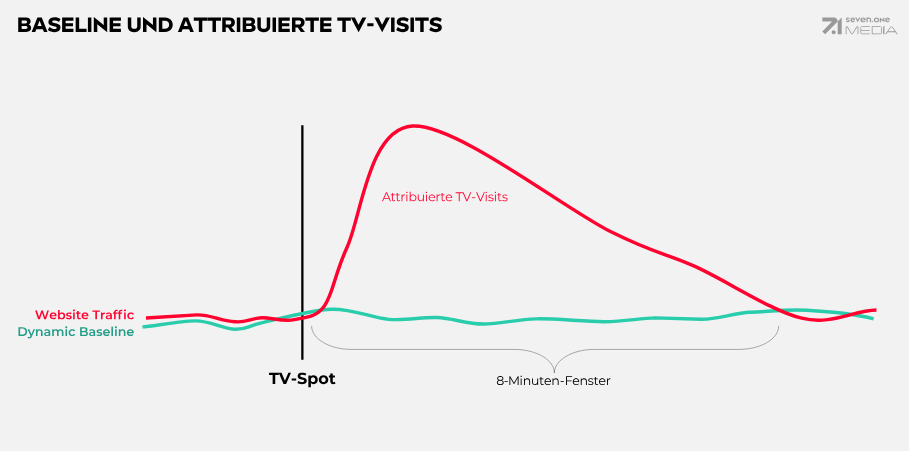
Seven.One’s MediaLytics tool uses advertisers’ raw data from Google Analytics and the BigQuery database to calculate a baseline – in other words, the level of traffic a particular website could be expected to receive in the absence of TV advertising. With each passing day and every additional data point, the estimate of this baseline becomes more accurate.
Once a TV commercial has aired, the probability that it prompted each website visit occurring within the following eight minutes can be calculated. The calculation is based on how far traffic deviates from the baseline. Marketing and media campaigns running outside linear television are already factored into that baseline. But why eight minutes?
Marco Kristl, Associate Director Brand Growth Strategy at Seven.One Entertainment Group, explains that the eight-minute window emerged gradually over ten years of further development of the tool. This is roughly how long it takes for television’s very short-term effect on website traffic to dissipate and for the attribution curve to converge with the baseline again.
Of course, a visit to a website does not necessarily mean that someone will go on to place an order. To demonstrate television’s impact on other performance metrics as well, the analysis therefore tracks whether the visitors identified in the first step subsequently make a purchase on the site.
Using Google Analytics, orders can be tracked via device identifiers. ‘Each visit is assigned a probability of having been prompted by television,’ explains Marco Kristl. According to Kristl, orders can be traced for up to two weeks after a TV commercial has aired. ‘So we know the probability that an order placed during that period was initiated by television.’
Short-term impact on sales
Is that not a great deal of effort to prove something that is not even regarded as one of television’s principal strengths? For years, the emphasis has been primarily on television’s long-term impact and on the fact that its broad reach allows it to connect with people who are not currently in the market. Then, when the time to buy approaches, the brand comes back to mind – because television has been building its mental availability in the meantime.
And what about all the marketing experts, from Les Binet and Byron Sharp to Jenni Romaniuk, who have placed this mechanism at the heart of their research?
‘All of that still holds true,’ stresses Seven.One Managing Director Guido Modenbach. ‘Television builds mental availability among people who are not currently in the market. At the same time, however, its broad reach means it can also provide a short-term boost to sales.’ In his view, linear television can make a significant contribution to sales performance.
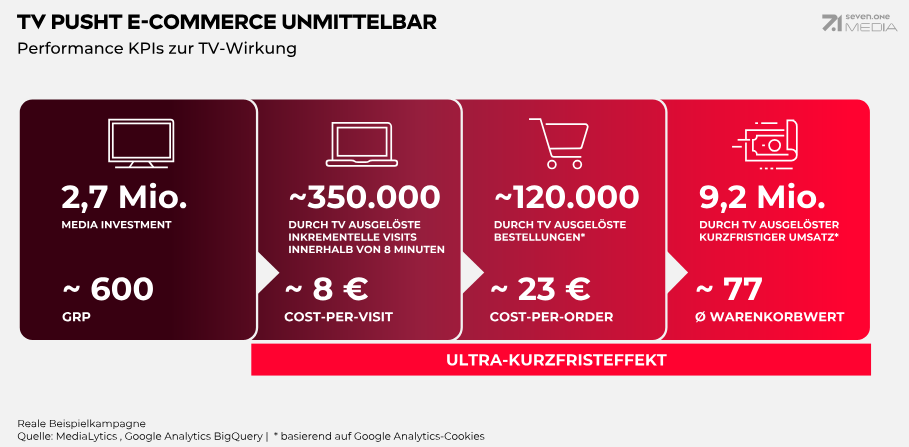
The researchers calculated the activation effect and resulting revenue using a real-world example. In a TV campaign that ran for several weeks, an FMCG client invested a total of €2.7 million in advertising across ProSieben.Sat1 Group channels. This represented approximately 600 GRPs within the campaign’s planning target audience.
Using the approach described above, the researchers were able to identify 350,000 incremental website visits within eight minutes of the commercials airing. This equated to a cost of €8 per visit.
Those visits subsequently led to orders – some immediately, within the eight-minute window, and others during the following two weeks. Using stored user identifiers, these subsequent orders can be attributed to individual purchasers.
Approximately 120,000 orders triggered by TV advertising generated €9.2 million in short-term incremental revenue, at a cost of €23 per order. The average basket value was €77, 10% higher than the average basket value across all customers during the period analysed.
According to Gerald Neumüller, Head of Research at Seven.One Entertainment Group, television’s role at the bottom of the marketing funnel is ‘definitely underestimated’. ‘Television can hold its own in the world of performance metrics too,’ he concludes.
And this is only the medium’s short-term activation effect – its immediate impact on sales among people who are actively considering a purchase at that particular moment. The proportion of all potential customers who fall into this category can vary significantly depending on the product category. Professor John Dawes of the Ehrenberg-Bass Institute, for example, formulated the 95:5 rule for a product with a five-year purchase cycle, where only five per cent of the target audience is in-market at any given time. For products with shorter purchase cycles, the ratio changes accordingly.
Television can therefore reach people who are not currently in-market by building mental availability at the top of the marketing funnel, while at the bottom of the funnel it can prompt those who are already actively searching and weighing up their options to make a purchase.
The argument itself is not new. It is only the continued development of analytical tools such as MediaLytics, however, that has made it possible to demonstrate the short-term incremental revenue generated by TV advertising and to examine its performance metrics in greater detail.
In doing so, linear television is harnessing a mechanism familiar from online and streaming environments, across multiple devices. An advertising break is shown on television while, either simultaneously or shortly afterwards, viewers make purchases online. Until now, this effect has been visible primarily in spikes in traffic to the relevant websites. Modern measurement methods, however, now make it possible to track the immediate impact on sales as well.
‘Television works at both ends of the marketing funnel,’ says Seven.One’s Modenbach. In recent years, he says, this has also been recognised by a number of brands that are primarily focused on online channels.
The Australian team led by Byron Sharp at the Ehrenberg-Bass Institute described this relationship years ago, distinguishing between mental and physical availability. Advertising builds mental availability by creating and refreshing memory structures, while targeting represents physical availability: a brand needs to be as easy as possible to access in potential buying situations.
‘Targeting people who are about to buy is physical availability,’ Sharp recently wrote in a LinkedIn post. In his view, it is wrong to describe this type of activity as advertising, and the budget for it should not be ‘stolen’ from traditional advertising expenditure. That investment is needed to build mental availability among the majority of potential customers.
Ultimately, advertising has one overriding job: to sell. The money invested needs to find its way back into advertisers’ coffers and, ideally, generate considerably more than was originally spent. This is where return on investment comes in – a measure of efficiency that has been debated within the industry for decades. At the heart of this debate are a number of misconceptions that have long been fuelled by the shift of marketing budgets towards online media and that marketing experts such as Les Binet, former Head of Effectiveness at London advertising agency Adam&Eve DDB, have consistently sought to correct.
The crucial point is this: return on investment tells us about the efficiency of advertising, not the scale of its impact. Or, as Les Binet puts it: ‘If you invest nothing, you can increase your return on investment almost indefinitely.’ Return on investment is a ratio – it expresses the contribution media make to revenue relative to the amount spent. A small campaign with a high return on investment may generate substantially less money than a larger campaign with a lower return on investment. To assess the true contribution of individual media channels, it is therefore also necessary to consider the absolute amount of incremental revenue generated by the campaign.
How television performs in revenue models
Sophisticated data models, such as those developed by Omnicom company bynd, provide a detailed view of the broad range of factors that influence results.
Put simply, data analysts select a target variable, such as the revenue generated by a particular product or product group, and use statistical methods to determine which factors influence it. Alongside media activity, these may include pricing, sales promotions, competitor activity and seasonal effects.
A recent meta-analysis by bynd shows the average amount of incremental revenue generated by television. It is based on 279 models from sectors outside FMCG and 382 models from the FMCG sector.
The findings show that television generates the highest profit compared with other media. Prof. Dr Alexander Preuß, Managing Partner at bynd, explains: ‘We can see not only that the volume of revenue television helps to generate remains stable, but also that return on investment remains stable over time.’
According to Preuß, the findings run counter to the widespread belief that TV advertising is becoming less effective. Preuß, who heads the Success Measurement division and is also Professor of Statistics and Research Methods at Hochschule Fresenius, adds: ‘We have robust evidence that the effectiveness of TV advertising remains stable.’
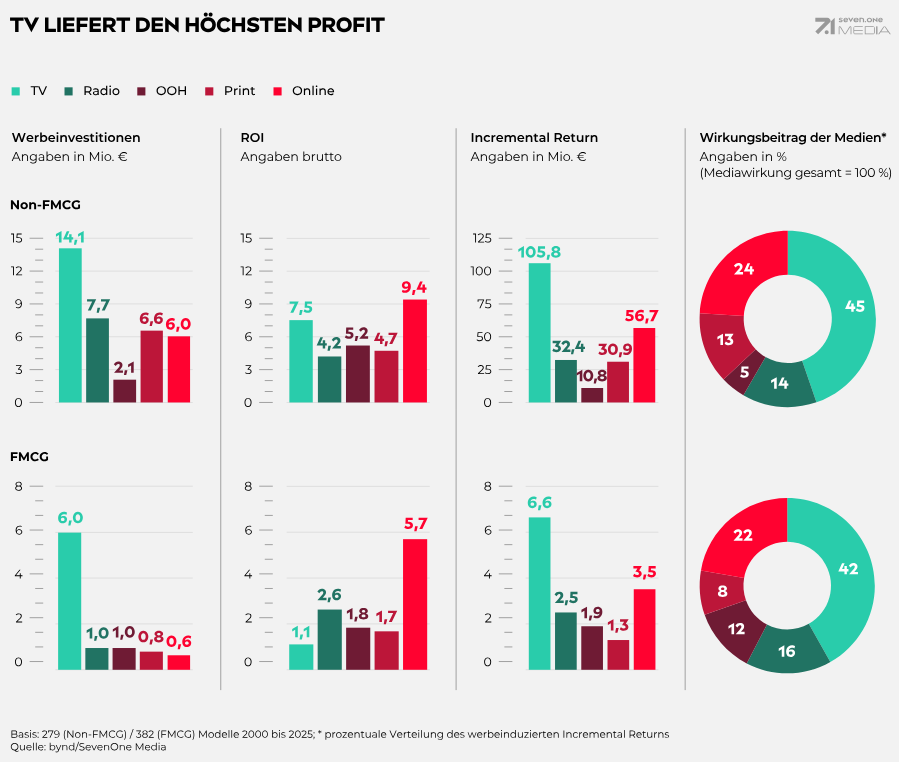
And according to Seven.One’s Gerald Neumüller, this does not apply only to analyses of individual five-year periods. ‘Over the past two years, the figure has actually been slightly above average. This confirms the medium’s consistently high level of effectiveness.’
But how does that square with the fact that television reach has been declining for years, particularly among younger target audiences?
Prof. Dr Preuß acknowledges that it is no secret that younger audiences are harder to reach today than they were a few years ago. But that does not by any means imply that advertising itself is becoming less effective among younger target groups. ‘At present, we have no indicator suggesting that the impact per contact or per GRP is weakening.’
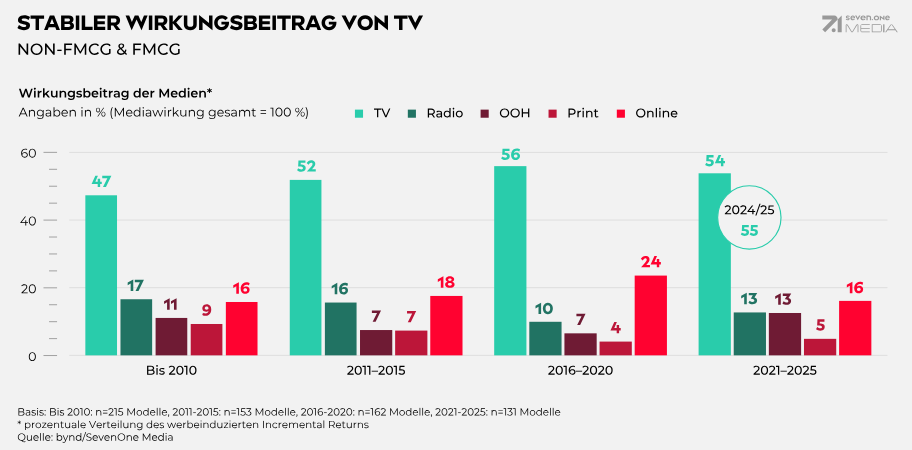
As the modelling expert points out, advertising effectiveness is, of course, always the result of media-mix strategies, which have become considerably more sophisticated over recent decades. While print has lost some of its effectiveness over the years, other media have benefited from this evolution – most notably digital channels.
Advertising weight and campaign timing are managed differently today than they were twenty years ago, and greater emphasis is also placed on continuity. Television, however, has maintained its importance for decades in terms of its contribution to overall advertising effectiveness. ‘There is no reason to assume that this will change fundamentally in the foreseeable future.’
DOWNLOAD: OUT OF THE BOX – HOW TELEVISION DRIVES SALES (PDF, 537 kB)
DOWNLOAD: ENGLISH VERSION OF OUT OF THE BOX – HOW TV ADVERTISING PROVES ITS IMPACT (PDF, 446 kB)
Source: seven.one