

What you will find in the article:
- Brand loyalty does not lead to increased purchasing behaviour.
- What matters more is mental availability and the brand’s distinctive features.
- Most customers do not love brands, but they trust them.
- Brands act as mental shortcuts to simplify decision-making.
- A brand’s success lies in expanding its reach and the number of buyers.
Brand love is not the key to a brand’s growth. It is more important that customers are able to recall thebrand in as many purchasing situations as possible and recognise it quickly. Rachel Kennedy from the Ehrenberg-Bass Institute for Marketing Science spoke about this in her presentation at Thursday’s Brand Management conference. She drew, amongst other things , on a study led by Jordan White, which examined consumers’ relationships with brands.
The research involved around 5,000 American shoppers, 165 brands and categories in which consumers are expected to have an above-average attachment to brands. These included, for example, luxury goods, running shoes, cars, soft drinks and iPhones. The study therefore tested ‘brand love’ in an environment designed to be as favourable as possible.
Customers do not love brands. They express trust more
The results showed that approximately four in ten shoppers in a given category describe at least one brand as one they love. However, the proportion is significantly lower for individual brands. Roughly 80 to 90 per cent of shoppers do not consider most of the brands they buy in a given category to be ‘loved’. ‘Most shoppers do not love most of the brands they buy. Full stop. And they don’t need to either,’ she summarised.
Differences are also evident between individual categories. In the banking sector, for example, around three per cent of customers describe their bank as ‘loved’. However, seven times as many people are willing to say that they trust it. “People are seven times more likely to say they trust their bank than to say they love it,” she added.
According to the data presented, people who describe a brand as ‘loved’ are more likely to recommend it and are more likely to intend to buy it again. However, their actual purchasing behaviour does not differ significantly. They also buy competing brands, in a similarly predictable manner to other buyers.
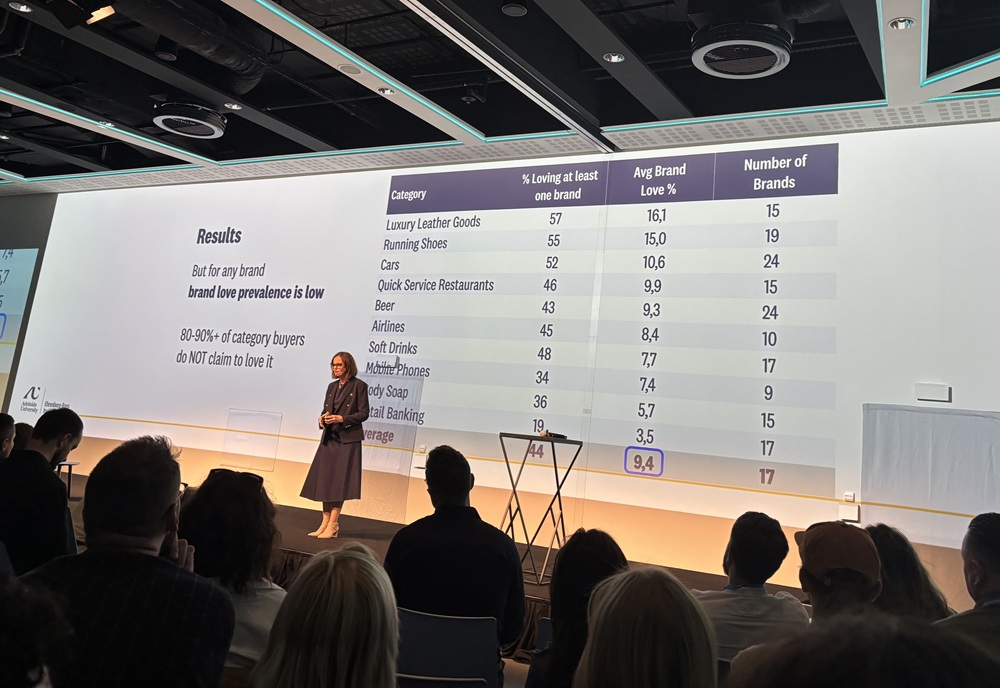 80 to 90 per cent of customers do not describe brands in a given category as ‘beloved’; Source: Rachel Kennedy on Brand Management. Photo: MediaGuru.cz
Brands as mental shortcuts
According to the Ehrenberg-Bass Institute, there is therefore no need to base a growth strategy on the aim of creating a deep emotional connection to a brand. What is more important is mental availability – that is, the likelihood that a person will recall a brand or notice it in a specific shopping situation. “If I were your CEO or CFO, I would not approve any investment in brand activation that is justified by an attempt to deepen emotional impact,” she told the Prague audience.
Kennedy pointed out, however, that mental availability is not the same as brand awareness or being‘top of mind’. Memory functions depending on the situation and context. Furthermore, consumers do not have a single fixed list of brands that they consider across an entire category. For example, when deciding on a mortgage, most people may only consider one or two brands. This approach is based on the assumption that, when shopping, people do not want to pay more attention to brands than is necessary. Brands therefore act as mental shortcuts that simplify decision-making. “Shoppers are cognitive misers. If they can avoid thinking, they will.”
So-called ‘category entry points’are linked to mental availability. These are situations, needs or thoughts that lead a person into a particular shopping category. They might include, for example, looking for a present, wanting to make one’s children happy, or treating oneself. According to Rachel Kennedy, it is not possible to ‘own’ these entry points. However, a brand can be associated with as wide a range as possible of situations in which people shop within that category.
The difference between large and smaller brands lies, amongst other things, in the scope of these associations. A brand with 66 per cent penetration may be associated with more than a dozen entry points by 64 per cent of its shoppers. Conversely, for a brand with 11 per cent penetration, nearly four in ten shoppers do not associate it with any entry point. “Big brands win. More people know them, and they’re known for more things. That’s a measure of success, not brand love,” she added.
 Penetration as a sustainable path to brand growth; Source: Rachel Kennedy’s presentation at Brand Management 2026. Photo: MediaGuru.cz
Distinctive elements help consumers recognise a brand quickly
The next part of the presentation focused on a brand’s distinctive elements, which enable communication to be unequivocally linked to the brand rather than to the competition. Distinctive elements can be visual – such as a characteristic packaging shape, typography or a mascot – but they can also be auditory or olfactory. Their significance lies in the speed with which the brand is recognised and the ability to use them across various messages and media. At the same time, they can help the brand stand out at the point of purchase. The task of marketers is to protect existing distinctive elements whilst also developing new ones. However, a distinctive element on its own is not enough. For a connection with the brand to form in people’s minds, the communication must also be interesting enough for people to pay attention to it and remember it.
The framework presented at the conference bases brand growth primarily on attracting a larger number of buyers and on expanding both mental and physical accessibility. The more people who are familiar with a brand and can associate it with a wider range of purchasing situations, the more opportunities the brand has to be considered and purchased.
Rachel Kennedy also questioned certain traditional marketing concepts, such as ‘top of mind’, segmentation, targeting and positioning, when used as the primary explanation for how human memory and brand growth work. She describes this as a more complex process.
Her closing message to marketers focused on the difference between their perspective and that of ordinary shoppers. Marketing professionals pay considerably more attention to brands than consumers do. It is precisely this fact that marketers should take into account when making decisions and look at the brand more from the perspective of someone who only considers it when faced with a specific purchasing need. “Marketers think about brands far more than ordinary consumers. It is therefore easy to lose the ability to see the world through the eyes of the people who buy the brands. Accept that you are a bit odd in this respect, and do not forget that buyers think differently from marketing professionals,” she concluded.
Source: mediaguru.cz