
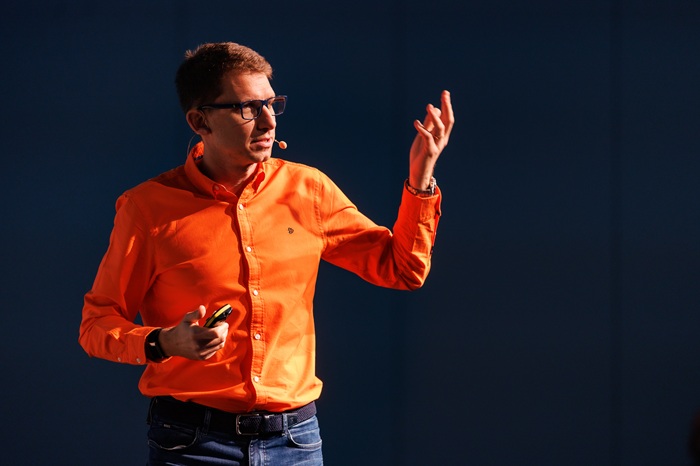
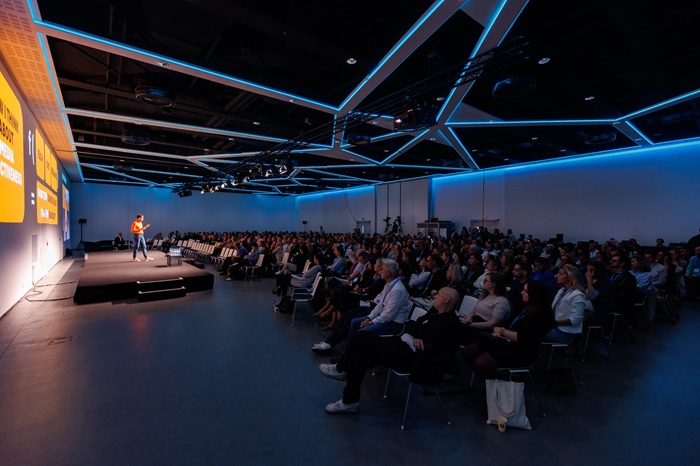
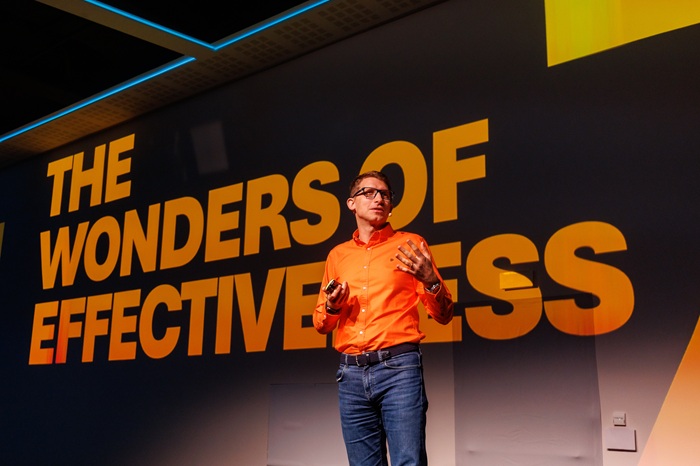
Sorin Patilinet, author of the new book Marketing Effectiveness and a global marketing practitioner, spoke at the Brand Management 2025 conference. In his presentation, he compared brand-building to an engineering achievement which, like the structures classified as the Seven Wonders of the World, stands the test of time. He therefore identified seven key pillars—the “seven wonders of effectiveness”: strategy, product, price, distribution, media, creativity and measurement. Each of these pillars plays a crucial role in a brand’s long-term growth.
When discussing products, he highlighted not only functionality but also innovation and attractive design. Price must reflect value, while retail serves as a place of both discovery and conversion and can provide a brand with a rapid springboard for growth. He also placed considerable emphasis on media and on maintaining a balance between short-term sales and the long-term development of brand value. He described creativity as the engine of emotion and memorability, while measurement is equally important.
He concluded with three practical recommendations: adapt effectiveness methods to the company’s decision-making culture, remain consistent in research and use internal competition as a source of motivation.
Following his presentation, Sorin Patilinet gave us an interview, which you can read below.
Let us start at the beginning. How would you describe marketing effectiveness? What does marketing effectiveness actually mean?
Marketing effectiveness is an algorithm that allows you to establish a direct connection between the inputs you put into a marketing plan and the expected outputs. Those outputs differ depending on the organisation and its business model. Some companies measure effectiveness in terms of return on investment, or ROI, or its impact on sales. Others may use the number of app installations or the company’s share price. Every company therefore has different success metrics, but the essence of marketing effectiveness always lies in understanding the relationship between what you put into marketing and what you get out of it.
Can marketing effectiveness change over time? For example, could something that was effective 20 years ago no longer be effective today?
No, the essence has not changed. Twenty years ago, the objective was still to turn consumers into customers, increase penetration and expand distribution. Viewed holistically, marketing effectiveness remains the same. Only the tools and methods we use to achieve that effect have changed, because channels have evolved in response to changes in consumer behaviour. The objectives, however, remain the same.
If a company sets itself the objective of clearing its inventory and succeeds by significantly reducing the product’s price, does that count as marketing effectiveness?
No, that is inventory efficiency. Marketing effectiveness is the combination of all the elements that collectively contribute to marketing success. The performance of any established brand must be evaluated as a whole. Reducing the price may work in the short term, but it can diminish the brand’s value and long-term potential.

You have written a book entitled Marketing Effectiveness, which was published recently. What is its central idea?
I examined the information available to the marketing industry for decision-making. I found that most sources come from academics, agencies and research companies. Very few brands genuinely open up and show how they operate in practice.
I conducted numerous interviews with academics, who told me that academic rigour was the most important consideration when researching marketing effectiveness. They do not consider how much it costs or whether the study can be replicated. Brands, however, have completely different objectives. In the book, I therefore draw on my experience of marketing effectiveness and offer a practical perspective on issues that are frequently discussed. I also want to move the conversation beyond advertising effectiveness alone, as that tends to dominate the discussion. We should also be talking about the effectiveness of pricing, products, the overall strategy and other elements of marketing. The industry narrative often focuses solely on “how to improve this advertisement”. But advertising is only one small part of the marketing mix, not the bulk of it.
Even so, I would like to stay with advertising for a moment. In your view, what distinguishes good advertising campaigns from genuinely effective ones?
For most established brands, advertising accounts for approximately 0–15% of sales in the short term, but this effect roughly doubles over the long term. Overall, advertising may therefore account for about one-third of a brand’s long-term impact. Other factors, such as product availability, the core proposition and packaging, have a greater influence. What I like about communications and advertising is that they are the only tools that build a brand over the long term. Everything else we do, such as promotions or discounts, tends to address a short-term problem rather than build the brand. The reason we have major brands such as Pepsi, Lay’s and Snickers today is that they invested in advertising in the past.
To return to the question of what distinguishes good campaigns from genuinely effective ones, there is no single formula. During my time at Mars, we measured more than 4,000 campaigns and found no universal model. The objective was to ensure that measurement did not restrict creativity. Nevertheless, certain principles do recur. One is attracting attention. We can see that the amount of time available to capture attention is continually shrinking, as people increasingly prefer short-form content. It is therefore important to “fill” communications with attention-grabbing moments: familiar situations, sounds and easily recognisable music. Emotion is also important. Academic studies confirm that emotional advertising performs better than product-focused advertising. It is also helpful to simplify the outputs so that customers can understand them easily.
The industry narrative often focuses solely on “how to improve this advertisement”. But advertising is only one small part of the marketing mix, not the bulk of it.
Sorin Patilinet
In your view, how successful are brands today at applying marketing effectiveness?
Naturally, there are brands that do it extremely well. Nevertheless, we still often think it is enough to take a television advertisement and “convert” it into digital content. This approach should be completely reversed. We should develop content primarily for short-form formats and only then use it to create longer-form material. We are still in love with long stories because they look attractive, but people do not actually watch them. If we observed our own behaviour when using our phones and interacting with advertising, we would write better briefs and focus on better ideas.
This brings us to the question of how effectiveness should be evaluated. Which tools are most suitable for measuring marketing effectiveness?
The best tools are those that track customer behaviour and their responses to advertising exposure. For example, you want to know whether a particular advertisement attracted more attention than another, whether it generated positive emotions or whether it was easy to understand.
Today, there are many tools available for evaluating objectives of this kind. Even in the Czech Republic, I see companies drawing on neuroscience and attention measurement, allowing them to conduct smarter campaign pre-testing and increase the likelihood of success. During the campaign, you can monitor various signals showing whether the campaign is working—for example, by comparing its performance with historical benchmarks. For me, however, the main objective is always to connect these measurements with sales and transactions—in other words, with genuine business outcomes. When it comes to measurement, I consider understanding consumers’ actual behaviour more important than understanding what they say they do. That is why I do not use self-reported surveys. Of course, there are still situations in which people are asked questions, such as in ethnographic, exploratory or primary research.
We often think it is enough to take a television advertisement and “convert” it into digital content. This approach should be completely reversed.
Sorin Patilinet
What advice would you give companies seeking to build a culture of marketing effectiveness? What should they focus on above all?
I think the first step is to develop a thorough understanding of the effect you want to track and ensure that all key stakeholders within the company—from the CFO to the CEO—agree on it. Effectiveness metrics might include brand equity, revenue or dividends, for example, but all must speak the same “language of outcomes”.
The second key element is senior leadership support. The measurement method requires consistency, and without leadership support you will focus on the wrong things.
The third area, which I also emphasised in my conference presentation, is consistent measurement. Do not change your method simply because you are tired of it or find it boring. Similarly, we should not change creative concepts merely because we have grown “tired” of the previous campaign.
A culture of effectiveness also involves competition and team motivation—for example, through internal competitions or awards for the best results. Culture cannot be built through PowerPoint presentations alone. People must talk about it and share their results.
For companies focusing on fast-moving consumer goods and investing heavily in media advertising, it may be more difficult to combine the short- and long-term effects of communications. How should they approach this?
It is true that sales are important to these companies, but they also have to consider the brand’s long-term development. Various levers influence long-term brand value, including communications, brand-building and advertising. On the other hand, there are tactics that generate a short-term response, such as promotions, discounts or product innovations designed to attract retailers’ interest. Whether a company focuses more on short-term or long-term effects depends on how it allocates investment between these areas. Major advertisers, however, never turn their backs on long-term growth and always invest in brand-building.
Major advertisers never turn their backs on long-term growth and always invest in brand-building.
Sorin Patilinet
In your presentation, you used the Seven Wonders of the World to illustrate the key elements of marketing effectiveness. How can these elements be integrated?
I used the Seven Wonders as a metaphor to show that we should think beyond advertising and take a broader view of marketing. Some experts refer to this as the traditional four Ps: product, price, place and promotion. It is a holistic approach to marketing effectiveness. We should not focus solely on whether a single advertisement works and then discard the entire marketing plan if it does not. Many factors contribute to marketing success, and simply discussing those factors gives a company a better starting point.
Sorin Patilinet
Marketing strategist, engineer and author. He currently works with PepsiCo’s global marketing teams and previously led global marketing research at Mars. He is the author of Marketing Effectiveness: Applying Marketing Science for Brand Growth and regularly teaches MBA students at the Wharton School. He also contributes to Marketing Week and advises leaders at organisations ranging from start-ups to global corporations on how to make their marketing smarter and more effective.
Source: mediaguru.cz