

The webinar, led by Andrew Tindall of System1 and Mark Ritson, founder of the well-known MiniMBA in Marketing course, delivered a clear warning: “Advertising has never done less.” Although global advertising spend has risen by 30% over the past decade, research combining a database of more than a thousand Effie Worldwide case studies with System1’s extensive consumer response data shows that advertising is becoming increasingly less capable of building brands and generating long-term growth.
 Source: The Creative Dividend 2025 webinar
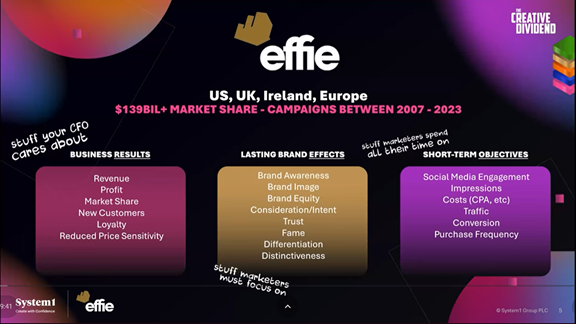
At the centre of experts’ attention are, on the one hand, the commercial outcomes of marketing, such as revenue, profit, market share gain, new customers, loyalty and reduced price sensitivity. On the other hand, there are effects — both long-term ones, such as brand awareness, distinctiveness, image, brand equity, and differentiation, and short-term ones, such as engagement, traffic, conversions and impressions.
 Source: The Creative Dividend 2025 webinar
The truth is that today, we are seeing more and more advertising. The number of ads has doubled, while our attention has remained the same. As a result, our attention is becoming increasingly fragmented. In a way, this is also due to the shift towards digital media, which continues to grow.
 Source: The Creative Dividend 2025 webinar
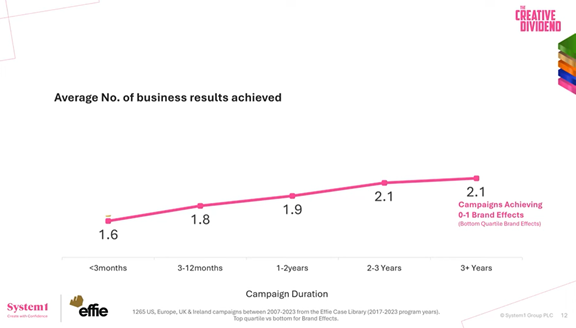
Digital media have introduced something new: the measurement of advertising in days, hours and minutes, enabling marketers to focus on short-term results. They are spending more and more on advertising but neglecting brand building in the process. They may be asking themselves whether brand building is even necessary at all. As the chart below shows, even campaigns that do not build the brand deliver good business results.
 Source: Creative Dividend 2025 webinar
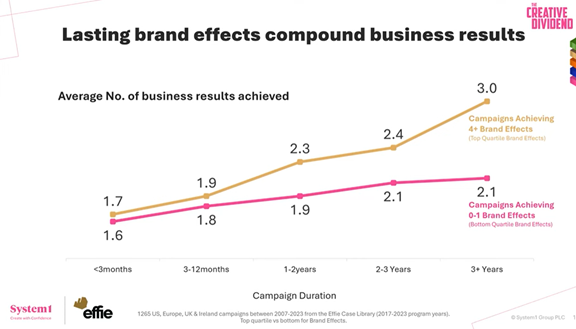
However, brand-building campaigns — campaigns that, even in this age of efficiency, are able to create awareness and support trust, salience, differentiation, and distinctiveness — actually deliver a far greater effect.
 Source: The Creative Dividend 2025 webinar
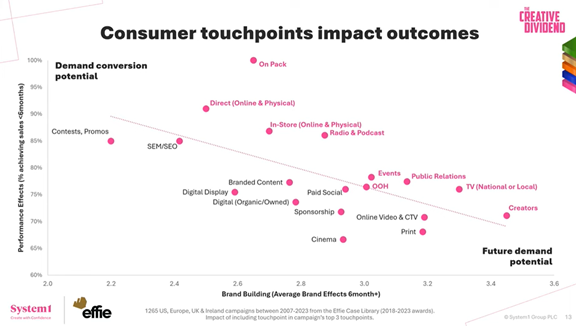
Naturally, various touchpoints also contribute to a stronger brand effect.
 Source: The Creative Dividend 2025 webinar
The chart shows that television is certainly not dead — quite the opposite. It has strong potential for long-term brand building. According to Tindall, traditional channels such as radio, direct mail, post, television and PR still work very well even in today’s digital era of efficiency.
However, the research revealed a fairly alarming finding: advertising has become less emotional. Whereas in the past it was able to evoke strong feelings, tell stories and allow consumers to “be entertained by a brand”, today’s ads more often limit themselves to rational sales arguments. It’s like the difference between a theatre performance and a PowerPoint presentation. One draws you in, the other sends you to sleep, Tindall remarked aptly.
Mark Ritson’s three pillars of effective advertising
Mark Ritson then built on Tindall’s findings, focusing on three key factors: emotion, distinctiveness and consistency.
At the outset, he asked what makes one ad 12 times more effective than another, referring to Paul Dyson’s model, according to which the quality of the creative work has the second-biggest impact on advertising profitability, immediately after the brand’s size.
1. Emotion: The consumer has to feel something
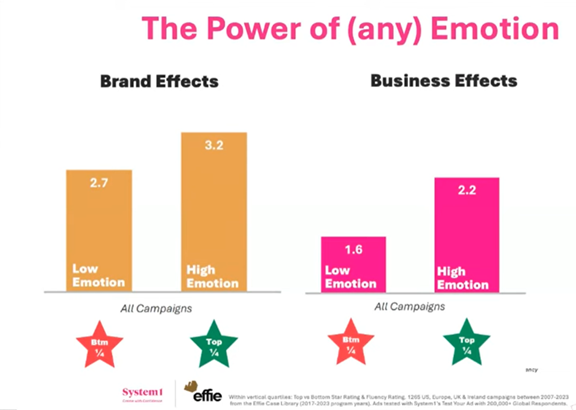
According to Ritson, emotion is “the biggest lever of effectiveness we have at our disposal”. Ads that trigger a strong emotional response — whether positive or negative — are more likely to lead to brand growth and better commercial results. “Let’s make the consumer feel something. Anything. Make him feel anxious, make him feel proud, make him feel revolted for a while,” he said. System1 data confirms that the worst kind of advertising is advertising that is boring and average. Emotion creates memory traces and strengthens associations with the brand. In the long term, positive emotions pay off the most, creating a lasting favourable impression and influencing consumers’ future decision-making.
As an example of a highly emotional ad, Ritson cited Bellagio’s spot entitled This Is the Life:
Video: Bellagio – This Is the Life
The research clearly showed that more emotional ads account for a significantly higher share of brand effect.
 Source: The Creative Dividend 2025 webinar
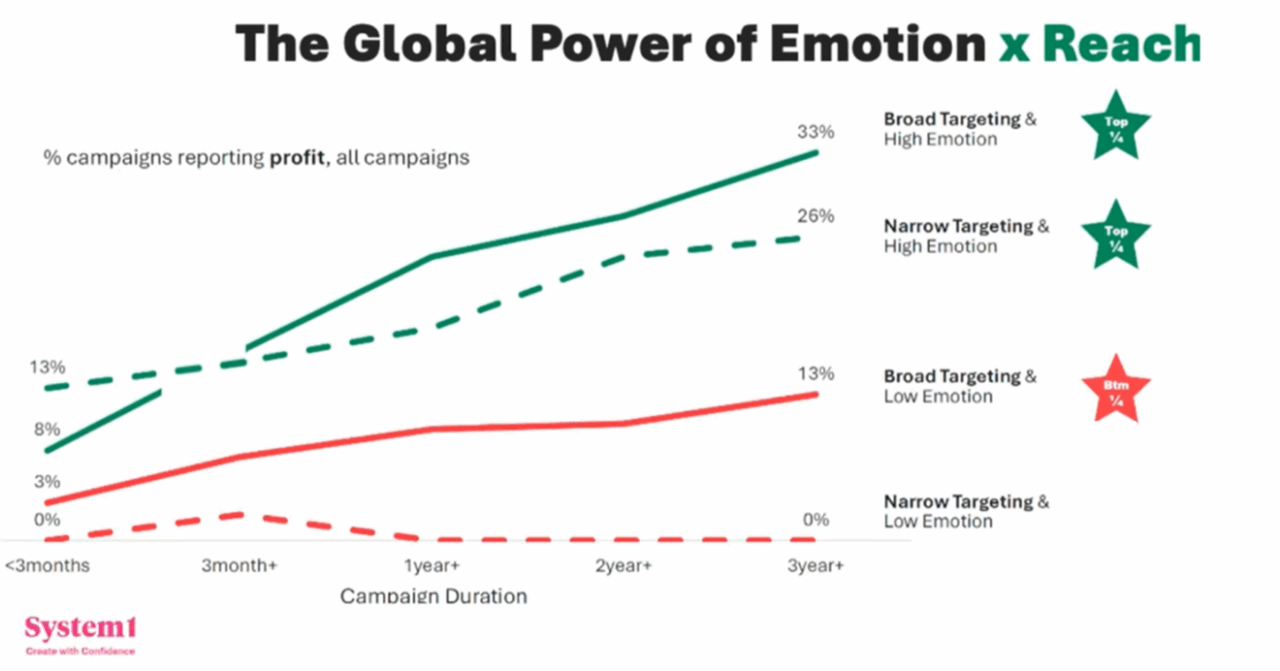
Another interesting finding is that broadly targeted ads with lower emotional intensity come nowhere near achieving the same results as highly emotional ads with narrow targeting. According to Ritson, brands that want to maximise emotional charge and impact should adopt a sophisticated mass-marketing approach amplified by a high emotional charge, which is clearly the best option.
 Source: The Creative Dividend 2025 webinar
2. Distinctiveness: Do customers know which brand the ad relates to?
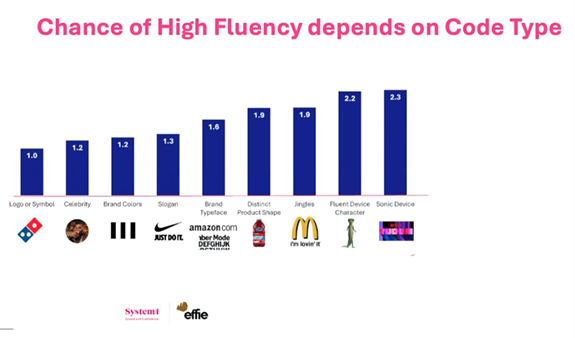
Strong emotion is not enough if the viewer does not remember which brand the advertisement was for. This is where the concept of fluency comes into play — the brand’s ability to be instantly recognisable through visual, audio or linguistic elements, known as brand codes. Different brand codes have varying levels of influence on distinctiveness.
 Source: The Creative Dividend 2025 webinar
System1 examined 12,000 ads and found that, in order to achieve high distinctiveness, a spot needs to feature seven distinctive brand assets — such as a logo, colours, slogan, product shape, musical motif, character or specific audio cue. As an example of a brand that really knows what it is doing in this respect, Ritson cited Twix.
Once again, it generates a pleasant emotional response, but unlike the Bellagio ad mentioned above, it also demonstrates a high level of distinctiveness.
3. Time: We have been baking our cakes not long enough
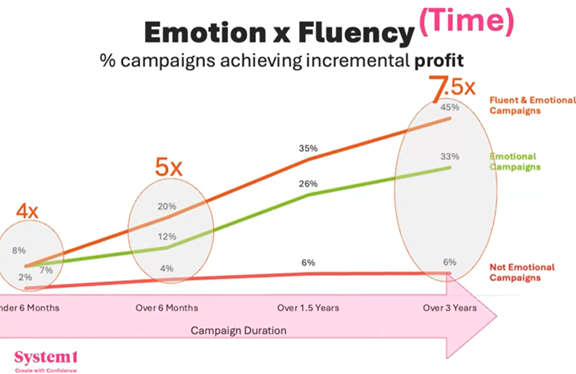
The third variable is campaign duration. According to the data, ads that remain in the market for more than three years deliver 7.5 times greater impact than those that run for only a few months. Ritson criticises marketers for lacking patience. “They are obsessed with change,” he said. “The minute most companies have created their advertising, they are starting to think about how they’re going to change it, how they are going to beat it and what they’re going to do next,” he explained. He pointed out that consistency — the same theme, the same symbols, the same story — creates “compound creativity”, which accumulates over time.
 Source: Creative Dividend 2025 webinar
A prime example is KitKat, whose slogan “Have a break, have a KitKat” has been used for more than half a century and has turned the advertising itself into a cultural motif.
Video: Don’t let life’s interruptions get in the way. Have a quality break with KitKat®
Traditional media still at the forefront
Although the market is currently dominated by digital, data from The Creative Dividend research confirms that television, radio, outdoor, and PR remain the most effective channels for long-term brand building.
According to the speakers, the greatest enemies of brands are boredom and impatience.
The conclusion? Creativity is not magic. It is a discipline. Brands that can evoke emotion, ensure their distinctiveness and give their advertising time are certain to succeed with consumers.
The comprehensive research can be downloaded here.
Source: The Creative Dividend 2025 webinar.