

The aim of the TV Now and Next report, produced under the auspices of Thinkbox, was to understand how video viewing has changed in recent years and what impact these changes are having on the media ecosystem. It focuses primarily on three key questions: what is happening to the volume of video viewing, what type of content people are actually consuming, and what these changes mean for viewers’ exposure to advertising. The authors of the study, Anthony Jones, Head of Research at Thinkbox, and Nailah Uddin, Research Manager, focused on the development of viewing behaviour and its implications for the effectiveness and role of television advertising today and in the near future. The data presented is based on a combination of several research sources examining video content viewing among the adult population in the United Kingdom.
A decade of sweeping change
Over the past ten years, the way people watch video has been shaped by a wave of change. Around 2015, viewing was still dominated primarily by traditional television, supplemented by VOD services, which together accounted for most of the time spent watching video. Total daily viewing time stood at approximately four hours per viewer. Over time, however, the share of online video content increased. In addition to the growth of platforms such as YouTube, short-form video, represented by TikTok, has also begun to gain ground. Cinema viewing, by contrast, remained at a very low level throughout the period. Total TV — traditional television together with streaming services — maintained its dominant position throughout, accounting for the largest share of viewing time.
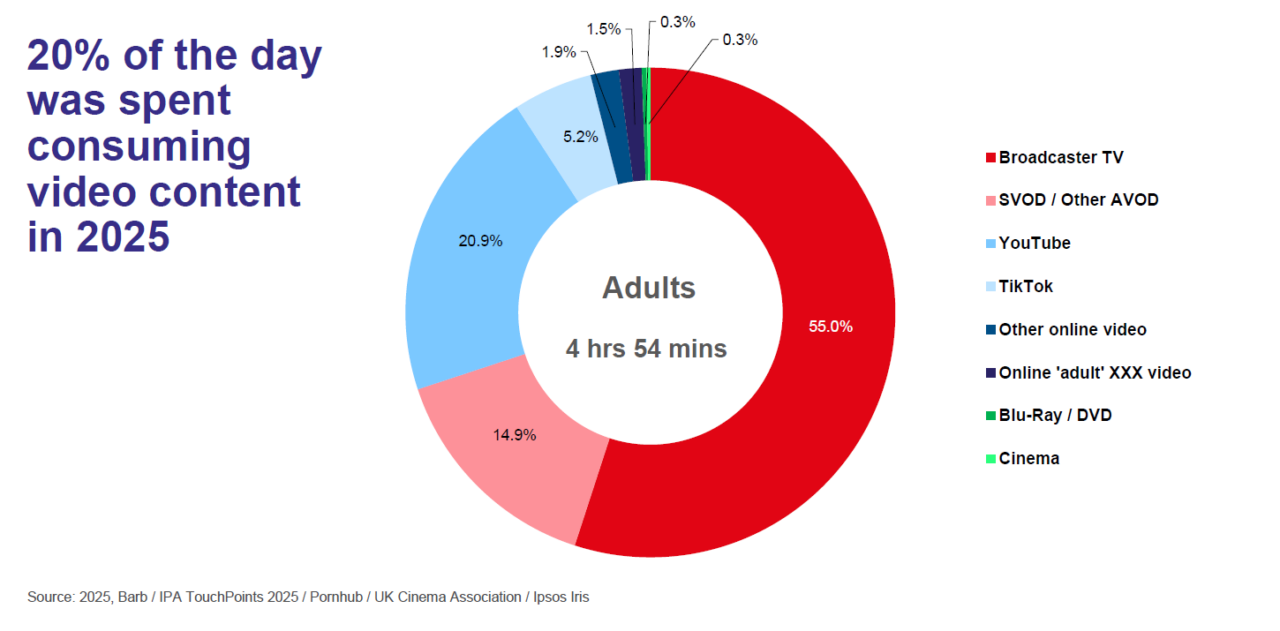
In 2025, people spent an average of 4 hours and 54 minutes a day consuming video content, representing approximately 20% of the day.
 Source: Thinkbox.tv
Of this, approximately 70% is accounted for by so-called Total TV — a combination of traditional television broadcasting and streaming services. YouTube takes second place, representing roughly one fifth of total viewing, followed at a considerable distance by TikTok, whose share remains in the low single digits. The rest of the viewing is made up of other forms of online video and marginal channels, which now account for only a minimal share.
Stable dominance of television despite the growth of new formats
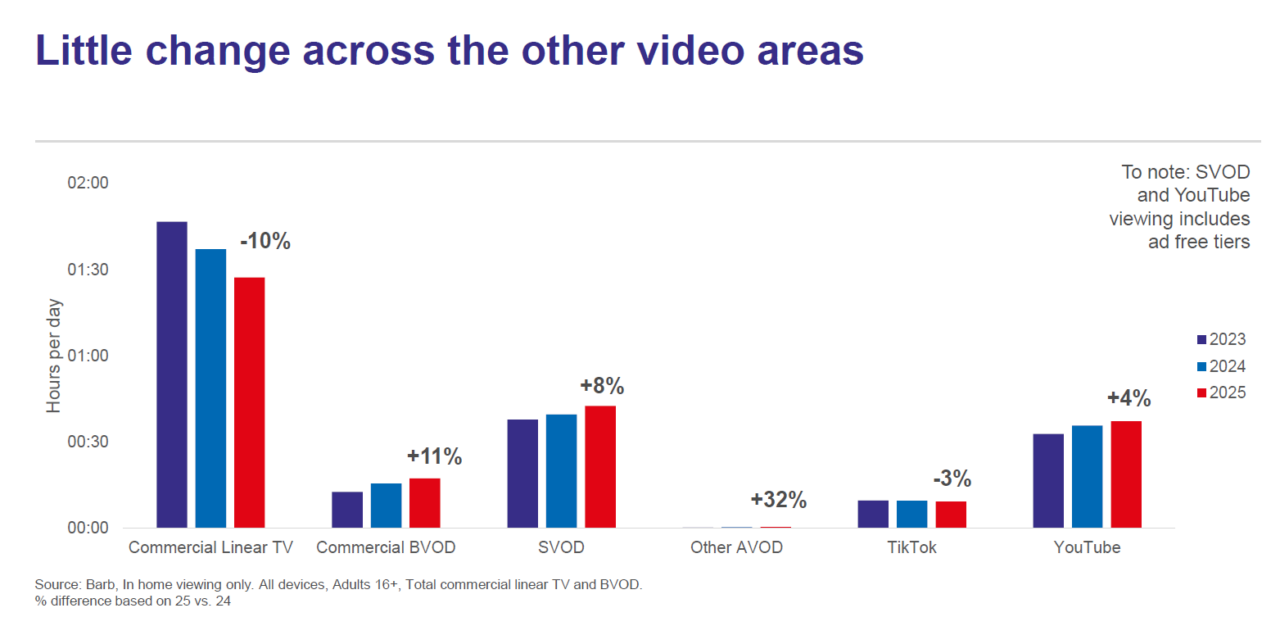
The growth of VOD services continues. As shown in the chart covering the period 2023–2025, SVOD viewing increased by 8% year on year. YouTube also recorded growth, although only by 4%. Despite the growth of other media, commercial linear television remains in first place. Although it is showing a gradual decline of 10%, it continues to maintain a significant lead over other types of video content and remains the most important source of viewing.
 Source: Thinkbox.tv
Another important fact is that the television screen remains the centre of home entertainment. Viewing on TV sets accounts for 84% of identified video viewing, while smartphones, tablets and computers play a significantly smaller role.
Mass audiences and familiar formats
The researchers were probably not surprised to find that television content — across both traditional channels and streaming platforms — is able to reach very broad audiences and generate high viewing figures for individual programmes.
The most-watched episodes attract audiences in the millions, with the leading titles available on both streaming platforms and traditional television channels. The highest viewing figure is achieved by Adolescence on Netflix, with more than 15 million viewers, followed by BBC programmes such as The Celebrity Traitors and The Traitors. Programmes from commercial broadcasters such as ITV, as well as from other platforms such as Amazon, also perform well.
Both new formats and established programmes made it into the top 20. It is therefore clear that viewers are interested in both new content and familiar, tried-and-tested formats. The results also confirm that the television environment as a whole — regardless of the specific platform — continues to attract mass audiences and is capable of creating content with very high reach.
Another notable feature is the strong position of domestic production. Most of the most successful programmes are British-made.
YouTube: a major player, but a different world
YouTube represents a significant part of the media ecosystem, but its role differs considerably from that of television. The total volume of television viewing is more than four times higher than that of YouTube.
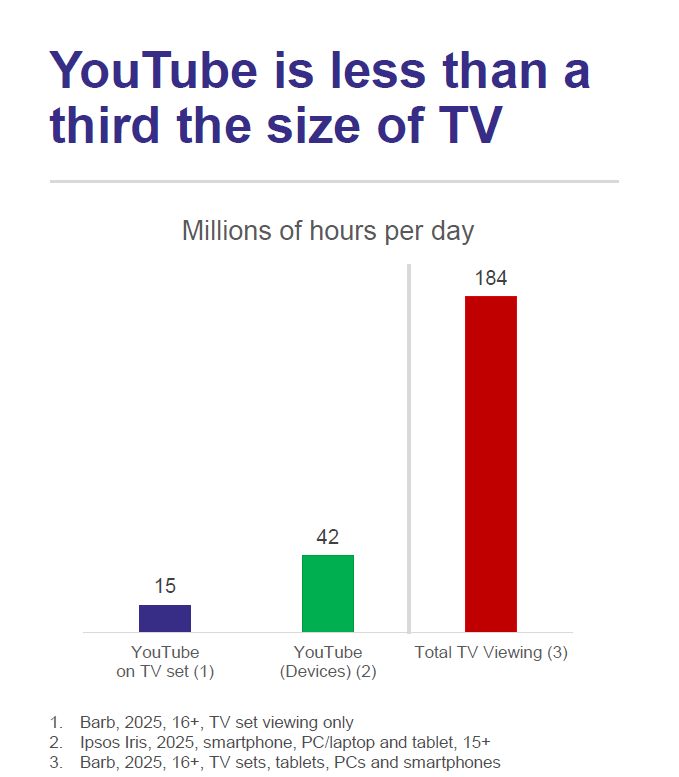
YouTube also lags far behind television in terms of reach. It needs a month to achieve the same reach that television delivers in a single day. One reason is likely to be the content itself, which differs significantly from television: only 41% of it consists of TV-type content, dominated by music and short clips. The remaining 59% is a diverse mix, ranging from gaming and podcasts to reaction videos.
User behaviour is also interesting: most people watch YouTube only minimally, while a smaller group of “superfans” consume significantly more. This group of YouTube superfans also has a specific profile. They are much more likely to belong to younger age groups, with representation gradually declining with age. Even more interestingly, although the heaviest YouTube viewers spend around two hours a day on the platform, their viewing of television content is even higher — approximately two hours and 23 minutes a day.
Advertising: Total TV is the key channel
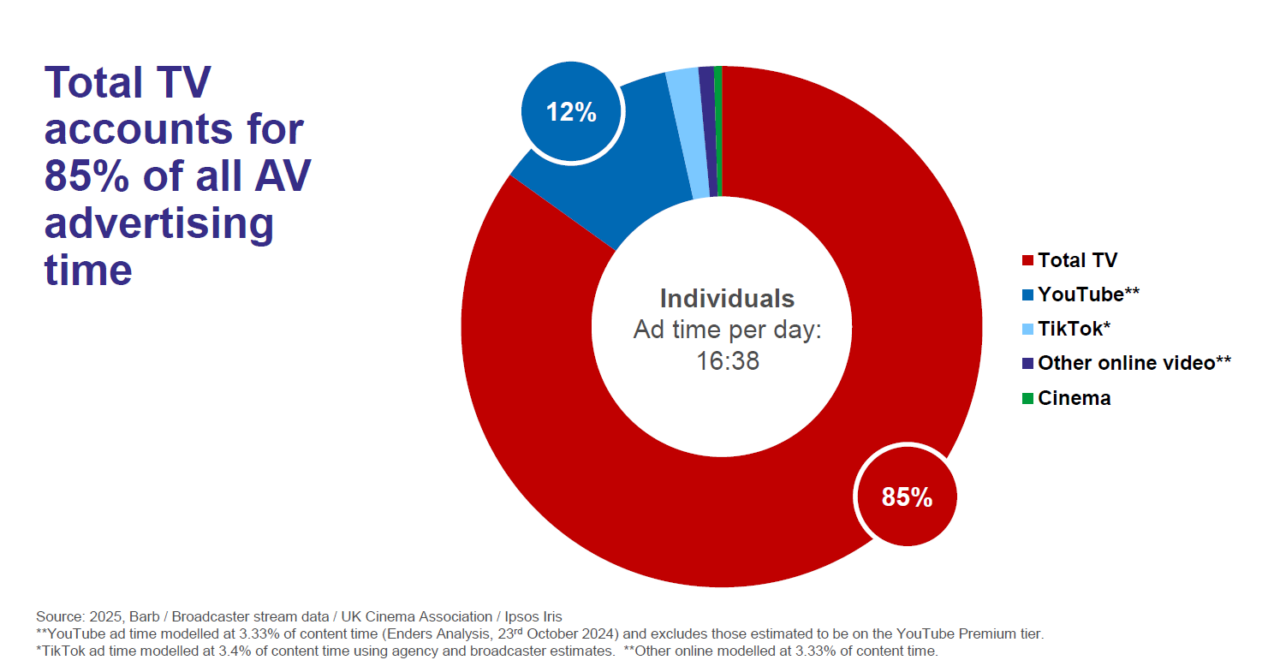
From an advertising perspective, television remains dominant. Total TV accounts for 85% of all audiovisual advertising time.
 Source: Thinkbox.tv
Even among younger viewers aged 16–34, people spend more time watching television advertising than ads on YouTube and TikTok combined.
The study further shows that between 2023 and 2025, there was a significant increase in the number of households subscribing to ad-supported streaming services. At the same time, the proportion of television viewing time during which viewers are exposed to advertising also increased year on year. Among the adult population as a whole, it rose from approximately 57% in 2024 to 61% in 2025, meaning that a larger share of viewing is taking place in ad-supported environments. The change is even more pronounced among 16–34-year-olds, where this share increased from around 38% to 48%, a rise of ten percentage points.
Context as the key to effectiveness
However, it is not just about quantity, but also about the quality of the context. Research shows that the right viewing environment can increase ad recall by as much as 6.3 times.
In this respect, television offers unique conditions: a large screen, professionally produced content, shared viewing and the right mood. For example, shared viewing increases ad recall by 23%, trust by 15% and likeability by 75%.
The media world: more channels, more time, more video
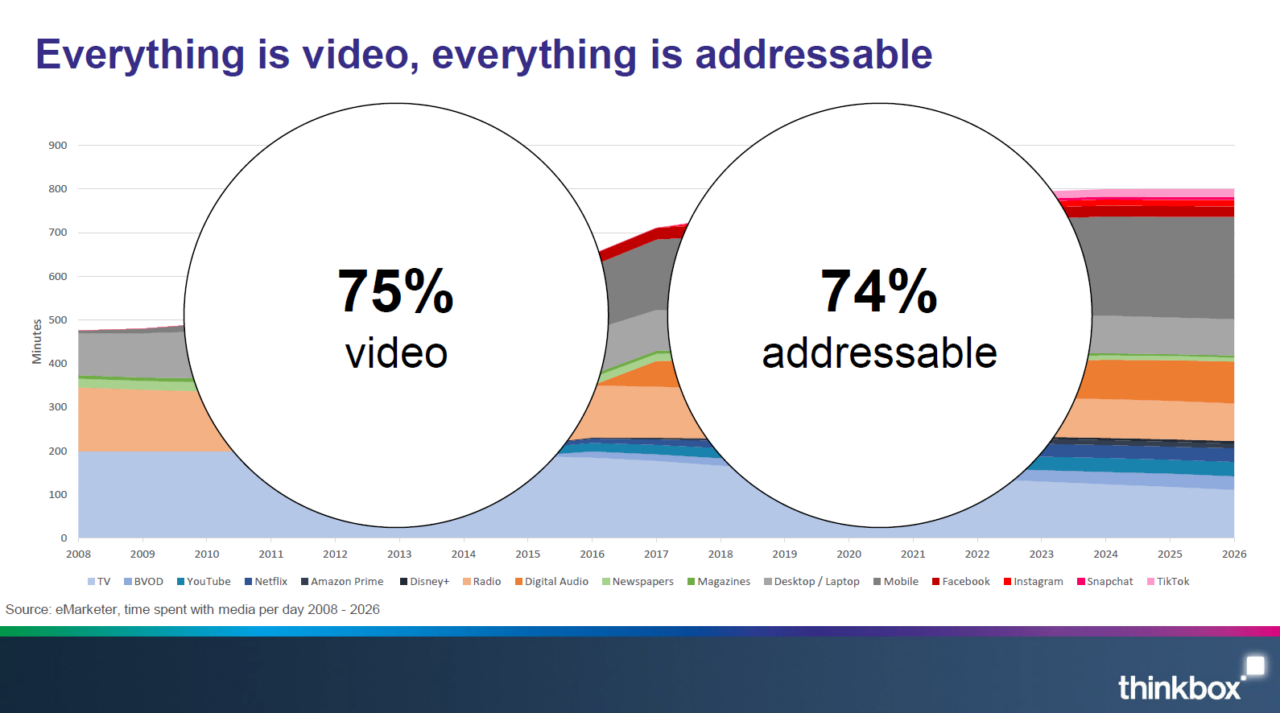
The overall media environment has expanded significantly. Between 2008 and 2026, approximately 10 new media channels have been added, and people now spend 5.4 more hours per day consuming media. Video has become the dominant format, accounting for around 75% of media consumption. At the same time, most media inventory is now addressable.
 Source: Thinkbox.tv
Addressable TV: precise targeting
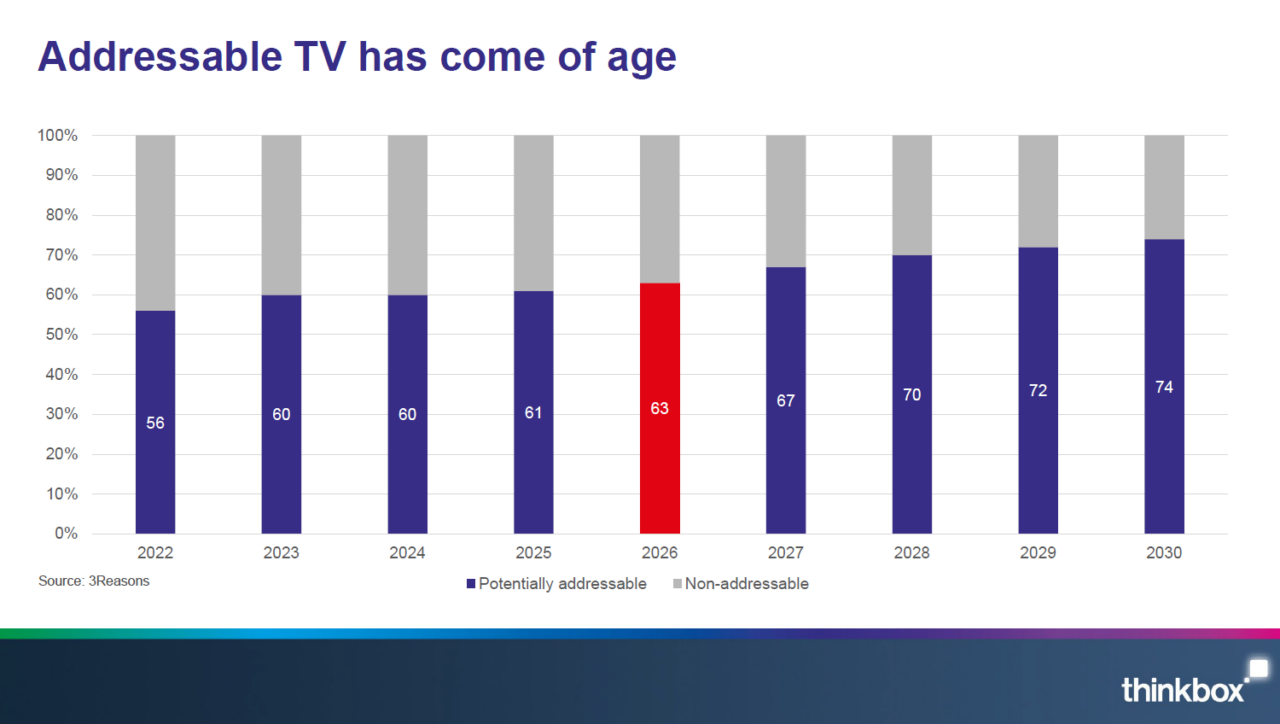
Addressable advertising enables the delivery of messages to specific viewers or households. Its importance continues to grow, and by 2030, almost three quarters of television advertising could potentially be addressable.
 Source: Thinkbox.tv
This approach increases effectiveness: for example, it can increase brand awareness by 120% and boost website traffic by up to three times.
Key benefits of Total TV
In the conclusion of the study, Total TV is described as a unified ecosystem that shares a number of key characteristics: it is regulated, professionally produced, verified and independently measured, making it trusted by viewers. The differences between individual forms of content distribution — such as linear broadcasting and streaming services — are not seen as separate worlds, but rather as different expressions of the same environment. As a unified environment, Total TV offers two fundamental benefits: broad reach and precise targeting.
It is therefore clear that television is far from being an outdated medium. On the contrary, it is a complex and flexible ecosystem capable of combining mass reach with individual relevance. Thanks to these capabilities, it will continue to play a key role in the media and advertising landscape in the future.
Source: thinkbox.tv