

What you will find in the article
- Television is trusted by 61% of EU citizens, versus 29% for social media
- Experts link television’s credibility to professionalism and broadcaster accountability
- Television helps audiences understand events and connect with the wider world
- Authenticity matters more as AI makes audiovisual content harder to verify
- Public service media trust also depends on institutional independence
Trust is hard to earn, easy to lose and impossible to impose. This holds true in personal relationships, in the world of brands and across the media landscape. At a time when virtually anyone can create audiovisual content and a multitude of platforms offer access to an almost limitless array of videos, trustworthiness matters more than ever. It is no longer simply a question of what appears on screen, but also of who is behind the content and why viewers should trust it.
Television continues to occupy a prominent position in this respect. But what lies behind its enduring credibility? Is it the result of decades of professional practice? Does it stem from the accountability of broadcasters? Or is greater significance attached to the relationship that audiences develop with the medium over time? Experts offer several explanations that merit closer examination.
A trusted window on the world: why television still matters
‘Television evolves with every technological advance, but its role as a trusted window on the world remains essential.’ This is how Sherri Aldis, Director of the United Nations Regional Information Centre (UNRIC), described television in her statement marking World Television Day in 2025. She noted that, despite rapidly changing media consumption habits, television retains its ability to bring people together through facts, foster mutual understanding and strengthen their connection to the world they share. She also highlighted the importance of audiovisual storytelling in creating space for dialogue and the exchange of ideas. From her perspective, television’s credibility is therefore not merely a question of the accuracy and reliability of individual pieces of information. It is also rooted in the social role of the medium, which helps people make sense of events, form their own opinions and navigate the world around them.
Indeed, trust has long been a central theme for the organisations supporting World Television Day. As early as 2017, the celebrations were held under the slogan In TV We Trust. Caroline Petit, then Deputy Director of UNRIC, identified trustworthiness as a value that was more important than ever to the television industry. She also stressed that television had a vital role to play in safeguarding audiences against the growing proliferation of fake news, propaganda and hate speech across an increasing number of communication platforms.
Her words take on an additional significance today. Generative artificial intelligence and readily available tools for editing and manipulating audiovisual content are opening up new creative possibilities, while making it considerably more difficult to distinguish authentic material. Knowing that a particular piece of content comes from an established media organisation whose practices and accountability can be scrutinised may therefore be all the more important.
More than twice as many Europeans trust television as trust social media
Television’s enduring strength is reflected in the findings of the extensive European survey Standard Eurobarometer 104, conducted in October and November 2025. According to the survey, television is trusted by 61% of European Union citizens. Radio enjoys an even higher level of trust, at 68%. Television nevertheless ranks ahead of the press, trusted by 59% of respondents, and well ahead of websites (42%) and social media (29%).
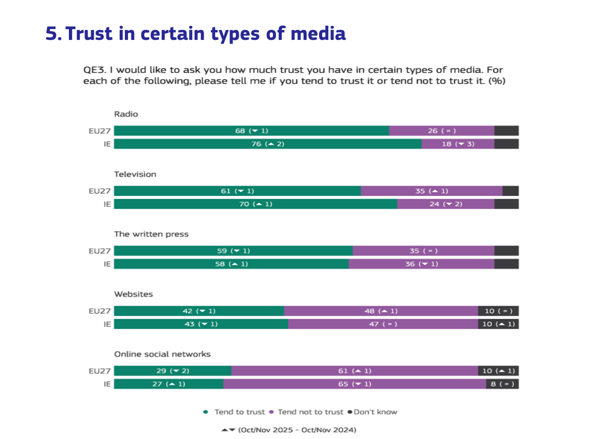
Crucially, the Eurobarometer survey directly examined levels of trust in different types of media. Its findings are therefore not derived from viewing figures, the popularity of television programmes or attitudes towards advertising. The figures alone, however, do not explain why television commands such a high level of trust.
One possible explanation comes from Grégoire Polad, Director General of the Association of Commercial Television and Video on Demand Services in Europe (ACT). In his statement marking World Television Day 2025, he drew attention to a defining characteristic of professional broadcasters: they are accountable for their content and operations. ‘As organisations that are fully accountable for our activities, we set the standard for responsible service provision,’ Polad said in the context of protecting viewers, promoting societal values and fostering a high-quality media environment.
His perspective highlights the distinction between the mere availability of audiovisual content and the way a professional media organisation operates. What matters to viewers may be not only whether the content is engaging and accessible, but also whether it is backed by an identifiable media service provider, professional content creators and established procedures against which its practices can be assessed.
This does not, of course, mean that every television programme is inherently trustworthy, or that digital content cannot meet equally high standards. Professionalism and accountability do, however, provide important foundations on which audience trust can be built.
High-quality content is not enough. Independence matters too
International scholars have also drawn attention to the importance of how television institutions operate. Professor Justin Lewis of Cardiff University and Professor Georgina Born of University College London, together with other experts, have explored the conditions that enable public service media to earn and retain trust. In December 2025, they published an article for the British Academy, drawing on an extensive international comparison of public service media across Europe, Canada and Australia. Their findings suggest that higher levels of trust and public support tend to be associated with stable operating conditions and independent decision-making. According to Born and Lewis, what matters is not only the decisions a media institution makes, but also who determines how it operates and how those decisions are reached.
Lewis elaborated on this principle when giving evidence before a UK parliamentary committee on 2 June 2026. He highlighted research findings pointing to a relationship between the extent of direct government influence over a public service broadcaster and the level of public trust it enjoys. In countries where governments exercise greater direct influence over decisions concerning public service broadcasters, trust in these institutions tends to be lower, while greater independence is associated with higher levels of trust. He articulated the principle that, for television broadcasting to be trusted and independent, its institutional framework must be sufficiently insulated from direct political decision-making.
A similar relationship had previously been explored by Sara Connolly and Shaun Hargreaves Heap of the University of East Anglia. Their study, Cross Country Differences in Trust in Television and the Governance of Public Broadcasters, published in the journal Kyklos in 2007, examined differences in trust in television across European countries and the potential significance of public service broadcasters’ independence.
Both studies serve as a reminder that the credibility of a television institution is not solely the product of the day-to-day work of its content creators. It is also shaped by the broader conditions in which the institution operates.
The three dimensions of trust: what do people in Czechia expect from the media?
What actually leads people to place their trust in a particular media outlet? This is precisely the question explored by Marína Urbániková and Klára Smejkalová of Masaryk University. In their study, Trust and Distrust in Public Service Media: A Case Study From the Czech Republic, published in the academic journal Media and Communication in December 2023, they used focus group discussions to investigate why people in the Czech Republic trust or distrust public service media. Drawing on four focus group interviews involving a total of 24 participants, they identified three principal dimensions of trust: trust in the message itself, trust in those who produce it and trust in the media organisation.
The first dimension concerns content. People trust messages they perceive as truthful, reliable, relevant and factual. The second dimension relates to the people who produce that content: according to the research, whether audiences regard public service media journalists as professionals plays an important role in their assessment of a source’s credibility. The third dimension is perhaps the most intriguing. It concerns the media organisation itself, particularly its independence from political influence and the existence of mechanisms designed to ensure the quality of its work.
The research thus suggests that trust is not merely a response to an individual message. It may also be shaped by people’s perceptions of how a media outlet operates and whether its staff and the organisation as a whole are worthy of their trust.
The authors reached another noteworthy conclusion: trust and distrust are not simply two sides of the same coin. The reasons why people trust a media outlet are not merely the inverse of those that give rise to distrust. This insight illustrates the complexity of media trust as a phenomenon. It cannot be explained by a single factor, nor can it automatically be assumed that removing a particular source of distrust will, in itself, generate trust.
The study focused on Czech Television and Czech Radio, both of which are public service media organisations. Its specific findings therefore cannot readily be extrapolated to the television market as a whole. It does, however, offer valuable insights into the individual components that may underpin trust in a media organisation.
A different but equally compelling perspective is offered by a new Czech study, Stable Trust in Chaotic Times: An Exploratory Analysis of Trust in Public Service Media Before and During Polycrisis, published in the academic journal Mass Communication and Society in June 2026. Its authors, Lukáš Slavík, Lucie Čejková, Jakub Macek and Marína Urbániková of Masaryk University, examined the stability of trust in Czech Television during a series of exceptional societal events. Their findings were striking. Despite considerable social upheaval, the relationships between the various factors under investigation and trust remained largely stable. The authors offer a possible explanation through the concept of diffuse trust, which differs from trust based on immediate assessments of specific performance or decisions. Such trust may be deeply rooted, drawing on people’s long-standing experience of an institution and the value they believe it brings to society.
Trustworthiness: a value that must be nurtured
From the experts’ perspective, several interconnected factors contribute to television’s credibility. Sherri Aldis reminds us of its social significance and its ability to help people make sense of the world. Grégoire Polad emphasises the accountability of professional broadcasters. Marína Urbániková and Klára Smejkalová demonstrate that people distinguish between trust in content, its creators and the institution itself. Justin Lewis and Georgina Born highlight the importance of independence and the governance of public service media. Meanwhile, this year’s study from Masaryk University suggests that trust may be a deeply rooted and enduring value. Each of these perspectives sheds light on a different aspect of television’s credibility.
Television, meanwhile, is far from standing still. Technology, content distribution methods and the environment in which it operates are all evolving. Yet, according to Eurobarometer, a considerably greater proportion of Europeans continue to place their trust in television than in websites or social media. In a rapidly changing media landscape, trustworthiness may well be one of the values that are becoming increasingly important.
World Television Day thus offers an opportunity to reflect on the fact that the strength of television as a medium may lie not only in its technological capabilities and content, but also in the trust that broadcasters are able to build over time.