

When Toy Story premiered in US cinemas on 22 November 1995, it was not merely a new family animated film, but a technological milestone in the history of cinema. The film was a genuine success with audiences: its original US release grossed approximately USD 192 million, making Toy Story the highest-grossing film on the domestic market in 1995. Including later re-releases, some sources put its total box-office takings at more than USD 400 million. The importance of the film, which launched the rise of Pixar — then still an independent company — was also confirmed in 2005 by the US Library of Congress, when it selected the film for preservation in the National Film Registry as a culturally, historically or aesthetically significant work.
The fifth film is racing into cinemas
The fifth instalment of Toy Story, scheduled for release in Czech cinemas on 18 June, is not only a nostalgic return to beloved characters, but also a response to the changing world of childhood. While the previous films focused primarily on growing up, leaving toys behind and searching for new meaning, this time the central question is whether traditional toys still have a place in an age of tablets, algorithms and non-stop digital entertainment.
The core conflict is not framed as a simple battle between good and evil. The internet, video tutorials and digital tools can be extremely useful. They can help people learn, repair or create something. The problem arises when the screen stops being a tool and starts determining what a child pays attention to, how they spend their time and where they find a sense of satisfaction.
Above all, the film takes aim at today’s attention economy. Digital platforms try to keep users in front of screens for as long as possible, constantly offering them new stimuli and preventing them from feeling bored. Yet boredom can be important and can stimulate creativity. When a child does not have instant entertainment ready to hand, they have to start inventing stories, rules and new ways to play for themselves. An ordinary toy thereby gains a special value: it is not a finished world, but merely a starting point that the child fills with their own imagination.
Video: Toy Story 5 (2026) HD trailer
Marketing partnerships
The Toy Story series is naturally also an extraordinarily successful marketing brand. Its commercial power stems from the very premise: the main characters are toys that can be transferred almost unchanged from the cinema screen into children’s bedrooms. The marketing potential of the film was already clear when the first instalment was released in 1995. Canadian company Thinkway Toys obtained the licence to produce figures and prepared, among other things, Woody and Buzz figurines. Initially, however, retailers reportedly did not expect such huge demand, meaning some products quickly sold out after the premiere. The campaign also included a partnership with Burger King, which ordered 35 million small toys and puppets linked to the film for its promotion. Even that quantity was not enough to meet demand in some outlets. The marketing of Toy Story gradually expanded beyond children’s figures. The characters appeared on clothing, school supplies, food, cosmetics, home accessories and in video games. When Toy Story 4 was released in 2019, Disney — which, incidentally, had acquired Pixar back in 2006 — worked in Europe with companies including eBay, Hilton, Europcar, Kellogg’s, Duracell, Babybel and Boots.
In the spot entitled “Snack Attack”, released at the time by Bel Brands, Woody, Buzz, Jessie and the other toys join forces to deliver Babybel cheese to Bonnie. The advert is interesting because it does not merely use a montage of film scenes but creates a standalone situation featuring characters from the series.
Video: Toy Story 4: Babybel Snack Attack
Kellogg’s promoted the film through special cereal packaging, including Coco Pops and Rice Krispies. In the UK and Irish campaign, customers received two of four sets of stickers featuring the film’s characters in each promotional pack. The Hilton hotel chain, meanwhile, linked Toy Story 4 with the promotion of family stays. Under the slogan “Better Together”, it offered stays at selected European hotels during which children could, under certain conditions, stay and eat free of charge. The campaign used the film characters and the theme of a shared family adventure.
Toy Story 5 brings a host of advertising campaigns
Unsurprisingly, the current premiere of the new film Toy Story 5 has also given rise to a number of marketing campaigns and brand partnerships across telecommunications, gastronomy, food, travel and consumer goods. The campaigns often draw on the film’s main theme — the clash between traditional toys and digital technologies — while also heavily leveraging the nostalgia of adult viewers who grew up with the first instalments of the series.
For example, the American telecommunications company AT&T prepared its own animated television spot with Pixar Animation Studios. It features Bonnie as well as familiar characters from the series, with the main theme being the connection between people in everyday life. The campaign is built around the motif of friendship, which has been associated with the series ever since the song You’ve Got a Friend in Me, and transfers it to AT&T’s communication services. The partnership also includes promotion of the film in selected AT&T stores, community film screenings and digital content. It is a classic brand partnership: the company is not promoting a specific film product but connecting its core value — communication and connectivity — with the film’s emotional world.
Video: AT&T + Disney and Pixar’s Toy Story 5
One of the most extensive campaigns was carried out by Papa Johns. In the US and 42 other international markets, it introduced limited-time pizzas inspired by the film, themed sauces, packaging, collectable Woody, Buzz and Jessie figures and, in some countries, an in-app game. The collaboration also includes a standalone animated advertising spot created by Pixar. In London, the brand additionally transformed a space in Shoreditch into a temporary version of Pizza Planet, the restaurant and arcade known from the first film. Visitors found arcade machines, a toy claw machine, themed photo settings, competitions and collector’s items. The campaign therefore connects television advertising, product, app and physical experience.
Video: Toy Story 5 – Papa Johns
Naturally, Kellogg’s could not be missing from the list of marketing partners. For the film, the brand revived a marketing tradition many customers remember from childhood: after more than ten years, it brought real toys back into cereal boxes. Special editions of Frosted Flakes, Froot Loops, Apple Jacks and Corn Pops contain collectables linked to the film’s characters. The campaign is particularly well aligned with the theme of Toy Story 5: the film deals with physical toys being displaced by screens, while Kellogg’s encourages children to find a real object in the box and play with it without a digital device. At the same time, it appeals to parents who remember similar cereal-box gifts from their own childhood. The promotion also included a large interactive version of a claw machine in Los Angeles.
Virgin Australia linked the premiere with a travel campaign. From 15 June to 19 July, it is offering passengers on domestic flights an onboard game inspired by the film. Participants can enter a competition to win a trip to Tokyo with a Pixar-themed programme. The partnership makes use of the natural connection between flying and Buzz Lightyear, while also bringing film promotion directly into the journey itself. Customers do not encounter the campaign only in advertising; they actively take part in it during the flight.
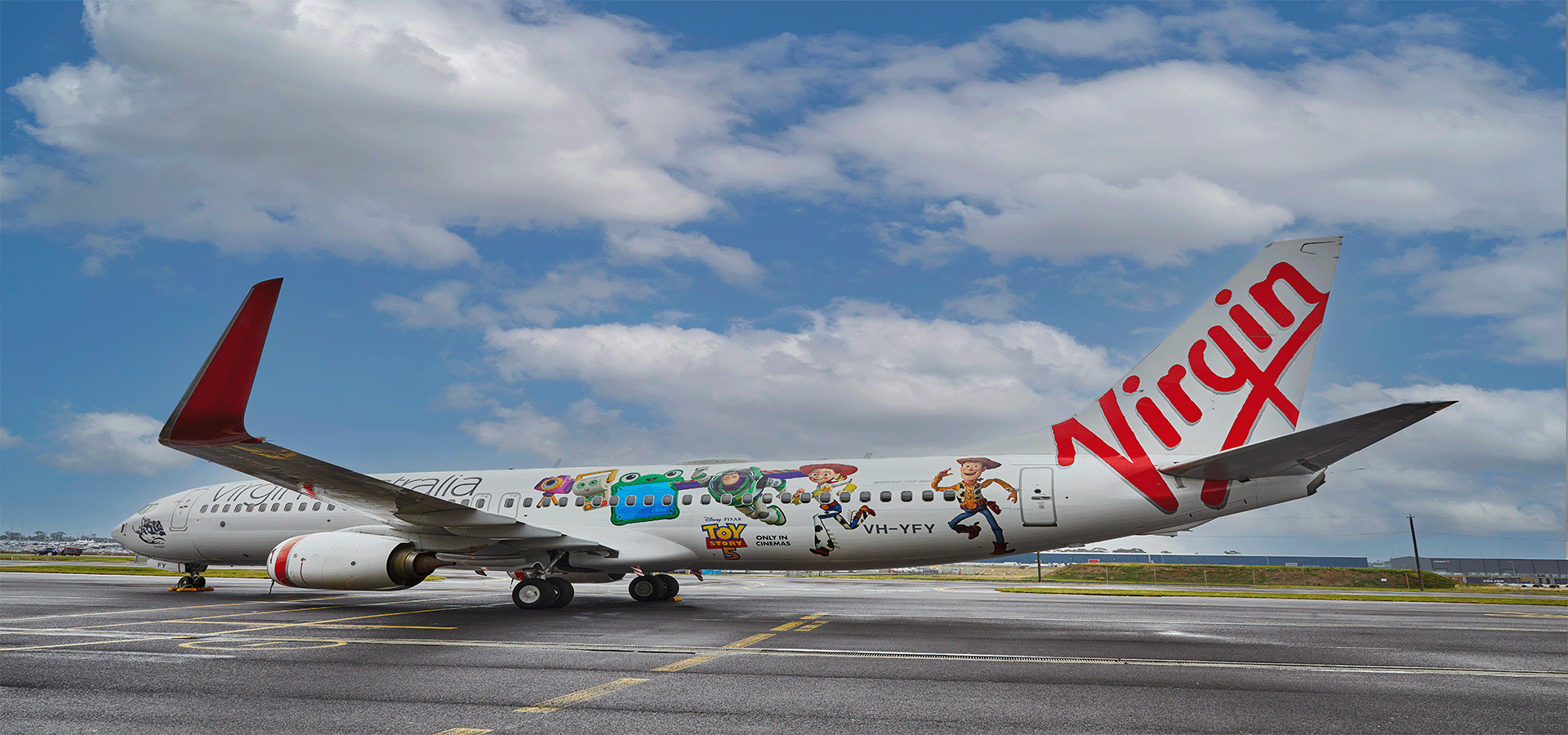 Source: Virgin Australia
Porsche prepared three unique cars in connection with the film’s world premiere, designed to appeal primarily to adult fans of the series. The one-of-a-kind Porsche 911 cars, inspired by Woody, Jessie and Buzz, were created through the Porsche Sonderwunsch programme. Their paintwork, interiors and details imitate the materials and colours of the individual characters — from denim texture and cowboy patterns to Buzz’s white, green and purple colour combination. Goodyear also joined the collaboration, supplying tyres and creating a special “Lightyear” marking for Buzz’s car. The cars are to be auctioned, with the proceeds supporting several US charities. The collaboration primarily targets adult fans, collectors and audiences interested in luxury cars.
Video: Porsche x Pixar | Toy Story 5
Electronics accessories manufacturer Belkin launched a special iPad case inspired by the new character Lilypad — a frog-like tablet that represents competition for traditional toys in the film. The case turns a real tablet into an object resembling the film character. This collaboration involves a notable paradox. The film raises the question of whether screens are crowding out real play, while the partner offers an accessory precisely for a tablet. From a marketing perspective, however, it is a very direct connection between a fictional object and a real product.
Video: New Toy Story 5 iPad Case | Belkin x Disney Pixar Lilypad Case
The marketing partnerships connected with the release of the new film Toy Story 5 are truly diverse. The strongest campaigns bring the world of the film into reality: Papa Johns builds Pizza Planet, Kellogg’s brings toys back into cereal boxes, AT&T creates a new story with the film characters, and Porsche turns toy-inspired design into real cars.
At the same time, there is a clear division of target groups. Food and gastronomy brands such as Kellogg’s primarily target families with children, while Porsche, limited-edition collector’s items and nostalgic motifs appeal to adults who first saw Toy Story back in 1995. The campaign therefore sells not only a new film, but also a memory of childhood — and it is precisely this combination of a child audience and parental nostalgia that is one of the greatest marketing advantages of the entire series.