

Kofola is among the most beloved Czech soft drinks, but it nearly did not exist at all. Its great-great-grandfather was a syrup called Syrupus Colae compositus Hell, created by the Opava pharmacist Gustav Hell, which already contained extract from kola nuts. The creation of Kofola as we know it today was later driven, in the 1950s, by the then totalitarian Czechoslovak state’s desire to outdo the world-famous Coca-Cola. Developing a new drink capable of rivalling Coca-Cola, however, was no easy task. Everything dragged on endlessly, while Coca-Cola continued to rule the world market.
In the end, a team of scientists led by Zdeněk Blažek created a syrup concentrate called KOFO, containing 14 herbal and fruit ingredients, caffeine, and other components. Incidentally, this concentrate is still used today. The new Czech soft drink first entered the market in 1960.
People loved it
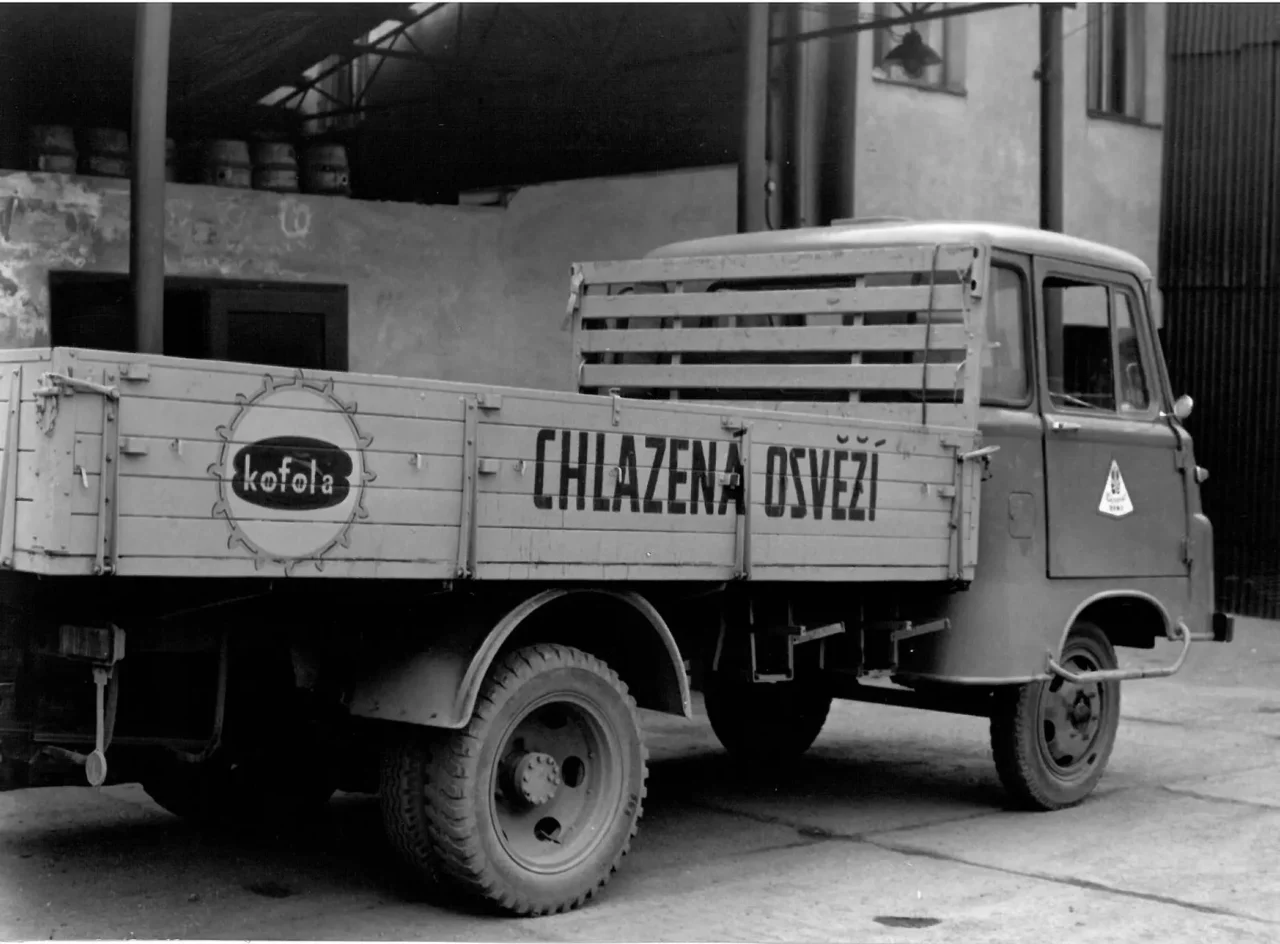
From the very beginning, Kofola’s rise into the wider world was accompanied by slogans, posters, and mobile advertising, all bearing a logo shaped like a coffee bean, which remained in use for a full thirty years. Thanks to its availability and low price, the drink quickly became popular and established itself as an excellent domestic alternative to more expensive Western colas. By the early 1970s, annual production had reached an incredible 180 million litres. Demand grew so large that ingredients began to run short and had to be imported from abroad. Kofola became a genuine legend.
 Source: Kofola archive
Over the course of its existence, Kofola has been through quite a lot. It remained at the top until the Velvet Revolution. After that, like other domestic soft drinks, it had to fight for a place in the sun against foreign brands. It changed owners several times but eventually returned to prominence thanks to a shift in marketing strategy and renewed investment. In the 1990s, Kofola used various advertising slogans, such as “Kofola — who can resist it?” and “Tradition simply tastes better.”
 Source: Kofola archive
If you love her…
In 2001, the brand launched an advertising campaign with the slogan “If you love her, nothing else matters,” which became a striking communication element aimed at a younger generation, though it won the hearts of more than just the romantically inclined. The campaign positioned the brand as a slightly rebellious, authentic, and deeply human alternative to global cola brands. Instead of perfection, it offered wit, humour, and an understanding of small human weaknesses. The ads worked with absurdity, exaggeration, and situations that in another campaign might have been considered a “problem,” yet Kofola managed to present them as a natural part of life. As a result, the slogan entered common usage and began to function not only as an advertising line but also as a widely used catchphrase. The campaign also laid a solid foundation for the brand’s later, more powerful work with emotion, including its legendary Christmas commercials. A typical example of this slightly offbeat style is the spot “Kofola – Nude Beach,” created in 2006 by the advertising agency Kaspen and brought back to television screens in 2011.
Video: Kofola – Nude Beach
I don’t have to — I can already see it!
Kofola truly reached the pinnacle of marketing thanks to its Christmas campaign. The television ad featuring a live “golden piglet” with its big curved tusks appeared on Czech television screens in 2003, and it has been faithfully accompanying us through Advent ever since. The creative concept, developed by Kaspen, found its way into the hearts of Czech viewers even though it revolves around a theft — and in broad daylight, no less. Yet because of the humorous context and the harmless nature of the situation, the motif of theft tends to provoke smiles rather than criticism.
It is worth mentioning that producing the commercial was far from easy. It was filmed in autumn, so a snowy landscape was a complete fantasy, forcing the production team to use artificial snow. What is more, the wild boar that chases the two protagonists at the end of the scene was afraid of people — a real scaredy-cat, in fact. The final scene had to be filmed in two separate takes: once with the fleeing pair, and then again with the “piglet”. In the end, shooting the commercial took a full three days. By contrast, Bublina, the six-year-old boar that later appeared in subsequent versions, was a true television star and now has a whole series of Czech and international roles to her name; among other things, she also appeared in the humorous series Strážmistr Topinka. The original Kofola ad lasted 47 seconds, making it, together with the similarly popular ad widely known as Bóbika, a representative of a new trend in narrative advertising at the time — that is, spots initially broadcast in full length and later shown only in shortened form through selected scenes.
Video: Kofola – The Golden Piglet
What contributed to the high effectiveness of the golden piglet ad? There are several reasons. First, the ad does not really present the product itself, so it does not push viewers to buy and instead respects their expectations of a calm Christmas atmosphere. It also makes use of nostalgia — showing snow, winter fun, and a shared activity between a child and a parent. The motif of the Christmas Eve fast and the golden piglet points to traditional Christmas customs. The spot is meticulously constructed: even the opening cawing of a crow creates an expectation of drama. The punchline rests on a humorous reversal of roles: the child is in control of the situation, while the adult is caught off guard, which feels very much in line with a distinctly Czech sense of humour. And finally, the closing scene rewards the more discerning viewer with strong craftsmanship: a real wild boar and convincingly shot — albeit artificial — snow.
The following years: the same commercial, but with new additions
In the years that followed, the same story continued to be repeated on television — without any major changes. The difference lay more in the media execution. From 2007 onward, the brand began supplementing the “piglet advert” with a closing addendum, while also expanding its Christmas communication through limited-edition flavours inspired by festive tastes and aromas, as well as through online activations:
- 2007: Kofola Cinnamon — the first limited Christmas edition, accompanied by a final extension to the spot and interactive video postcards; thanks to viral sharing, 1.2 million greetings were sent.
- 2008: Kofola Barborka — regarded as one of the most successful flavours up to that time; online, the activity “Angel Piglets” invited users to create Christmas greetings in which written text was transformed into spoken word, and they could also design their own piglet.
- 2009: Kofola Stars, flavoured with pomegranate and vanilla, accompanied by the new Christmas slogan: “Just take a sip at Christmas, and you’ll see next year!” Customers received fortune-telling cards, and an online application allowed them to predict the future.
- 2011: This year saw the launch of Kofola Extra Herbal, flavoured with mint, gentian, and dandelion. It was considered such an exceptional product that no additional Christmas limited edition was released that year. The spot was accompanied by an original augmented-reality greeting — when the label was scanned, a trio of singing piglets appeared.
- 2012–2013: Kofola Vanilla — a highly successful Christmas flavour that later became part of the regular range; in 2013, “Devilish Fairy Tales” were created as a playful Christmas greeting.
- 2014: Kofola Cinnamon returned, joined by new flavours Kofola Marzipan and Kofola Gingerbread (created especially for Lidl).
- 2015: Kofola Marzipan — featuring wise little owls as new companions for the piglet — and Kofola Choco (created especially for Albert in the Czech Republic and Tesco in Slovakia).
- 2016: Kofola Coconut and Kofola Walnut. An animated ending was added to the Christmas spot, where the piglet gained two more friends — a squirrel and a hare.
- 2017: Kofola Plum with Cinnamon and Kofola Pear with Cinnamon — the traditional commercial was extended with an animated ending promoting the limited editions.
- 2018: Kofola Mandarin — a flavour inspired by one of the symbols of Christmas.
- 2019: Kofola Christmas Spice and Kofola Apple with Cinnamon — the commercial featured a constellation motif and the Golden Piglet in the night sky, and viewers also learned that the piglet’s name is Zlatuška.
- 2020: Kofola Honey and Kofola Coconut (for Albert) — the classic commercial was supplemented by the message: “Kofola. When you love it, nothing else matters. For 60 years!”
- 2021: Kofola Apple with Cinnamon (a beloved historical flavour) and the new Kofola Caramel.
- 2022: Kofola Vanilla Crescent Cookie and Kofola Linzer Cookie — in the commercial, the piglet moved through an original paper world made from real baking paper.
- 2023: Kofola Rum and Kofola Vanilla Crescent Cookie — a non-alcoholic limited edition with the aroma of rum as a traditional part of Christmas baking.
- 2024: Kofola Marlenka — a collaboration with the traditional Czech brand Marlenka, inspiring a flavour with notes of nuts and honey. A special edition of Marlenka Honey Kofola Balls was also created.
- 2025: Kofola Christmas Punch — a limited edition combining apple, orange, cinnamon, and cloves, evoking festive punch.
Video: Kofola – Enjoy a Loving Christmas (2025)
Critics and viewers alike appreciated the campaigns
Kofola’s Christmas campaigns rank among the most highly regarded in the Czech advertising landscape — not primarily because of individual years, but because of their long-term consistency, effectiveness, and cultural impact.
Kofola’s Christmas spots are frequently mentioned in trade media and regularly appear at the top of audience polls on the most beloved Christmas commercials, often beating global brands. Industry commentators repeatedly emphasise that the “golden piglet” spot is a truly exceptional example of advertising that has become part of collective memory and an annual Christmas ritual. They describe it as a textbook case of brand-building, proving that long-term work with a single strong story can be more valuable than yearly creative reinvention.
The fact is that Kofola did try, in the past, to vary its Christmas communication — but after a negative response, it returned to the original spot. Viewers complained about the piglet’s absence and demanded its return. For part of the audience, the Kofola piglet is simply the signal that Christmas has truly begun. Any attempt to replace it is perceived as a disruption of tradition. In this way, Kofola has joined the company of John Lewis, whose Christmas advertising likewise evolved from an ordinary marketing tool into an annually anticipated cultural ritual.