

What you will find in the article:
- Television is now an interactive medium influencing purchasing decisions.
- Streaming services dominate viewing habits across all generations.
- Consumers find television advertising more trustworthy than social media ads.
- Viewers frequently use multiple screens while watching television content.
- Television enhances brand credibility discovered through social media and online searches.
This change is also being driven by the fact that streaming services are transforming viewing behaviour across generations. Television is gradually becoming an interactive environment that offers advertising which consumers perceive as more trustworthy, less disruptive and of higher quality than advertising on social media.
Although the digital environment offers an enormous volume of content, advertising and stimuli, television continues to maintain an exceptionally strong position. In a world saturated with short-form posts and constant shifts in attention, it provides a more stable and trustworthy environment. Moreover, television no longer serves solely as a medium for building brand awareness; it is increasingly having a direct influence on purchasing decisions.
Streaming services drive viewing
Modern television viewing is now firmly linked to streaming services. Streaming has become one of the dominant ways of watching television content across generations. Television content is watched through streaming applications by 92% of Generation Z, 90% of millennials, 83% of Generation X and 61% of baby boomers, who were long considered loyal to traditional cable television.
Sport and live events used to be the only area that kept audiences watching live television. However, there has been a significant shift here as well: 65% of consumers now watch sport and live broadcasts through streaming platforms rather than cable television.
At the same time, the number of subscription services used by each household is increasing. Streaming is no longer about a single platform, but an entire ecosystem of services. More than 76% of Generation Z and millennials use three or more services. The most striking change, however, can be seen among baby boomers, 52% of whom now subscribe to at least three streaming services. Behaviour that was once typical mainly of younger audiences has therefore become the norm. The most commonly used services are Netflix (78%), Hulu (63%), Prime Video (55%), Disney+ (46%) and Paramount+ (40%). As a result, the television market is becoming increasingly fragmented, with consumers combining content from different sources according to price, availability and personal preference.
Television advertising continues to enjoy a high level of trust
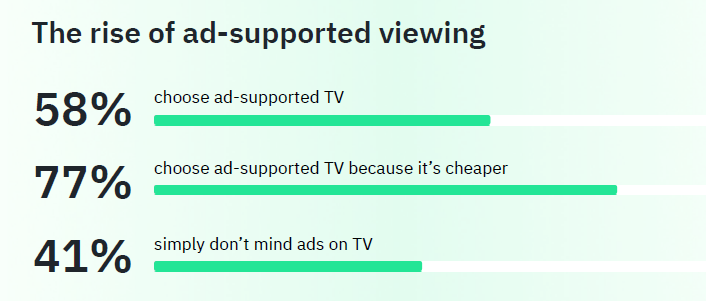
The growing number of subscriptions is also making consumers more sensitive to price. This is why ad-supported subscription tiers are becoming significantly more popular. Viewers are willing to tolerate advertising in exchange for a lower subscription price, and for many people this model has become a completely normal part of watching content. There are, however, significant differences between generations. While 74% of baby boomers use advertising-supported streaming services, the figure among Generation Z is only 43%. Younger audiences are the most willing to pay for premium, advertisement-free services, confirming how important it is for them to retain control over the way they consume media. Older audiences, by contrast, are more likely to accept advertising as a natural part of television content.
 Source: tvscientific.com
The research also confirms that consumers regard television advertising as significantly more trustworthy than advertising on social media. Respondents are more likely to perceive it as higher quality, less disruptive and more deserving of their attention. Television therefore provides an environment that lends brands a certain degree of legitimacy. This is particularly important at a time when people increasingly discover new products on social media or through online searches. According to the study, however, television helps reinforce these initial impressions and turn them into trust.
Social media, search and television work together
Consumer behaviour now operates as an interconnected chain across different media. People may first encounter a brand on social media, then see it advertised on television and immediately search for it online. The individual channels complement and reinforce one another. Social media often provides the initial stimulus, while television lends the brand credibility and helps reassure consumers that the product is relevant and of high quality. Generation Z is the most responsive in this respect: 57% of young people say that a brand appears more legitimate when they see it on television after encountering it on social media. Among baby boomers, 34% of respondents agree.
The discovery of new products is currently divided among several key environments:
- Social media;
- Online search; and
- TV and streaming platforms.
Consumers today therefore do not use just one media channel but move among several. Streaming is changing how content is watched, social media and online search help people discover new brands, and television subsequently strengthens those brands’ credibility. In a fragmented media landscape, television continues to maintain its position as a trusted medium that commands high levels of attention while also enhancing the effectiveness of other communication channels.
 Source: tvscientific.com
The second-screen era has changed viewer behaviour
The way people watch television has also changed fundamentally. Today’s viewers rarely watch just one screen. Instead, using two screens simultaneously has become the new norm. Television is no longer a separate activity, but part of a constantly connected digital environment.
 Source: tvscientific.com
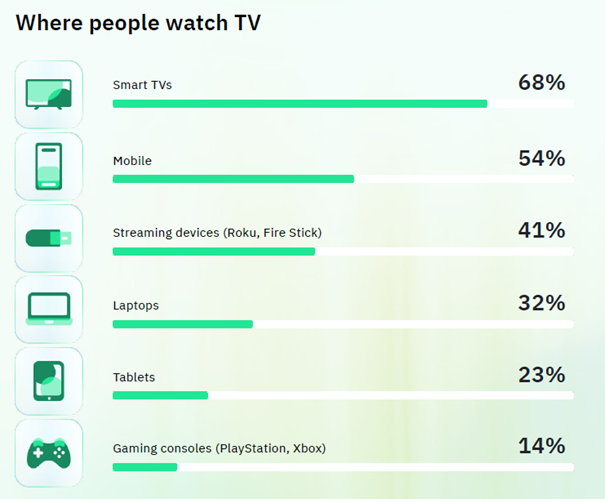
Smart TVs remain the most commonly used devices for watching content, but mobile phones also play a significant role. Younger generations in particular watch content much more flexibly, switching between different devices depending on the situation.
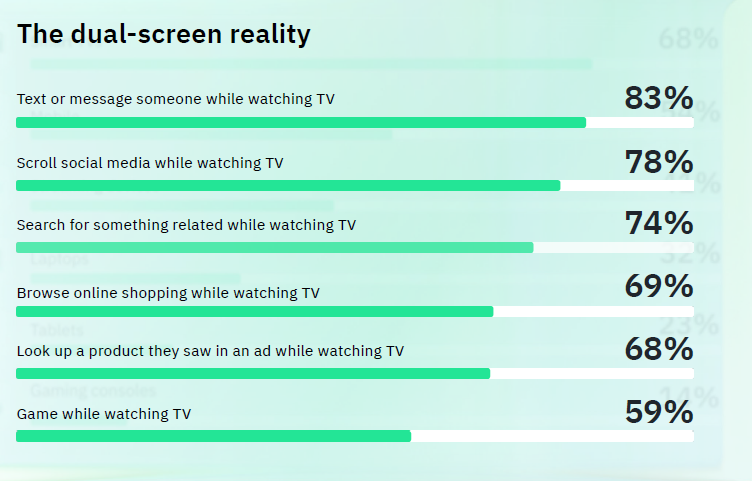
The most common activity while watching television is communicating: 83% of people send messages or interact with others while watching. Social media use is also widespread, with 78% of consumers using social platforms while watching television. A further 74% actively search for information related to the content they are viewing. Television also has a significant influence on online shopping behaviour. In total, 69% of people browse online shops while watching television, while 68% search for products they have seen advertised during a television broadcast. Gaming is another common form of multitasking, with 59% of respondents playing games while watching television.
Television is no longer consumed as a stand-alone medium. Instead, it forms part of a broader digital ecosystem in which viewers simultaneously communicate, search for information, shop and respond to advertising content in real time.
 Source: tvscientific.com
However, behaviour varies significantly between generations. Generation Z is the most active and, at the same time, the most distracted while watching television: 91% use social media, 93% send messages and 73% also play games while watching. Millennials are the most shopping-oriented generation, with 78% browsing online shops or making purchases while watching television. Generation X is the most likely to respond to advertising: 74% search for products they have seen in television advertisements. Baby boomers, by contrast, are the most focused audience, with only 48% using social media or shopping online while watching television.
The data suggests that television advertising can prompt consumers to take immediate action online, such as searching for information or visiting a brand’s website. When a brand appears on television, people immediately search for it, compare products, read reviews or visit its website. Performance TV—television advertising focused on measurable outcomes—therefore connects television reach with specific, measurable results online.
Television is becoming a direct trigger for purchases
The ability to prompt an immediate response is one of the study’s most important findings. According to the data, television advertising now has a significant influence on purchasing behaviour. A large proportion of consumers said that they had taken a specific action after seeing an advertisement. In total, 65% of people said they had made a purchase after seeing a television advertisement. The most common response is to search for the brand, which 60% of consumers do after seeing it advertised on television. A further 47% visit the brand’s website, while 42% actively search for product reviews or ratings. For many people, television provides the initial stimulus that sets the entire purchasing process in motion.
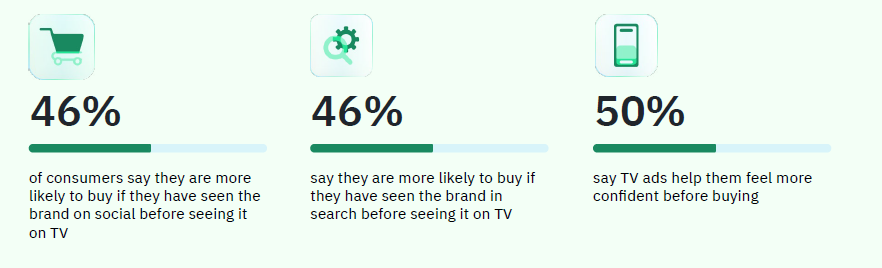
Interestingly, television is most effective when combined with other digital channels. If consumers have previously encountered a brand on social media or in online search results, television advertising significantly increases the likelihood of purchase. Television therefore does not operate in isolation, but as part of a broader communications ecosystem in which individual touchpoints work together to strengthen both trust and willingness to buy.
 Source: tvscientific.com
Key shopping seasons amplify the influence of television advertising
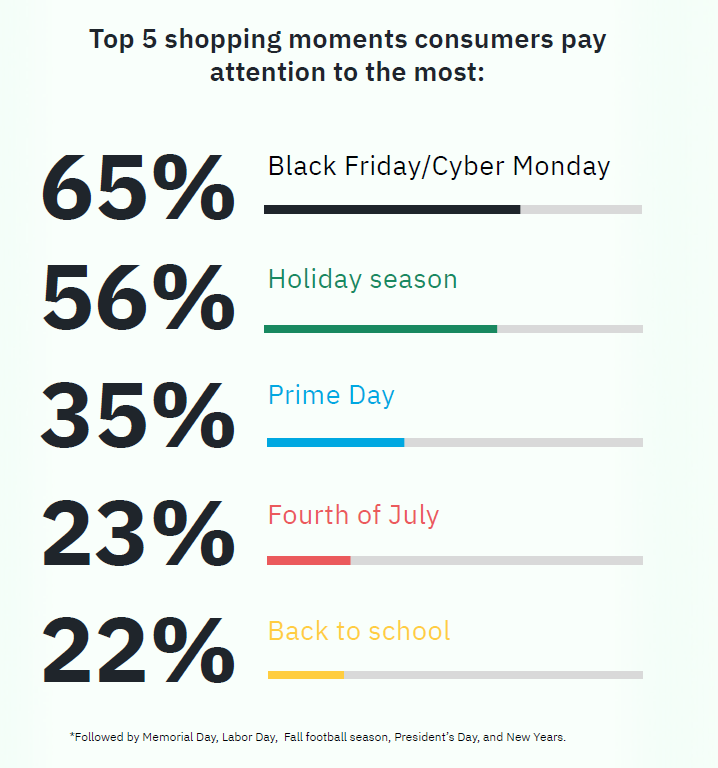
Major shopping events also play an important role. Black Friday and Cyber Monday attract the greatest consumer attention, followed by the Christmas shopping season and events such as Prime Day. During these periods, people are more willing to spend, so they closely monitor brands’ offers and pay considerably more attention to advertising than they do during the rest of the year. The study shows that television can have a significant influence on consumers’ final purchasing decisions at precisely these moments.
 Source: tvscientific.com
Emotions and simplicity determine advertising success
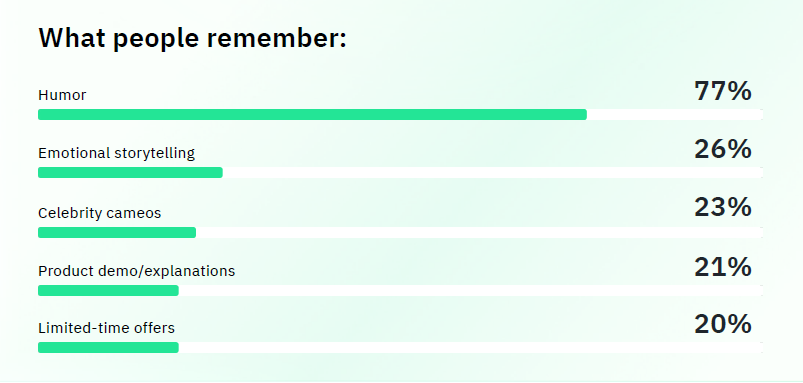
The way advertisements are presented also plays an important role. People are most likely to remember advertisements that make them laugh. According to the study, humour significantly outperforms all other elements in terms of memorability. Emotional stories, well-known personalities and clear product demonstrations also play an important role.
 Source: tvscientific.com
If an advertisement is intended to prompt viewers to take immediate action, simple and concise messages work best, particularly when they include a clear offer or discount—identified as the decisive factor by 52% of respondents. The clarity and brevity of the message are also important. For 41% of people, the most effective advertisements are those that get to the point quickly and do not overwhelm them with unnecessary information. Content relevance matters too: 36% of consumers are more responsive to advertising tailored to their interests and preferences. Authenticity remains another powerful element, with 35% of people more engaged by advertisements featuring real people using the product.
The findings confirm that the most effective approach combines a clear value proposition, a simple message and authentic content that is personally relevant to the audience.
However, the study also points out that the content of an advertisement alone is not enough. The environment in which it appears is equally important. Younger generations respond best to advertisements on streaming services, as this is where they spend most of their time. Older audiences, by contrast, are still more likely to associate traditional cable television with a high-quality advertising environment. According to the study, successful communication therefore requires the right combination of content, format and environment.
The future of television will be interactive
The final section of the study examines the future of television and suggests that television advertising will become increasingly interactive. Interest is growing in formats that allow viewers to respond immediately, obtain further information or make a purchase directly. Consumers are also becoming more interested in advertisements tailored to their previous searches, advertisements featuring QR codes and formats that enable them to buy products while watching content. Television is therefore gradually becoming more like digital platforms, where consumers can move instantly from attention to action.
Advertising created by content creators also plays an important role. Younger generations in particular respond much more positively to this type of promotion than to traditional advertising formats. The study indicates that combining the television environment with elements familiar from social media will become increasingly important in the future.
Television is no longer just a brand-building medium
The overall picture presented by the study is very clear: television is no longer merely a means of building brands, but a fully-fledged tool that combines trust, attention and immediate consumer response. Modern viewers watch content across multiple devices, discover products on social media, confirm their credibility through television and respond within seconds using another screen. It is precisely this ability to combine emotion, trust and immediate action that makes television one of today’s most influential media channels.
Source: tvscientific.com