

Overall trust in news in the Czech Republic stands at 31%, which is two percentage points lower than last year and also below this year’s global average of 37%. Since 2023, it has remained stable within the range of 30 to 33 per cent. This is according to the latest edition of the Reuters Institute’s annual Digital News Report 2026.
Of those monitored by the survey, public service media remain the most trusted news brands. 59% of respondents trust Czech Television’s news coverage, and 58% trust Czech Radio. These are followed by CNN Prima News (57%), Seznam Zprávy and Hospodářské noviny (both 55%). However, not all news media are included in the survey, so this is not a complete list of media outlets ranked by their trustworthiness.
The proportion of people who avoid the news sometimes or often rose by four percentage points year-on-year to 41%. This is one of the highest figures since this indicator began to be tracked.
Only 13% of respondents pay for online news, the same proportion as last year.
The internet remains the main source of information. 81% of respondents use online news weekly (up 1 percentage point year-on-year). This figure also includes those who obtain news from podcasts and AI chatbots. Artificial intelligence tools are among the fastest-growing sources of news. Nine per cent of Czechs use AI chatbots to keep up with current events, representing a year-on-year increase of three percentage points. The popularity of news podcasts has also risen slightly, with 9% of respondents listening to them regularly (up 1 percentage point).
Television continues to hold a strong position at 60%, whilst 44% of people use social media to follow the news.
The most widely used social media platform for news in the Czech Republic is Facebook (44%), ahead of YouTube (25%), WhatsApp (25%) and Instagram (22%). It is worth noting that these social media platforms have grown in popularity as news sources year-on-year, with Facebook and WhatsApp seeing the biggest increases.
Conversely, the weekly reach of print media has fallen to 11%. The study also notes that overall news viewership has been declining slightly for several years.
The Czech media market was influenced last year in particular by the emergence of generative artificial intelligence, further consolidation of media ownership and growing uncertainty surrounding the funding of public service media, according to media analyst Václav Štětka from the European University Viadrina in a commentary in this year’s edition of the Digital News Report. Although television and radio licence fees were only due to rise in 2025, the new coalition government is proposing to replace them with funding from the state budget. According to Štětka, the proposed model could jeopardise the financial stability of Czech Television and Czech Radio and raises concerns about greater dependence on the government. Combined with verbal attacks by some politicians on Czech Television journalists, he says this has created “unprecedented uncertainty regarding the future independence of public service media”.
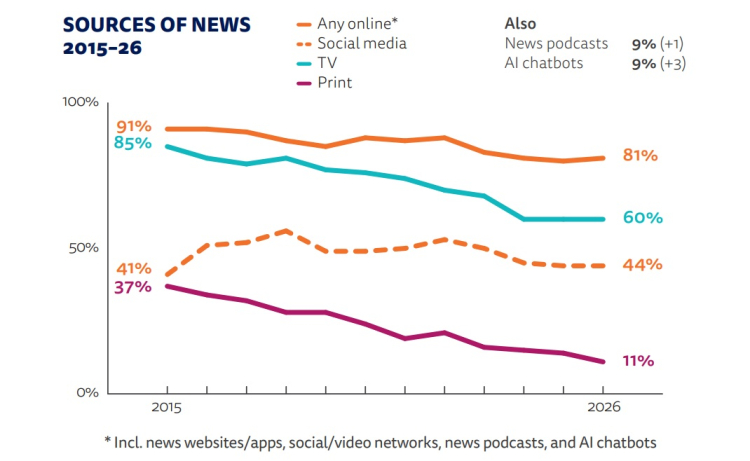 Sources used for following the news in the Czech Republic; Source: Digital News Report 2026
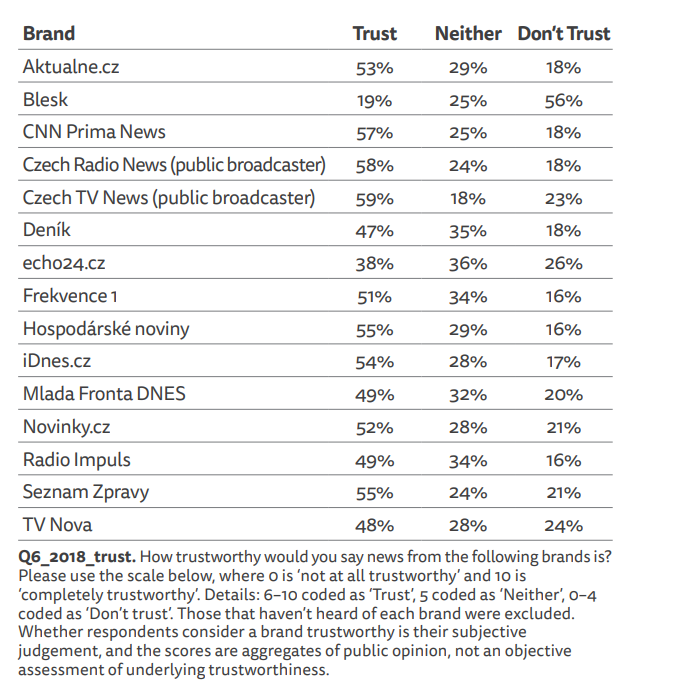 Trust ratings for selected Czech news media (0 = completely untrustworthy, 10 = completely trustworthy); Source: Digital News Report 2026
Key trends from the Digital News Report 2026
Trust in news reporting fell to its lowest level in ten years of measurement in 2026. At the same time, the shift of audiences from traditional media to social media, video platforms and, more recently, generative AI tools continues. The Digital News Report is based on a survey of nearly 100,000 users across 48 countries.
- Trust in news at an all-time low
Global trust in news has fallen to 37%, the lowest figure since 2015. The most significant year-on-year declines were recorded in the Philippines, Ireland, Thailand, Peru and Poland. In the United States, only a quarter of respondents trust most news reports, and among right-wing Americans, the figure is as low as 15%.
- Social media overtakes traditional media for the first time
For the first time in the history of the study, social media and video platforms are the most common source of news. They have overtaken both television news and the websites and apps of news organisations themselves. Moreover, this trend is not limited to young people but is gradually affecting almost all age groups.
The research also confirms that the younger generation is unlikely to adopt their parents’ media habits. For example, more than half of people aged 18 to 24 have never regularly read a printed newspaper.
- Video is becoming the dominant format
77% of respondents watch online news videos every week. However, it is primarily the consumption of videos on third-party platforms such as YouTube, Instagram, TikTok or Facebook that is growing. So far, media organisations have benefited only to a limited extent from this trend on their own websites and apps.
- AI chatbots as a new source of news
The use of generative AI tools for gathering information is also growing significantly. Weekly use of AI chatbots to follow the news has risen year-on-year from 7% to 10%. Among people aged 35 and under, the proportion of users has already reached 16%.
Interestingly, these are not primarily users who are abandoning traditional media. On the contrary, they are often above-average news consumers. However, trust in AI responses remains low – at just 20% globally.
- Content creators and influencers are gaining ground
More than a quarter of respondents (27%) obtain at least some of their news from individual content creators or influencers focused on current affairs. If creators without a primary news focus are also included, 46% of people use their content.
However, influencers are not yet replacing traditional media. Only 3% of respondents said that news creators meet all their information needs.
- The public is dissatisfied with the coverage of key issues
The study also reveals a high level of dissatisfaction with how the media reports on key social issues. Criticism relates in particular to the topics of inflation, migration, Donald Trump’s second presidential term, climate change, and the wars in Ukraine and the Middle East.
- Impartiality remains an important value
Despite the polarisation of the audience, a preference for impartial reporting still prevails. Significantly more people prefer sources without an obvious bias than media outlets that reinforce their own views. Furthermore, support for like-minded media has fallen to 20% since 2020.
The full report is available here.
Source: mediaguru.cz