

Artificial intelligence can now outperform humans in execution and operational tasks, but its capacity for strategic management remains limited. This was stated by Martin Svetlík, Chief Creative Officer at Ogilvy, at the Brandstorming conference organised last week by Internet Info. According to him, companies face the question of how much of their decision-making they are willing to entrust to AI, and whether current tools are sufficiently prepared for such a role.
In his view, the difference between humans and AI is primarily evident in the distinction between execution and strategy. Whilst artificial intelligence is extremely effective at the operational level – whether in data analysis, content creation or testing – it reaches its limits in the realm of strategic decision-making. Research shows, for example, that AI tends to generate the ‘most likely’ solution, i.e. what corresponds to the prevailing discourse, rather than necessarily what is right for a specific brand. This often results in uniform recommendations that may even be received by rival companies.
Conversely, a strength of AI lies in its ability to work with synthetic data and audiences, which enables rapid testing of ideas. Studies show that these models are capable of simulating real human behaviour with a relatively high degree of accuracy. In some cases, artificial intelligence also outperforms humans in the persuasiveness of advertising messages. At the same time, however, if people realise that the content was created by AI, their trust diminishes.
Svetlík also highlighted the risks associated with an uncritical approach to technology. AI can be “effective even in its mistakes” and, thanks to its speed and scalability, can amplify them. Another problem is its limited understanding of context and relevance. Whilst humans can take broader contexts into account, AI optimises solutions without fully understanding their implications. This is particularly evident in complex or unfamiliar situations, where current models fail. The growing proportion of AI-generated content on the internet may lead to models “learning from their own noise”. Furthermore, the debate about AI’s capabilities is distorted by media oversimplifications and exaggerated expectations. “The real problem isn’t that AI can’t do it. The problem is that we tend to attribute more to it than it can actually handle,” he summarised.
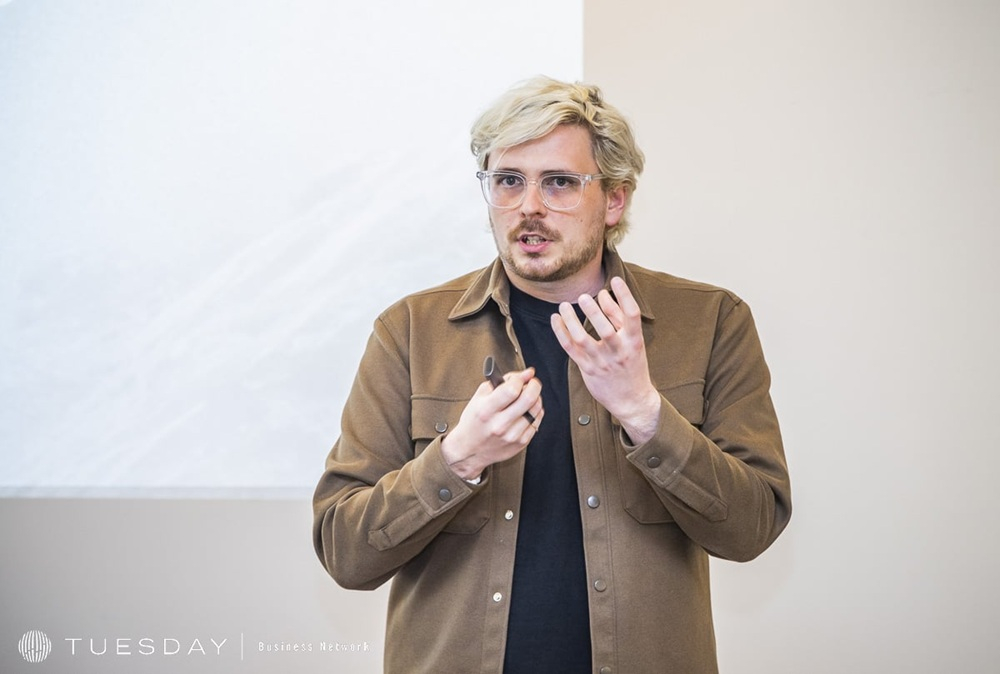 Tomáš Pohl at the Brandstorming conference; Source: Internet Info
Current campaigns are interchangeable, and AI contributes to this
Tomáš Pohl, CEO of the Justmighty agency, also notes that creativity is disappearing from advertising communication. In his view, several concurrent factors are behind this decline. The market is saturated with content, agencies share the same know-how, and companies are using the same channels with the same strategies. The results are therefore inevitably similar. Added to this is a growing obsession with short-term performance: companies want to invest a hundred thousand and pull out three hundred in two weeks. Brand building takes a back seat in such an environment, and corporate approval processes gradually chip away at creativity until nothing original remains. The problem is not so much bad ideas, but rather mediocrity, he also described at the Brandstorming conference.
The relationship between creativity and data is a separate issue. Pohl does not oppose data, but he warns against how its role has shifted in recent years. “Data tells us what has worked historically. It doesn’t tell us why someone should like it, why they should love it,” he reflects. Companies have stopped using creativity to complement data and have started using it to drive it. Reports measure clicks, not emotions, and if everyone optimises according to the same metrics, they will inevitably end up in the same place. Pohl is similarly sceptical about the overestimation of AI. By its very nature, artificial intelligence combines what already exists, and its outputs therefore cannot be truly original. “Creativity does not arise from using this tool. It arises in people’s minds.”
According to Pohl, the solution does not lie in rejecting data or technology, but in the courage to be different. People make decisions primarily on an emotional basis and only rationalise their decisions afterwards. Historically, the best brands have not emerged from data, but from ideas that were not lacking in courage. “The problem is not a lack of ideas. It is a lack of courage on the part of both the implementers and the clients,” he added. According to him, creativity is not merely a decorative element of a campaign. It is a means of creating memorability, and without it, a brand becomes nothing more than a commodity. “The best brands are built on a balance of creativity and data. Data reinforces creativity, but never replaces it. Courage delivers more than optimisation,” he believes.
Source: mediaguru.cz