

The thirteenth edition of the Content First conference, organised by Internet Info, provided up-to-date insights into the current state of content marketing in the Czech Republic and around the world. The central theme of the day, which featured a total of 12 speakers, was artificial intelligence – not merely as a miraculous tool for rapidly generating text or images, but as a phenomenon that is completely transforming brands’ strategic thinking, their approach to communities, the way they work with influencers, and the very essence of SEO itself. Proven content formats, which until recently worked reliably, are coming under pressure due to AI, with clearly visible consequences.
Conflict as the basis of the story
Today, brands are literally stalking their customers in both the digital and real worlds, but they often forget that nobody is interested in them for their own sake. People don’t remember advertising campaigns, but stories. Jiří Langpaul (WeAreGinger, who has worked for the Kooperativa brand since 1999) pointed out that the cornerstone of every story must be a real conflict and a clearly defined enemy. A brand can thus establish its identity through classic archetypes, such as David and Goliath, which worked brilliantly in the insurance sector (“For life as it is”) and propelled Kooperativa from a newcomer to the market leader over the course of a quarter of a century.
However, the real challenge for brands today is not just finding a good story, but sustaining it over the long term. Langpaul pointed out that the greatest threats to communication continuity do not come from competitors, but surprisingly often from within the company itself. These include pressure from new managers eager for change and the egos of creators who want to leave their mark at any cost. The real ‘bragging rights’ lie in building on an already established and functioning story.
 Jiří Langpaul at the Content First 2026 conference; Source: Internet Info
The delicate balance between brand and performance
Using the example of the Astratex e-shop, Michal Bilka described the constant search for a balance between performance and brand marketing. According to him, performance without brand leads only to a discount trap, whereas a strong brand without performance spells a slow death. Astratex divides its communication into educational, inspirational and sales-oriented sections, focusing on real solutions to its customers’ problems rather than the superficial sale of ‘sexy’ goods. In doing so, it establishes itself as a reliable advisor and builds strong trust with its target audience, which often sells more effectively than discounts and pretty photos alone.
At the same time, the brand takes a very open approach to the use of artificial intelligence, for example through the Nano Banana model. At Astratex, AI is not used merely for rough translations, but for lifestyle content localisation across fourteen markets – whilst the photos still feature real models with a specific product, it is artificial intelligence that fills in the contexts and backgrounds. The emphasis is on speed, authenticity and creating content that can be read not only by people but also by modern AI search engines.
 Michal Bilka at the Content First 2026 conference; Source: Internet info
From AI slop to meaningful creation
Petr Koubek from the LCG New Media agency analysed one of the most pressing topics in the current industry debate: how to deal with AI without becoming a mere producer of mediocre “AI fluff” – content that grabs attention but fails to convey anything of substance. Koubek likened the advent of AI to the invention of photography – back then, too, the change meant that artists had to find a new purpose for their work, which led to the birth of new artistic movements, such as Impressionism. For artificial intelligence to be a good servant, its human “superior” must know the rules very well; only then is it possible to break them in a targeted and functional way.
Koubek emphasised that if a campaign does not have a clear idea and objective from the outset, AI will neither deliver nor devise the result on its own. It is not a substitute for human judgement, but merely a means of speeding up processes, conducting research or generating variations. He also advised clients to give their creatives time to work with AI, allow them sufficient freedom, bear in mind that even the prompting itself is demanding work, and be prepared for the fact that seemingly minor visual details are sometimes surprisingly difficult and inefficient to correct in generated materials.
On reviews as “digital gold”
Josef Berger and Mikuláš Kvapil from Emorfiq provided another example of how ineffective “nice texts” generated by AI can be in practice. Their approach to content creation is purely data-driven. They do not view artificial intelligence merely as a chatbot for prompting (AI copywriter), but as the core of a fully integrated ecosystem (AI content engine). In this concept, the system learns from the company’s fixed knowledge base, processes data according to precise rules, and only then is the content automatically published following validation.
The speakers also emphasised the importance of working with user reviews, which can no longer be viewed merely as the end of the purchasing cycle, but rather as one of the most important inputs for AI. The AI can discern the overall sentiment, identify recurring patterns of issues, and immediately suggest responses. In this way, not only is authentic, customer-focused ‘sales’ content created, but thanks to automation, the content spreads more easily, algorithm rankings improve, and the path to easier and smoother expansion into foreign markets is opened up.
 Matěj Smlsal at Content First 2026; Source: Internet Info
The harsh reality of building a personal brand
An authentic story about how collaboration between creators and companies works was presented by influencer Matěj Smlsal (Ten Smlsal), who, after more than a decade, left his job at major newsrooms (Hospodářské noviny, iDnes) and threw himself into building his own YouTube channel. However, he came up against a brick wall when clients were unwilling to pay for videos where view figures were uncertain and which did not feature well-known faces. Low view counts eventually even forced him to take a job as a courier for a while.
The turning point came with the launch of the ‘Celebrity at Driving School’ format. Smlsal eventually learned to work with brands (such as Burger King or Tesco) in a completely different way, with an emphasis on experience, behind-the-scenes company insights and infotainment. He discourages advertisers from overt advertising and attempts to turn social media into corporate brochures. The most valuable lesson from his talk, therefore, remains the realisation that genuine, mutually beneficial collaboration with an influencer does not arise simply from paying a fee, but from the brand’s active participation in creating attractive content that viewers would watch even if there were no commercial interest involved.
Golden rules for choosing the right faces
Speaking of influencer marketing: roughly 81% of companies admit that their biggest problem is choosing the right personality. Michaela Miklasová (Head of Influencer Marketing at the WOO agency) explained that an audience of millions does not necessarily mean high-quality and measurable reach.
According to data from the WOO Influencer Marketing Report 2025, thorough analytics are therefore absolutely essential. Clients should seek the perfect match not only in terms of the right people following the influencer (audience fit), but also in terms of alignment in the content and tone of voice (content fit), and ensuring the brand faces no risk of reputational conflict in the long term (long-term brand fit). She also mentioned working with agency blacklists. The “forbidden” zone includes, for example, personalities and creators with problematic content (including those actively collaborating with the Asian marketplace Temu). She does not see the future in the largest audience, but in building long-term and highly credible ambassadors.
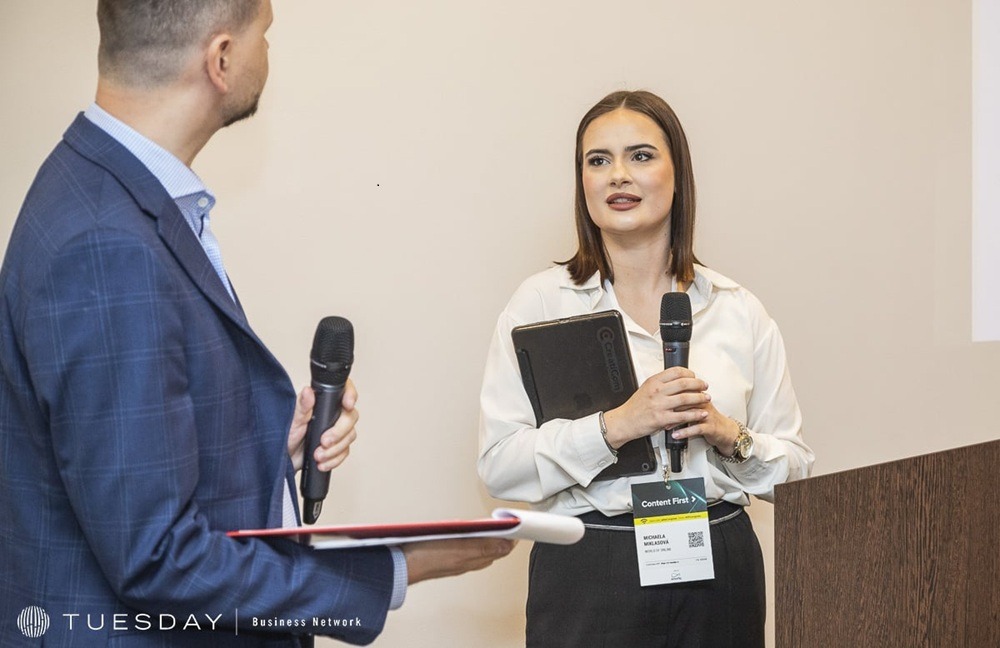 Michaela Miklasová at Content First 2026; Source: Internet Info
Turn passive consumers into a community
David Duc from the ShortPRO agency logically followed on from influencer marketing, focusing on building a genuine and commercially effective online community. He emphasised the fundamental difference between simply subscribing to or consuming videos and genuine audience engagement. Many companies get stuck at the stage of one-way communication or two-way dialogue, but real progress occurs when a third dimension emerges in the form of active audience engagement. He illustrated this with a case study for the Czech popcorn manufacturer Hopi Popi.
Duc noted that brands must not only look at their direct competitors, but also at indirect competitors (for example, a gym should be aware of community channels about nutrition or exercise in general). According to him, comments are a powerful yet most underrated aspect of communication, through which a company can generate content, gauge sentiment and extend the valuable time a user spends with a video. To establish a high-quality and credible identity, companies must provide context, define a common ‘enemy’ and offer people status and a sense of involvement, including the human and natural admission of minor mistakes and imperfections.
An artificial face that never lets you down
Virtual ambassadors (AI avatars) are a new tool that marketers should start thinking of as a new corporate asset. Alexander Bruna (Elevaty.ai) analysed the reasons why we are gradually moving away from characters designed purely for entertainment towards fully-fledged influencers such as Lil Miquela (a virtual singer collaborating with brands such as Prada and BMW), who, moreover, pose no risk of damaging a brand’s long-established reputation overnight through inappropriate behaviour.
The younger generation perceives these virtual influencers as completely natural and highly authentic, and in many respects, the young audience even considers them more attractive partners for communication. From an initial investment of several hundred thousand crowns, the brand gains a fully compliant representative who can flexibly and consistently create campaigns for it, handle customer care and moderate internal corporate marketing communications, all with minimal additional production costs but with absolute reliability and control over the entire identity.
Search engines are looking for genuine expertise
According to Klára Chaloupková and Veronika Martinec Decsy from the eVisions agency, a complete game-changer has also hit the SEO and copywriting sectors. According to the analysis, traditional click-through rates are falling because search engines no longer look for isolated and often self-serving keywords alone. Thanks to more sophisticated language models, the credibility of sources and context are now absolutely crucial. A new trend is therefore emerging strongly – the E-E-A-T concept (experience, expertise, authoritativeness, trustworthiness).
Both speakers therefore warned companies against replacing quality copywriting with the mass production of cheap paragraphs generated via simple prompts. Instead, authors and brands should collaborate expertly on content creation, for example directly with product managers. A good introduction and a summarising conclusion play a crucial role here, as models often gather answers and data from precisely these sections. For a website to ‘captivate’ not only readers but also artificial intelligence, it must act as a highly reliable source of information brimming with verifiable knowledge. The future of SEO also lies in video or in the ability to answer ‘How to…’ questions, which are among the most frequently searched, and AI-driven SEO ranks them as preferred.
 The Content First 2026 conference took place at the Jalta Boutique Hotel in Prague; Source: Internet Info
Corporate media is not content, but a service
We are moving away from mere production towards content conceived as useful assistance for customers and employees. Lucie Milerová from the agency 52pages pointed out that people have long since stopped wanting to read lengthy articles, let alone download e-books – people need immediate answers to their questions from companies and expect precise comparisons. In short, corporate content is meant to serve a purpose.
A company that creates content should take on one of three roles where the use of artificial intelligence offers enormous added value. It can become an effective ‘curator’ of its own internal data (unlike large global models, a corporate curator offers accuracy and protection against data being transferred to competitors). Equally effectively, it can fulfil the role of an internal “translator” in a multilingual corporate environment, where AI can be used, for example, to translate or even dub videos for employees quickly, accurately and flawlessly. And last but not least, the brand can take on the classic role of a “publisher”, delivering original editorial and highly distinctive content.
Authentic and imperfect podcasts
Although artificial intelligence is already fully involved in podcast production (around 39% of new titles over the past month were AI-generated), according to Hana Němečková (Storylab), it still lacks the most important elements for full-time hosting: emotion and authentic human imperfection. This is because, by their very nature, podcasts are still more of a small-scale, community-based and improvisation-driven affair than a generically standardised factory-made show.
The importance of this format is also clearly demonstrated by a recent move by the giant Netflix, which has made a significant and massive entry into the podcast community. Whilst having avatars host podcasts or using artificial intelligence to generate content has not yet yielded very good results and is largely rejected by the audience (see the failure of S. Bartlett or the much-criticised The Epstein Files from Apple Podcasts), technology does an excellent job in the production process itself. It provides a great relief from demanding and tedious ‘administrative’ and managerial work, handling quick research, creating engaging descriptions, automated script transcription, editing for Reels videos, or generating preview visuals.
A lack of strategy is the killer of content
The final thought, which in a way sums things up to a certain extent, came at the very end. Where does the problem lie in the fact that, despite the existence and easy availability of dozens of sophisticated data analytics tools and well-designed AI tools, the vast majority of online content lacks the right spark and any deeper emotion? Jan Pilát, a representative of WPP Media Czech Republic, sees the culprit in the absence of a well-thought-out strategy.
Content messaging must be viewed through three fundamental pillars, between which there should be synergy. Data provides the foundation, offering insight into the customer’s psyche. Each chosen medium then requires a very thorough understanding of and respect for its inherent capabilities as well as its strict technological limitations. The third pillar is human creativity itself (perhaps even supported by AI tools). Only where smart “data-driven storytelling” with a human touch enters this mix (as demonstrated by a case study in the form of a modification of the well-known experiment involving a Mentos sweet dropped into a Coke – the Mentos Fizzooka) can we evoke the warm emotions that algorithms are still unable to replicate.
Source: mediaguru.cz