

What you will find in the article:
- History of chocolate from ancient civilizations to modern times
- Impact of advertising on chocolate consumption and marketing
- Significant milestones in chocolate production and innovation
- Iconic chocolate commercials, including Cadbury's "Gorilla" ad
- International Chocolate Day and its cultural significance
Chocolate has been part of human history for thousands of years. The ancient Maya and Aztecs valued cocoa beans so highly that they even used them as currency. The Aztecs also prepared a bitter, spiced drink known as cacáhuatl, consumed primarily by rulers and priests during ritual ceremonies. They believed it had both stimulating and medicinal properties. Cocoa only acquired its sweeter character after arriving in Europe. When the Spanish brought it to the continent in the 16th century, its original bitter taste did not particularly appeal to European palates, so sugar and other ingredients were added to the drink. Over time, it evolved into a luxury delicacy enjoyed primarily by the European aristocracy.
International Chocolate Day
Chocolate underwent a fundamental transformation in the 19th century with the development of industrial cocoa processing. The invention of the cocoa press in 1828 made it possible to separate cocoa butter from cocoa solids, paving the way for further innovation. In 1847, British company J. S. Fry & Sons introduced the first modern chocolate bar, while the first milk chocolate was created in Switzerland in 1875. What had once been a luxury reserved for the elite gradually became a product accessible to an increasingly broad consumer base.
American entrepreneur Milton S. Hershey also played an important role in bringing chocolate to the mass market. His company launched its first own-produced milk chocolate bar in 1900. International Chocolate Day, celebrated on 13 September, is commonly associated with Hershey’s birthday.
The scale of today’s chocolate business is enormous. In 2026, the International Cocoa Organization (ICCO) reported that global cocoa bean production reached approximately 4.73 million tonnes in the 2024/2025 crop year. Cocoa production is also highly concentrated geographically, with a substantial share coming from West Africa. As a result, harvest developments in the region can influence chocolate prices around the world.
From Print Advertising to Television
It is difficult to determine who created the very first chocolate advertisement. Cocoa and chocolate were promoted in newspapers, on billboards and in commercial catalogues long before modern advertising archives existed. One particularly early surviving example, however, is an 1863 advertisement by British company J. S. Fry & Sons promoting Fry’s Chocolate in a contemporary travel guide.
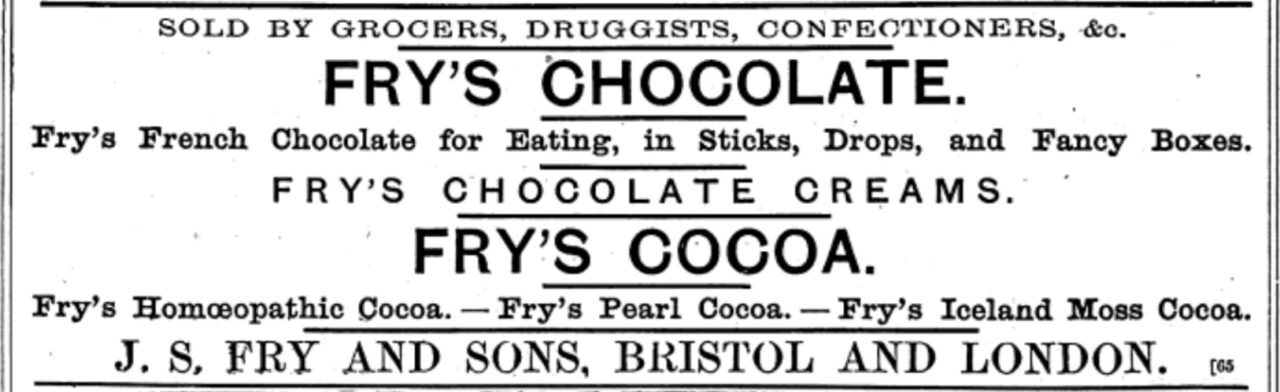 Source: Fry and Sons, Public domain, via Wikimedia Commons
Fry’s played a pivotal role in the history of chocolate. The company was among the pioneers of solid chocolate bar production and, together with Cadbury and later Rowntree’s, helped shape the modern British chocolate industry. By the first half of the 20th century, chocolate brands were making extensive use of posters, illustrations, mascots and celebrities, while advertising characters increasingly became part of popular culture.
Research into interwar British advertising, for example, documents the Cocoa Nibs mascots introduced by Rowntree’s in 1919 and subsequently used in the company’s poster campaigns.
Historically, chocolate manufacturers often highlighted the product’s nutritional qualities, positioning chocolate as a wholesome food particularly suitable for children and soldiers. Cadbury’s “Glass and a Half” advertising device, introduced in 1928, helped the brand build an image centred on trust and nutritional value.
Television marked a turning point. Cadbury was among the earliest advertisers on British commercial television. Its Cadbury Drinking Chocolate commercial aired on 22 September 1955 as part of the advertising shown during the very first evening of broadcasts by British commercial broadcaster ITV. In retrospect, it was a historic moment: Cadbury and its chocolate drink advertisement were there at the very beginning of British television advertising.
By the late 1950s, television had already become a key medium for chocolate manufacturers. According to a study examining the history of Cadbury advertising, television accounted for approximately 64% of all chocolate advertising in 1959. Television commercials gave chocolate brands an entirely new way to engage consumers through moving images, music and emotion.
Cadbury Dairy Milk and the Drumming Gorilla
One of the most iconic chocolate commercials is “Gorilla”, launched by Cadbury Dairy Milk in 2007. The 90-second film features a gorilla sitting behind a drum kit, waiting for the famous drum break in Phil Collins’ In the Air Tonight. The chocolate itself only appears at the very end. There are no ingredients, no indulgent close-ups of someone tasting the product and virtually no conventional product messaging.
Video: Cadbury's Gorilla (2007)
Agency Fallon set out to create an advertisement that would not attempt to explain the joy of chocolate, but would instead generate that feeling itself. The concept departed dramatically from the conventions of food advertising at the time, yet proved commercially successful. According to Cadbury, Dairy Milk sales rose by approximately nine per cent in the short term following the campaign’s launch. The commercial also generated enormous online attention and inspired hundreds of parodies.
In 2008, the campaign won, alongside “Halo 3”, the Grand Prix in the Film category at Cannes Lions. It was the first time in the history of the festival’s Film category that the Grand Prix had been shared between two entries. During the same period, Gorilla also received the prestigious D&AD Black Pencil and Yellow Pencil, as well as Gold at the British Arrows.
A commercial that deliberately ignored almost every conventional rule of food advertising thus became one of the defining case studies in 21st-century advertising creativity.
Cadbury Dairy Milk: When Eyebrows Dance to the Beat
Cadbury followed the success of its unconventional advertising approach with “Eyebrows” in 2009, once again choosing humour over traditional chocolate presentation.
Two children are waiting in a photography studio to have their picture taken. As soon as the photographer steps away, they begin moving their eyebrows in synchronised rhythm to Don’t Stop the Rock. The commercial was again created by Fallon and directed by Tom Kuntz. In 2009, it became the most-watched advertisement on the British website tellyAds.com and attracted approximately five million views on YouTube.
Video: Cadbury Dairy Milk – Eyebrows
The commercial also received industry recognition. In 2008, it won a D&AD Wood Pencil and Bronze at the Clio Awards. In 2010, it added Gold at the British Arrows in the confectionery and snacks category.
Galaxy Chocolate and the Return of Audrey Hepburn
A bus breaks down on the Italian coast. One of its passengers, a digitally recreated Audrey Hepburn, steps out and accepts a lift from an elegant man in a convertible. As they drive along the coast, she enjoys a bar of Galaxy chocolate.
Agency AMV BBDO and visual effects studio Framestore created the 2013 commercial using body doubles and computer-generated effects to recreate the appearance of Audrey Hepburn, who died in 1993. The use of her likeness was approved by her sons.
Video: Galaxy – Audrey Hepburn
Côte d’Or and the Untamed Power of Chocolate
In 2016, Côte d’Or launched a campaign connecting the brand’s African roots, its iconic elephant symbol and the intense sensory pleasure of chocolate.
Similarities in colours, shapes and textures create a visual parallel between cracks in natural landscapes and pieces of chocolate breaking apart. The commercial symbolically demonstrates how the power of untamed nature is reflected in the chocolate’s intense flavour.
Video: Côte d’Or – Le plaisir à l’état brut (2016)
Lindt Excellence Delivers an Intense Sensory Experience
In 2019, Lindt launched an international television campaign for its Excellence dark chocolate range, focusing on an intense sensory experience.
In the commercial, directed by Karina Taira, a woman arrives home after a demanding day, slips off her heels, puts a record on the turntable and enjoys a moment of relaxation with a bar of chocolate. Extreme slow-motion close-ups of the chocolate are intercut with shots of a master chocolatier at work.
The advertisement combines personal indulgence with the craftsmanship of chocolate-making, emphasising the intensity of the product’s flavour. The commercial was created by Hamburg-based agency TRACK for Lindt Excellence’s international dark chocolate campaign and began airing on German television in August 2019.
Video: Lindt Excellence
Milka: From the Purple Cow to Tackling Loneliness
Milka deserves a chapter of its own. In 1972, the brand elevated the purple cow to a central symbol of its advertising communication. A year later, the unusually coloured animal also appeared in a television commercial and gradually became one of the best-known advertising mascots.
For decades, Milka used its purple cow and idyllic Alpine scenery to build a distinctive brand world centred on tenderness, gentleness and kindness.
Video: Milka: Troufni si na jemnost
As the brand demonstrated in 2024, however, these values can also be used to address more serious social issues. In partnership with the Spanish Red Cross, Milka launched “Ternura contra la soledad” (“Tenderness Against Loneliness”), a campaign drawing attention to the issue of unwanted loneliness.
The commercial, created by Ogilvy, features five real people who share their experiences of loneliness from inside a transparent cube installed on a busy street in Madrid. They also recall small acts of kindness that helped them through difficult moments.
The campaign reminds audiences that sometimes a simple phone call, a hug or genuine interest in another person can make a difference. Milka also supported the Red Cross programme with a donation of €100,000 and pledged a further five cents for every complete view of the video on YouTube, up to an additional €20,000.
Video: Milka a Červený kříž – Ternura Contra La Soledad
Chocolate in the Czech Republic
The Czech Republic also has a strong chocolate-making tradition. According to Nestlé, its Zora factory in Olomouc currently produces more than 40,000 tonnes of chocolate per year. The factory manufactures products for brands including Orion and Studentská pečeť, as well as confectionery for export to markets such as the United Kingdom, Germany, France and Ukraine. Studentská pečeť itself celebrated its 50th anniversary in 2025. According to Nestlé, Studentská pečeť ranks among the three best-selling chocolate brands on the Czech and Slovak markets. By August 2025, when the brand celebrated its half-century anniversary, more than 12 million bars had already been produced in Olomouc.
This long-standing tradition of domestic chocolate production is also reflected in television advertising. Czech chocolate commercials differ from many international campaigns in one particularly interesting respect. Global brands often seek the simplest possible universal theme – one that will work equally well in London, New York and Tokyo. Local brands, by contrast, are far more likely to draw on tradition, national identity, family memories and a sense of familiarity. They sell not only taste, but also the feeling that this is a product consumers have “always known”. Orion is a good example, consistently emphasising Czech roots, family traditions and everyday moments of happiness in its brand communication.
The roots of Orion date back to 1896, when the Maršner family began producing confectionery. The Orion brand itself was officially registered in 1914. In its 2021 campaign “Naše čokoládová radost” (“Our Chocolate Joy”), the brand depicts everyday situations typical of Czech and Slovak life – family baking, summer days by the water and small shared rituals. Chocolate is not presented as an extravagant hero of the campaign, but as a natural part of everyday life.
Video: Orion – Naše čokoládová radost
Also worth revisiting is “Čokoládové městečko” (“Chocolate Town”), introduced by Orion as early as 1993. The animated fairytale world was accompanied by a swing song performed by Ondřej Havelka. Its fairytale visual style and distinctive musical theme became such recognisable elements of Orion’s communication that the brand continued to revisit them in various forms in subsequent years.
Video: Orion – Čokoládové město
Studentská pečeť was created in 1975 by combining chocolate with peanuts, raisins and jelly pieces. According to the manufacturer, the combination has no direct equivalent anywhere else in the world. Studentská pečeť’s advertising can therefore draw both on its long history and on its distinctive combination of ingredients.
Video: Studentská pečeť
In 2017, however, the brand decided to connect with a younger generation through a campaign celebrating individuality, freedom and the courage to break away from convention. Directed by Milan Balog, the television commercial follows young people who refuse to conform to the expectations of those around them and choose to enjoy life on their own terms. The brand effectively translated its defining product characteristic – the unconventional combination of chocolate, peanuts, raisins and jelly – into an advertising proposition encouraging consumers to live by their own rules. The campaign was created for the Czech and Slovak markets. In February 2018, the brand brought the original television commercial back on air and supplemented the campaign with a new consumer promotion.
Video: Studentská pečeť – Žij podle vlastních pravidel
Chocolate Takes Centre Stage
What do a purple cow, children dancing with their eyebrows and people talking about loneliness inside a transparent cube have in common? At first glance, absolutely nothing. Yet all of them have appeared in chocolate advertising. They demonstrate just how far chocolate marketing has evolved beyond traditional product presentation. Advertising creatives are no longer afraid to embrace absurd humour, fantasy, digital technology or serious social issues. Sometimes they even push the chocolate itself into the background, devoting almost all the audience’s attention to a story that may initially seem to have very little to do with the product. The sheer diversity of these approaches shows that even a product as familiar as chocolate can continue to inspire fresh advertising ideas.And that the route to a viewer’s attention does not necessarily have to go through their taste buds.