

What you will find in the article:
- Marketers are increasing their investment in AI, but have doubts about its effectiveness.
- Consumers are more satisfied with advertising and are complaining about it less.
- AI assistants are widely used, but enjoy low levels of consumer trust.
- Investment in micro- and nano-creators is growing; relevance is key.
- Google dominates in terms of advertising appeal, whilst Twitch and Pinterest are also popular.
Advertisers are increasing their investment in AI assistants at a relatively rapid pace, although consumers remain cautious about chatbot recommendations, according to this year’s wave of the survey, which involved interviews with more than 800 senior marketing professionals and also drew on findings from a survey of 23,000 consumers worldwide.
Fewer complaints on the one hand, more scepticism on the other
In recent years, marketers have had to take into account an unprecedented number of different factors when planning media campaigns. AI is rapidly becoming an integral part of the media landscape, the importance of creator-generated content is growing, and it is therefore becoming increasingly difficult to navigate an ever more fragmented media mix and a growing volume of data.
Only half of advertisers are confident that they have struck the right balance between brand building and performance marketing (compared to 60 per cent in 2025). Fifty-seven per cent of advertisers are confident that their organisation’s media mix is correctly calibrated, compared with 64 per cent in 2025. And only 51 per cent feel they are able to derive practical insights from their data that help them meet their marketing objectives.
From the consumers’ perspective, however, the picture is not quite so bleak. In 2026, consumers are generally complaining less about advertising. The proportion of those who feel there is too much advertising has fallen from 25 to 21 per cent, and the proportion of those who find adverts too repetitive has dropped from 24 to 20 per cent. Efforts to actively avoid adverts have also weakened year-on-year (from 21 per cent to 18 per cent). Consumers are therefore more satisfied with the adverts they are exposed to, which suggests that marketers are doing their job better.
Marketers’ uncertainty is therefore not entirely justified. Moreover, the large number of channels they must use today work well in combination with one another. According to the Kantar LIFT database, an ever-increasing proportion of campaign effectiveness today stems from individual media channels reinforcing one another. Between 2020 and 2025, this synergy between channels accounted for 43 per cent of campaign effectiveness, whereas before 2014 it was only 18 per cent.
As AI and the creator economy mature, and the commercialisation of previously non-commercial channels continues, it will become increasingly important for marketers to recognise which changes and information to pay attention to. This is precisely what can help them avoid a return to the days when consumers actively avoided advertising on a large scale.
AI assistants: high usage rates, but they need to earn trust
Almost three-quarters of consumers (73 per cent) use AI assistants in their personal or professional lives, and a third already use them to search for information about brands and products. However, less than a quarter (24 per cent) of consumers trust brand recommendations from AI assistants. In terms of advertising appeal – which takes into account both consumer preferences and their presence on individual channels – AI assistants ranked as low as 20th out of 27.
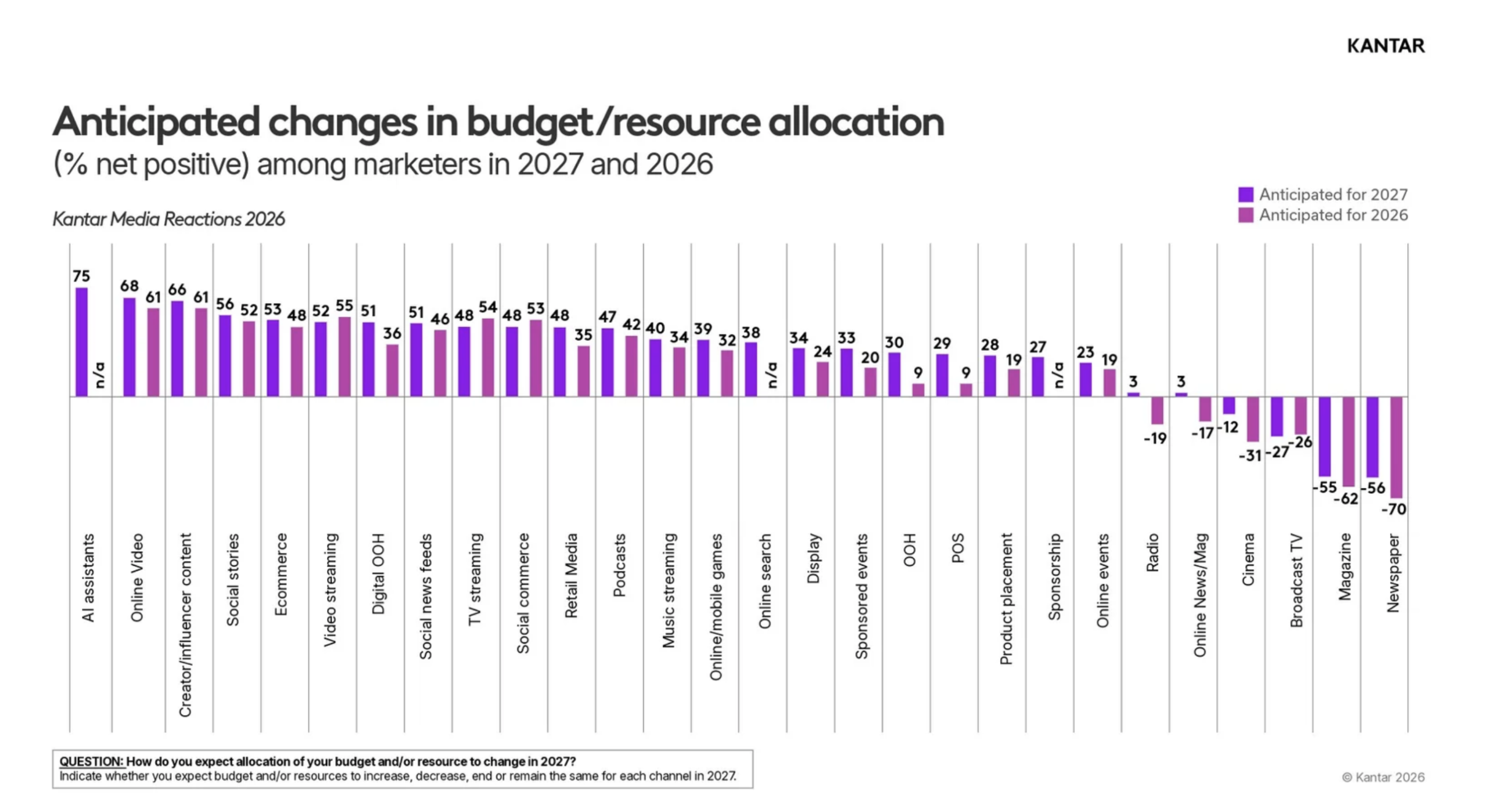
Yet exactly three-quarters of marketers plan to increase their investment in visibility within AI assistants by 2027, including paid advertising. At the same time, many marketers recognise that this is precisely where brands that differentiate themselves in a meaningful way can stand out. More than six in ten marketers (62 per cent) believe that AI will significantly influence, in the future, which brands are recommended to consumers and what advice they receive when making their choices. It will therefore be crucial to differentiate oneself meaningfully not only in the eyes of people, but also in those of machines.
Creators: from follower numbers to relevance for specific communities
Marketers have been increasing their investment in collaborations with creators and influencers for several years, but their relationship has not always been as mature as it is today. Currently, 62 per cent of marketers believe that brands should guide creators rather than control them. Furthermore, planned investments are shifting in favour of micro- and nano-creators at the expense of the big ones, which shows that marketers value their ability to reach the right audience more than the sheer number of followers.
Almost half of marketers worldwide view creators as partners in creative production and storytelling (47 per cent) and value their ability to reach specific communities rather than a broad audience (45 per cent).
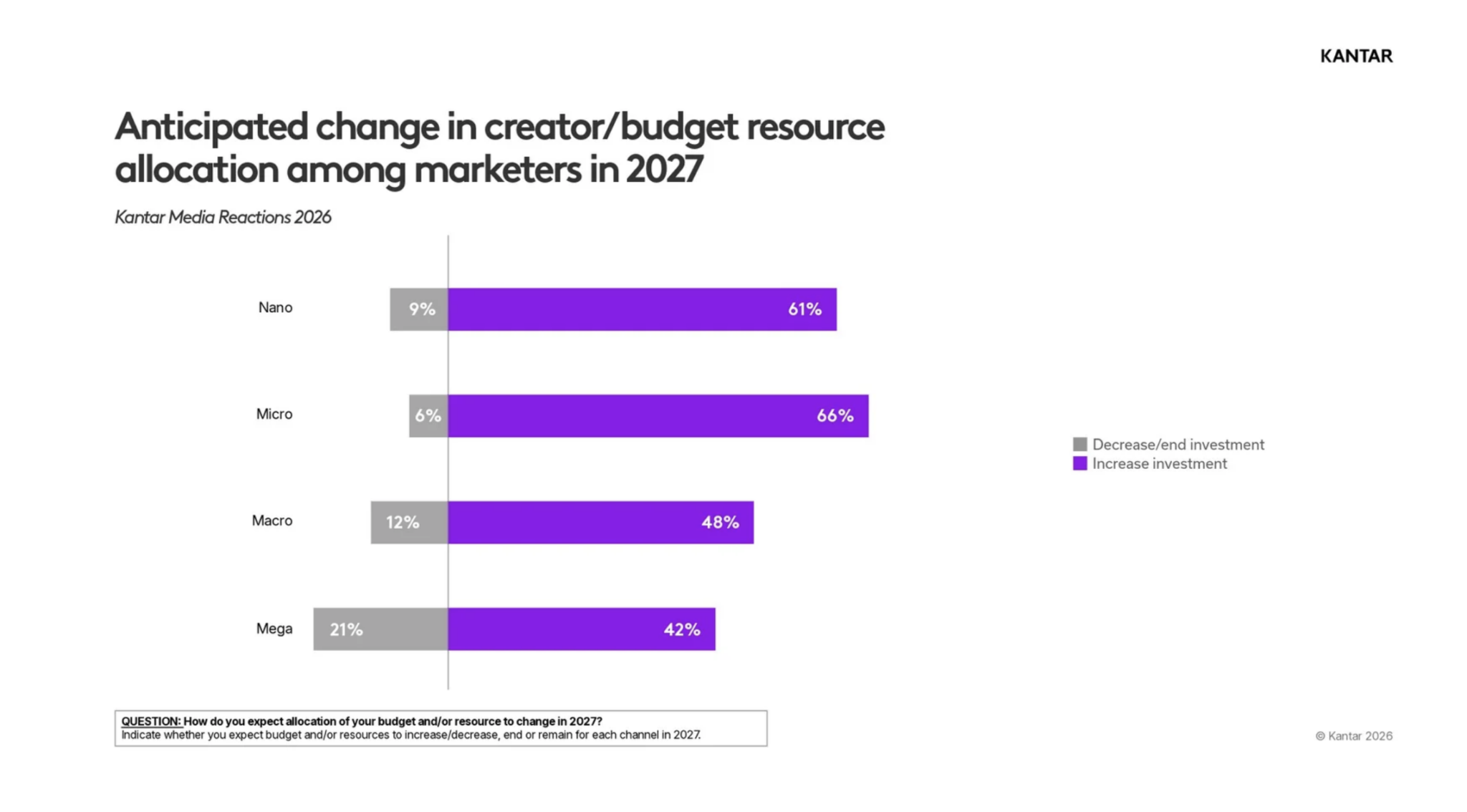
And, as always, it depends on the context. Consumers are more open to brands collaborating with creators in the categories of clothing and footwear, food and dining, and out-of-home entertainment. At the opposite end of the scale are healthcare, children’s products and personal finance.
Commerce: a layer across touchpoints, not a standalone channel
Today’s shopping journey also extends to media channels that were not originally intended for shopping at all. Almost a third of consumers (32 per cent) now use social media to browse or buy products; a fifth say they often first hear about new products from content creators; and 17 per cent would even entrust a purchase to an AI assistant in the future.
With the advent of retail media, it no longer makes sense to view ‘commerce’ as a standalone channel. It is now becoming a layer permeating the entire media landscape. However, neither “social commerce” nor content creators are among the advertising channels that consumers prefer most. Marketers should therefore proceed with caution when experimenting with these options, testing them and continuously evaluating what works.
Google and YouTube offer an advertising environment that works
Google tops the global rankings for advertising appeal among consumers, thanks to the high popularity of its adverts and their wide reach. Eight out of ten consumers encounter adverts on Google, and global brands consider them the most relevant and useful. Following Google in the top five are Amazon, YouTube, Instagram and Netflix.
Whilst Google and other platforms benefit from broad reach, Twitch, Disney and Pinterest stand out in terms of consumer preferences themselves. For campaigns targeting more specific audiences, it is on these platforms that consumers are most open to adverts and have the most positive attitude towards them. Pinterest scores particularly highly for the relevance and usefulness of its adverts, Disney for their entertainment value, and Twitch for the higher perceived quality of its adverts.
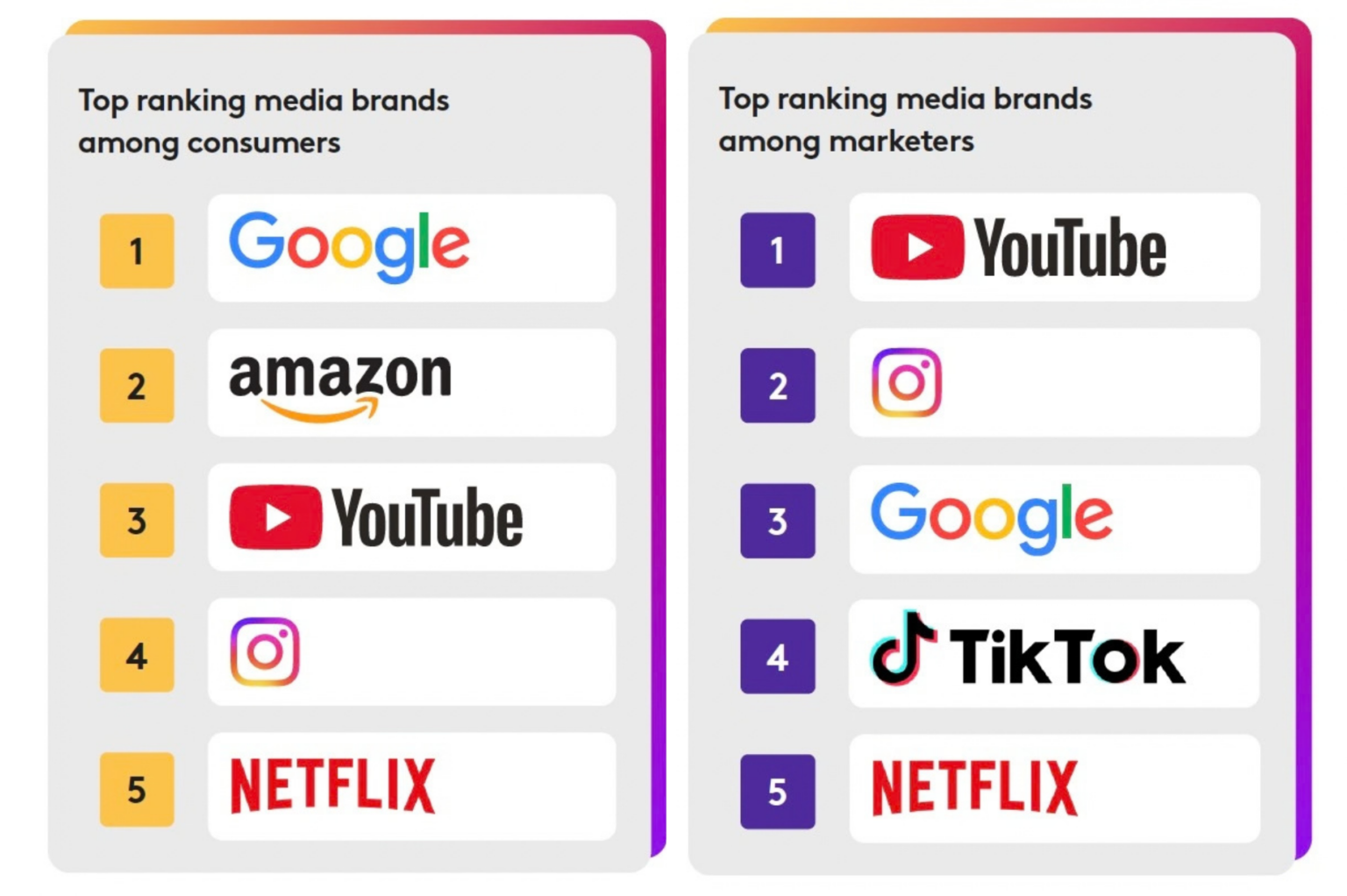
Marketers’ preferences remain closely linked to which platforms they trust. In terms of openness to advertising, YouTube leads the way, followed by Instagram, Google, TikTok and Netflix – platforms which marketers also trust significantly. They cite the credibility and transparency of measurement as the most important factors in this trust, followed by brand safety and consumers’ openness to advertising on a given platform. The order of these factors matters: transparency is a fundamental prerequisite, but it is not the only criterion that marketers consider.
However, marketers’ investments do not directly mirror this ranking of platforms. When deciding on budgets, other factors play a role alongside trust, such as reach, the presence of other brands, or previous investment levels. In 2027, more than half of marketers worldwide plan to increase their spending on TikTok, followed by YouTube and Instagram. TikTok has been attracting growing investment practically since its inception and is now also among the platforms that marketers trust the most.
Source: aka.cz