
What you will find in the article:
- Historie piva sahá až 13 tisíc let do minulosti, pivo se stalo součástí kultury už ve starověkém Egyptě.
- Reklama na pivo se vyvíjela od jednoduchých znamení přes barevné litografie, které změnily reklamu na umění v 19. století.
- Pivní značky začaly vytvářet vlastní reklamní světy ve 20. století a dodnes patří reklamy na pivo k těm oblíbeným.
The story of beer does not begin in a pub, brewery or medieval monastery. Its history is much older. In Raqefet Cave in present-day Israel, archaeologists discovered remains of equipment and fermented cereal mixtures dating back approximately 13,000 years. Experts interpret them as evidence of the production of a beer-like drink, probably prepared for ritual feasts of the Natufian culture. It was, of course, nothing like the clear golden lager we know today, but rather a thick, cloudy and only mildly alcoholic cereal mixture.
Several thousand years later, in the 4th millennium BC, beer was already firmly established as part of everyday life in Mesopotamia. At the time, beer was brewed by women, who used barley and an ingredient known as bappir, believed to have been a special barley bread intended for brewing. People often drank beer together through straws from a shared vessel, so even then it was not merely refreshment, but also an occasion for sharing and social interaction, much as it is today.
Beer was also a common part of the diet in ancient Egypt. It was therefore not simply a luxury drink consumed during celebrations. Labourers, soldiers and people working on major construction projects received it as well. Together with bread, beer represented an important source of energy and could form part of wages or rations. Egyptian beer was generally thicker and less filtered and tasted very different from beer today. Even so, different varieties and production methods already existed.
In medieval Europe, beer brewing gradually moved into monasteries, urban households and professional breweries as well. Monasteries in particular provided an ideal environment for passing on recipes and refining production methods. A Czech example can be found at Strahov, where written records document a brewery as early as around 1400. Rulers and city councils also sought to control beer quality and composition. The best-known example is the Bavarian regulation of 1516, according to which beer was to be brewed from barley, hops and water. Yeast was not included on the list. Brewers used it in practice, but its microbiological role in fermentation was not yet understood.
A New Beer Style
A crucial moment in modern beer history took place on 5 October 1842 in Pilsen. Bavarian brewer Josef Groll produced the first batch of a new pale bottom-fermented beer. The combination of pale malt, Saaz hops, soft Pilsen water and a new brewing process created a beer with a sparkling golden colour, pronounced bitterness and a white head. Breweries around the world began imitating the Pilsner-style lager, and the words “pils”, “pilsner” and “pilsener” became names for an entire beer style.
And although today’s breweries use stainless-steel tanks, precise laboratory analyses and automated production lines, the basics remain surprisingly similar: malted grain provides sugars, hops add bitterness and aroma, yeast converts sugar into alcohol and carbon dioxide, and water makes up most of the final drink – delicious beer. Over thousands of years, humanity’s fondness for fermented grain has hardly changed. What has changed is our ability to control the process. And the way this delicious brew is promoted has changed too.
The Oldest Beer Advertisements
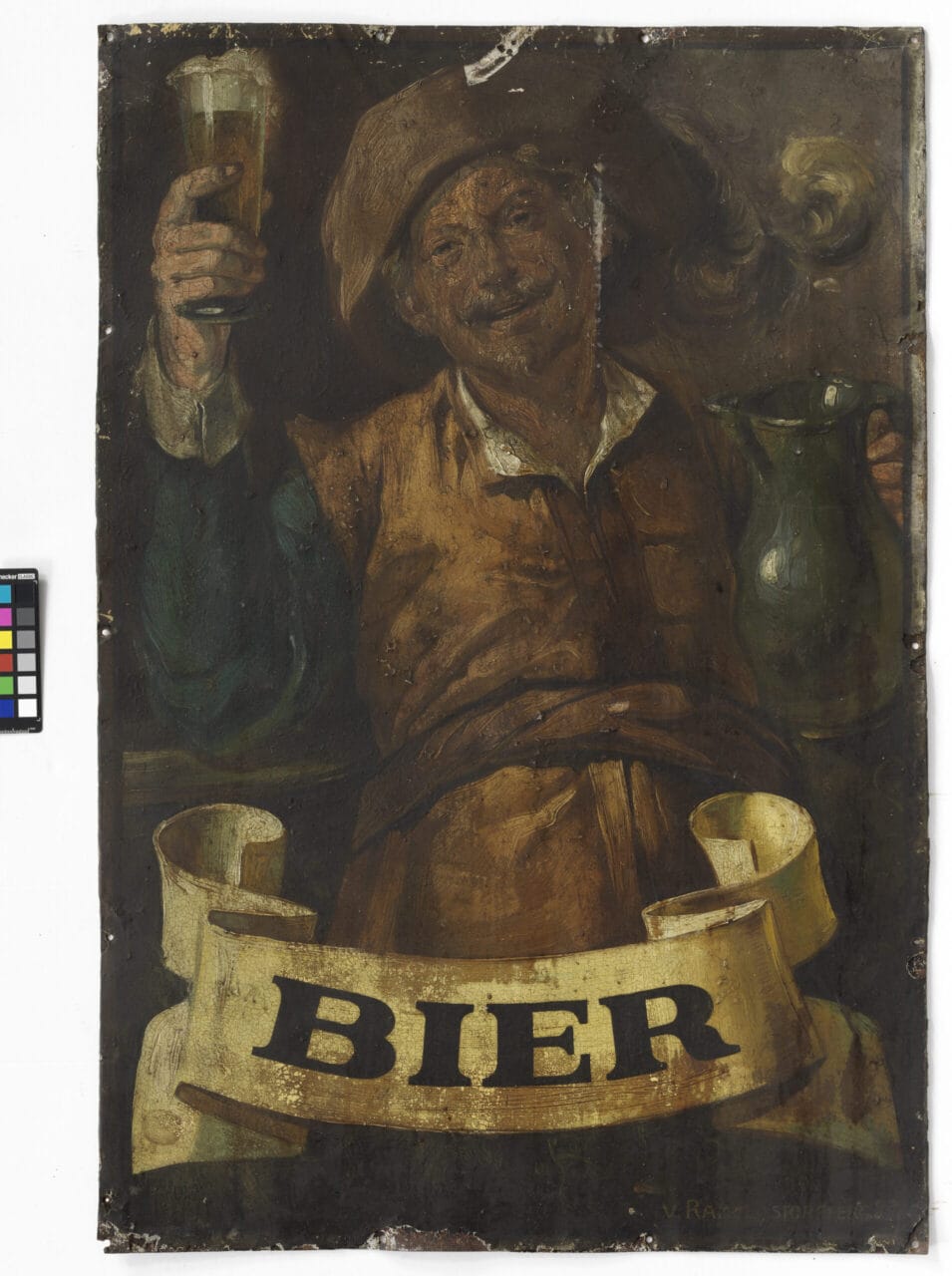
Once, it was enough simply to signal that beer was served here. Among the earliest forms of beer advertising were simple signs placed outside a house or inn. In medieval Europe, freshly brewed beer might be announced by a branch, a bundle of greenery or a broom hung above the door. Later came painted pub signs. Their major advantage was that even people who could not read could understand them. Advertising at the time therefore made no promises of exceptional flavour or memorable experiences with friends – it simply announced that beer was sold there. The Wien Museum holds an inn and shop sign marked “Bier”, dating from approximately 1820–1840. It depicts a man drinking, as well as a beer mug and a glass. The sign came from a house on Nikolsdorfer Straße in Vienna that was demolished in 1843.
 Source: Unknown artist; photo by Birgit and Peter Kainz, Wien Museum, CC BY 4.0.
As brewing became more professional and transport networks developed, beer stopped being only a local product. Breweries began using bottles embossed with the producer’s name, paper labels, crown caps, beer mats, tap handles, metal signs and advertising trays. Customers therefore encountered the brand not only in newspapers, but directly on the table, on the bottle or at the bar. Packaging was no longer there merely to protect the contents – it also had to ensure that people remembered the name of the beer.
This shift can be seen particularly clearly in the history of Pilsen lager. Beer from the Citizens’ Brewery began to be exported to Vienna in 1856, reached the United States in 1873 and gradually spread to other cities around the world. Because the word “pilsner” increasingly came to be used as a generic term for the beer style regardless of origin, the trademark Plzeňský Prazdroj – Pilsner Urquell was registered in 1898. The brand was no longer promoting taste alone, but also origin and authenticity.
In the 19th Century, Advertising Became Art
The true revolution came with improvements in colour lithography. From the second half of the 19th century, large, colourful and visually striking posters could be printed more cheaply. Breweries were suddenly competing not only on the quality of their beer, but also over who could attract more attention on the street or at the railway station. Advertisements featured elegant ladies, satisfied guests, imposing breweries, golden glasses of beer and sometimes even the brewers themselves as guarantees of authenticity. One of the most famous examples is the Bières de la Meuse poster created by Alphonse Mucha in 1897. The woman holding a glass of beer wears a wreath of poppies, wheat ears and hops in her hair. The advertisement is no longer merely saying “buy this beer”. It sells beauty, elegance and a particular lifestyle – exactly as film and music celebrities would later do.
Slogans and Mascots
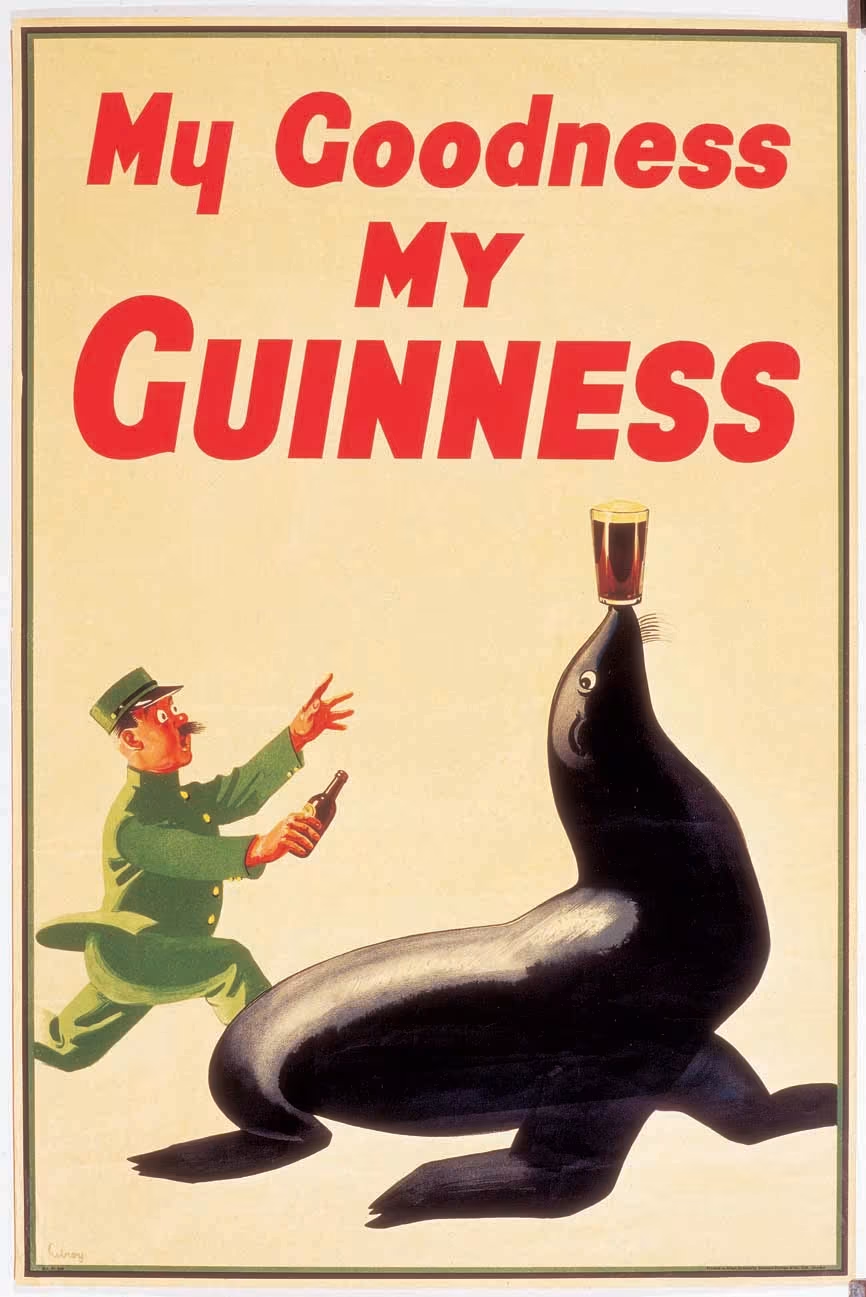
In the 20th century, beer brands began creating advertising worlds of their own. Guinness, for example, did not officially advertise for approximately the first 170 years of its existence. Its first nationwide advertisement in the British press appeared in February 1929 with the slogan “Guinness is Good for You”. The brand subsequently worked with artist John Gilroy, who created campaigns full of humour, unusual animals and easily remembered situations. In May 1935, a Guinness advertisement featured a sea lion running away from its keeper with a glass of beer, while the famous toucan made its debut in the autumn of the same year. It became so popular that it returned on posters throughout the 1950s and later appeared in television advertising as well. Guinness thus gained an instantly recognisable face, personality and distinctive sense of humour.
 Source: https://www.guinness-storehouse.com/en/whats-hoppening/history-of-guinness-toucan
Advertising on Trucks, at Trade Fairs and World Expositions
Historical beer advertising was by no means confined to paper. Breweries branded company carts and trucks, opened exhibition pavilions, supplied equipment to pubs and sponsored public events. Pilsner Urquell, for example, presented itself at the Poznań trade fair in 1925. In 1932 and 1933, the brewery supported the Spexor automotive expeditions to the Orient and Africa, which according to the company archive generated considerable advertising attention. In 1937, it opened its own restaurant pavilion at the Paris World Exposition.
That same year, an advertisement for Pilsner Urquell appeared on the back cover of the American magazine Night Life with a slogan that can be loosely translated as: “The whole city brews it, the whole world drinks it, smart places serve it!” Beer was thus presented as an international product with just one true home – Pilsen.
Television Brought Storytelling and Humour
Then television entered beer marketing. From the 1950s onwards, television became one of the main advertising media. Static posters gave way to TV commercials full of movement, music, dialogue and short stories. Spots could resemble comedies, musicals, adventure films or sports broadcasts. Famous actors, singers and athletes gradually entered advertising because they could give a brand a personality in just a few seconds – something brands had previously spent years developing through illustrated mascots and slogans.
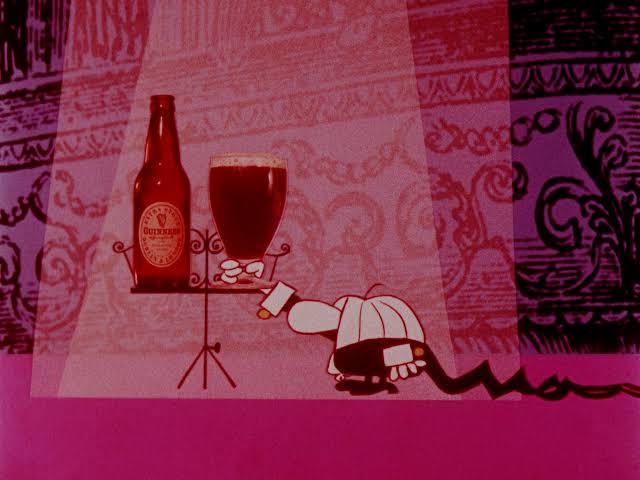
A good example of advertising from the 1960s is the animated spot “Guinness at the Albert Hall”. It shows a conductor moving members of a choir around. After taking a drink of beer, he gains so much strength that he can lift the entire choir. The one-minute commercial was directed by animator Richard Williams, later a three-time Academy Award winner best known for his work on Who Framed Roger Rabbit. The British Film Institute states that the advertisement became an important milestone in Williams’s career and won several awards.
Video: Guinness At The Albert Hall (1962)
The 1950s and 1960s taught beer advertising to talk, sing and tell short stories. Television offered brands movement, music, humour and the opportunity to enter directly into the homes of millions of viewers. But the evolution was far from over. With the development of filmmaking technology, the internet and social media, the television commercial gradually became part of large-scale campaigns that live simultaneously on screens, mobile devices and in public spaces. The latest chapter is being written by artificial intelligence, which helps create images, animations, music and different versions of a single advertising idea. Technology changes, but the basic principle remains the same: capture the viewer’s attention and create an image they will remember.
Artificial intelligence, however, is only one of the tools available to modern advertising. Brands can also appear contemporary through their use of social media, the integration of different media channels or the new use of motifs from their own advertising archives. This is precisely the route Guinness took in one of its latest campaigns. It demonstrates that modern advertising does not have to rely solely on new technologies. Cleverly reusing motifs that a brand has already made famous can be just as powerful. In this year’s “The World’s Cup” campaign, Guinness returned to the slogan The World’s Cup… well in hand, first used during the 1990 FIFA World Cup, and combined it with the idea of “singing pints”. In the short commercial, fingers draw simple faces in the foam of two glasses, which shout “Goooal!” before clinking together in a toast.
Video: Guinness – Singing Pints
Beer has accompanied humanity for thousands of years, but the way we tell its story is constantly changing. From pub signs and colourful posters through the first television commercials to digital campaigns and artificial intelligence, beer continues to find new ways to attract attention. One thing, however, remains unchanged: beer is not merely a drink, but also a symbol of gathering, tradition and stories passed on from one generation to the next – around a table as well as on a television screen.
Sources: internationalbeerday.com, brauer-bund.de, britishmuseum.org, prague.eu, pilsnerurquell.com, nih.gov, prazdroj.cz, guinness-storehouse.com, stanford.edu