

What you will find in the article:
- Televize si udržuje vysokou důvěru ve srovnání s online médii.
- Důvěra v televizní reklamu v Británii vzrostla na 46 %.
- Američané důvěřují televizi čtyřikrát více než sociálním médiím.
- Televize nabízí důvěryhodné prostředí pro značky a reklamu.
- Důvěra v televizní zpravodajství je výrazně vyšší než u influencerů.
The Global TV Group, in its July 2026 report The Power of TV Advertising: The 5 Pillars of TV’s Impact, brings together international research focused on five areas that the authors identify as television’s greatest benefits for advertisers: reach, attention, business outcomes, a trusted and brand-safe environment, and innovation. The starting point is an increasingly fragmented media landscape. According to the report’s authors, digital fragmentation has made effective reach harder and more expensive to build. Yet brands still need to reach broad audiences quickly, capture their attention and communicate in a trusted environment that supports both brand building and demand. According to the report, Total TV continues to deliver all three of these benefits across major global markets.
One of the five core areas is trust. The Global TV Group links it to the quality of the environment in which advertising appears: according to the report, television offers a trusted context that helps build brands and support demand, contributing to higher brand value and more effective advertising. Television’s strong position is confirmed across several dimensions:
- trust in the television environment,
- trust in brands that advertise on television,
- trust in television news.
Trust in TV Advertising Is Growing in the UK
Data from the UK Credos Trust Tracker show that television advertising achieved the highest level of trust of all measured advertising channels in 2025. It was trusted by 46% of respondents, compared with 33% in 2021. Cinema and radio advertising followed, both at 42%. Advertising on social media ranked significantly lower at 27%, while influencer advertising reached 25%.
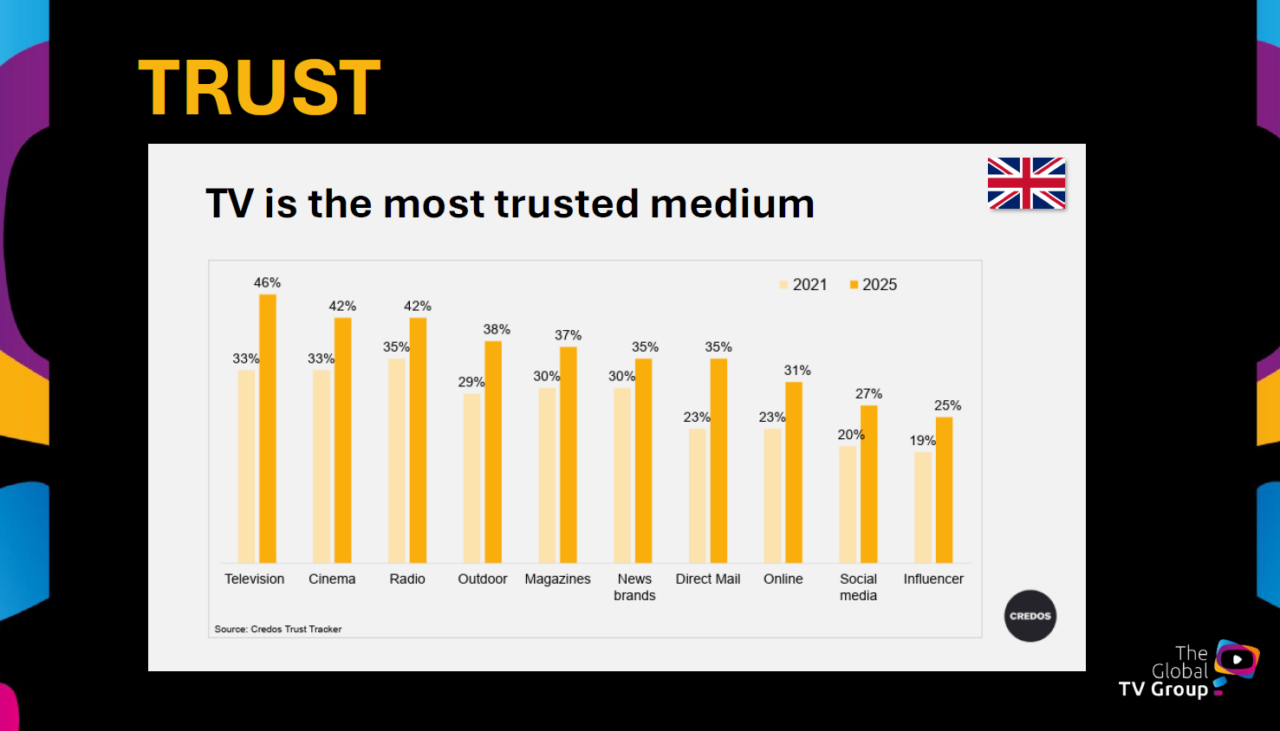 Source: The Power of TV Advertising: The 5 Pillars of TV’s Impact, The Global TV Group
US data also show a substantial difference between television and social media. According to MRI-Simmons, a US research and data company specialising in consumer and media behaviour, adults are four times more likely to trust television than social media.
In Europe, Television Also Leads at the First Point of Brand Discovery
An interesting perspective is provided by European data from RTL AdAlliance in The Living Room Study 2026. Respondents indicated whether they agreed with the statement that they could trust a brand they had first discovered through advertising in a given medium. Linear television scored 61%, the same as cinema. Radio followed at 60%, magazines and newspapers at 58%, broadcast video on demand (BVOD) at 56%, outdoor advertising at 52% and subscription video-on-demand services (SVOD) at 51%.
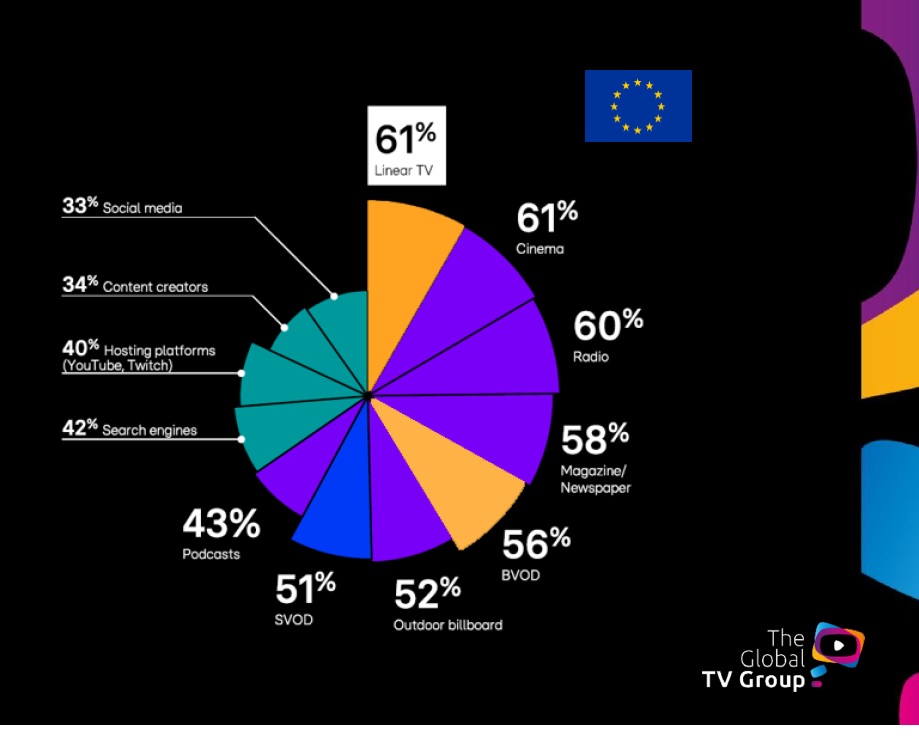 Source: The Power of TV Advertising: The 5 Pillars of TV’s Impact, The Global TV Group
Significantly lower scores were recorded by the digital environment in the same European study. Podcasts reached 43%, search engines 42%, and content-hosting platforms such as YouTube and Twitch 40%. Content creators scored 34% and social media 33%. In this particular measure, the gap between linear television and social media therefore amounts to 28 percentage points.
Further European data come from the EBU Trust in Media 2024 report, according to which broadcast media are the most trusted in most European Union countries. A 2025 study by Tapestry Research shows that twice as many people trust brands that advertise on television as brands that advertise on YouTube.
Canada: Six in Ten People Consider TV Video Advertising the Most Trustworthy
A Canadian YouGov survey conducted in July 2024 among adults aged 18 and over compared the trustworthiness of video advertising across different media. Television video advertising was rated the most trustworthy by 60% of respondents, compared with 20% for online video and 21% for social media. Television’s result was therefore roughly three times higher than both digital categories.
The opposite picture emerges when respondents were asked where video advertising is least trustworthy. Only 15% selected television, compared with 24% for online video and 61% for social media. Within the same survey, television was therefore most often associated with the most trustworthy video advertising and least often with the least trustworthy.
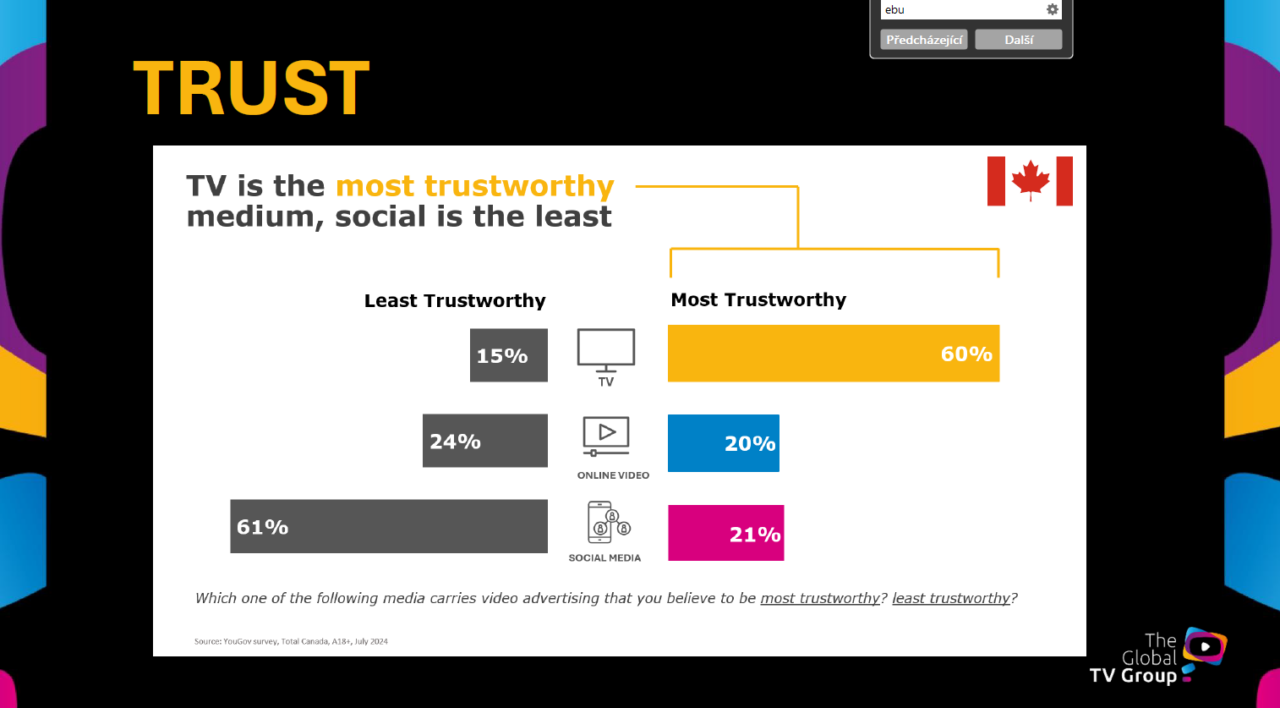 Source: The Power of TV Advertising: The 5 Pillars of TV’s Impact, The Global TV Group
Trust Is Also Influenced by the Environment in Which Advertising Appears
According to the Context Effects study, conducted for Thinkbox by research companies Map The Territory and Tapestry Research, people are 44% more likely to trust an advertisement shown alongside professionally produced content than one shown in non-professional content. The result demonstrates that the surrounding content also plays a role in how trustworthy an advertisement is perceived to be.
Television News Enjoys a High Level of Trust
French data focused specifically on news provide another dimension of trust. According to the Baromètre de la confiance des Français dans les médias 2026, 69% of French people trust television news programmes. According to the study, trust in television news is 2.4 times higher than trust in social media and 3.6 times higher than trust in influencers, with influencers ranking as the least trusted source in this comparison.
Key Takeaways
The data compiled by The Global TV Group show a strong position for television in terms of trust across different markets. However, it is important to distinguish between what the individual studies measure. The UK Credos Trust Tracker examines trust in advertising across individual media channels, US MRI-Simmons data compare trust in television and social media, the European RTL AdAlliance study looks at trust in a brand first discovered through advertising in a particular medium, the Canadian survey evaluates the trustworthiness of video advertising across media, and the French study focuses on trust in news. The findings therefore cannot be directly compared or combined into a single metric, but together they show a consistently strong position for television.
The difference compared with social media is particularly striking. In the European study, 61% of respondents said they could trust a brand they first discovered through advertising on linear television, compared with 33% for social media. In Canada, 60% of people identify television as the most trustworthy medium for video advertising, compared with 21% for social media; conversely, 61% name social media as the least trustworthy medium, compared with 15% for television. In the US, according to MRI-Simmons, adults are four times more likely to trust television than social media.
The report also shows that the context surrounding an advertising message matters. According to the Context Effects study, people are 44% more likely to trust an advertisement shown alongside professionally produced content than one shown in non-professional content. Alongside reach and television’s other benefits, The Global TV Group therefore also highlights the importance of a high-quality, trusted environment for brands.
Source: theglobaltvgroup.com