
What you will find in the article:
- Mascots play a crucial role in modern advertising.
- They evoke emotions and build brand-consumer relationships.
- Historical mascots like the Michelin Man and Elsie the Cow endure.
- Mascots outperform celebrities in brand recognition and memorability.
- Annual mascot rankings are conducted in the Czech Republic.
Mascots are by no means a new phenomenon in advertising or culture. Their roots reach deep into human history and mythology. Their original purpose was to serve as talismans or symbols of good fortune and protection. In the 21st century, mascots are no longer merely lucky charms. They provide a powerful communication link between a brand and its audience, although they often bring brands good fortune too. Consumers find these distinctive characters, which give brands both a face and a personality, easy to understand and identify with.
A look back at the past
Probably the oldest mascot, the Michelin Man, also known as Bibendum, was born in 1898, making him older than the world’s oldest living person. At the time, no one could have expected him to enjoy such longevity.

The figure made from tyres quickly became a symbol of the brand and gradually evolved with the times, transforming from a formal gentleman with a cigar into a friendly, athletic character with greater appeal to modern audiences. The Michelin Man is more than an advertising symbol. He is a long-standing embodiment of the brand’s values and proof that a well-designed mascot can remain relevant for more than a century.
Mr Peanut was introduced in 1946. In 2020, however, Planters held a funeral for him in a Super Bowl advert, causing an enormous stir. The commercial broadcast ahead of the Super Bowl showed Mr Peanut sacrificing himself to save his friends, after which the brand announced the death of its iconic character. It was a deliberate marketing move intended to attract public attention and set the stage for the next phase of the campaign. The story reached its climax during the 2020 Super Bowl, when Planters introduced a new character: Baby Nut. He was a “reborn” version of Mr Peanut. This cute, infant version of the iconic mascot was designed to appeal to younger audiences and capitalise on the popularity of “baby” versions of familiar characters in popular culture. The campaign immediately generated a huge response on social media, ranging from enthusiasm to criticism, thereby achieving its main objective: placing Planters at the centre of public conversation. The move demonstrated that even a traditional mascot more than 100 years old could be radically reinvented to remain relevant in the digital age. The story of Mr Peanut and Baby Nut became an example of how iconic mascots can be used narratively, not merely as brand symbols but as characters with their own “life cycles”, capable of arousing strong emotions and attracting widespread media attention.
Video: Planters – Baby Nut (Super Bowl 2020)
Slightly younger is Elsie the Cow, one of the most iconic advertising mascots of the 20th century and a figure closely associated with the American dairy company Borden. Created in 1936, she was intended to symbolise perfect dairy products for the Borden Dairy Company. Her popularity grew considerably at the 1939–40 New York World’s Fair, where she was represented not only as an illustration but also by a real cow bearing her name. She gradually acquired her own “biography”, family and personality, and appeared in print advertising, on the radio, in films and at public events. From the 1940s to the 1960s, she was one of the best-known advertising characters in the United States and became part of popular culture. Her importance was confirmed when Advertising Age named her one of the ten greatest advertising icons of the 20th century. Although Borden underwent numerous changes over the years and filed for bankruptcy in 2020, Elsie herself did not disappear. She continues to appear on the packaging and in marketing materials for Borden products, although she no longer plays as dominant a role as she once did.
Video: When Elsie the Cow Met Broadway
Another unquestionably famous historical mascot is Kellogg’s Tony the Tiger, who declares that its cereal is “gr-r-reat!”
Video: Tony the Tiger – advert compilation
Mascots leave celebrities standing
Interestingly, mascots significantly outperform celebrities in popularity, despite celebrity endorsements generally being regarded as one of the most successful strategies in advertising. This is according to a survey conducted by Distinctive Bats. The study found that mascots were more memorable to consumers. While 68% of respondents recognised the mascots, only half recognised the celebrities. Respondents correctly associated a mascot with its brand in 45% of cases, compared with just 21% for celebrities, suggesting that the link between mascots and brands is more natural and effective.
According to E-Score data published by E-Poll Market Research last year, some of the most popular mascots in the United States include the Pillsbury Doughboy and the M&M’s characters.

In the United Kingdom, some of the most successful mascots include the Compare the Meerkat characters and Kevin the Carrot, Aldi’s official advertising mascot, who has dominated the retailer’s Christmas campaigns in recent years. Kevin is a narrative mascot, currently one of the most effective types of advertising character.
Video: Aldi’s 2023 Christmas advert featuring Kevin the Carrot
The Czech Republic has an annual mascot ranking
A study entitled Best Actor and Mascot in Advertising is conducted regularly in the Czech Republic. The research is carried out by the ResSOLUTION Group agency in collaboration with Nielsen and the Czech Association of Advertising Agencies. The 8,000 respondents aged over 15 who complete the survey online form part of National Sample CZ, formerly known as the Czech National Panel.
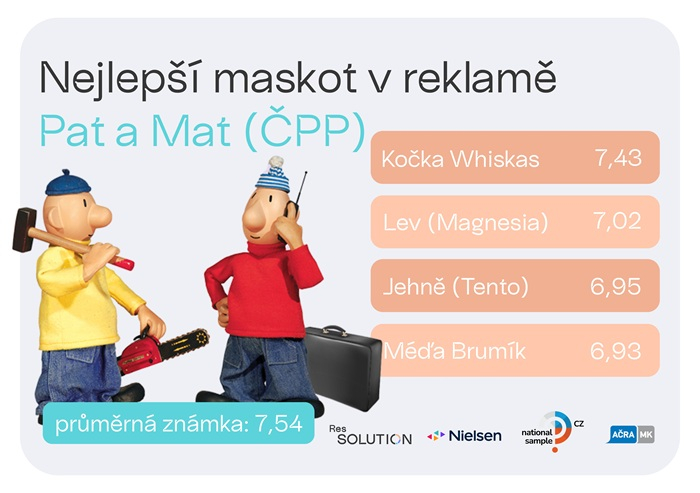
According to the results of the latest study, which assessed commercials and mascots from the 2024 calendar year and was published in May 2025, Pat and Mat took first place. These two instantly recognisable characters have appeared in campaigns for Česká podnikatelská pojišťovna, a Czech insurance company, for several years. They received an overall score of 7.54.
Video: Česká podnikatelská pojišťovna – Free liability insurance
The second-highest-rated character was the cat from Whiskas adverts, a regular fixture near the top of the rankings, with a score of 7.43. In third place was the lion from Magnesia’s campaigns, which received a score of 7.02. The top five was completed by the lamb from Tento adverts and Brumík the Bear.
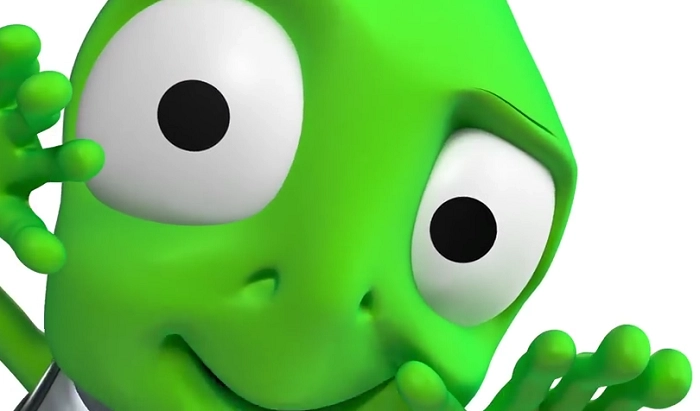
Naturally, the annoying green Alzák is also one of the best-known mascots among Czech consumers. The brand has used him continuously since 2007. Despite repeated controversies and discussions about retiring the character, Alza has decided to retain him over the long term. He is one of the longest-running and most intensively used mascots in Czech advertising. Alzák enjoys exceptionally high recognition, probably due in part to the negative emotions he provokes in many consumers, including irritation, anger and aversion. The trigger is usually his piercing voice rather than his appearance. In short, nobody likes him, but everybody knows him, and that is precisely the point of advertising.
Video: Alza.cz wishes you all the best for 2019
Other instantly recognisable mascots to have appeared in Czech adverts include the Duracell Bunny, Moneta’s ginger cat, Nesquik’s Bunny and the purple Milka cow. Milka has used the purple cow as its mascot for more than 50 years. Today, the purple chocolate packaging stands out among the wide selection on supermarket shelves, and thanks to the purple cow, everyone immediately knows which chocolate brand it represents. But did you know that the cow featured on Milka’s packaging and in its adverts does not share the brand’s name? She is called Lila and was created in 1973 by Peter Schmidt, a designer at Young & Rubicam. Milka’s Lila became a television star almost immediately after her introduction. The full impact of Milka’s advertising campaign became apparent in southern Germany when more than 4,000 children were asked to draw a picture of a cow. One-third of the children, who had grown up enjoying Milka chocolate, coloured their cows purple.
Video: Milka – Dare to Be Tender
Artificial intelligence: threat or opportunity?
Mascots simply work. They make adverts more memorable, create a stronger bond with the brand and generate greater purchase intent than adverts without mascots.
Unfortunately, even established mascots that have appeared on television screens for years are no longer safe from the much-feared rise of artificial intelligence. Generative AI can create characters within seconds, which means that the mascot landscape will soon become overcrowded and therefore even more challenging.
AI is not merely a risk, however. It is also important to recognise the potential of interactive mascots powered by artificial intelligence. Such mascots could, for example, communicate with consumers in real time. They could answer questions about a brand or product, helping to bring the brand’s personality to life. The Duracell Bunny, for instance, could advise a confused shopper on which battery they need for their garage-door remote control.
This is likely to open up new opportunities for brands capable of combining technology with a human touch. Brands that adapt to the new landscape while ensuring that their mascots retain a clear personality, consistent values and an accessible tone of voice could use AI to deepen their relationships with customers. The future certainly belongs neither to blind reliance on artificial intelligence nor to nostalgic attachment to old formats, but to an intelligent combination of the two. Mascots that feel authentic, trustworthy and “alive” can remain powerful brand symbols in the age of artificial intelligence, albeit in a new and more interactive form.