

What you will find in the article:
- Sustainable behaviour appears in only 4.3% of advertisements.
- Television ads feature sustainability more than digital or print.
- Sustainability does not weaken advertising effectiveness; it can enhance it.
- Automotive industry leads with 28% sustainable behaviour in ads.
- Consumer concern about climate change is high, especially in emerging markets.
The updated dataset covers more than a year and a half, from November 2024 to the end of May 2026. A total of 18,559 advertisements from around the world were classified according to four areas of sustainable behaviour, 1,894 more than in the previous edition covering the first quarter of 2026.
Key findings of the study
Sustainable behaviour appears only rarely in advertising: it is present in 4.3% of the advertisements analysed, compared with 6.1% in April 2025. It is most commonly associated with transport and travel, followed at some distance by diet, products & purchases, and home & energy-related decisions. Sustainable behaviour appears more frequently in television advertising than in digital campaigns, print and out-of-home advertising.
Advertisements featuring sustainable content are not less effective. They achieve slightly better short-term and long-term results and stand out more effectively from other advertisements, particularly within their own product categories. However, only 1% of advertisements contain an explicit environmental message, even though combining such a message with a specific sustainable behaviour can further strengthen the long-term impact on the brand.
The most common explicit environmental themes include recyclable packaging, reducing the use of plastics, energy efficiency and purchasing sustainably sourced products.
The automotive industry has the highest proportion of sustainable behaviour, at 28%, followed by health/dietary foods at 13% and the leisure sector at 12%. Norway, Sweden and South Korea lead among individual countries. Brazil, India and Mexico offer significant opportunities, as concern about climate change is great in these markets, yet sustainability features relatively rarely in their advertising.
The number of sustainability-themed advertisements continues to decline
According to consumers, climate change is among the greatest global problems today. It is regarded as a serious issue by 51% of respondents. The only concerns ranked above climate change are global conflicts, at 70%, and rising energy prices, at 57%.
These three global challenges are followed at a considerable distance by problems with the distribution of goods, at 19%; crop failures, at 14%; limited production of goods, at 13%; and Covid, at 8%. The results confirm that sustainability remains a relevant topic for advertising communication.
Interestingly, concern about climate change is highest in Brazil, India and Mexico. In Brazil, 62% of respondents regard it as one of the world’s most serious problems, compared with 61% in India and 60% in Mexico. These figures are significantly higher than the global average of 51%. Yet sustainable behaviour appears much less frequently in advertising in these markets than it does globally. This represents an excellent opportunity for brands: consumer interest in climate issues is high, but advertising communication does not yet adequately reflect that interest.
Nevertheless, the proportion of advertisements featuring sustainable behaviour continues to decline gradually and remains very low in the latest analysis, at 4.3%. A slight decrease can be seen across all the areas examined. Sustainability appears most frequently in connection with transport and travel, at 2.2%. These are followed at some distance by food, product purchases, and decisions concerning home and energy consumption.
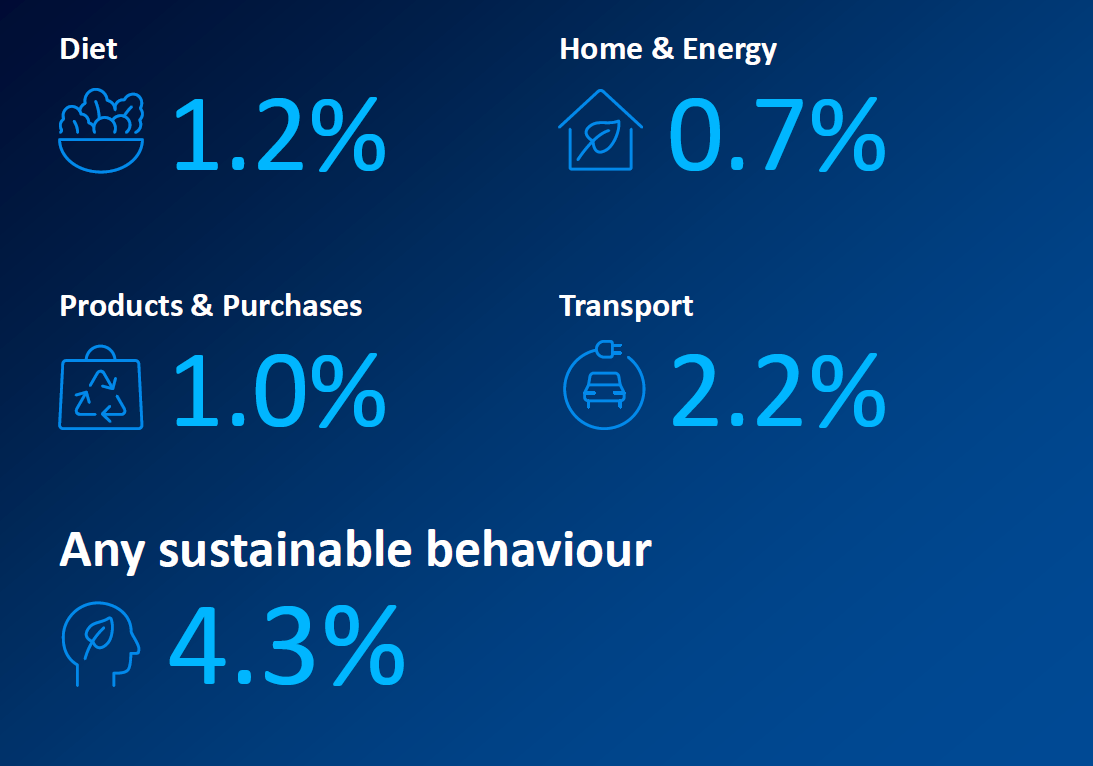 Source: Kantar Sustainable Behaviours Ad Tracker study
In terms of media, sustainable behaviour appears most frequently in television advertising, at 4.9%, while digital formats lag behind at 2.9%. Sustainability is least represented in print and OOH advertising, at 2.3%. The differences between media remain similar to those recorded in previous quarters.
Television advertising covers a broader range of sustainability themes. Transport and travel, food, and issues associated with purchases and packaging all appear more frequently in television commercials. In digital, print and OOH advertising, more sustainable transport and travel are the most prominent themes.
Sustainability has the potential to support sales
Advertisements featuring sustainable behaviour are not less effective. On the contrary, they have slightly greater potential to support both short-term sales and long-term brand value. They also stand out more clearly from other advertisements, particularly those produced by competitors in the same category, and are more likely to elicit an emotional response and encourage people to share the content.
Very few advertisements combine a specific sustainable behaviour with a clear environmental message. When sustainability appears in a campaign, the brand generally demonstrates a particular form of behaviour without accompanying it with an explicit environmental message. Advertisements that combine both approaches remain rare. The overwhelming majority of the campaigns examined use neither.
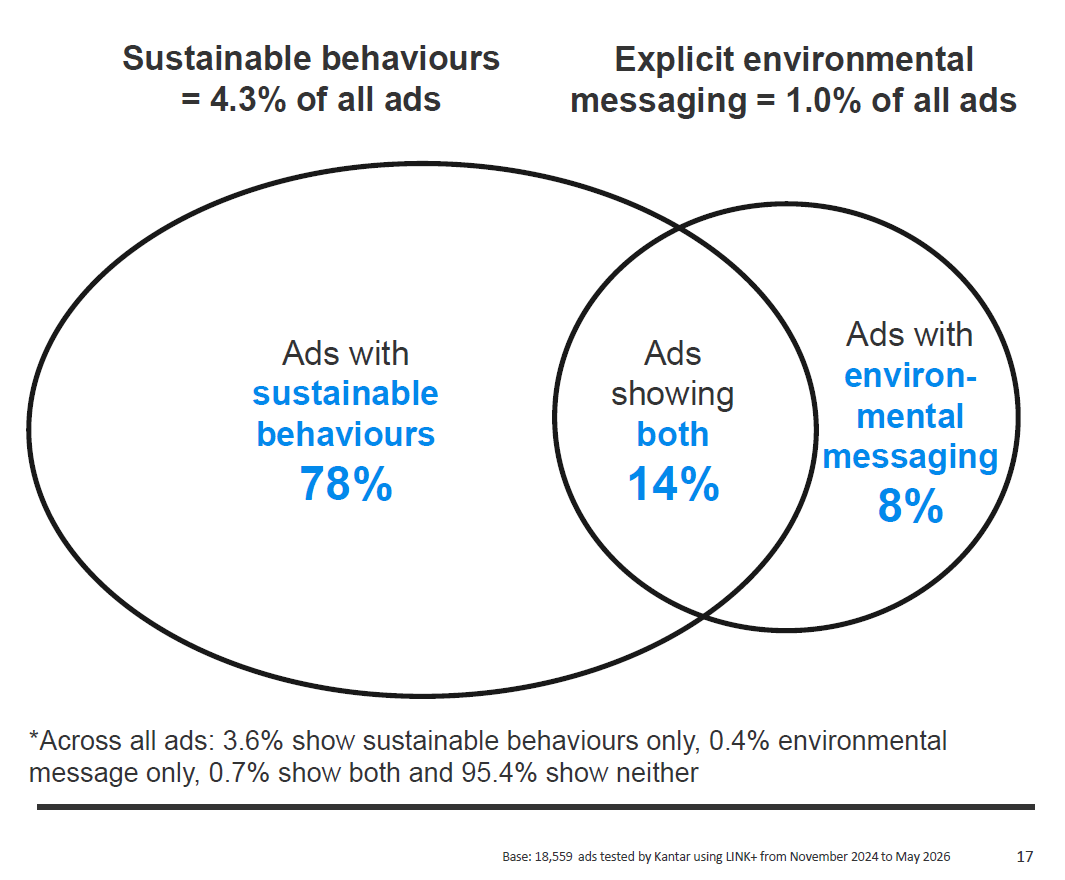 Source: Kantar Sustainable Behaviours Ad Tracker study
In terms of long-term brand building, the distinctiveness of the advertisement and emotional engagement, campaigns that combine specific sustainable behaviour with a clear environmental message achieve the best results. Compared with advertisements containing neither of these elements, they score 12 points higher on a percentile scale for their long-term contribution to the brand. They have an 18-point advantage in advertising distinctiveness and a 19-point advantage in emotional engagement.
In terms of short-term sales potential, however, advertisements based solely on an environmental message perform best, achieving an eight-point advantage.
The findings therefore show that the individual approaches offer different advantages, while combining them is particularly powerful for long-term brand building and the development of an emotional relationship with the audience.
The most common forms of environmental messaging in advertising
For a more detailed analysis of brands’ environmental messages, Kantar used artificial intelligence. It analysed 723 advertisements from 2022 to 2026 to establish which specific sustainability-related themes and claims brands use. As a result, Kantar’s project now examines not only whether sustainability appears in advertising, but also how brands communicate it. What conclusions emerged from the analysis?
Explicit sustainability messages most commonly relate to packaging. Recyclable packaging is mentioned in almost 18% of advertisements containing a sustainability message, while reducing the use of plastic or offering plastic-free solutions is mentioned in just under 14%. Other prominent themes include energy efficiency, sustainably sourced products and electric or hybrid vehicles. Reducing carbon footprints, conserving water, avoiding animal testing, planting trees and using renewable energy appear less frequently. Topics such as biodegradability, plant-based products, biodiversity protection, sustainable fashion and pollution prevention remain relatively marginal.
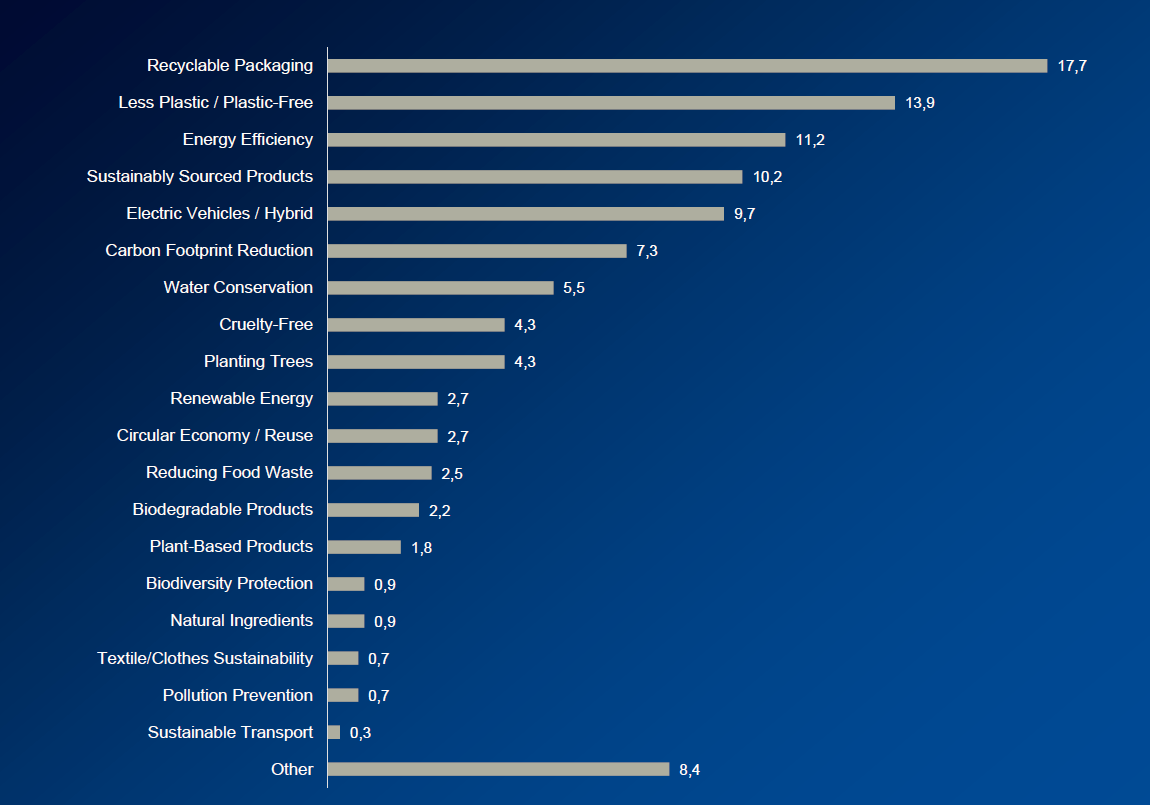 Source: Kantar Sustainable Behaviours Ad Tracker study
There are two main types of explicit sustainability messages:
- How the brand helps people behave more sustainably: This form of communication primarily strengthens brand distinctiveness and is more likely to elicit an emotional response.
- What the brand is doing to promote sustainability: This approach contributes more strongly to the brand’s meaningfulness and long-term value.
Both approaches achieve above-average results across most of the metrics examined. Communication focusing on helping people stands out particularly in terms of brand distinctiveness and emotional engagement. Emphasising the brand’s own actions, by contrast, leads to greater meaningfulness and a slightly stronger long-term contribution to the brand. The two approaches perform equally well in terms of the distinctiveness of the advertisement.
Significant differences between industries and countries
The prevalence of sustainable behaviour differs considerably between industries. The automotive industry leads by a wide margin, with sustainable behaviour appearing in 28% of advertisements. Health and dietary foods rank second at 13%, followed by the leisure sector at 12%. Consumer durables and prepared, frozen and convenience foods also perform above the global average.
A closer look at food categories shows that advertising for meat also ranks slightly above average. In most other industries, however, sustainability remains only marginally represented. It did not appear at all in advertisements for cereals or tobacco and nicotine products.
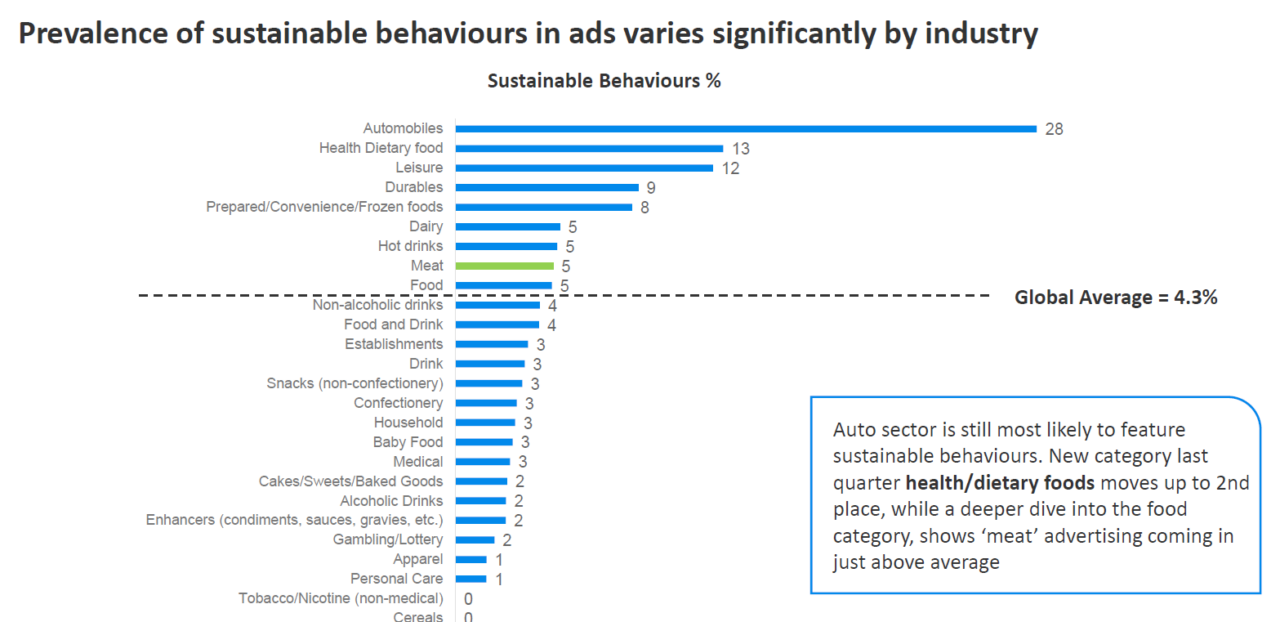 Source: Kantar Sustainable Behaviours Ad Tracker study
Sustainable behaviour appears only rarely in advertising for alcoholic drinks. One exception is the Italian brand Ichnusa, which openly drew attention to littering in a digital and OOH campaign. It combined the slogan “If it has to end like this, don’t even drink it” with a striking visual featuring discarded bottles and cans. The campaign offers a good example of how a clear and provocative environmental message can attract attention and win awards even in a category where sustainability is not normally prominent.
 Source: Kantar Sustainable Behaviours Ad Tracker study
There are also significant differences between individual countries. Norway ranks first, with sustainable behaviour appearing in 13% of advertisements. It is followed by Sweden at 12% and South Korea at 11%. The Netherlands, Belgium, Spain, France and the United Kingdom also perform above the global average.
Switzerland, which has recently been added to the study, is approximately in line with the global average. Greece remains below it, while no advertisements featuring sustainable behaviour were identified in the Ukrainian sample analysed. Algeria, Malaysia and Saudi Arabia also recorded zero representation, while sustainability appears only very marginally in advertising in the Czech Republic.
The most substantial differences between countries can be seen within specific areas of sustainable behaviour. Belgium leads in food, followed by Norway, Argentina, Sweden and the Netherlands. In the area of households and energy, Sweden has a considerable lead, with sustainable behaviour appearing in 7% of advertisements, followed by the Netherlands and South Korea. For themes associated with products and shopping, Spain ranks first, while Italy, France, Poland, South Korea and Germany record identical, lower but still above-average levels. More sustainable transport appears most frequently in Norway, where it features in 8% of advertisements. Norway is followed by South Korea and Spain, and then by South Africa and Denmark. Globally, however, all four areas remain very poorly represented in advertising.
About the Study
The Sustainable Behaviours Ad Tracker is an ongoing project by Kantar examining the representation of sustainable behaviour and environmental messaging in advertising. The latest document presents results for the second quarter of 2026 and expands the previous first-quarter edition by a further 1,894 advertisements. The complete dataset therefore includes 18,559 advertisements from different parts of the world, analysed by Kantar between November 2024 and the end of May 2026. The document also introduces the first edition of the Kantar Sustainable Behaviours Ad Tracker Awards.
The analysis is based on advertisements tested using the Kantar LINK+ database and tool. The advertisements are assessed according to whether they contain any of the four areas of sustainable behaviour defined by the Every Brief Counts initiative: more sustainable food choices; home and energy-related decisions; product selection and purchasing; and more sustainable transport or travel. Through LINK+, Kantar examines three aspects of sustainability communication: its presence in advertising, its impact on brands and consumer behaviour, and differences in how advertisements affect consumer groups defined according to their attitudes towards sustainability.
Source: kantar.com