

What you will find in the article:
- Television advertising captures more attention than digital formats.
- Attention is crucial for brand memorability and purchasing decisions.
- Longer attention spans lead to improved brand metrics and outcomes.
- Television commercials generate significantly more attentive seconds per impression.
- Cost per attentive second makes TV advertising highly cost-effective.
Every battle for market share begins long before a customer reaches for a particular product or service. A brand must first ensure that it is recognisable, establish itself in the consumer’s memory and create a mental impression that can later translate into a purchasing decision. This principle is captured by Leo Burnett’s observation: “Before you can have a share of market, you must have a share of mind.” In advertising, this means one thing: without attention, there is nothing to store in the memory and nothing to draw upon later when making a brand choice at the point of purchase.
In an environment saturated with advertising messages, merely delivering an advert is not enough. An impression does not in itself mean that a person has genuinely noticed the message. Advertising must first capture attention. Only then can it build memorability, influence perceptions of the brand and affect commercial results. In this sense, attention is not an isolated metric; it is a multiplier of effectiveness. The more attention an advert receives, the greater its chances of producing a genuine effect:
- Higher attention delivers stronger business outcomes.
- TV consistently attracts more attentive seconds per impression than digital channels.
- When attention is factored into cost, TV emerges as one of the most efficient media investments available.
Attention is linked to profitability
The relationship between attention and business outcomes becomes apparent when media channels are compared by long-term profit ROI and attentive seconds per thousand impressions. According to the Maximizing Profit through Attention study conducted by Lumen and Ebiquity in 2024, television ranks significantly higher in this comparison than online video, paid social media, out-of-home advertising and online display advertising. This suggests that the ability to hold attention is not only a communications advantage but also a profit-driver.
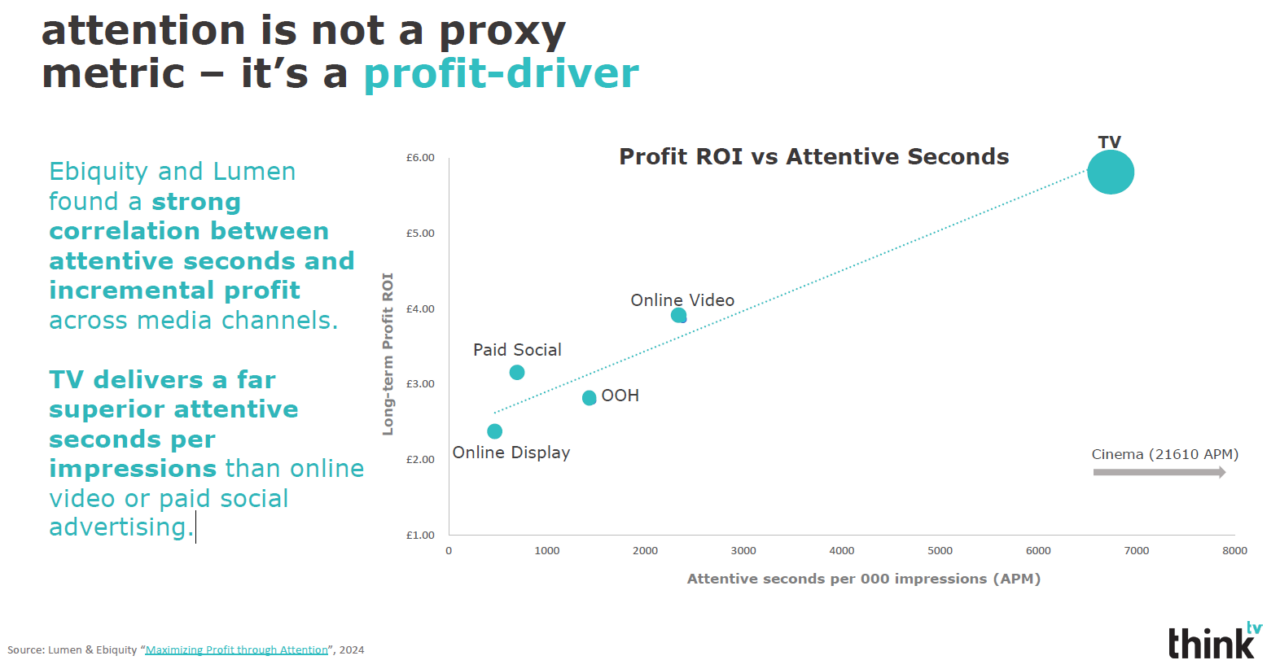
It is necessary to distinguish between simply reaching an audience and receiving attention. A medium may deliver a large number of impressions, but if people do not pay attention to the message, its real value declines. Conversely, a channel capable of holding attention for longer creates better conditions for both memorability and long-term commercial impact.
The longer the attention, the better the brand outcomes
The duration of attention also affects brand metrics. As the attentive seconds increase, so do brand awareness, purchase consideration, preference and action intent. When no attention is paid, there is no measurable effect. However, even a few seconds of focused attention lead to improvements in awareness, consideration, preference and action intent. The most significant improvement can be seen in brand awareness, which, after ten seconds of attention, is approximately 4.5 percentage points above the campaign average. The other metrics also rise progressively as the duration of attention increases.
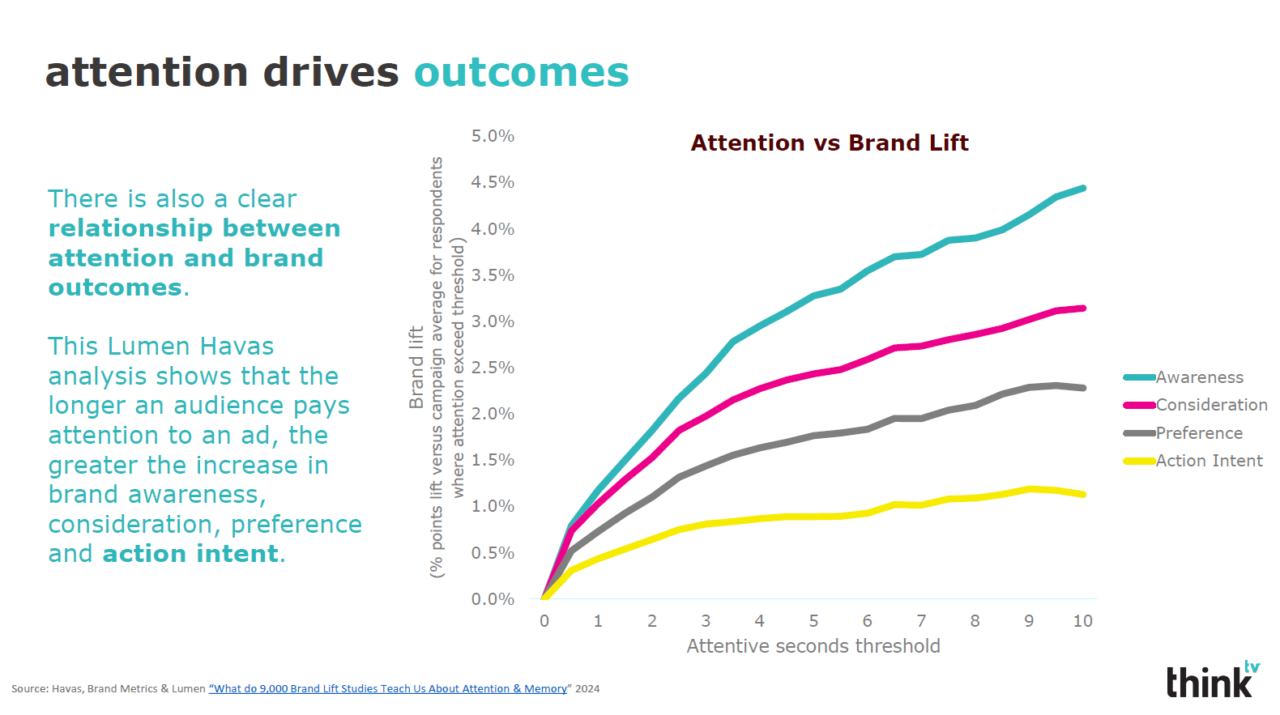
From a brand-building perspective, this is a crucial finding. Brief exposure may be sufficient for an advert to be noticed at a basic level, but sustained attention increases the likelihood that the message will become more firmly embedded in the memory and influence more than immediate brand recognition alone.
Television advertising delivers the most attentive seconds
A comparison of advertising formats by the number of seconds of attention generated per thousand impressions identifies television advertising as the strongest medium, with television commercials attracting the highest number of attentive seconds. A 30-second television commercial generates 10,627 attentive seconds per thousand impressions, while a 15-second commercial generates 6,250 seconds. A non-skippable YouTube advert delivers 3,579 seconds, whereas social media and display advertising achieve significantly lower figures, generally amounting to only a few hundred seconds.
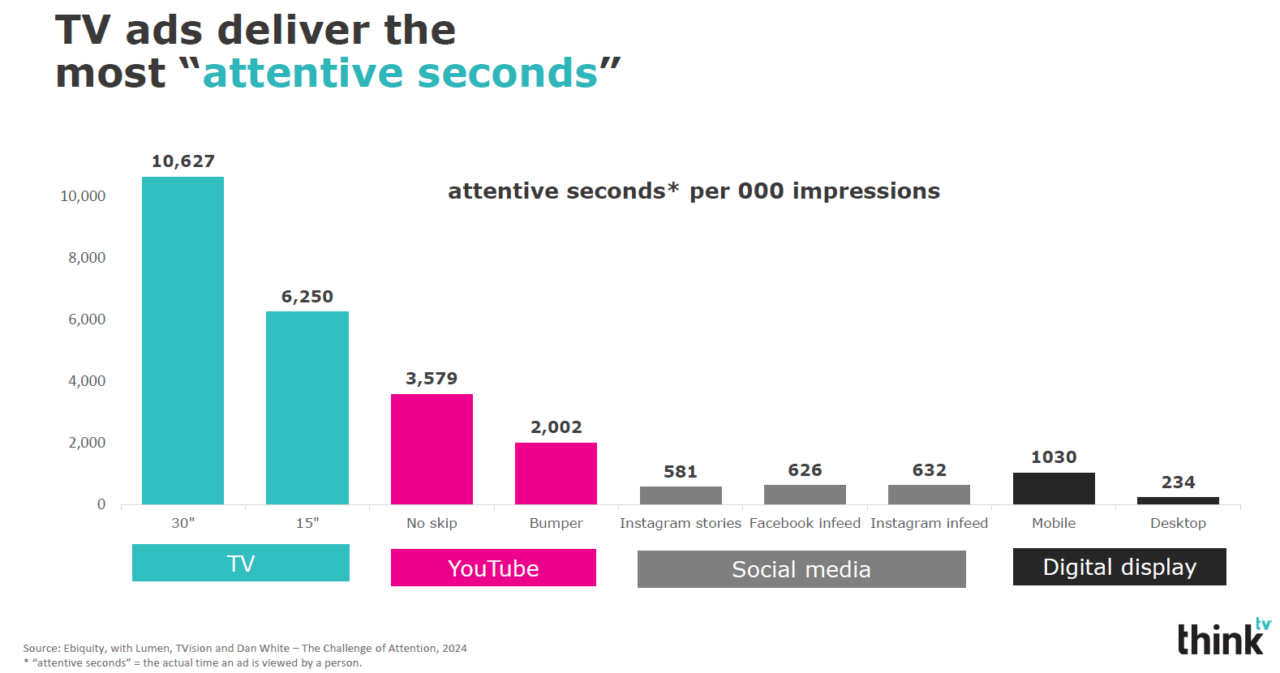
The differences are therefore substantial. A 30-second television commercial attracts nearly three times as many attentive seconds as a non-skippable YouTube advert and more than five times as many as a short six-second format. The difference is even more pronounced when television is compared with social media.
Cheap impressions become expensive if no one is paying attention
Advertising costs are frequently assessed using the cost per thousand impressions. Such a comparison can be misleading, however, if it does not take into account whether those impressions generated genuine attention. When the figures are recalculated based on the cost per thousand attentive seconds, television advertising emerges as one of the most cost-effective formats.
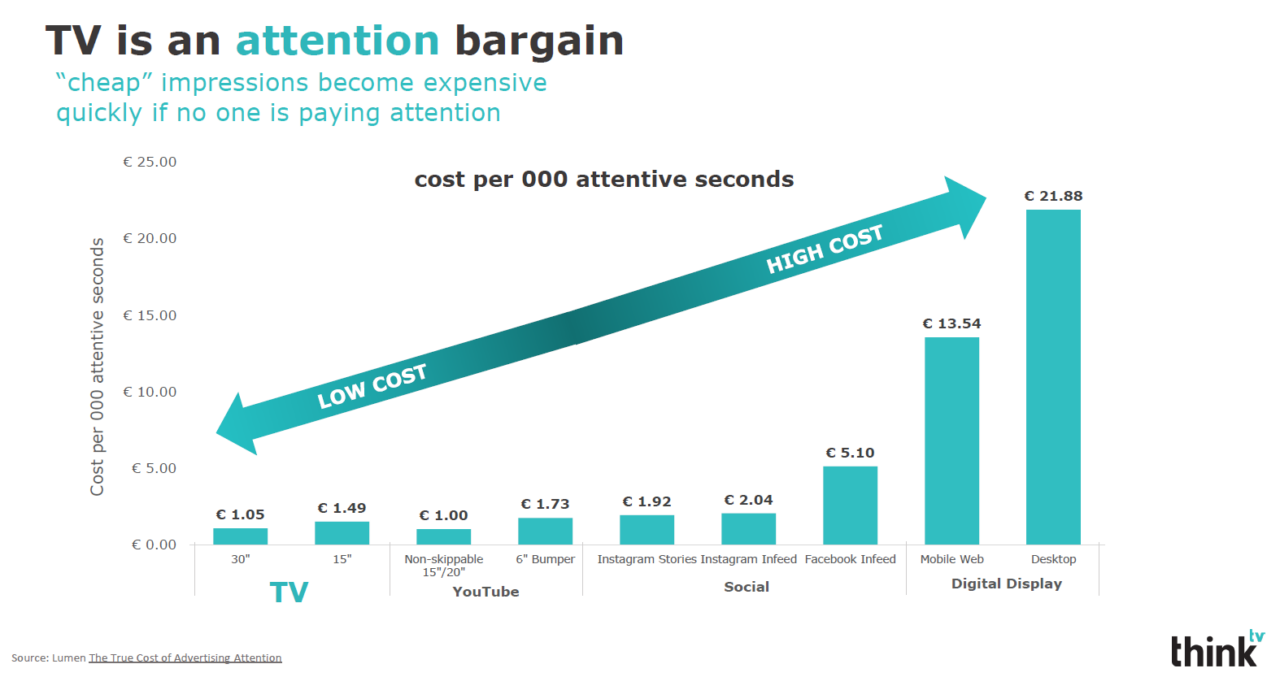
In terms of the cost of attentive seconds, television advertising is among the most efficient formats. A 30-second commercial costs €1.05 per thousand attentive seconds, which is comparable to a non-skippable YouTube advert. Social media is more expensive, while display advertising costs considerably more, particularly on desktop computers. Television advertising therefore stands out not only because it attracts a high volume of attention but also because it secures this attention at a highly competitive cost. Conversely, formats that may initially appear inexpensive become costly when measured against the genuine attention they receive.
The large screen improves brand recall
Advertising effectiveness depends not only on the medium in which an advert appears but also on the device on which people watch it. The large TV screen provides an environment in which advertising has a greater chance of being noticed and remembered by consumers. Adverts watched on a TV screen achieve 34% higher brand recall than those watched on a computer screen and 60% higher brand recall than those watched on a mobile device.
The large screen is therefore more than simply a more convenient way to watch content. It provides an environment that amplifies the impact of the advertising message. The larger image, the living-room setting, longer periods of concentration and a less fragmented viewing experience may all help people retain the advert more effectively in their memory.
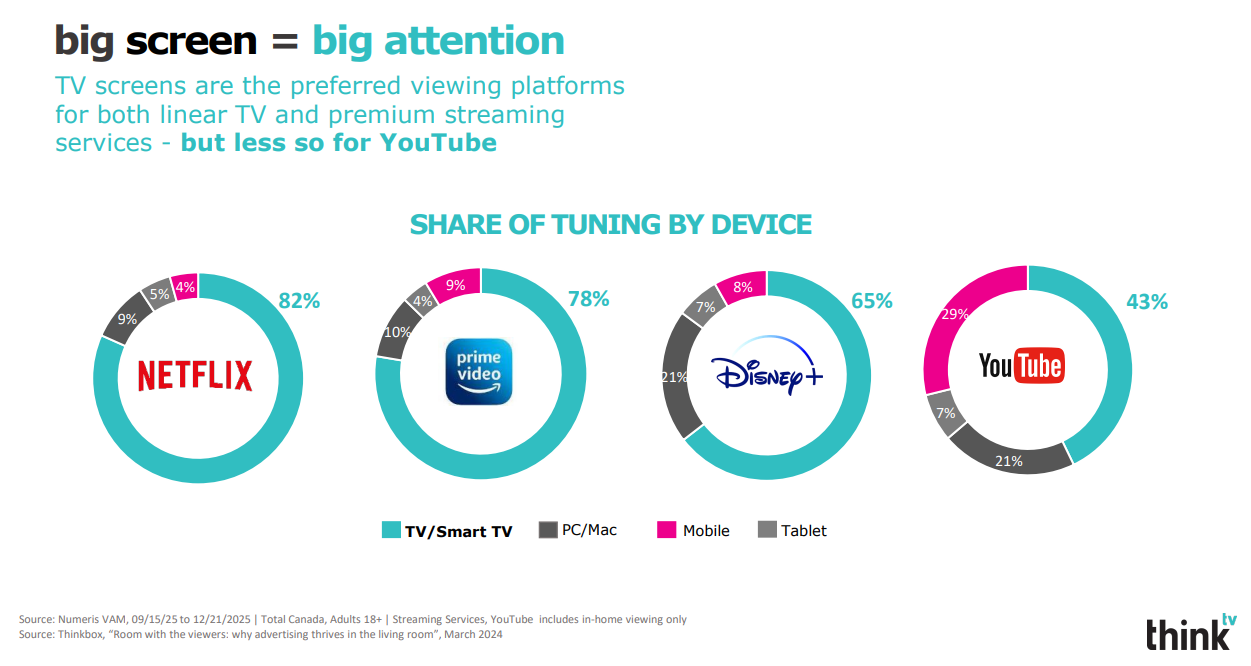
The television screen is important not only for linear television broadcasting but also for premium streaming services. Television sets and smart TVs are the primary devices used to watch Netflix, Prime Video and Disney+, while YouTube viewing is distributed more evenly across devices. Even in YouTube’s case, however, the television screen accounts for the largest share of viewing. It is therefore clear that premium video content remains strongly associated with the large screen. Viewing on mobile devices is significant, particularly for YouTube, but the TV set remains the principal viewing platform for streaming services.
Linear television still has the largest share of large-screen viewing
When considering the total amount of time spent watching content on a TV set or smart TV, linear television remains the strongest category. Among adults aged 18+, it accounts for 80% of large-screen viewing, while streaming services represent 12% and YouTube 7%. Among people aged 25 to 54, linear television accounts for 63%, streaming services for 23% and YouTube for 14%. Even among younger adults aged 18 to 34, linear television still represents 61% of large-screen viewing, compared with 21% for streaming services and 18% for YouTube.
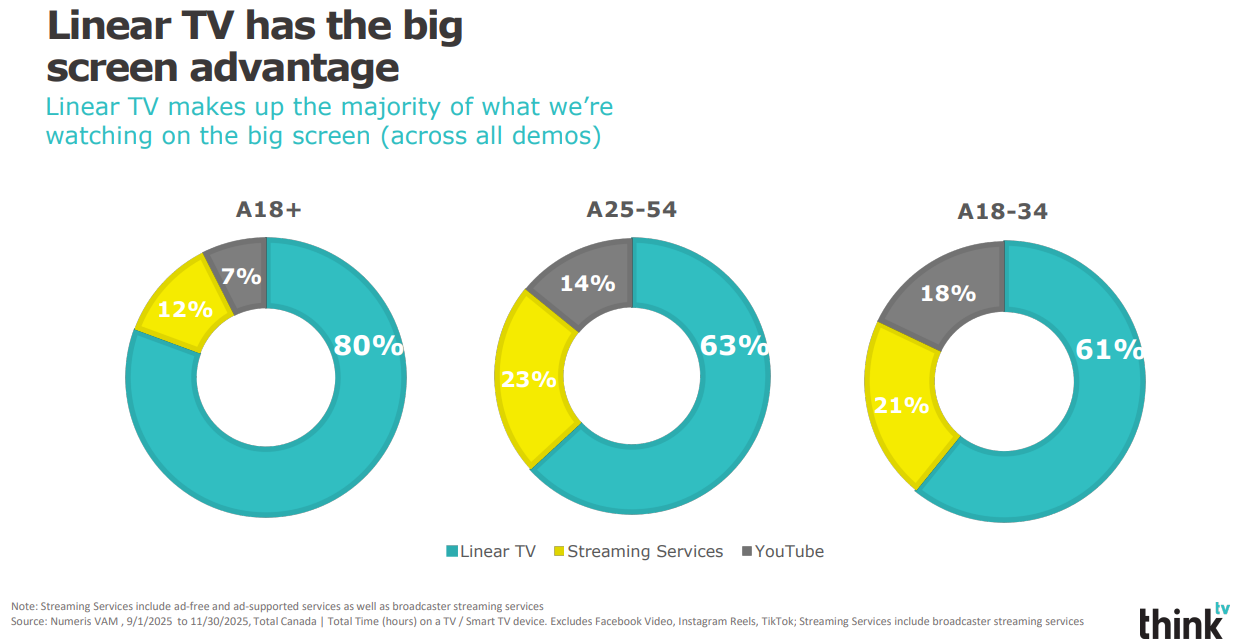
Linear television remains the largest component of large-screen viewing even among younger audiences. Streaming services and YouTube are important, but they have not taken over the entire TV-screen environment. This is significant for advertisers: the large screen remains a powerful means of reaching audiences, and linear television continues to play the leading role within this environment.
Television strengthens search and other channels
The impact of television advertising is not limited to the moment at which it is broadcast. Television creates demand that subsequently manifests itself through other channels. This is particularly important for search, which is often regarded as a performance channel. Approximately 30% of search clicks, however, are prompted by other marketing channels. A further 30% to 60% are associated with seasonality, loyalty and general trends within the relevant product category.
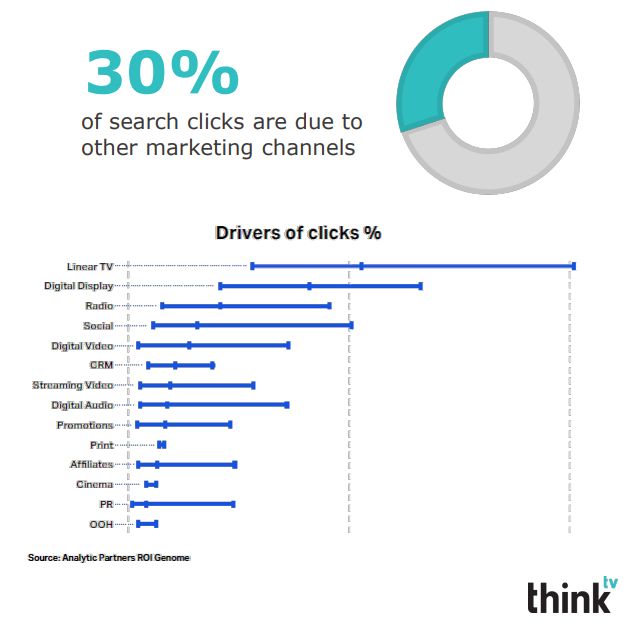
Television is one of the principal media that prompt people to click on search results. A person will often see a television advert first, remember the brand or offer and search for it later. The search results may then make it appear that the search advert played the decisive role. In reality, however, some of the motivation arose earlier. Emotion helps to build memory, and memory subsequently increases the effectiveness of activation channels.
Television improves the performance of digital advertising
Television advertising can also enhance the effectiveness of digital media. As a result of television’s influence, digital advertising achieves a 19% higher return on investment. Without this effect, the average ROI generated by digital advertising would be lower. Once its broader impact is taken into account, television advertising’s adjusted ROI increases by 23%.
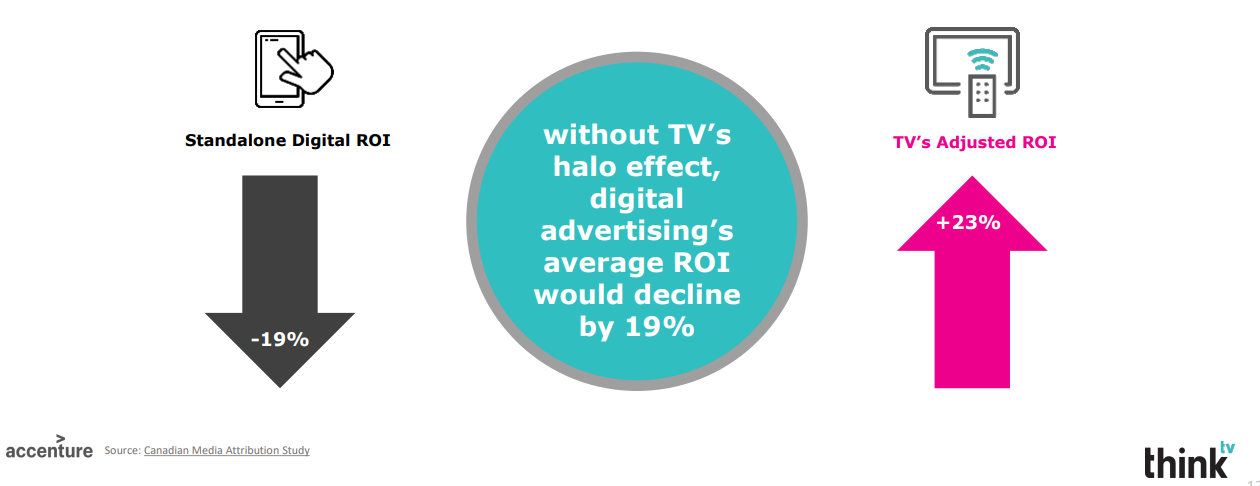
These figures are important when planning the media mix. If marketers assess digital advertising in isolation, they may attribute more credit to it than it genuinely deserves. Part of its performance results from demand and brand memorability created at an earlier stage. In this context, television does not operate solely as an independent communications channel. It also acts as a medium that improves the effectiveness of other investments.
Underinvesting in television may mean underinvesting in growth
Given that attention drives effectiveness and television attracts the most attention, reducing investment in television may also limit a brand’s growth potential. This is not merely a matter of tradition or habit. What matters is the ability to secure a meaningful amount of the viewer’s time, create memorability, strengthen brand metrics and support other channels, including search and digital advertising. Brands that focus solely on the cost per impression when planning their campaigns may overlook the genuine value of attention. The key factor is not simply how many times an advert was delivered, but whether it had sufficient opportunity to make an impact. This is where the strength of media capable of offering longer and higher-quality contact with their audiences lies. It matters because in an advertising environment characterised by intense competition for people’s minds, a brand’s ability to capture attention is crucial.
Key conclusions
Attention is a fundamental prerequisite for advertising effectiveness. An advertising message to which people devote more time has a greater chance of becoming embedded in the memory, increasing brand awareness and translating into business outcomes. Attentive seconds are therefore emerging as one of the factors that determine campaign success.
When attention is factored into cost, television ranks among the most cost-effective formats. It is not simply a question of the number of impressions delivered, but primarily of the ability to capture and hold viewers’ attention. This makes television advertising a competitive media investment.
The large screen strengthens ad recall. Adverts watched on a TV set are retained in the memory more effectively than messages viewed on smaller devices. The TV screen also remains the principal environment for consuming linear television and a substantial proportion of streamed video content.
Television strengthens other channels. Television’s contribution does not end with television reach. Television advertising supports the effectiveness of other marketing channels, helps create demand and improves the performance of digital advertising and search. Its true impact may therefore not always be fully reflected in evaluations based solely on the customer’s last point of contact.
Source: thinktv.ca