
What you will find in the article:
- Napoleon's life serves as a compelling narrative for advertisers.
- Brands utilize themes of ambition, defeat, and exile in campaigns.
- He established Saint Napoleon's Day to enhance his personal brand.
- Napoleon's public image was crafted through narratives and proclamations.
- Various brands, like Tango and Garmin, creatively feature Napoleon.
When Napoleon celebrated his thirty-third birthday on 15 August 1802, it was no longer merely a private celebration for a successful general. Thirteen days earlier, he had been proclaimed First Consul for Life, significantly strengthening his position. A ceremony was held at Notre-Dame Cathedral in Paris to mark not only his birthday but also his newly acquired lifetime consulship.
Four years later, Napoleon Bonaparte was already Emperor and decided to give 15 August even greater significance. By a decree issued on 19 February 1806, he established that the day would be celebrated throughout the Empire not only as the anniversary of his birth but also as Saint Napoleon's Day and a commemoration of the restoration of Catholicism in France. There was, however, one complication: no universally recognised Saint Napoleon existed in the Church calendar. According to historian Thierry Lentz, the Emperor's uncle, Cardinal Joseph Fesch, approached the Vatican and requested that a suitable saint be identified. The Vatican subsequently linked Napoleon's name to the little-known early Christian martyr Neopolis. Whether this figure truly existed remains uncertain. Nevertheless, Saint Napoleon's feast day was very conveniently assigned to 15 August.
Napoleon acted with considerable cleverness. The fifteenth of August was already the important Catholic feast of the Assumption of the Virgin Mary, so he was not introducing an entirely new date. Instead, he attached his own name and political significance to a day people already knew and associated with religious services and celebrations. At the same time, he linked it to the Concordat, which had redefined relations between France and the Catholic Church after the revolutionary years. A single day thus commemorated a traditional religious feast, reconciliation between state and church and, most importantly, the Emperor himself.
From today's perspective, this was a remarkably sophisticated exercise in personal branding. Napoleon did not rely solely on portraits, monuments or reports of military victories to persuade the inhabitants of his Empire. He secured a recurring day on which his name was heard in churches, at public celebrations and in official speeches. He did not merely create his own holiday. He created an annual nationwide communications campaign. And he had no idea that more than two hundred years after his death he would still be appearing in advertising campaigns.
Napoleon as a brand before modern marketing existed
Napoleon is particularly appealing to advertisers because he understood the importance of public image exceptionally well. During his first Italian campaign, he used proclamations, army newspapers and later, the bulletins of the Grande Armée to influence both soldiers and public opinion. These were not simply sources of information. The bulletins functioned as carefully crafted narratives of victory, courage and the historic mission of the French army, sometimes embellishing reality to such an extent that soldiers coined a saying equating a lie with an army bulletin.
Another reason for Napoleon's appeal to advertisers lies in the many contradictions within his life story. He was both a victor and a defeated man, a revolutionary and an emperor, a moderniser of state administration and an authoritarian ruler, a feared military commander and a lonely exile. Advertising can therefore portray Napoleon as triumphant, ridiculous, frustrated, romantic or defeated without making the character culturally unrecognisable.
Moreover, numerous legends have grown up around him, some more famous than the historical reality. The most prominent example is the notion that he was exceptionally short. According to the Fondation Napoléon, he stood approximately 168.6 centimetres tall, which was average or slightly above average for the period. The image of a diminutive ruler was reinforced by comparisons with the tall soldiers of the Imperial Guard, misunderstandings involving French and British units of measurement and, above all, British caricature. James Gillray depicted "Little Boney" as an angry child, creating an image that outlived both its creator and the original political conflict. Napoleon is therefore both the architect of his own brand and the victim of a highly successful competitive rebranding. Which brands have made use of the famous military leader?
Tango: Bonaparte in a madcap advertisement
In 1992, the British soft drink brand Tango included a commercial known as "Little Napoleon and His Big Orange Hand" in its unconventional advertising series. Napoleon appears with an absurdly oversized orange hand, a visual device consistent with the exaggerated world of the brand's communications at the time. The historical figure does not convey any product-related message. Instead, he serves as an embodiment of megalomania and excess. The extravagance of his ambitions is reflected in the extravagance of the advertising imagery.
Video: Little Napoleon and His Big Orange Hand
Garmin: Navigation points the way to victory
In a commercial aired by Garmin during the Super Bowl in 2008, Napoleon rides through Paris using GPS navigation. Upon arriving to meet his troops, he finds that among the large white horses awaiting him, there is a conspicuously small pony reserved for him. The advertisement operates on two levels. The first draws upon Napoleon's reputation as a military commander whose success depended on the movement of armies and spatial awareness. Navigation technology becomes the modern equivalent of the strategist's essential tool. The second level is the final joke involving the pony, which capitalises on the enduring myth surrounding Napoleon's height.
Video: Napoleon Finds His Way W/GPS
McDonald's: What Napoleon was really hiding beneath his coat
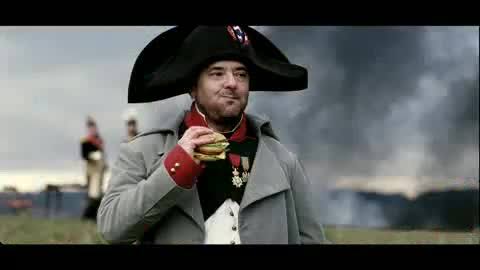
In 2011, the Belgian branch of McDonald's also employed Napoleon as part of a campaign that placed the brand within familiar cultural legends. The commercial presents a fictional explanation for Napoleon's famous pose with one hand tucked inside his clothing. Created by TBWA\Brussels, the advertisement follows a simple but effective principle: the brand pretends to solve a historical mystery. The product becomes not merely a prop placed in the past but the supposedly missing piece of a well-known historical story. The real explanation for Napoleon's pose is much more mundane. A hand tucked into a waistcoat was a common gesture in eighteenth- and nineteenth-century portraiture, symbolising self-control, dignity and calm authority. There is no convincing evidence supporting popular theories involving stomach ailments, an injured arm or other medical conditions.
Video: McDonald's – Napoleon
Red Bull: Escaping Elba
A 2012 animated Red Bull commercial summarises Napoleon's life through song and the brand's distinctive cartoon style. The advertisement combines two famous elements of his story: his hand concealed beneath his clothing and his exile on the island of Elba. It turns out that Napoleon is hiding a can of Red Bull beneath his coat. After drinking it, he grows wings and escapes the island. Red Bull takes an actual historical event, Napoleon's escape from exile, and transforms it into a literal demonstration of the brand's long-standing slogan: "Red Bull gives you wings."
Video: Red Bull – Napoleon
Amazon Prime: Conquering audiences instead of Europe
Amazon Prime's "Changes Everything" campaign rewrote famous stories as though their protagonists had access to Amazon Prime services. In a commercial released around the turn of 2021 and 2022, Napoleon watches The Marvelous Mrs. Maisel, discovers a talent for comedy and orders a microphone. Instead of conquering hostile territories, he begins conquering audiences as a stand-up comedian. The advertisement does not remove Napoleon's defining characteristic, his immense ambition. It simply redirects it towards a more socially acceptable pursuit. The wider "Prime Changes Everything" campaign, which included the Napoleon commercial, won two Bronze Gerety Awards in 2022 for copywriting and direction.
Video: Amazon Prime – Napoleon finds his true calling
Carrefour: What is Napoleon planning?
The commercial below appeared during the opening phase of a large-scale campaign designed first to arouse curiosity and only later reveal the brand behind it. The advertisement is often referred to by the title "Dlaczego Napoleon sprzedaje Luwr?" ("Why Is Napoleon Selling the Louvre?"). The role of Napoleon was played by renowned Polish actor Jacek Braciak. In the commercial, the Emperor negotiates the sale of his "home", namely the Louvre in Paris, as though it were an ordinary property listing, saying "Yes, I'd like to sell my residence. Sixty thousand square metres. Recently renovated façade. The tympanum of the central projection depicts me as the Genius of France accompanied by Minerva, Mercury and allegories of Peace and Law." This decorative description is not simply a product of the writers' imagination. In 1811, sculptor Claude Ramey created a design for the southern pediment of the north wing of the Cour Carrée at the Louvre. It depicted Napoleon summoning Minerva, Mercury and personifications of peace and legislation. The central imperial figure was later transformed, most likely during the Bourbon Restoration, into a nude Genius. The commercial takes a genuine motif from imperial propaganda and turns it into an absurd argument for determining the price of a property. At the end, viewers are presented with the question: "What is Napoleon planning?" along with the campaign website. The advertiser's identity was initially concealed.
Video: Carrefour – Napoleon
The teaser campaign consisted of three main commercials. In the first, Napoleon sells the Louvre; in the second, he asks questions about Poland and discovers the internet; in the third, he learns Polish tongue twisters.
The teaser phase lasted approximately two weeks. It ran across television, radio, online and outdoor media and directed people to a website where they could guess what Napoleon was preparing. Some speculated that Amazon was about to enter the Polish market. On 8 March 2016, Carrefour revealed itself as the company behind the mysterious campaign. The communication subsequently continued under the banner "Bonjour w Carrefour", with Napoleon, as portrayed by Jacek Braciak, becoming the long-term face of the retailer. He later appeared in a variety of seasonal and product-focused advertisements, including campaigns promoting holidays and gardening products. The original campaign was followed by a separate phase entitled "Napoleon's Decrees", which won a Silver Effie Award. This was therefore not a collection of unrelated advertisements but a carefully developed communications platform in which Carrefour used Napoleon as a symbol of the brand's French origins, authority and strategic leadership.
Advertisements using Napoleonic motifs
Napoleon does not always have to be the main protagonist of a historical sketch. Some campaigns employ only a fragment of his cultural image: his supposed short stature, his role as a familiar figure from school history lessons, his defeat at Waterloo or the broader concept of conquest.
The John Deere commercial "Learn Something New", released in 2017, presents Napoleon's alleged shortness as one of several widespread misconceptions. Alongside myths about horned Viking helmets and ostriches burying their heads in the sand, viewers are told that Napoleon was not unusually short. Here, the historical figure functions not as a joke but as evidence that established beliefs can be incorrect.
In a 2016 advertisement, Crest used Napoleon as a comic teacher. The ruler becomes annoyed with a schoolchild who has stayed at home because of toothache and worries that the only French thing the child will ever know is the croissant. History serves as an argument for school attendance and dental care. Napoleon appears not because of his military expertise but as a representative of important educational knowledge the child is missing.
Another possibility is the Waterloo motif, the name of a place that has become synonymous with ultimate defeat in many languages. Waterloo Beer capitalised on the release of Ridley Scott's film Napoleon with its campaign "A Huge Win for Napoléon". The historical irony stems directly from the product's name: Napoleon can finally "defeat" Waterloo, at least in a beer advertisement.
Napoleon returns. This time in the service of brands
Throughout his life, Napoleon repeatedly returned – from military campaigns, from defeats and from exile. After Waterloo, however, he never regained power. In advertising, by contrast, he can return again and again. In these stories, he can fly away from Elba thanks to Red Bull, find the right route with Garmin navigation, discover a career in comedy through Amazon Prime or sell the Louvre before setting off to Poland in the service of Carrefour.
Napoleon's real story ended on Saint Helena. In advertising, however, there is no final Waterloo. A new product and a new script can always bring the Emperor back. Creators simply select a moment from his life and ask a straightforward question: What if he had had our brand at his disposal? The result is more than a historical joke. It is a new version of the story in which Napoleon is given another chance to change something, put something right or finally bring events to a victorious conclusion.
Sources: napoleon.org, metmuseum.org, chaterauversailles.fr, snopes.com, lbbonline.com, nowymarketing.pl, history.com