

Football has long remained the most-watched sport worldwide. According to estimates , around 1.2 billion people across the globe tuned in to watch the opening ceremony and the opening match. By way of comparison, the American Super Bowl – one of the most expensive media slots of all – was watched by approximately 125 million viewers this year. That is almost ten times fewer. This year’s tournament also features an extraordinary format: three host nations, an expansion of the field from 32 to 48 teams, and an increase in the number of matches from 64 to 104. There were 507 million applicants for 6.7 million tickets. The figures speak for themselves.
How are brands capitalising on this opportunity?
An event of this scale also involves significant financial flows. FIFA estimates the contribution to global GDP at USD 40.9 billion, with an estimated USD 10.5 billion flowing into communications related to the tournament. Interestingly, this is more a matter of reallocating existing budgets than making entirely new investments: the estimated increase amounts to just 1.1 per cent.
The World Cup generates opportunities for brands across various categories. Traditionally, the strongest sector is bookmakers; indeed, one need only watch the ad breaks during live broadcasts. The estimated volume of money wagered per bookmaker stands at 1.8 billion koruna. Given the match times, the tournament also opens up opportunities for food delivery services: 76 per cent of fans say they are more likely to order food for delivery whilst watching a match. Manufacturers of television equipment also see an opportunity: 69 per cent of those surveyed plan to upgrade their home cinema systems in connection with the championship, and 18 per cent plan to buy a new television or projector.
Live broadcasts are no longer enough
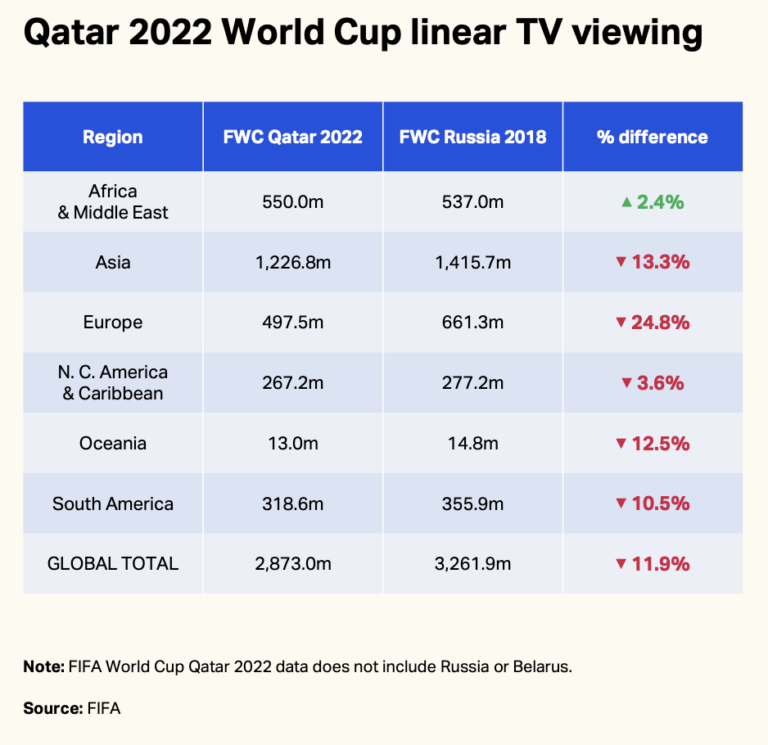
This year’s World Cup confirms just how much content consumption has changed in recent years. Whilst linear broadcasting still takes centre stage – as evidenced by the 1.2 million viewers on Czech Television on the first day of coverage – its reach is declining with every World Cup. Globally, we are seeing an 11.2 per cent drop in linear viewing between tournaments; in Europe, the figure is as high as 25 per cent.
However, this does not mean that interest in the tournament is waning. The total reach of the 2022 championship was estimated at 2.87 billion people. Rather, consumption is becoming more fragmented across platforms. As many as 71 per cent of respondents admit that whilst watching the live broadcast, they also engage with a second or even third screen, and 86 per cent plan to follow key moments of the tournament on social media, video platforms, official apps or podcasts. FIFA itself is embracing this trend, having named TikTok and YouTube as its official partners for this year and allowing them to share content related to the World Cup.
From sport to influencer marketing
Brands therefore face the challenge of ensuring their presence on relevant platforms with relevant content, as no single platform can reach all viewers. One possible approach is to use active or former athletes as influencers: 70 per cent of those surveyed say they follow athletes or sports teams on social media.
Cape Verdean goalkeeper Vozinha can now also be considered an influencer; before the opening match against Spain, he had only a few tens of thousands of followers on his account. Thanks in part to his saves, Cape Verde secured a surprise draw, and Vozinha has become a global figure with nearly 16 million followers.
The World Cup is changing just as rapidly as the way we watch it. Its four-year cycle clearly illustrates how platforms and viewers’ attention evolve over time. Linear broadcasting remains central, because we want to experience sporting events together. However, second screens, sports influencers and additional content on social media are also becoming increasingly important. For brands, the Mundial therefore presents a challenge: to manage fragmentation and use it to their advantage. And it is precisely at events like this that it becomes clear that those who are not afraid to innovate and take a creative approach to communication and their media mix have the best chance of success.
Source: mam.cz