

Lately, experts have been invoking the word “attention” in every possible context. But what exactly is attention? Until now, the media industry has lacked a universal definition of the term. For its advertising study, Newsworks followed Lumen’s definition, which defines attention as the amount of time people spend looking at an advertisement, measured specifically in attention seconds per thousand impressions (APM). The new analysis combines data on online advertising exposure, case studies from the IPA Databank, and the results of brand research carried out by Brand Metrics.
Attention is the driving force of effectiveness
Over the past ten years, advertising investment has shifted quite dramatically away from high-attention media — such as television, radio, print, and news brand sites — towards low-attention environments, especially social media and programmatic online advertising. Whereas in 2015, 68% of advertising spend flowed into high-attention media, today the figure is only 30%. Low-attention channels, by contrast, have grown and now command a handsome 70%. Paradoxically, advertisers are therefore spending more in places where their message is most likely to be ignored.
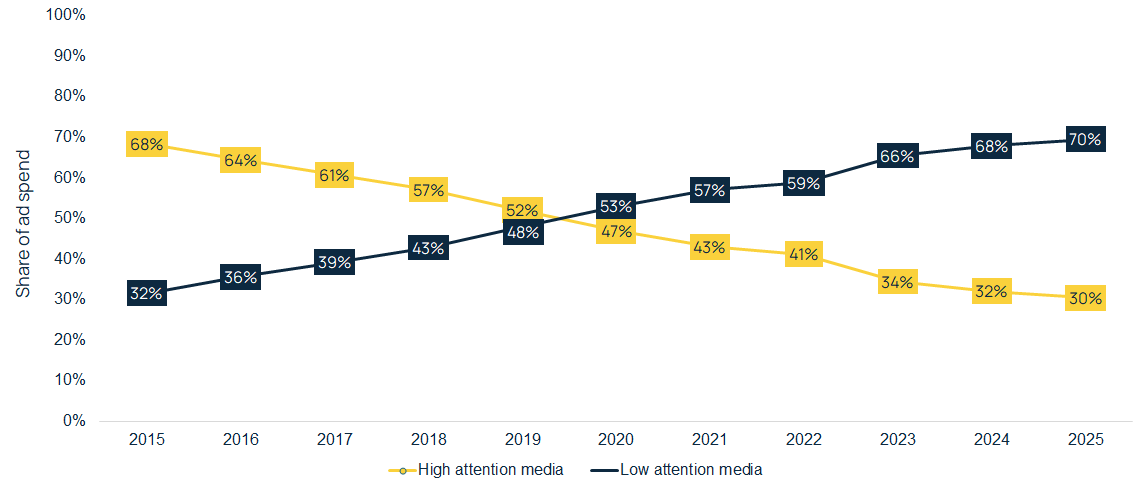 Source: AA/WARC, total ad spend. High- and low-attention media are defined according to Lumen Attention data: high-attention media = television, cinema, radio, magazines, and news brands; low-attention media = OOH, social media, and purely online media, excluding search and direct mail.
In a way, this is paradoxical, because according to the analysis, campaigns using high-attention media deliver 58% more attention seconds per pound invested, as well as 17% stronger brand effects and 12% higher market-share growth.
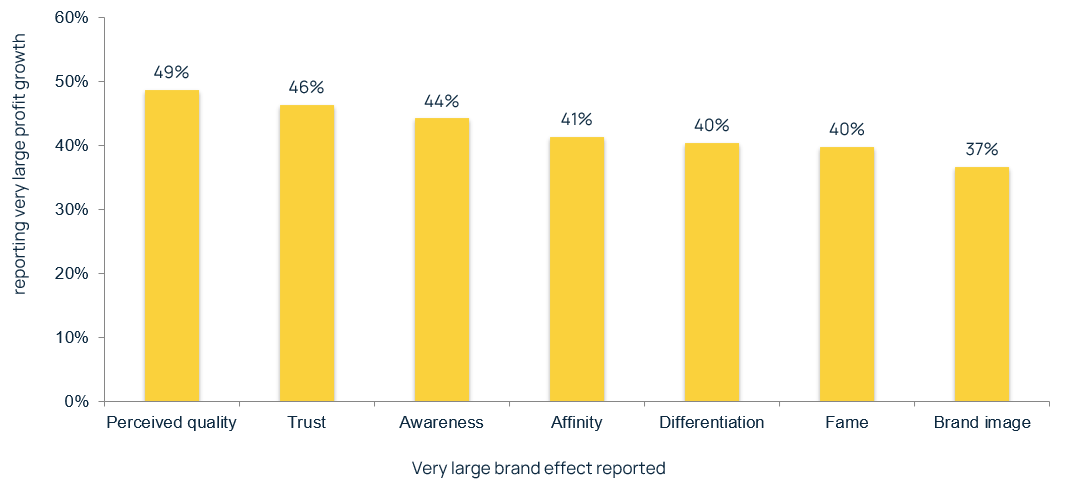
The key lies in content quality. People devote their valuable time to advertisements when they trust the medium in which the ad is placed. Quality, trust, and brand awareness are directly linked to profit growth — for example, 49% of campaigns that achieved a significant uplift in perceived quality also recorded strong profit growth.
 Source: Newsworks.org.uk
Major differences in digital display advertising
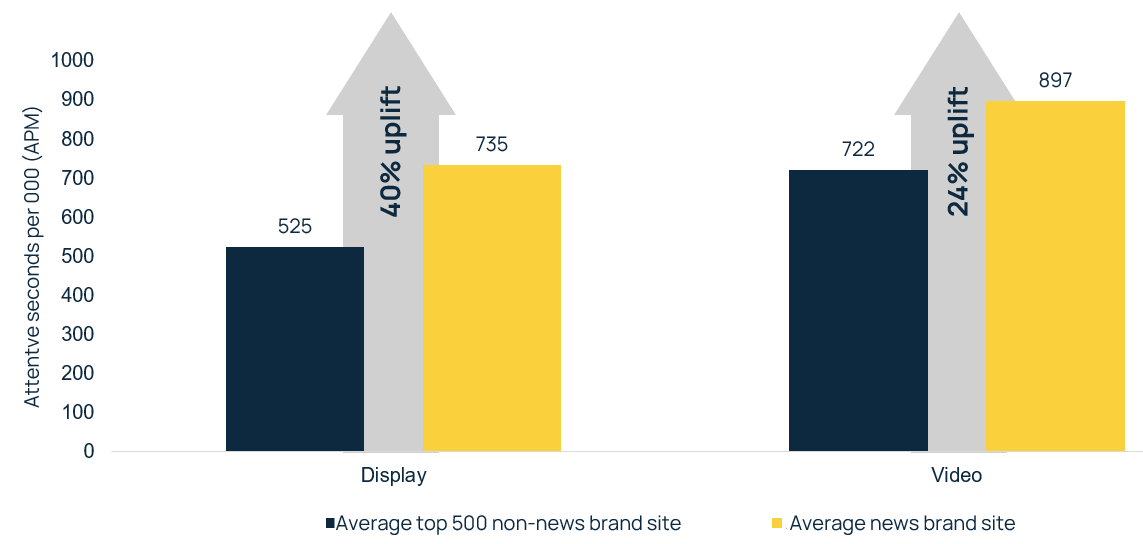
The study confirms that advertising in news media has significantly greater value than standard display advertising. An analysis of twelve news websites and the 500 largest domains by impressions (2023–2024) showed that display ads on news brand sites receive 40% more attention, while video formats attract 24% more attention than on other websites.
 Source: Newsworks.org.uk
Length of exposure is also crucial. The average video viewing time on non-news brand sites is 1.97 seconds, whereas on news brand sites it is 2.36 seconds — that is, 20% longer. For display formats, the difference is even greater: 1.63 seconds versus 2.13 seconds (a 31% difference).
In other words, advertising placed in the context of high-quality, trustworthy journalism not only attracts more attention but also holds consumers’ attention for significantly longer. And that translates directly into campaign effectiveness.
Attention improves brand perception and action intent
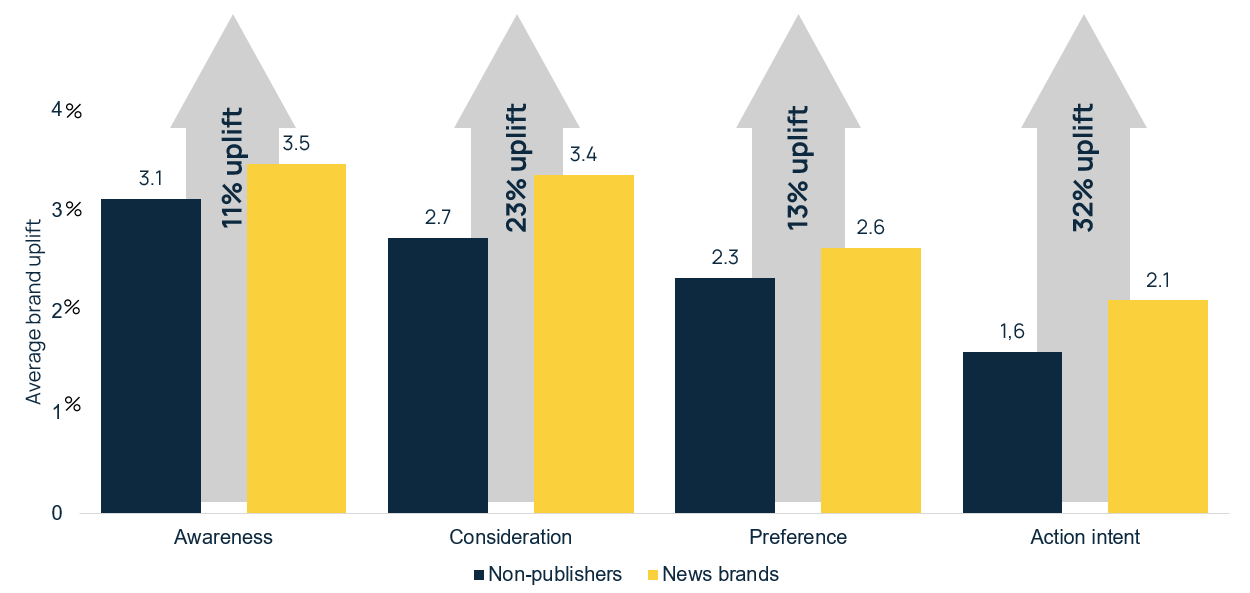
Findings from Brand Metrics, which measured hundreds of campaigns, show that advertising on news websites delivers better results across the entire purchase funnel.
- 11% higher awareness,
- 23% higher consideration,
- 13% higher brand preference,
- 32% higher action intent (e.g. intent to buy, try, etc.).
 Source: Newsworks.org.uk
Put simply, the more attention an advertisement attracts, the greater its influence on whether people remember the brand, consider it, and ultimately take action.
News media have a positive impact on business results
Data from the IPA Databank show that including news media in a campaign brings measurable business benefits. In campaigns with high overall attention, they increase business effects by 22%; in campaigns with low attention, they boost them by as much as 50%. In such cases, profit growth rises by up to 89%. It appears that news brand sites can literally “rescue” campaigns that rely primarily on social media or other less engaging formats because they provide them with the necessary weight and credibility.
Brand building and long-term growth
Compared with other campaigns, those that include news media deliver better results across key business metrics — from sales and loyalty to profit — including higher revenues, greater profitability, stronger growth in new customers, and increased market share.
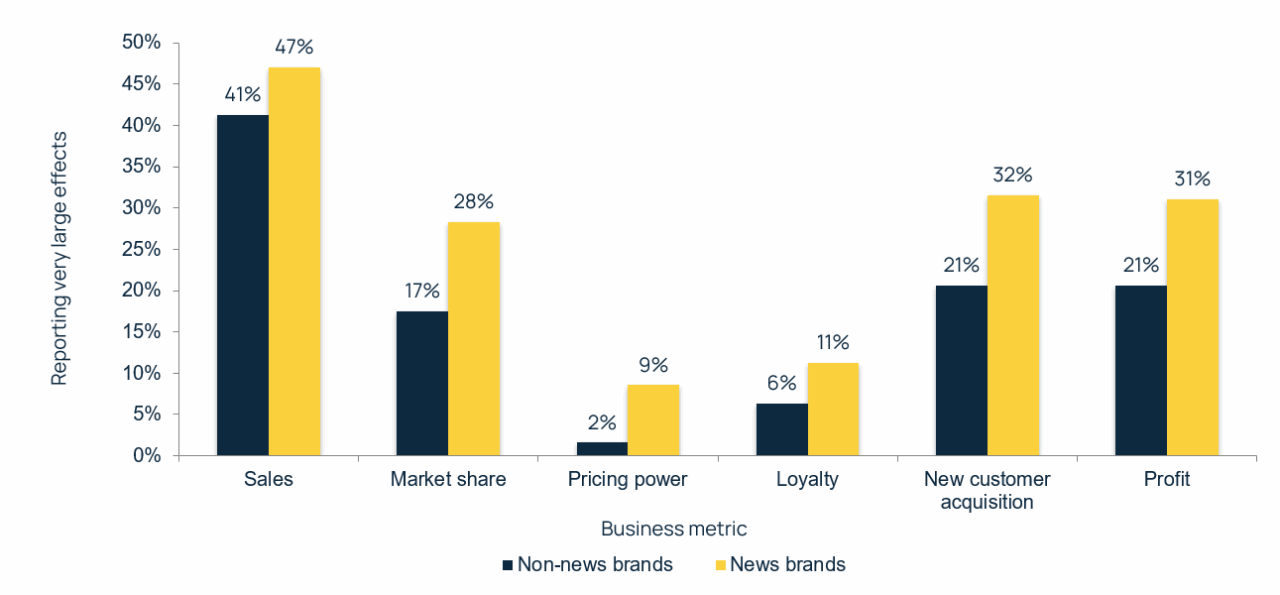 Source: Newsworks.org.uk
The impact on brand perception is also clear. Campaigns involving news media show, among other effects, a 138% increase in perceived quality, a 38% rise in brand affinity, and a 14% improvement in brand image.
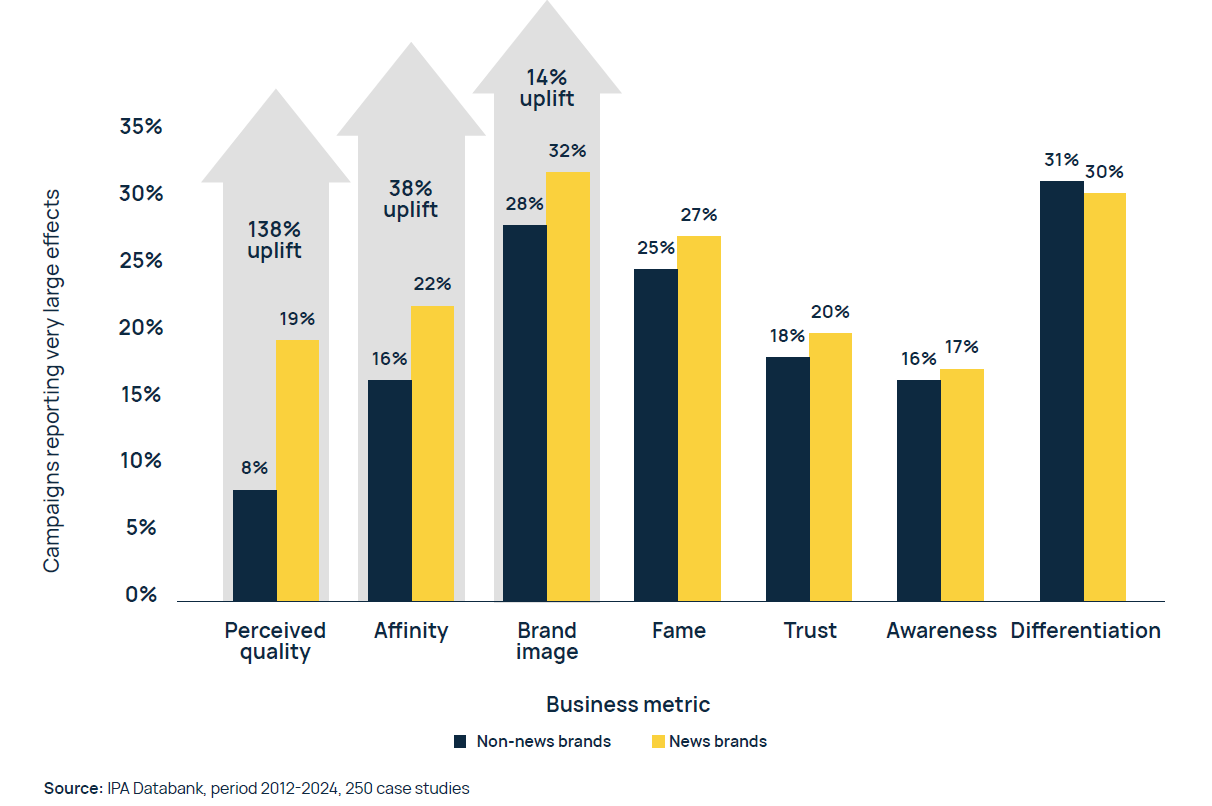 Source: Newsworks.org.uk
Since 2018, the share of campaigns using news media for brand building has increased by 46%, confirming their growing importance for long-term growth. Over the same period, the contribution of news media to brand effectiveness has doubled.
Investing in trusted high-attention media pays off
The study clearly confirmed that attention = effectiveness = profit. Advertising works best when it has a genuine chance to be seen and remembered — and that can only be achieved in environments that people regard as high-quality and trustworthy, such as news websites and television. These media not only deliver significantly stronger brand effects and better business results but also contribute to a healthy information ecosystem.
For brands that want to grow, the formula is therefore simple: invest more in quality media, because high-attention environments are the key to building healthy, profitable brands over the long term.
The full report is available here.
Source: newsworks.com