


Globo, Brazil’s largest commercial TV group, is rolling out DTV+, a next-generation free-to-air TV standard designed for connected TVs. It brings broadcast channels into the TV operating system, with app-like navigation, login and interactive layers placed directly on top of live programming.
The move fits Brazil’s viewing reality. Linear TV accounts for 57.9% of total video consumption (Dec 2024, Kantar IBOPE Media, Brazil’s TV measurement currency). Connected-TV household penetration reaches 72% (2024), and internet consumption via TV has more than doubled over the last five years (CGI.br, Brazil’s internet governance body).
Turn free-to-air TV into a logged, interactive home-screen experience
DTV+ makes free-to-air TV easier to find, open and use, with app-style navigation on smart TVs, while login supports authenticated viewing and richer interaction.

It builds on Brazil’s digital TV upgrades since 2007, including a 2020 update that brought HDR and immersive audio, plus an interactive middleware layer (DTV Play). In other markets, similar transitions are often grouped under labels such as NextGen TV or “TV 3.0”.
On compliant TV sets, DTV+ brings free-to-air TV to the main screen, with familiar app-style behaviours such as opening from the home screen and pinning favourites. Login supports authenticated viewing and a clearer audience profile, while recognising that TV is often watched by more than one person in the room.
In entertainment, the on-TV voting model is illustrated through “Big Brother”, the long-running global reality TV format, where participation can sit on the TV screen rather than shifting viewers to a second device.
And on the reach side, Globo references around 140 million Globo ID accounts, with payment details held for a subset through subscriptions and other services.
Package advanced ads and interactive formats inside live TV
Globo’s proposition turns standard breaks and live moments into products that can be sold with dynamic ad insertion, geographic targeting and built-in interactive units. For instance, in news programming, the format catalogue includes sponsor-branded utility overlays, such as currency-rate information carried with a financial services partner.
DTV+ is designed to support dynamic ad insertion (DAI) at free-to-air scale and geographic targeting, including the option to run different ads in different parts of a large city during the same break. This creates a route to addressable offers that can work for smaller advertisers as well as national brands.
The SMB market context is framed as a USD 5.3bn “Digital + TV for SMBs” addressable market, split into USD 3.2bn for digital ads for SMBs and USD 2.1bn for TV ads for SMBs.
The format layer is presented as a catalogue that can be packaged across genres, including sports overlays (statistics, highlights and voting) and sponsored interactivity such as quizzes using QR-code coupons.
During live football, a ‘Craque do Jogo’ (‘Player of the Match’) panel can open on the right side of the screen while the match continues. Viewers answer the on-screen prompt ‘Quem é o Craque do Jogo?’ (‘Who is the Player of the Match?’) and vote from a list of players using the remote.

Commerce is treated as another activation format, using on-screen prompts that can hand over to a QR “shopping cart”, support one-click confirmation on TV, or allow completion on mobile with the same Globo ID.

For instance, in drama or entertainment scenes, clickable markers can appear on objects, and selecting one opens a product card on screen. In the example shown, the viewer sees ‘Relógio de Couro’ (‘Leather Watch’) priced at R$ 899 (Brazilian reais) with a ‘COMPRAR’ (‘Buy’) button and a cart icon, so interest can move into a basket without leaving the programme.
Scale from pilots to rollout and extend beyond spot sales
The rollout path moves from city pilots towards broader market availability, while also adding service-led revenue lines such as datacasting alongside media inventory.
Commercial selling is planned around the 2026 FIFA World Cup. On top of this, Rock in Rio, the large Rio-based music festival, illustrates how DTV+ can carry immersive audio and enhanced viewing features, as viewers were able to select an immersive mix, including one that brings the crowd sound forward.
Source: egta.com
OTHER CASE STUDIES

AN IMMERSIVE CANAL+ BRAND SOLUTIONS COLLABORATION FOR SKIN-CARE BRANDS WITH SENSITIVE STORIES TO TELL
26. 6. 2026CANAL+ BRAND SOLUTIONS and its in-house studio LA FACTORY created “Marquer l’Invisible” for Avène, linking Cicalfate+ to a documentary-style story about scars, tattooing, repair and protection without turning the content into a product demonstration. The activation combined production, premium CANAL+ app placement, a 20-second STREAM+ pre-roll teaser, and social distribution through Clique, giving advertisers a clear example of integrated branded content execution. Rolled out from 6 April 2026 and targeting women aged 25–54, the campaign shows how co-constructing the story, media setting and brand role from the outset can strengthen authenticity, cultural relevance and audience fit.

M6 UNLIMITED TESTS AI SPOT CREATION FOR SMALLER TV AND STREAMING ADVERTISERS
22. 5. 2026M6 Unlimited is testing a simpler route into TV and streaming for SMEs and new advertisers by combining lower entry budgets, a future ad manager, and support across strategy, creative production, and measurement. In a proof of concept with Waymark, it used INGA’s existing brand assets to create an AI-generated TV-ready spot, positioning ad sales teams earlier in the creative process for advertisers that do not arrive with finished video. Before any media plan was built, Toluna Insights pre-tested the ad and placed it in the top 20% for attention, brand recall, message recall, brand association, brand fit, and brand action, while also identifying weaker emotional resonance as a clear optimisation point. The case shows how AI-assisted production and testing can lower creative barriers for smaller advertisers while giving sales houses evidence to refine campaigns before wider rollout.
THE TV ADVERTISING PARADOX, A THINKTV NEW ZEALAND CASE STUDY (2/2)
22. 5. 2026ThinkTV New Zealand built its campaign around the contradiction that linear TV was being called obsolete while still delivering scale, attention, and brand outcomes, using evidence-led messaging aimed primarily at CMOs and CFOs rather than broadcasters speaking for themselves. The centerpiece was an 80-page standalone edition of NZ Marketing magazine, with 4,000 copies distributed to marketers, agencies, and key decision-makers, supported by eight weeks of out-of-home, four months of TV, and a dedicated website. The campaign’s core visual distilled the issue into a single question: TV reach is stable, so why is investment falling? LinkedIn then amplified the debate, with marketers publicly challenging agency recommendations and growing reliance on YouTube.

A BIG-SCREEN STUDY FINDS STRONGER ATTENTION ON TV4 PLAY THAN ON YOUTUBE
24. 4. 2026TV4 just launched its third attention study, comparing the viewing experience on its streaming service (TV4 Play) with YouTube’s big screen experience at home. It confirms once again the assumption that the streaming environment provided by a qualitative TV network (BVOD) delivers a much bigger attention than UGC platforms, such as YouTube. An at-home test… Continue reading GLOBO CREATES HOME SCREEN PROMINENCE FOR FREE-TO-AIR TV ON SMART TVS
THE TV ADVERTISING PARADOX, A THINKTV NEW ZEALAND CASE STUDY (1/2)
24. 4. 2026In late 2024, ThinkTV New Zealand, under the leadership of Jacqueline Freeman, GM Communications, undertook a full market review to understand how television was being perceived, valued, and used across the New Zealand marketing ecosystem. This was a broad diagnostic rather than a simple pulse check. It drew on perspectives from CMOs, CFOs, insights people,… Continue reading GLOBO CREATES HOME SCREEN PROMINENCE FOR FREE-TO-AIR TV ON SMART TVS
AD EMISSIONS MEASUREMENT: LESSONS FROM THE FINNISH MARKET
31. 3. 2026Finland’s commercial TV broadcasters spent the past year developing a carbon emissions measurement framework for linear TV advertising, starting with no local methodology and ending with a validated model owned by an industry body. For markets facing the same challenge, the experience offers a useful reference point. Start narrow, then scale The project focused exclusively… Continue reading GLOBO CREATES HOME SCREEN PROMINENCE FOR FREE-TO-AIR TV ON SMART TVS

A NEW WAY FOR FRANCETV PUBLICITÉ TO SELL CONTEXTUAL VIDEO ADVERTISING
27. 3. 2026FranceTV Publicité (FTP), the advertising sales house for French public television, has introduced Context.IA into its digital video offer. The solution uses programme context to decide when an ad should appear, instead of relying only on fixed scheduling. That makes Context.IA a new commercial tool inside FranceTV Publicité’s own video inventory. Context.IA links programme cues… Continue reading GLOBO CREATES HOME SCREEN PROMINENCE FOR FREE-TO-AIR TV ON SMART TVS
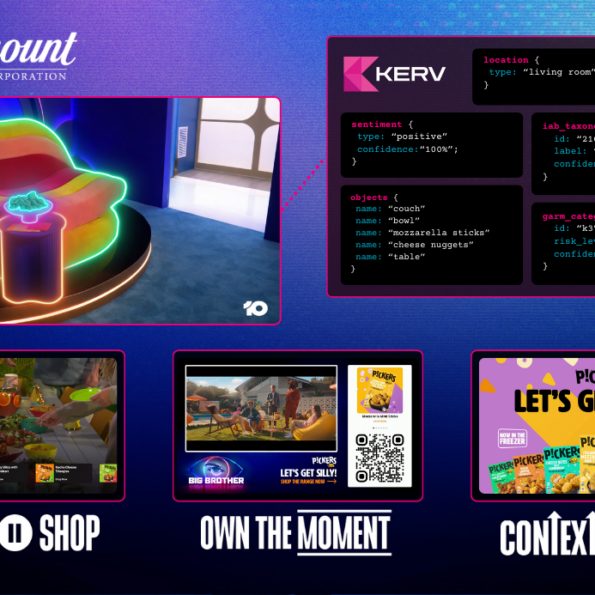
BUILDING A SHOPPABLE, ATTENTION-READY CTV OFFER: THE BIG BROTHER CONTEXTUAL CASE
26. 3. 2026In 2025, Paramount Australia, in partnership with FreeWheel and egta, hosted a webinar outlining a forward-looking view of the evolving advertising market. One key topic explored the industry’s shift to pull-based discovery, experience-driven engagement, and frictionless content-commerce integration. Paramount Australia’s Contextual Advertising Suite directly responds to these trends, reinforcing the company’s leadership in premium CTV… Continue reading GLOBO CREATES HOME SCREEN PROMINENCE FOR FREE-TO-AIR TV ON SMART TVS

GLOBO CREATES HOME SCREEN PROMINENCE FOR FREE-TO-AIR TV ON SMART TVS
26. 2. 2026Globo, Brazil’s largest commercial TV group, is rolling out DTV+, a next-generation free-to-air TV standard designed for connected TVs. It brings broadcast channels into the TV operating system, with app-like navigation, login and interactive layers placed directly on top of live programming. The move fits Brazil’s viewing reality. Linear TV accounts for 57.9% of total… Continue reading GLOBO CREATES HOME SCREEN PROMINENCE FOR FREE-TO-AIR TV ON SMART TVS
THE VISUAL TRANSFER EFFECT: HOW SOUND BUILDS BRANDS
24. 2. 2026In collaboration with neuro-marketing agency Unravel, Talpa Media has produced the scientific proof that audio does not just complement TV. It actively reactivates it, reconstructing visual brand memories in the consumer’s mind through sound. The findings carry significant implications for how audio is planned, sold, and valued within the wider media mix. Context Talpa Media… Continue reading GLOBO CREATES HOME SCREEN PROMINENCE FOR FREE-TO-AIR TV ON SMART TVS

RMB TURNS QR CODE VOTING INTO A SHARED VIEWING MOMENT THAT STRENGTHS BRAND IMAGE FOR SPRITE AND DELI CHOC
24. 2. 2026Campaign objectives The chocolate snack Deli Choc and soft drink Sprite brands worked with RMB to reach younger audiences by becoming part of Belgian hip-hop show “PLAYGROUND”, supporting new rap talent through a live QR vote and cross-platform content. This helps the brands appear as enablers of the format rather than separate ads. For RMB… Continue reading GLOBO CREATES HOME SCREEN PROMINENCE FOR FREE-TO-AIR TV ON SMART TVS

CANADIAN SUPERSTAR ANDREW PHUNG HELPS VIA RAIL CHALLENGE CAR CONVENIENCE ASSUMPTIONS WITH LONG-FORM STORYTELLING ACROSS CBC’S TV ECOSYSTEM
24. 2. 2026Campaign objectives VIA Rail, the company operating Canada’s national passenger rail service, combined a new product launch with brand building, using long-form content to tackle misconceptions that tend to block conversion in travel: comfort, ease, and whether rail feels like a realistic alternative to driving for intercity trips. The objectives behind this campaign were to… Continue reading GLOBO CREATES HOME SCREEN PROMINENCE FOR FREE-TO-AIR TV ON SMART TVS