

What you will find in the article:
- Emergence of cross-platform measurement in video advertising
- Importance of attention over volume for effective advertising
- Impact of viewing time on brand recall and recognition
- Role of high-quality content and context in consumer engagement
- Optimizing campaigns for visibility and attention enhances sales results
The report Why All Impressions Aren’t Created Equal, published by VAB, Screenforce’s US sister organisation, reveals that the impact of video advertising varies significantly depending on the platform, screen and context. It therefore addresses a central issue in the current debate about video measurement: anyone looking solely at reach sees only part of the picture. In its report, VAB examines every stage of the purchase funnel—brand awareness, consideration and sales.
Brand awareness: attention is key
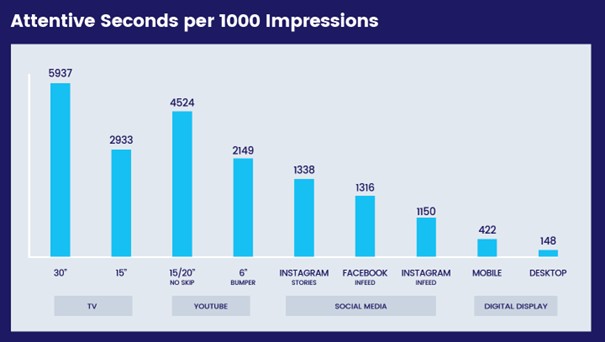
At the first stage of the purchase funnel, visibility matters, but the key question is whether the viewer actually notices the advertisement. Research shows that the length of time for which a person genuinely watches an advertisement—known as “dwell time”—is a much better indicator of effectiveness than the duration of the commercial itself. Actual viewing time varies considerably between platforms and largely determines whether the message remains in the viewer’s memory, as it is closely linked to attention. The chart below shows the number of seconds of attention per 1,000 impressions. It demonstrates that a 30-second television commercial attracts the most attention because it can hold viewers’ attention for more than just a few seconds.
Recommendation: Optimise campaigns for attention and monitor how long people actually watch an advertisement.
The research also shows that channels which consistently generate more attention, such as premium video, are considerably more effective at building brand awareness. Not every interaction with an advertisement has the same value. Impressions that involve genuine attention demonstrably make a greater contribution to both brand recall and the communication of the advertising message.
Recommendation: Improve campaign effectiveness by investing in platforms and formats capable of converting attention into stronger advertising recall and brand recognition.
The way in which an advertisement is displayed also plays a crucial role. Advertisements that are fully visible, occupy the entire screen and are watched with the sound on attract significantly more attention and improve advertising recall. This combination of factors clearly distinguishes television from many other video platforms.
Recommendation: Choose platforms and formats that use sound and offer maximum visibility.
Consideration: A high-quality environment strengthens brand preference
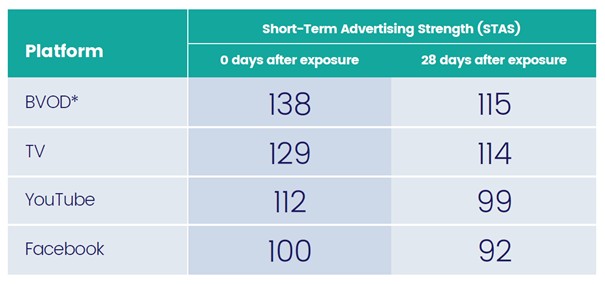
Once consumers begin assessing the available options, the focus shifts from reach alone to the level of engagement. At this stage, the quality of the content and the environment in which the advertisement appears prove particularly important. Advertisements placed within premium content on larger screens generate greater engagement and are remembered more effectively. This increases the likelihood that consumers will consider the brand when a purchasing need arises. The overview below shows the short-term advertising strength, or STAS, following exposure to a commercial. Exposure to advertising in BVOD and television environments produces sales increases of 38% and 29%, respectively, compared with no advertising exposure. The effect of advertising on BVOD and television also remains stronger 28 days after broadcast than the effect of advertising on YouTube and Facebook on the day it appears.
Recommendation: Secure premium placements alongside high-quality content on the big screen.
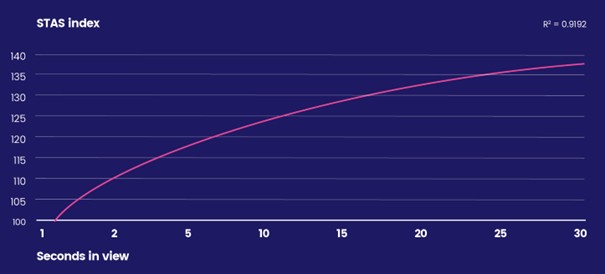
The duration of attention also plays an important role at this stage. The longer a person genuinely watches an advertisement, the more firmly the brand becomes embedded in their memory. This strengthens not only brand recognition, but also the likelihood that the consumer will choose the brand at a later stage. The relationship between viewing time and effectiveness is clear: greater attention produces a greater impact.
Recommendation: Strengthen long-term brand recall by using longer formats and environments with extended viewing times.
Context also has a significant influence. Advertisements that fit the content and environment in which they appear create a stronger emotional connection and improve brand recall. The combination of relevant context, high-quality content and sufficient viewing time determines whether an advertisement produces only a fleeting exposure or genuinely contributes to brand-building.
Recommendation: Ensure that advertisements are contextually aligned with the content in which they appear.
Sales: Attention and visibility translate into results
Ultimately, what matters is the impact on behaviour. Here too, research demonstrates that not all impressions have equal value. Screen size, visibility and advertising format have a direct influence on sales results. Exposing viewers to television advertising on a large screen therefore produces, on average, a substantially greater sales effect than when the viewer does not notice the advertisement at all.
Recommendation: To support sales, optimise campaigns according to screen size, advertising format and visibility.
The more visible an advertisement is and the longer a person genuinely watches it, the greater its impact on sales. Visibility and viewing time therefore influence not only attention, but also conversion. Impressions that viewers notice only briefly or partially contribute far less to sales results, as the chart below illustrates. Television advertising contributes significantly more to conversions, partly because of its longer viewing times and higher levels of attention.
Recommendation: Select channels and formats that offer high visibility and the ability to hold viewers’ attention.
The content of the message also matters. Campaigns that evoke emotion and use human stories prove more effective both at building brand preference and at generating a long-term effect on sales. Creative execution and context reinforce one another, provided that the viewer pays sufficient attention.
Recommendation: For maximum impact, combine emotionally powerful creative work with placement in a high-quality, compelling environment.
Conclusion: Total Video requires quality to be valued properly
The transition to cross-platform video measurement makes it possible to assess campaigns as a single whole. However, this research shows that simply adding impressions together does not provide an adequate picture of genuine effectiveness.
The value of video is determined by attention, context and the quality of advertising exposure. Impressions differ significantly in these respects and therefore deserve to be valued differently.
This approach is fully reflected in a Total Video strategy. Combining linear television with video on demand creates a mix that brings together reach and attention, as well as scale and impact. Premium video therefore remains a key driver of both brand-building and sales across screens.
This article summarises the report Why All Impressions Aren’t Created Equal, published by VAB, Screenforce’s US sister organisation. The summary was prepared by Screenforce. The full report can be downloaded here.
Source: screenforce.nl