
What you will find in the article:
- Famous historical figures enhance advertising effectiveness and emotional connection.
- Television ads utilize brief, recognizable traits of historical icons.
- Examples include George Washington, Leonardo da Vinci, and Abraham Lincoln.
- Czech advertising often features local historical figures for national pride.
- Ads may simplify historical narratives for marketing purposes.
Television advertising has only a limited amount of time at its disposal. It cannot offer lengthy explanations, develop characters or provide extensive historical context. That is precisely why famous figures from history are so useful. They come with a ready-made story, reputation and fame, as well as emotions that can quickly be transferred to a brand. Smetana represents Czech music and national pride; Mucha, beauty and artistic renown; Lincoln, honesty; Leonardo da Vinci, inventiveness; and Cleopatra, seductiveness and power. An advert does not need to present a famous person’s entire life story. It only needs to draw on their most distinctive characteristic. Let us take a look at how television advertising brings famous figures from the past back to life, which aspects of their lives it chooses to highlight, and why these individuals can help sell beer, cars, insurance, energy drinks and even online grocery shopping.
How advertising turns history into a brand story
A historical figure is easy to understand and remember and immediately attracts attention. At the same time, however, it is easy to reduce them to a caricature or slogan. Advertising generally selects only those elements of history that suit its purposes – a single characteristic, scene or symbol – and relies more on our general awareness of history than on strict historical accuracy. The result may be an epic story, patriotic emotion, gentle humour or exaggeration bordering on the absurd. Before our summer series introduces us to Napoleon, Einstein, Cleopatra, Edison and Mozart, we will pause to consider several adverts illustrating the many different ways in which history can be used in advertising.
George Washington
The famous American statesman George Washington, who served as the first president of the United States from 1789 to 1797, was featured by Dodge, then part of Chrysler, in its “Challenger Freedom” advert. Released in 2010, the commercial was created by Wieden+Kennedy Portland. It stages a scene from the American War of Independence: British soldiers are preparing for battle when three black Dodge Challengers flying American flags burst out of the woods. George Washington is sitting behind the wheel of one of them. The advert concludes with a voice-over: “Here’s a couple of things America got right: cars and freedom.”
Video: Dodge Challenger and George Washington
According to The One Club, the advert aired during the USA’s World Cup match against England, and the campaign was intended as a reminder that cars symbolise freedom in American culture. There was, of course, also a political dimension. CBS and The Guardian suggested that the advert may have resonated in 2010 with the mood surrounding the Tea Party movement, the government bailout of the motor industry and anti-British sentiment following the Deepwater Horizon disaster in the Gulf of Mexico. Chrysler, however, maintained that it was primarily a playful use of the USA–England rivalry during the World Cup. It is an excellent example of how a historical figure does not have to “endorse” a product literally, but can instead embody a national myth, freedom and automotive identity.
Leonardo da Vinci
The “Leonardo” advert is associated with the year 1992. It is said to have been the first, or one of the first, animated Red Bull commercials, launching the long-running format subsequently used by the brand: placing a familiar character, historical event or widely recognised theme in an absurd miniature story with an unexpected punchline. The famous artist is an ideal figure for Red Bull because he embodies the archetype of the inventor and evokes imagination and flight. Here, the slogan “gives you wings” is not merely an exaggerated product claim; it plays directly on the image of Leonardo da Vinci dreaming of flight.
Video: Red Bull – Leonardo
Abraham Lincoln
GEICO chose the 16th president of the United States, Abraham Lincoln. The Lincoln commercial formed part of a GEICO campaign built around rhetorical questions such as: “Could switching to GEICO really save you 15% or more on car insurance?” This is followed by another question with an apparently obvious answer: “Was Abe Lincoln honest?” The commercial shows Lincoln in a stylised black-and-white scene in which Mary Todd asks whether her dress makes her backside look big. Torn between marital diplomacy and his reputation as “Honest Abe”, Lincoln pauses for a long time before beginning to mumble and equivocate. Mary naturally takes offence and leaves.
Video: GEICO – Abraham Lincoln
Smetana, Mucha and Zátopek brought back to life in Czech advertising
Czech advertising is not being left behind either. Local brands like to turn to figures associated with school textbooks, national culture and well-known stories from the past. Bedřich Smetana, Alfons Mucha, Josef Jungmann and Emil Zátopek are more than merely famous names in advertising. They evoke Czech creativity, perseverance and pride, as well as the ability to make an impact on the world stage. While international commercials often use history as a spectacular backdrop or a source of quick humour, Czech adverts frequently draw on national figures to give brands a sense of tradition and connect them to the country’s national story.
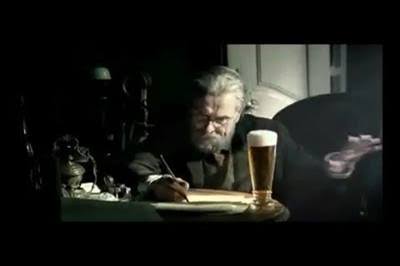
The brand that has made the greatest use of famous figures from Czech history is Pilsner Urquell. One of its most striking productions features Bedřich Smetana. The commercial shows the famous composer engrossed in creating his cycle My Country, specifically the celebrated symphonic poem Vltava. Here, beer is not presented simply as an ordinary product, but as an “inspiring taste” symbolically connected to one of the best-known works of Czech music.
Video: Pilsner Urquell – Bedřich Smetana
Pilsner Urquell adopts a similar approach in its advert featuring Alfons Mucha. The story takes place at Zbiroh Castle, where Mucha is working on his monumental masterpiece, The Slav Epic. This time, the brand borrows the image of an artist who achieved international renown while remaining deeply connected to Czech culture. The advert emphasises creativity, beauty and the creation of a great work that takes shape slowly and is driven by profound inner conviction. In doing so, Pilsner Urquell positions itself alongside the country’s national cultural heritage.
Video: Pilsner Urquell – Alfons Mucha
With Emil Zátopek, Pilsner Urquell moves from the arts to sport. In the Olympic campaign, the legendary runner appears as a symbol of perseverance, fair play and inner strength. The advert draws on his reputation as a man who succeeded through hard work and indomitable will rather than showmanship. Zátopek represents values that align well with both the Olympic ideal and the brand’s image as something honest, Czech, and time-tested.
Video: Pilsner Urquell – Emil Zátopek
Košík.cz, by contrast, plays with Czech history in an entirely different way. Instead of treating historical greats with reverence, it opts for exaggeration and humour. The advert entitled “No Czech Needs to Live in the Past Any More” features figures such as Father Czech, Bivoj, the executioner Mydlář and Jan Žižka, who deal with everyday problems in ways appropriate to their respective periods. The point is simple: today, there is no need to conquer, haul or hunt things down – all you have to do is order your shopping online. The campaign is therefore built on the contrast between the distant past and modern convenience.
Video: Košík.cz – No Czech Needs to Live in the Past Any More
Next time: Albert Einstein
Historical figures simply work. Advertising creatives select striking personalities, powerful stories and easily recognisable symbols from history that can give a brand emotion, humour, credibility or a sense of tradition in just a few seconds. Advertising naturally simplifies these figures, sometimes reducing them to a single characteristic or famous scene, but that is precisely where its power lies. It recalls a story the audience already knows and places it in a new and often surprising context. As future instalments in this series will show, some famous faces return to our screens with remarkable frequency. One of them is Albert Einstein, who is perfectly at home in the advertising industry.