

The number of media mentions, impressions or estimated reach are no longer relevant indicators of the success of communication activities. According to PR and communications measurement expert Katie Delahaye Paine, known as The Measurement Queen, the main criterion should be whether the campaign has succeeded in changing the target audience’s perception of the brand, their attitudes or their behaviour. “It’s not about a story appearing in 47 media outlets. What matters is whether anyone has changed their mind, started to trust the brand more, or behaved differently than before,” she said during her presentation at Tuesday’s Communication Summit, traditionally organised by Blue Events.
Paine distanced herself from traditional metrics based on impressions. According to her, these are often misleading because a significant proportion of views are generated by bots, part of the audience comes from outside the target market, and many tools also work with inflated traffic estimates. Marketers should therefore, in her view, focus more on the actual impact of the message. Furthermore, the way people obtain information has fundamentally changed. Today’s audience does not consume content solely through traditional media, but combines social media, podcasts, newsletters, recommendations from friends and their own searches. Communication measurement must therefore reflect the audience’s entire journey across channels.
When setting communication goals, she recommends starting with the expectations of the company’s management. The primary question is: what result would need to be achieved for management to consider the project an outstanding success? Only once this goal has been defined should the metrics used be derived from it. Her methodology also includes an evaluation system on a scale from minus ten to plus ten points, designed to clearly show management whether communication is moving in the right direction.
Paine also highlighted the effect whereby organisations gradually improve precisely those indicators that they begin to monitor systematically. She cited the example of a client with twelve agencies across Europe, which significantly increased its reach among its target audience without changing its strategy. According to her, all it took was to start measuring this parameter regularly.
The importance of PR lies not only in building awareness, but also in preventing reputational problems and crises. A key value of communication is the ability to maintain shareholder trust and prevent situations that could damage the public’s relationship with the brand.
When presenting results to management, she recommends moving away from complex tables and focusing on the narrative. Communication results should be presented using a clear structure: what the starting point was, what the company did, what changes have occurred, why they are important, and what further steps will follow.
In conclusion, Paine urged marketers and PR professionals not to measure individual channels in isolation. “Don’t measure what is easy to measure. Measure what really matters,” she emphasised, noting that a common mistake is measuring activities rather than results.
Katie Delahaye Paine, Communication Summit
7 steps to metrics that demonstrate real impact
- Define your ‘campaign moment’. Clarify your goal and what success looks like.
- Agree on suitable proxy indicators. Identify measurable indicators that will represent your goal.
- Create your performance index (one that shows actual results). Compile a summary metric that reflects overall performance.
- Set benchmarks. Determine baseline values, targets and comparative indicators.
- Create a methodological framework. Set up a structure for measuring and reporting results.
- Choose the right tools. Select technologies and platforms for data collection and analysis.
- Use data to tell a story. Turn data into concrete conclusions and recommendations, implement changes and then measure again.
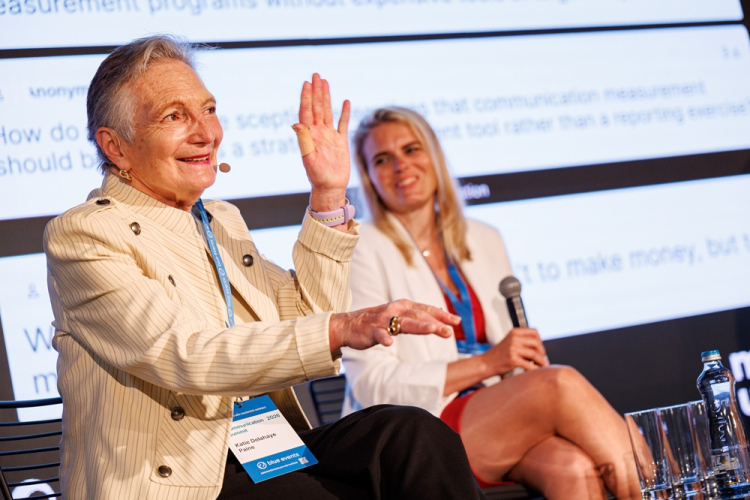 Katie Delahaye Paine and Magdalena Horánska at the Communication Summit 2026; Source: Blue Events
AI cannot yet replace humans in PR; measuring trust is key
In the ensuing discussion, Magdalena Horánska, CEO of Newton Media, joined the debate with Katie Delahaye Paine.
They agreed that artificial intelligence can significantly speed up the monitoring and evaluation of communications, but that it cannot yet be fully trusted without human oversight. They noted that current AI tools still make mistakes when performing more complex analytical tasks, such as assessing the share of specific spokespersons in media coverage or interpreting key messages. “When it comes to evaluating messages, the human element has to be there. So that we really measure what we want to measure,” was the view expressed during the debate.
The discussion also focused on the options available to smaller firms that do not have the budgets for advanced analytical tools. The speakers recommended using free trial versions of professional platforms for important campaigns or collaborating with universities and students looking for real-world projects.
There was also discussion on how to convince management of the need for and value of measuring communication. It is essential to focus on issues that management is actually addressing and to demonstrate how data helps track progress in precisely these areas. Paine likened measurement to medical diagnosis: just as a patient monitors their health indicators, an organisation should continuously monitor the development of its reputation or credibility.
Both speakers also agreed that the future of PR will increasingly require business thinking. Communication specialists must understand how the organisation works and be able to present the results of their work in a language that management understands. “If a PR professional wants to be heard at CEO level, they must speak their language. And that language is business,” they emphasised.
In addition to traditional metrics, they recommended paying greater attention to measuring trust. According to them, this can be monitored through simple, regular surveys focusing, for example, on whether people consider the organisation to be ethical, fair or capable of fulfilling its commitments. Trust, according to the debate participants, is one of the most important indicators of the long-term value of communication.
Source: mediaguru.cz