
Home can be anywhere
By 1989, planes were slowly becoming a common means of transport even for the global middle class. It was only logical that airlines began adapting their marketing communications accordingly. One truly groundbreaking example came from British Airways, which had just emerged from several years of extensive and demanding privatisation and restructuring under the leadership of Colin Marshall. The company now wanted to position itself as a genuinely global player and was not afraid to use the label “The World’s Favourite Airline.” It could afford to do so thanks to a unique television commercial known simply as The Face.
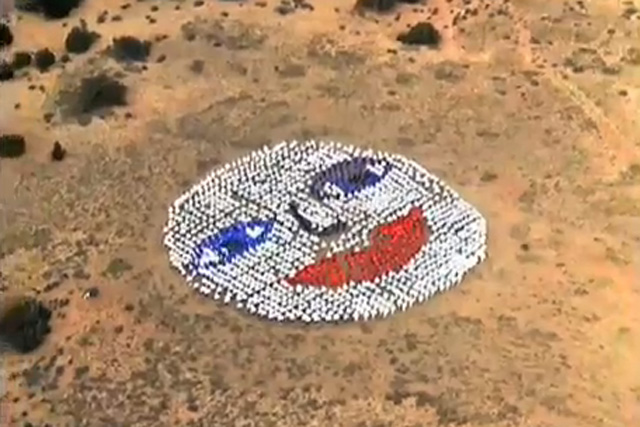
In the ad, we watch crowds of hundreds and then thousands of people from various countries around the world gathering in fields and other vast open spaces. At first glance, it is striking that they are all coordinated by colour. These masses gradually arrange themselves into shapes symbolising eyes, ears, and lips. In the epic conclusion of the ninety-second commercial, they meet and merge into a smiling human face. Paradoxically, not a single aeroplane appears throughout the ad, yet it still earned British Airways the status of a global cultural icon. It is a highly successful metaphor for the unification of the world, reinforced by an ambitious headline.
The filming took place on several continents — specifically in Europe, Africa, and America — and featured around three thousand extras. Most of the shots were captured using helicams and wide-angle cameras, and production purists will no doubt appreciate that digital touch-ups were kept to an absolute minimum. The entire undertaking cost British Airways around one million pounds, which was a truly gigantic sum in the context of the time. That is hardly surprising, however: the commercial was directed by filmmaker Hugh Hudson, and together with musical virtuoso Vangelis, he created something unique. In truth, it is closer to a short film with a strong message, with barely any focus on a specific product. It is, therefore, no surprise that this ad is still spoken of today as one of the most influential commercials of the twentieth century.
Video: British Airways – Face (1989, UK) [4K 60FPS Upscale]
But there is still only one true home
While British Airways sought to convey the message that the whole world is one big family at the end of the 1980s, the Australian airline Qantas attempted something radically different ten years later. Ahead of the upcoming Sydney Olympics, the airline sought to distinguish itself from Emirates and Singapore Airlines, which were beginning to dominate the Asian market at the time, while also strengthening its national identity. The goal was to create a long-lasting brand rooted above all in emotion rather than in machines. And it succeeded — the result is a statement that wherever you may be in the world, you still have only one home. And thanks in part to the anthem-like song by Peter Allen, it is a message with real depth that warms the heart.
The 1998 commercial I Still Call Australia Home is, from a narrative point of view, very simple. Over the course of two minutes, we follow children’s choirs singing the title song in various corners of the world. We gradually travel from Uluru, the Whitsunday Islands, and Sydney to New York, Rome, and Ho Chi Minh City, only to return at the end to the vast deserts of the Outback. The children sing directly into the camera, and the direction makes skilful use of stark geographical contrasts. Now and then, the Qantas logo or a plane appears somewhere in the frame, but this remains little more than a subtle reminder. The main takeaway is clear: wherever you are, Australia is still your home — and Qantas will take you there reliably.
This, too, was a truly gigantic production, undertaken by John Singleton, nicknamed Singo. The commercial features hundreds of child singers who travelled around the world for the shoot. Among them, members of the Australian Girls Choir and the National Boys Choir play the leading role. In its first years, the costs rose to as much as 10 million Australian dollars, but in return, the company gained its unofficial anthem — one that it still uses today during boarding and throughout flights. Unsurprisingly, it was also heard during the 2000 Olympics, and the Australian government continues to use it in tourism campaigns. This is testimony to the fact that it is essentially a musical advertisement built on pure childlike emotion and nostalgia. It has more than deserved its reputation among Australians and expatriates scattered all over the world.
Video: I Still Call Australia Home – 2M
A New Zealand pop-cultural revolution
And now for something truly epic. From a pop-cultural point of view, it is hard to dispute the idea that the best thing ever to happen to New Zealand was that director Peter Jackson chose it as the backdrop for his cinematic Middle-earth. His trilogies The Lord of the Rings and The Hobbit are cult classics and did a great deal to increase tourist interest in this geographically remote country. It is no surprise that their iconography also found its way into the marketing of local companies — and national carrier Air New Zealand was no exception. Their creative output reached a symbolic peak between 2012 and 2014, when the second trilogy was being completed. Air New Zealand understood that even a safety video could become an advertising blockbuster and, as an entertaining and non-conformist brand, gave the world this timeless classic.
Pre-flight safety instructions are usually boring — but they do not have to be. That is precisely what this commercial proves. Under the direction of Taika Waititi, it turns into a genuine journey through Middle-earth. Elven guides explain the rules of safety, while travellers encounter hobbits, dwarves, and elves. On board, we even meet actors such as Elijah Wood, Dean O’Gorman, and Sylvester McCoy. The locations vary, but for the most part, they are places where Jackson actually filmed — Tongariro National Park, Fiordland, the Pelorus River, Hairy Feet Waitomo, Matamata, and many others. Here, Air New Zealand presents itself as the official airline of Middle-earth, and the viewer eagerly accepts the game without the slightest hesitation. In surprising moments, both Waititi and Jackson themselves also make appearances in the spot.
Filming this masterpiece took several weeks. Genuine industry heavyweights took part, something Air New Zealand could afford thanks to co-production with Warner Bros. Elijah Wood did not hesitate long about his participation, and the historical accuracy of the props was supervised by the most qualified person possible — Sir Richard Taylor. The result was a true global viral hit, reaching one million views in the first 48 hours and more than twenty million after several months. Air New Zealand confirmed its reputation as the most creative airline in the world, and its safety video became a tourist attraction in its own right. It is no exaggeration to say that this campaign had an impact on the entire industry, transforming something obligatory into a creative storytelling discipline. It became clear that meta-humour and connection with the world of pop culture were the way forward.
Video: An Unexpected Briefing #AirNZSafetyVideo
Video: The Most Epic Safety Video Ever Made #AirNZSafetyVideo
A Turkish celebrity triumph
That popular culture could be a gold mine for airline marketing was not something realised only in New Zealand at the time. The same conclusion was reached in 2013 by Turkish Airlines, which was just beginning an aggressive expansion beyond Europe into the United States, South America, Asia, and Africa. The Turkish carrier naturally wanted to show that it was no longer merely an insignificant regional player and began positioning itself as a bridge between the global West and East. At the same time, it wanted to present itself as a cool brand, and two exclusive partnerships helped it do exactly that — one with FC Barcelona, the other with the NBA. As part of these partnerships, it secured two stars of world-class stature for its campaign: football legend Lionel Messi and basketball icon Kobe Bryant.
Turkish Airlines thus brought together two global sporting icons representing different sports and continents in a simple narrative. The commercial Kobe vs. Messi: Selfie Shootout is, in genre terms, a comedic duel over the best selfie, in which both athletes travel around the world with Turkish Airlines and send each other selfies from exotic destinations. Along the way, they visit places such as Moscow, Cappadocia, Bangkok, Kilimanjaro, the Maldives, and Istanbul’s Hagia Sophia. In this way, the airline demonstrates the fact that it flies to attractive destinations that everyone wants to visit. The entire commercial was conceived with viral ambitions and relies on audience engagement, encouraging viewers to share their own selfies from places Turkish Airlines has taken them. The strategy was a success.
Although Kobe and Messi appear to be in constant contact in the commercial, in reality, everything was filmed separately. Once again, the production moved around the world, and this was perhaps the most expensive Turkish advertisement of all time. Post-production involved companies from the United States, and the campaign achieved excellent results not only on television but above all online and on YouTube. It became the most-watched video on the platform in 2013, surpassing even such viral sensations as the music video for Gangnam Style by South Korean performer PSY. Within a year, it had reached one hundred million views, which is a truly exceptional figure in the industry. It was another building block of marketing based on celebrity partnerships and, at the same time, an outright pop-cultural sensation. It also functioned as a tourism spot, highlighting real destinations from Turkish Airlines’ portfolio. The biggest market players — such as Emirates, Qatar Airways, and American Airlines — reacted strongly, but they could never be first. That privilege will forever belong to the Turkish national carrier.
Video: Messi Got A Competition In Kobe Bryant – Turkish Airlines Advertisements
An effective, sexy, and glamorous counteroffensive
If we go back a few years to 2009, marketing was not yet dominated by what was viral, but rather by what was stylish. For the airline industry, this was also a highly critical period: the financial crisis was followed by painful market consolidation, from which premium carriers such as Emirates, Qatar Airways, and Singapore Airlines emerged as winners. Their competitors, therefore, had to find ways to remain relevant. Virgin Atlantic faced exactly this dilemma. The airline wanted, on the one hand, to revive its brand built on rebelliousness and glamorous aesthetics, while on the other to distinguish itself from the more conservative British Airways. In short, it wanted to prove that it was Still Red Hot. And so, on the occasion of its 25th anniversary, it bet on nostalgia, the 1980s glam-rock sound of Frankie Goes to Hollywood, and the blockbuster aesthetics of Top Gun and Miami Vice.
In the commercial, two airline crews meet at Heathrow Airport. One consists of British Airways employees, the other of Virgin Atlantic staff. The second group is visibly different at first glance — they enter the frame in stylised slow-motion shots, wearing their iconic red uniforms. It is no wonder that passengers and airport staff alike are captivated by their arrival. Compared to them, the British Airways crew comes across as dull and stuffy. Unlike the previous campaigns, this is a straightforward brand presentation of a self-confident company that knows it is bold and sexy. For such a commercial, Virgin could hardly have chosen anyone better than the Swedish creative trio Traktor, who were already known at the time for provocative campaigns for Nike, Diesel, and Levi’s. Even Richard Branson himself intervened in the production and personally approved the campaign.
Even today, it remains a textbook example of how to reinvent one’s identity effectively and update it for the needs of the modern market. The commercial became a hit in the United Kingdom, the United States, and Australia. It managed this essentially by being cool and sexy, while almost entirely dispensing with destination storytelling. The airline cast itself as a lifestyle brand targeting a younger audience above all. Even the cabin crew uniforms became pop-cultural artefacts that are still displayed today in museum collections around the world. To some extent, it is an exaggerated hyperbole — but one that does no harm whatsoever. The Still Red Hot campaign is historically regarded as a branding milestone, and its significance lies in something else as well: it showed smaller regional players how to define themselves in marketing terms and hold their own against the aggressive tigers of the Middle East and Southeast Asia.
Video: Virgin Atlantic: 25 Years, Still Red Hot Featuring Relax by Frankie Goes To Hollywood
We have witnessed the humanistic monumentality of British Airways, the anthem-like emotionality of Qantas, the pop-cultural playfulness of Air New Zealand, the viral self-confidence of Turkish Airlines, and the glamorous manifesto of Virgin Atlantic. Although these campaigns may seem quite different and were created with different goals in mind, they all share one thing: the courage to think beyond the traditional boundaries of product marketing. Historically, airlines have truly not been afraid of this, and in many cases, they created advertisements that outlived their own era and set a new direction for the entire industry. That, too, is a lesson for today’s marketers. At a time overloaded with performance metrics and short-term efficiency, it pays to return to what makes brands unforgettable — emotion, cultural awareness, courage, and authenticity. Viral success cannot be planned. But if you manage to say something meaningful about the world while remaining true to your brand’s own identity, you are doing the most important thing for its future.