
What you will find in the article:
- Exploration of energy drink advertising evolution and impact
- Key historical milestones in energy drink development
- Marketing strategies focusing on lifestyle and culture
- Notable energy drink commercials and their creative approaches
- Role of extreme sports in energy drink promotions
But energy drinks have never sold caffeine in a can alone. Their marketing gradually began selling speed, sport, nightlife, music, gaming culture, adventure, rebellion and sometimes even the ability to defy the laws of physics. Energy drink advertising works with extreme sports more often and can use other emotional shortcuts that may have little to do with the drink itself. In other words, advertising is often not about what is inside the can. It is about the world the can supposedly gives you access to.
The History of Energy Drinks
The roots of modern energy drinks do not lie in bars or restaurants. One of the pioneers of modern energy drinks, for example, was sold as a medicinal product in pharmacies. Japanese company Taisho Pharmaceutical launched Lipovitan D in 1962, which it describes as a pioneering energy drink. The small bottle contained, among other ingredients, B vitamins and 1,000 mg of taurine. This Asian model of a concentrated functional drink became an important precursor to the category that, a few decades later, would fill European refrigerators with tall, colourful cans.
Another key part of the story unfolded in Thailand. T.C. Pharmaceutical, founded by Chaleo Yoovidhya, gradually expanded its portfolio from pharmaceuticals into consumer goods and energy drinks, launching a beverage featuring two red bulls facing each other. The Thai “Red Bull” succeeded partly thanks to marketing that was relatively aggressive for its time: the company used discounts, gifts in exchange for collected bottle caps and a mix of different media. Even then, the principle was already emerging that an energy drink should not merely sit on a shelf – it should make some noise.
Then Austrian businessman Dietrich Mateschitz entered the story. Inspired by Asian functional drinks, he founded Red Bull in 1984 and spent almost three years working not only on the formula, but also on the packaging and marketing concept. Austrian Red Bull entered the market on 1 April 1987. Today, the company presents this moment as the birth of a new product category in the Western market – and looking at what followed, that is not far from the truth. According to Red Bull’s own figures, almost 14 billion cans were sold in 178 countries in 2025.
The Czech contribution to energy drink history came relatively early. Pinelli launched Semtex in 1995. When Kofola later acquired the company, co-founder Stanislav Hruška recalled that it was the first Czech energy drink to be launched on the Czech market. The name itself – shared with the Czechoslovak plastic explosive – shows how well brands of the 1990s understood the power of provocation. Kofola took over Semtex production in 2011.
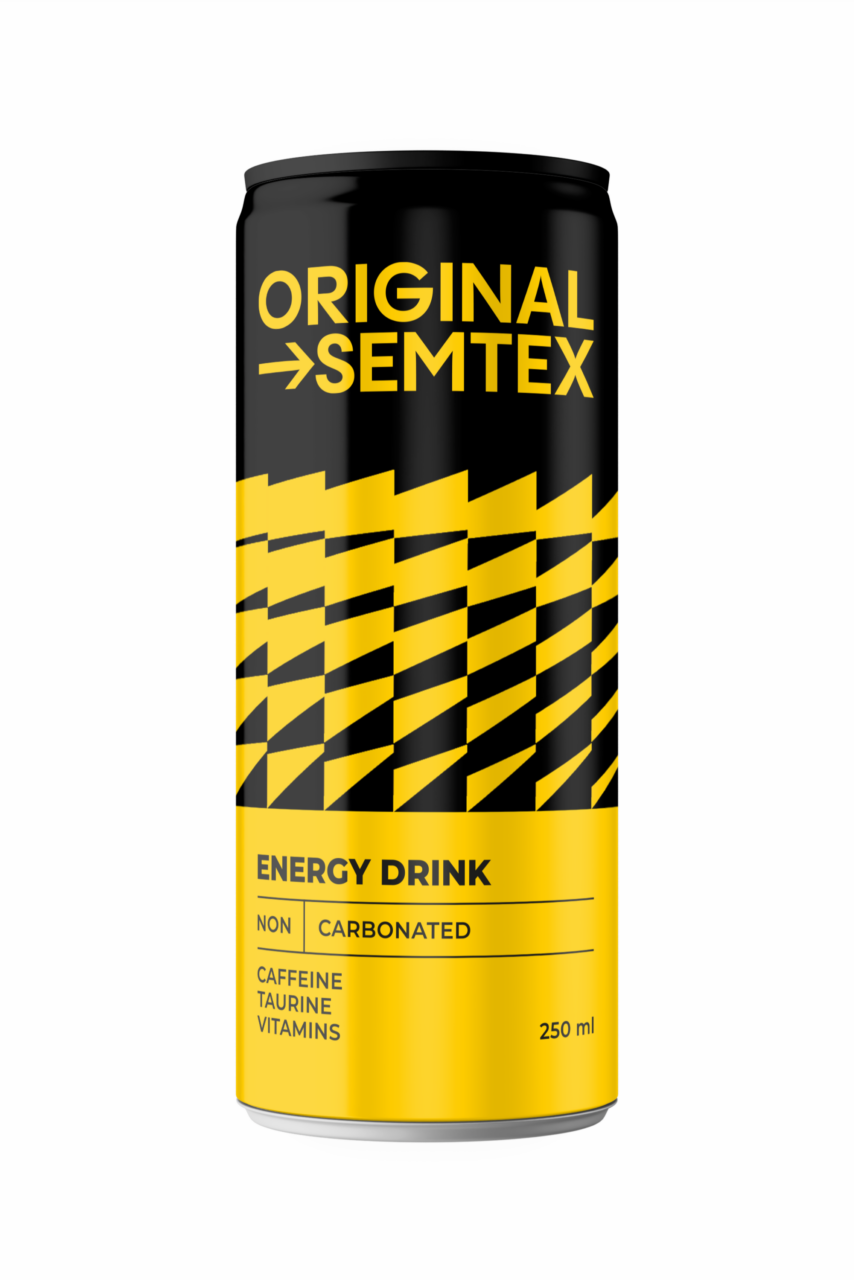 Source: Kofola
But it was not only energy drinks that evolved – their promotion did too. In the early days, marketing focused primarily on the effect of the drink itself – stimulation and a quick energy boost – as well as sales promotion. Gradually, however, brands stopped being satisfied with explaining what the drink did and began showing what kind of lifestyle it was meant to belong to. Sport, music, nightlife, celebrities and sponsorship increasingly entered the communication mix, and the energy drink became not only a functional beverage, but also part of an image.
Over time, energy drink advertising began to break beyond the boundaries of traditional commercials. Brands established themselves in skateboarding, snowboarding, motorsport, music, gaming and other subcultures, turning energy into a much broader concept than a short-term boost. An academic analysis found that energy drink advertising uses extreme sports more often than sports drink advertising and promotes consumption outside sport as well, for example at work.
Energy drinks are rewarding material for advertising creatives: they embody speed, performance, adrenaline, nightlife and the promise of extra energy. Let us take a look at commercials that show how energy drink advertising has evolved over the years – from simple humour and exaggeration through fascination with extreme performance to the worlds of celebrities, pop culture and energy for everyday life.
Red Bull: Leonardo, Who Was Missing Something for Flight
“Leonardo” is one of the cornerstones of Red Bull’s illustrated world. The commercial uses one of the best-known historical ideas – Leonardo da Vinci’s obsession with flight – and turns it into a simple advertising equation: the genius may have been able to design a flying machine, but if he had known Red Bull, perhaps he could have saved himself the trouble. Historical figures, universally familiar situations and an absurd final punchline became the recipe the brand still uses today. Few advertisements demonstrate more clearly that a global brand does not need photorealistic CGI – sometimes a line, an idea and a memorable visual style are enough.
Video: Red Bull – “Leonardo”
AMP Energy: When Jumper Cables Are Not Enough, Connect the Driver
The 2008 Super Bowl brought one of those commercials where the marketing department clearly decided to ask, “How far can we go?” – and then carried on several metres further. A tow-truck driver played by Michael Bower wants to start a dead car, connects jumper cables to his nipples, drinks AMP Energy and, to the sound of Push It by Salt-N-Pepa, begins functioning like a human car battery. A contemporary article in the San Francisco Chronicle described the spot as one of the most memorable commercials of the evening. It is also a telling example of an era when marketers promoting energy drinks loved physical humour, exaggerated masculinity and an extremely literal interpretation of the word energy.
Video: AMP Energy – Jump Start
Burn: Skateboarders Literally Leave Fire in Their Wake
Burn took a different route. The film “Ride”, directed by Garth Davis in Mexico City, draws on skateboard culture and shows riders leaving trails of fire behind them. The creators took the metaphor of “burning” creativity literally: the skateboarders were actually set on fire during filming. A specialist stunt team supervised safety, but the skateboarders themselves performed the runs without stunt doubles. The project for Burn, which at the time belonged to The Coca-Cola Company’s portfolio, was created by Publicis Mojo Sydney. It included the short films “Ride”, “Playground” and “Peepshow”. Particularly interesting was the media strategy: the short films were not intended to function only as traditional advertising, but were also distributed across dozens of community online channels and branded social media. As early as around 2010, Burn was therefore demonstrating a shift from “look at our can” to “look at a film from the culture we want to be part of”.
Video: Burn Energy – Ride
HELL Energy: Bruce Willis
In 2018, Hungarian brand HELL Energy chose a completely different weapon: Bruce Willis. The global campaign launched in early April, and marketing director Péter Pantl later openly described how the brand selected its ambassador. Three names made the final shortlist, and Willis won partly because HELL Energy wanted someone who needed no introduction. One interesting detail from the preparation process is that Pantl said he tested the choice, among others, on his seventeen-year-old daughter and her classmates, with Willis ranking among the strongest candidates. The collaboration ultimately became much more than a one-off. It was extended three times and lasted until February 2024. What began as a single advertisement therefore turned into six years of borrowed Hollywood aura.
Video: Hell Energy – Bruce Willis
In February 2024, the brand introduced Italian actor Michele Morrone, best known for the film 365 Days, as its new global ambassador. The campaign consisted of a series of mini-spots showing Morrone engaged in various activities. Filming took place in Hungary with a crew of around one hundred people.
Video: Hell Energy – Michele Morrone
HELL Energy continues to develop this strategy. In March 2026, it built the HELL CITY platform around Morrone, describing it not as a one-off campaign but as a long-term expandable “brand universe” with a cinematic, neon aesthetic inspired by metropolitan nightlife and the visual world of video games.
Semtex: Three Cans and Three Types of Energy
In 2019, Czech brand Semtex built its campaign not only around a new commercial, but also around a product change. The HIGH, LONG and FLOW range was designed to offer three different types of “energy” for different situations, while the creative concept by WMC/Grey was called “Choose Your Energy” with the line “Hack the Moment”. The main television commercial was followed by three shorter twenty-second ads for the individual variants. But what happened next was even more interesting: viewers began asking about the music used in the advertisement, even though at the time it did not exist as a complete song. Semtex therefore commissioned the full track and subsequently a music video as well. The campaign won third place at the Czech Effie 2020, and in the competition case study Kofola reported a year-on-year increase of 29% in Semtex sales volume and 28% in revenue. A brand that had been losing ground in 2018 despite a growing market therefore underwent a successful restart – and also created a song that had never originally been meant to exist.
Video: Semtex – Choose Your Energy
Coca-Cola Energy: Scorsese and Jonah Hill
When Coca-Cola launched its first Coca-Cola-branded energy drink in the United States in January 2020, it chose one of advertising’s most expensive showcases to raise awareness: the Super Bowl. The minute-long “Show Up” commercial starred Martin Scorsese and Jonah Hill, with rapper YBN Cordae also making a brief appearance. Scorsese arrives at a costume party and waits for Hill, who is at home fighting the classic evening battle between “I should go out” and “the sofa is winning so far”. The advertisement was created by Wieden+Kennedy Portland, and Coca-Cola added a carefully planned Monday activation: the day after the Super Bowl, it distributed samples at Grand Central Terminal and through Amazon Treasure Trucks in 29 US cities. Unfortunately, in May 2021 Coca-Cola announced the end of Coca-Cola Energy in North America as part of a portfolio streamlining effort. Even the famous Scorsese, it seems, cannot guarantee a happy ending.
Video: Coca-Cola Energy – “Show Up”, Jonah Hill & Martin Scorsese
Rockstar Energy: From Extreme Sports to the Spotlight
Rockstar appeared in Super Bowl advertising for the first time in 2021, shortly after PepsiCo acquired the brand. The thirty-second “Spotlight” commercial featuring rapper Lil Baby ran during the pre-game coverage of Super Bowl LV and was intended to symbolise the brand’s broader transformation. Skateboarder Chris Joslin also appeared under the advertising spotlights alongside the rapper. The commercial was created by Goodby, Silverstein & Partners and directed by Dave Meyers. At the same time, PepsiCo introduced new packaging, strengthened digital communication and spoke about deepening Rockstar’s connections with music and sport. It is a good example of how the vocabulary of the entire category was changing: instead of “do dangerous things”, the message became “work on yourself”.
Video: Rockstar Energy – “Spotlight – Hustle On”
CELSIUS: Table Football Turns into a Major Match
One of the most recent energy drink commercials is the thirty-second “The Surge” spot from April 2026. The story begins with an ordinary game of table football. But the arrival of the limited-edition CELSIUS Electric Vibe flavour triggers something much bigger: the scene transforms into a professional football match, with DJ Diplo and footballers Weston McKennie, Declan Rice and Hirving Lozano joining the action. Creator Marlon Garcia also appears. The campaign plays with the brand’s “Live. Fit. Go.” slogan, turning it into “Live. Fit. Goal.” for the football summer. The film was produced by Quiet Half.
Video: CELSIUS – “The Surge” (2026)
Perhaps even more interesting, however, is CELSIUS’s earlier “LIVE. FIT. GO.” campaign, which the brand itself described as the largest marketing initiative in its history. Alongside elite athletes, it featured a firefighter, a nurse, a marathon runner with a regular day job and other people juggling several roles at once. The brand aimed to expand the meaning of “fit” beyond physical fitness to include work, everyday responsibilities and personal goals. The June 2025 campaign included three fifteen-second films and one thirty-second “anthem spot”. Creative was handled by Anomaly, with Jackson Tisi directing.
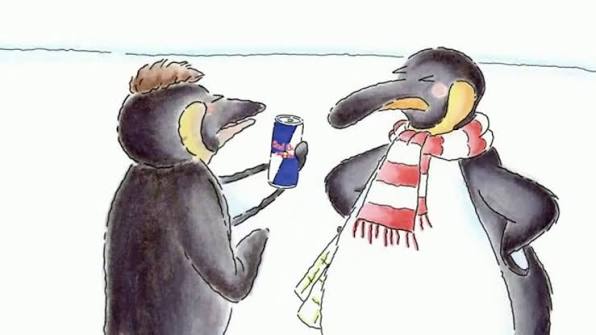
Red Bull: Penguins Try to Fly Again and an Old Idea Scores Once More
Instead of inventing a completely new concept, Red Bull revived its older illustrated “Penguins” commercial in 2025. A young penguin comes up with an ingenious solution to the age-old problem facing his species – if Red Bull gives you wings, all you have to do is drink it. There is, however, one small Antarctic problem: at forty degrees below zero, the drink is frozen solid. The new version retained almost the entire original joke, simply replacing the penguin chick with a slightly cheekier teenager. Perhaps the most interesting thing about the advertisement is precisely this recycling of an older idea: instead of obsessing over novelty, Red Bull relied on a visual brand style built up over several decades.
Video: Red Bull Super Bowl 2025 – Flying Penguins
And it worked exceptionally well. System1 awarded the commercial 4 stars and described both its short-term sales potential and brand recognition as “exceptional”. In its evaluation of advertising around the Super Bowl, it then measured Red Bull’s brand fluency at 98 out of 100. In other words, almost nobody had to wait for the logo to know which brand they were watching. It is a beautiful counterpoint to advertisements overloaded with celebrities – Red Bull needs only a penguin drawn with a few strokes.
C4 Energy: Kevin Hart Needs a 29-Hour Day
The 2024 “Energy That Hits” commercial plays with the image of Kevin Hart as someone who manages to be an actor, comedian, entrepreneur and fitness enthusiast all at once, trying to squeeze 29 hours of activity into a 24-hour day. The campaign was created in partnership with Hart’s company Hartbeat, which contributed to both the creative concept and production. Hart was a natural choice for the brand – according to his own words, he had used C4 products before becoming the face of the brand and was actively involved in shaping the campaign creatively.
Video: Kevin Hart – Energy That Hits
Rockstar: One Woman in Six Versions
Rockstar Energy launched its “You Can Own Any Moment” campaign in February 2024. In the extended version of the commercial, a woman gets out of a car and literally splits into several versions of herself: one swims, another plays tennis, another dances on a boardroom table, while yet another heads out to enjoy culture. The visual concept directly reflects the campaign’s central message: Rockstar wanted to emphasise that its drink provides longer-lasting energy for both body and mind. According to PepsiCo, the campaign was based on its own clinical study involving nearly 80 participants, from which the company derived claims that some formulations could deliver effects for up to five hours. At the same time, Rockstar also updated its visual identity and icon system on its packaging.
Video: Rockstar Energy – You Can Own Any Moment
From a Few Illustrated Lines to a Jump from the Stratosphere
With a little exaggeration, the history of energy drink advertising could be compared to an ever-expanding playing field. At first, it was enough to give Leonardo wings in a few dozen seconds or come up with another absurd punchline. Then came extreme sports, celebrities, music and proprietary events – and the line between advertising and entertainment slowly began to disappear. A perfect example is the 2012 Red Bull Stratos project. The Guinness World Records records Baumgartner’s jump as the livestreamed advertisement with the largest audience. At one point, eight million people were watching the jump on YouTube. Advertising was no longer interrupting the programme. Advertising itself had become the programme.
Video: Felix Baumgartner's supersonic freefall from 128k' - Mission Highlights
Today, television commercials and video spots are often no longer the final product, but the trigger for an entire campaign. A single advertisement becomes a gateway into the brand’s world, extending far beyond the television screen. It is clear that energy drink advertising is not running out of energy. The can has remained small, but the advertising space around it has expanded to the size of the stratosphere. Whether a brand needs thirty seconds, an illustrated penguin or a person falling from the stratosphere, the principle remains the same: do not just sell the drink – create a moment the audience actually wants to watch.