

What you will find in the article:
- The research measures viewers’ attention whilst watching a television advert.
- Differences in attention levels according to target groups and advert length.
- The data show the influence of the media environment on attention.
- A significant drop in attention after 20 seconds of viewing.
- The aim is to link the data for effective advertising planning.
At the OmniVision conference, held in the packed Spojka Karlín auditorium, the Omnicom Media Group presented to its clients the first results of a project focused on measuring the actual attention that television viewers pay to advertising. The research tracks the actual behaviour of viewers in 300 Czech households and offers an alternative perspective to traditional television advertising metrics, such as GRP or reach. The results were presented on behalf of Omnicom Media by Zuzana Horáková and Pavel Galík.
The project was developed in collaboration between Omnicom Media, the Australian company Amplified Intelligence and the research agency ResSolution Group. It builds on several years of online video measurement and now also includes Connected TV, linear television and YouTube viewed on television screens.
The measurement takes place in ordinary households using a device connected to the television, which identifies the content being watched and advertising spots using audio matching. A camera positioned above the screen then uses locally processed AI to assess whether the viewer is looking at the screen. Only anonymised data on the direction of gaze and the duration of viewing a specific advert is transmitted to the system; no video or audio recordings are sent. Based on this data, the system distinguishes between active attention, passive attention and situations where the viewer is not paying any attention to the advert at all.
The research provides data on where and under what conditions an advert gains and retains attention. It enables comparisons between television, CTV and online environments, assesses the impact of a advert’s length and its position within an advertising block, tracks differences between target groups, and compares the performance of brands and individual creative assets. It also includes an analysis of how attention wanes over the course of a commercial and when it is most appropriate to deliver a key message or branding.
According to the results presented, 81 per cent of television adverts attract at least some form of attention, whether active or passive. The research also revealed differences between individual viewer groups. For example, it showed how attention levels differ between men and women, younger and older viewers, as well as variations based on the region from which viewers come and the time at which they watch the broadcast. One of the key findings is also the significant influence of the media environment. Attention levels vary depending on the channel, the programme genre, the advertiser category or the length of the advert. These factors can result in differences of up to tens of percentage points. Conversely, according to the data, the position of a commercial within an advertising block has a more limited impact than is generally assumed.
The research also confirms the effect of a gradual decline in attention whilst watching an advert. A more pronounced drop occurs after approximately 20 seconds, which, according to the presenters, places greater demands on the creative execution of longer adverts.
The data also demonstrated that, with proper planning, it is possible to ensure that an advertising message captures a higher level of viewer attention. “With the same media budget and the same number of GRPs, the right planning can yield up to double the level of attention,” stated the presenters. They added that the long-term goal is to integrate television, digital and YouTube data into a single metric as part of total video planning. The common metric is to be aCPM, i.e. the cost per second of eye contact, which will enable media planning based on unified data.
Further information on the research can be found on the website here.
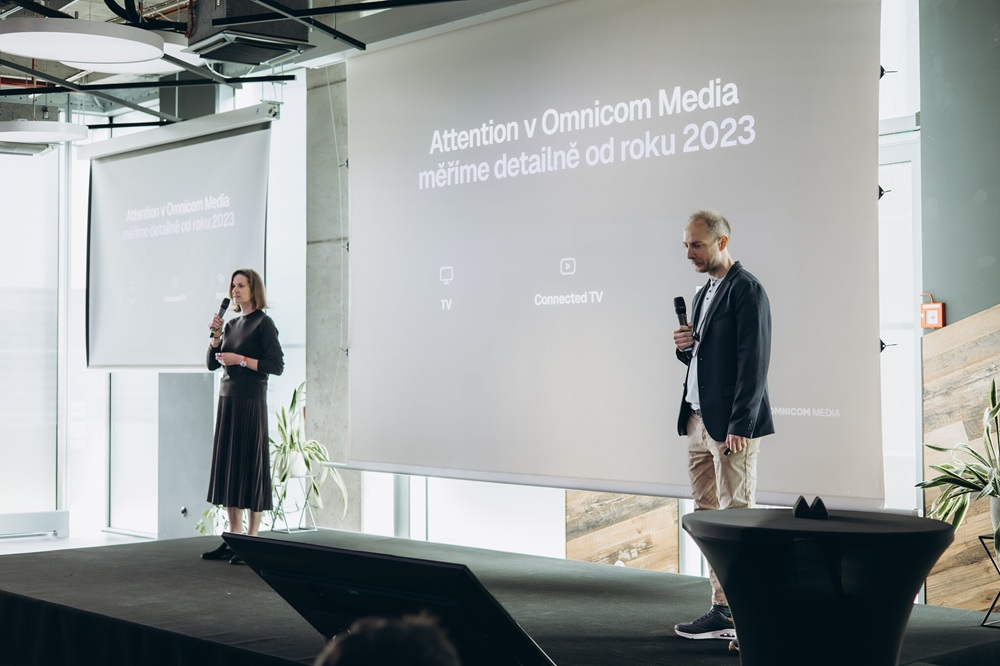 Zuzana Horáková and Pavel Galík at the OmniVision 2026 conference; Source: Omnicom Media, Karla Soukeníková
Total video: Qualified attention is key
Jerguš Slota, managing director of Hearts & Science, and Michal Michňa, media marketing manager at Allwyn, followed on from the opening presentation with an example of how a major advertiser approaches the planning of ‘total video’, which combines television, connected TV and online video.
According to the speakers, television remains the most powerful tool for building reach, though this varies significantly across generations. Younger target groups have noticeably lower reach via television, and Allwyn therefore has to compensate for this through digital channels. It is important to distinguish between total reach and qualified reach – that is, reach that has passed a certain attention threshold. For media planning and buying, Allwyn uses an in-house tool that determines specific targeting and frequency for individual age cohorts.
Allwyn categorises its campaigns into several archetypes based on the purpose of the advert (branding/launch, reminder campaigns, campaigns featuring a specific innovation or opportunity, or campaigns quickly communicating time-limited offers). The individual campaign types differ in terms of reach, effective frequency and attention quality requirements, expressed in seconds.
The so-called ‘qualitative layer’ plays a key role in planning. These are indices and coefficients that Allwyn uses to adjust traditional media reach to reflect the actual level of attention. The company continues to purchase standard media units, but additionally assesses the level of attention they actually generate among viewers.
Michal Michňa pointed out that achieving a high level of sustained attention (five seconds or more) on the Czech market is extremely challenging for some formats and would require the constant purchase of the highest-quality – and therefore most expensive – inventory. However, the data also shows that some formats, which would not be prioritised according to traditional metrics, actually perform very well when viewed through the lens of attention.
Planning based on attention data is, however, only part of the approach. Allwyn also draws on insights from MMM (marketing mix modelling) studies, including attribution. This approach has proved successful for the company. The data presented showed that, for the same level of investment, optimisation delivered a 70 per cent higher modelled return on the digital component of the campaign.
The speakers summarised the presentation’s conclusion in three questions that the company asks itself for every campaign: Are the media placements receiving sufficient attention? Does the creative subsequently retain this attention? And can we verify all these insights through a real impact on the business?
 Jerguš Slota and Michal Michňa at the OmniVision 2026 conference; Source: Omnicom Media, Karla Soukeníková
How to get a brand into AI responses
Daniel Path from Omnicom Media and Jaroslav Anelt from Rossmann spoke about how to increase the visibility of the private-label nappy brand Baby Dream in responses from language models (AI). They based their discussion on the observation that users are increasingly asking language models directly for specific recommendations, rather than using traditional search methods. The AI model thus enters the consumer’s decision-making process as early as the shortlisting stage, even before the actual purchase.
The nappy category was chosen as a typical example of a product involving a highly engaged decision-making process, where people intensively seek information on effectiveness, safety and price before purchasing, and rely heavily on recommendations from other parents. A similarly important decision-making process applies to electronics, footwear, finance, the automotive sector and health.
The brand’s starting position was, however, unfavourable: although Baby Dream is comparable in quality to branded products (A-brands) at a more affordable price and enjoys strong loyalty amongst existing users, its visibility in the recommendations generated by AI models was very low.
The parenting discussion forum Modrý koník was identified as a key source that language models draw upon and reference, which combines the authority of the source with a large number of genuine reviews and recommendations from mothers, some of which included mentions of Baby Dream. Texts were therefore created that focused on three types of queries relating to price, environmental credentials and the overall rating of the nappies. The content was also developed with the way in which language models process information in mind. The articles included, for example, brief summaries, clearly defined selection criteria, user reviews and an FAQ section.
The results only became apparent after the third article, when the brand’s visibility in AI responses began to improve. Within a month, the brand’s visibility in AI model responses rose from 17 to 40 per cent. For some specific queries, it reached as high as 60 per cent, and the brand moved into first place amongst its competitors within the monitored topics. The project is continuing with further content optimisation, modifications to the company website to suit the needs of AI systems, and testing of other platforms and formats, including video.
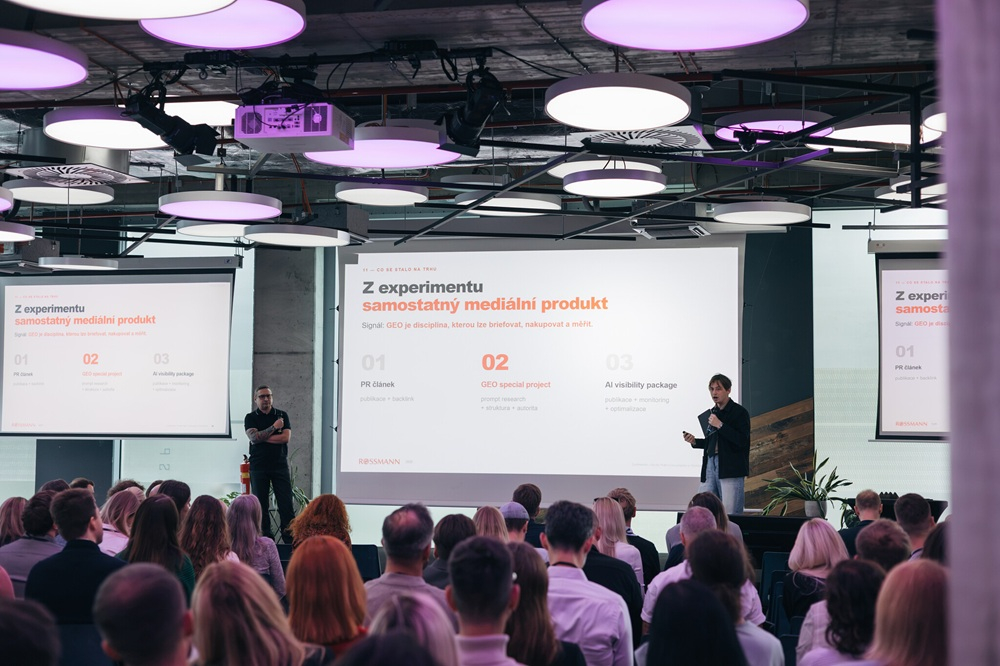 Jaroslav Anelt and Daniel Path at the OmniVision 2026 conference; Source: Omnicom Media, Karla Soukeníková
How gaming boosts sales
Philips’ gaming collaboration with the popular game Kingdom Come: Deliverance II by Warhorse Studios, which resulted in a limited edition of the OneBlade 360 men’s trimmer, reached half of the Czech gaming population. This was announced at the conference by Tobias Stolz-Zwilling, spokesperson for Warhorse Studios, and Matouš Hruška from the Fuse agency, which developed the campaign.
The special collector’s edition, limited to three thousand units, went on sale this February. The body of the trimmer and its case feature motifs from the game, and the edition also included special packaging inspired by medieval aesthetics and stylised medieval Czech. The entire edition sold out in just seven hours. A later estimate revealed that as many as 80,000 people had expressed an interest in purchasing it, added Tobias Stolz-Zwilling, who noted that the company had been unable to predict in advance just how much interest there would be in the collector’s edition. The campaign recorded a total of 6.2 million impressions, roughly half of which were paid content and half earned content. Once the limited edition had sold out, the campaign continued with standard brand advertising.
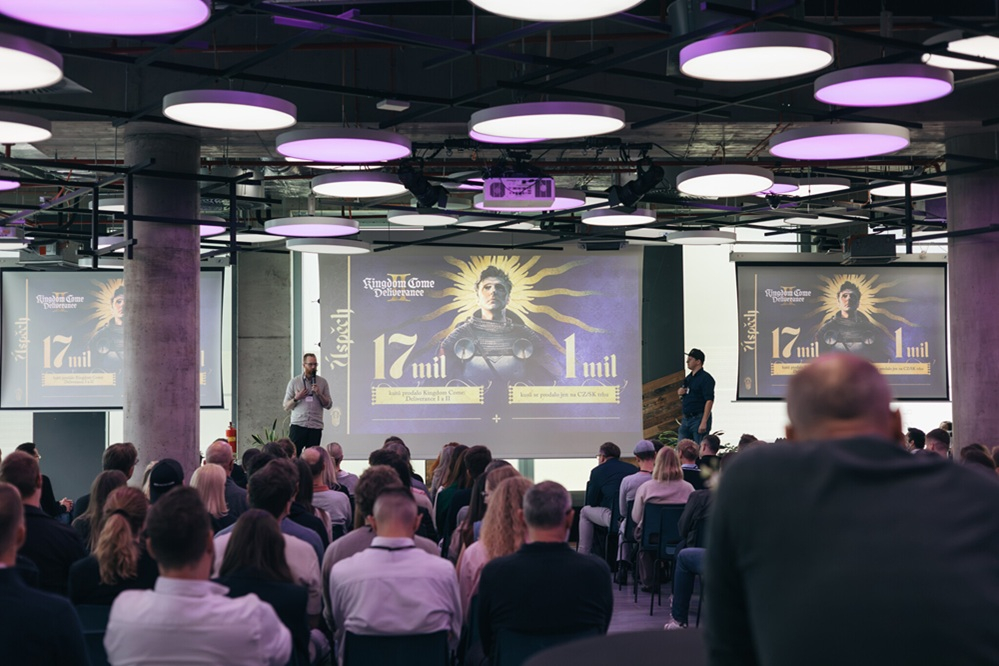 Tobias Stolz-Zwilling and Matouš Hruška at the OmniVision 2026 conference; Source: Omnicom Media, Karla Soukeníková
Source: mediaguru.cz