

What you will find in the article:
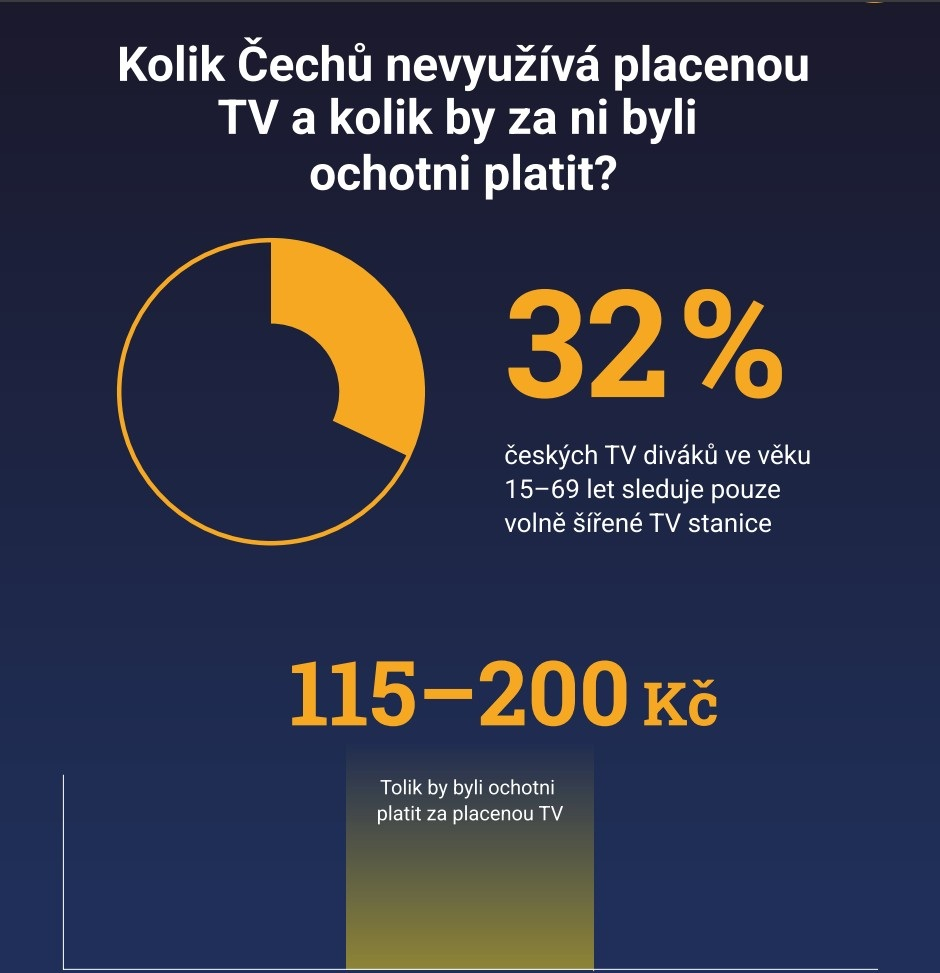
- 32% of viewers aged 15–69 use digital terrestrial broadcasting exclusively.
- Viewership of free-to-air channels has declined from 45% in 2021.
- 44% cite sufficient channel range as a reason for avoiding pay-TV.
- Viewers willing to pay 150 Kč for access to over 100 channels.
- Digital terrestrial broadcasting is most popular in smaller towns.
The proportion of viewers watching only free-to-air television channels has been falling in recent years. Whilst 45 per cent of viewers aged 15–69 used digital terrestrial television (DTT) as their main source of television reception in 2021, the figure today stands at 32 per cent. This is shown by the results of the Atmedia Index survey for the first half of this year, which was carried out by Atmedia, the sales agency for thematic television channels.
“The main reason why some viewers do not use pay-TV operators’ services is the sufficient range of TV channels broadcasting on digital multiplexes. This reason is cited by 44 per cent of terrestrial television viewers,” says Michaela Suráková, managing director at Atmedia. She also points out that the significance of this factor is declining over time, as five years ago 69 per cent of these viewers cited it.
The range of free-to-air channels on the Czech market has long been extensive. Of the total of 55 television channels currently measured , 34 broadcast via digital multiplexes and viewers can therefore watch them free of charge. “A significant proportion of television viewers still rely on digital terrestrial broadcasting, and for this reason it remains relevant for television players too. This is also confirmed by the emergence of new nationwide television channels in connection with the switch to the new DVB–T2 standard. Warner TV is a case in point,” adds Michaela Suráková.
The second most frequently cited reason why viewers stick with digital terrestrial broadcasting is a reluctance to pay for television content. This reason is cited by 35 per cent of viewers who watch only free-to-air television channels.
A fifth of viewers, meanwhile, consider pay-TV prices to be too high. “Some viewers are highly price-sensitive, and price plays a key role in their decision to switch to pay-TV. That is why, as part of the atmedia index research, we regularly carry out a so-called price test,” adds Suráková.
According to the results for the first half of this year, viewers who currently watch only free-to-air television channels would be willing to pay between 115 and 200 Kč per month for pay-TV operators’ services, with the optimal price point being 150 Kč. For this price, they expect access to more than 100 TV channels, at least two-thirds of which broadcast in HD quality. Features such as catch-up TV, the ability to watch content on multiple devices simultaneously, and the option to record programmes for later viewing are also a given for them.
Digital terrestrial broadcasting has the highest share in smaller towns with up to 20,000 inhabitants and in towns with between 20,000 and 100,000 inhabitants, where one-third of viewers (33 per cent) use it in both cases. It has a lower share in large cities with over 100,000 inhabitants (27%).
 Source: Atmedia
Source: mediaguru.cz