

What you will find in the article:
- Einstein's image is used to symbolize genius and innovation in ads.
- He has appeared in campaigns for various products, including bread and phones.
- Advertisers leverage his recognizable appearance for quick brand messaging.
- Einstein has been depicted in ads through real footage, actors, and CGI.
- Notable campaigns include Apple's "Think Different" and Pepsi's "No Brainer."
Albert Einstein was born in 1879 and died in 1955. Although he is now associated primarily with academia, he began working at the Swiss Patent Office in June 1902. It was during his time in Switzerland that he produced some of his most important scientific work. In 1905, he published, among other things, a paper on the special theory of relativity and explored the quantum nature of light. He completed his general theory of relativity in 1915. He was awarded the 1921 Nobel Prize in Physics, although the theory of relativity played no part in the award. The Nobel Committee recognised his contributions to theoretical physics, particularly his discovery of the law of the photoelectric effect.
For advertisers, however, it is not only Einstein’s scientific reputation that matters, but also his appearance and public image. While other scientists may not be instantly recognisable to the average viewer, Einstein’s silhouette, hairstyle and moustache function almost like a graphic logo. An advert, therefore, rarely needs to explain whom it depicts or why: Einstein automatically embodies genius, discovery and unconventional thinking.
Creatives love Einstein
Einstein appears in advertising primarily because he can convey, within a matter of seconds, a meaning that would otherwise require a much longer explanation. A product presented alongside him can appear intelligent, technologically advanced or ingenious. Consumer research conducted during the development of the British Smart Energy GB campaign, for example, showed that Einstein embodied the meaning of the word “smart” for consumers. He can simultaneously create surprise and communicate a wide range of messages – from technological innovation to household savings. In addition to his scientific authority, however, there is another dimension that creatives frequently exploit. The scientist’s tousled hair, his fondness for playing the violin and his famous informal photographs turned him into a figure who can also lend an advert a comic undertone. Einstein tends to be depicted in television advertising in three different ways:
- Archive images of the real Einstein: authentic photographs or film footage are used. Apple, for example, used Einstein in this way.
- An actor’s interpretation: a well-known actor or impersonator is cast to present Einstein as a dramatic or comic character. Examples include Geoffrey Rush in a National Geographic advert and Paul Giamatti in a Verizon campaign.
- Digital reconstruction: a photorealistic version of Einstein is created using computer-generated effects and performance capture. This approach was used in the Smart Energy GB campaign.
Apple: Think Different – The Crazy Ones
One of the best-known uses of Einstein in advertising is Apple’s 1997 Think Different campaign. The black-and-white television commercial brought together archive footage of people who had made a profound impact on society, science or culture. Alongside Einstein, it featured Bob Dylan, Martin Luther King Jr, Mahatma Gandhi, Pablo Picasso and other notable figures.
The commercial did not promote a particular computer or explain its technical specifications. Through these prominent individuals, Apple presented itself as a brand for people who challenge the established order and introduce new ideas. Einstein is neither a comic figure nor a product spokesman here. Instead, he serves as evidence supporting the campaign’s central claim: people who think differently can change the world. The campaign was created by TBWA\Chiat\Day and launched by Apple in 1997.
Video: Apple – Think Different
The Think Different campaign won the 1998 Emmy Award for Outstanding Commercial.
Pepsi: Einstein knows the answer
A 2000 advert for Pepsi presents Einstein in a more comic light. In the commercial, the physicist attempts to use mathematics to decide whether to choose Pepsi or its rival, Coca-Cola. It parodies the idea that even a perfectly simple consumer choice can be turned into a complex scientific problem.
The title No Brainer suggests that, according to the advertiser, there is really nothing to think about: choosing Pepsi should be the obvious decision, even for the greatest genius. The advert also used music by Philip Glass, specifically a motif from Einstein on the Beach, creating an additional cultural connection between the historical Einstein and his image in popular culture.
Video: Pepsi – No Brainer Einstein
Genius: The famous physicist has a gluten-free sandwich on his mind
British gluten-free bakery brand Genius used Einstein’s name and image in a campaign launched in 2010. The commercial shows Einstein working on physics calculations. Rather than concentrating fully on science, however, he is constantly distracted by thoughts of a sandwich made with Genius bread.
The advert is built around a play on words: Einstein is widely regarded as the embodiment of genius, while simultaneously promoting a brand called Genius. The brand capitalises on the meaning of its name and transfers some of Einstein’s reputation to the product. The campaign was created by Adam&Eve. The industry website Campaign also noted that Einstein was voiced by an impersonator of the British actor Stephen Fry.
Video: Genius Bread – Distracted Albert
National Geographic: The genius plays the violin
In 2017, National Geographic introduced Einstein as the central character in its television series Genius. In an advert broadcast in connection with Super Bowl LI, he was portrayed by Australian actor Geoffrey Rush. An older Einstein sits in his study playing the violin. It gradually becomes apparent that he is performing Lady Gaga’s Bad Romance. Timing was a crucial part of the concept. The 45-second commercial was broadcast immediately after Lady Gaga’s halftime performance. It was National Geographic’s first standalone advert to be shown during the Super Bowl. The commercial was filmed in Prague, and Geoffrey Rush learnt to play Bad Romance on the violin specifically for this purpose.
Einstein functions here simultaneously as a historical figure, a character in a drama series and a source of cultural surprise. Pairing the respected physicist with a modern pop song was intended to demonstrate that the series would not be a dry biographical account, but the story of a man who was not only a brilliant scientist but also an unconventional, passionate and rather contradictory individual.
Video: National Geographic – Genius: Bad Romance
National Geographic’s Bad Romance commercial won the 2017 Super Clio, awarded to the best advert associated with the Super Bowl broadcast. Its success was due chiefly to the precise media placement of the advert immediately after Lady Gaga’s performance. Rather than being merely a self-contained story, it cleverly followed on from the event that viewers had just watched.
Smart Energy GB: Einstein uses a smart meter
In 2021, the British organisation Smart Energy GB launched its extensive Join the Energy Revolution campaign, in which a digitally reconstructed Einstein finds himself in present-day Britain. He marvels at modern technology while simultaneously struggling to understand why the energy infrastructure has still not been modernised sufficiently.
Einstein was not created using simple facial animation. The Mill studio recorded an actor’s performance using volumetric capture and then transferred it to a photorealistic computer-generated model. The creators worked separately on his facial expressions, eyes, wrinkles and individual strands of hair. The resulting character could talk about modern technology and move through situations that never occurred during Einstein’s lifetime. It was therefore not an automatically generated image: the final performance combined an actor’s work with animation and the expertise of visual-effects specialists. Because using the photorealistic model was expensive, a less costly eight-bit Einstein was also created for the subsequent 2022 commercial Pep Talk.
The initial 40-second commercial was supplemented by shorter television versions focusing on the specific benefits of smart meters.
For the 2022 television follow-up Gadget, however, the creators adopted a different approach, producing the Einstein character with the help of an actor, a mask and prosthetic make-up. The commercial shows him talking to his neighbour Darren. Einstein explains that a smart meter’s in-home display allows people to monitor their energy consumption over different periods and helps them plan their household budget more effectively. The campaign was created by AMV BBDO, and the commercial appeared on television, online streaming services and YouTube.
What is interesting here is the reversal of the traditional relationship between the personality and the product. Einstein is not merely a symbol of abstract genius, but a practical adviser who translates the complicated subject of energy infrastructure into the realities of everyday household life.
Video: Smart Energy GB – Gadget
Verizon: Einstein – $25
American telecommunications provider Verizon cast the actor Paul Giamatti as Einstein. In the December 2022 commercial, he appeared alongside Cecily Strong. Giamatti’s Einstein discovers that his cheap mobile network has stopped working yet again. He is forced to admit that trying to save money was not a particularly smart decision, and Cecily Strong offers him a Verizon plan.
The advert is built around an unexpected punchline: the man regarded as the greatest genius of his age makes an ordinary consumer mistake. The product can therefore be presented as a solution so simple and advantageous that even Einstein himself eventually appreciates it. Paul Giamatti also appeared as Einstein in a subsequent commercial promoting the Samsung Galaxy S23+.
Video: Verizon – Einstein: $25
Albert Einstein as a star of television advertising
In television advertising, Albert Einstein appears less as a historical physicist and more as a cultural symbol of intelligence, technological progress, creativity and unconventional thinking – or as a humorously exaggerated embodiment of “the cleverest man in the world”.
It is precisely this adaptability that explains why Einstein has endured in advertising longer than most other historical figures. His likeness offers both instant recognition and considerable scope for surprise. The result, however, can be a significant simplification of the real person: the scientist, refugee, humanitarian and politically engaged individual is often reduced to little more than his hair, moustache and a general idea of genius.
Creatives who decide to use Einstein’s image do not have an entirely easy task. The scientist bequeathed his papers and literary rights to the Hebrew University of Jerusalem, which now manages his archive, while applications for commercial licences to use his name and likeness are handled by CMG Worldwide. Advertisers must therefore allow for the campaign to undergo an approval process and for the requirement that the advert must neither damage Einstein’s legacy nor attribute fabricated statements to him. Licensing rules have previously prohibited associations with tobacco, alcohol and gambling, for example.
Even obtaining a licence may not resolve every issue: the photographs, film footage, music and other creative elements used may be protected separately. The rules also vary from one country to another. This was demonstrated by a 2010 legal dispute. The Hebrew University sued General Motors after an advert placed Einstein’s head on the body of a muscular man with the formula E = mc² tattooed on it. The image was accompanied by the slogan “Ideas Are Sexy Too”. The lawsuit was prompted by objections to the unauthorised commercial use of Einstein’s likeness.
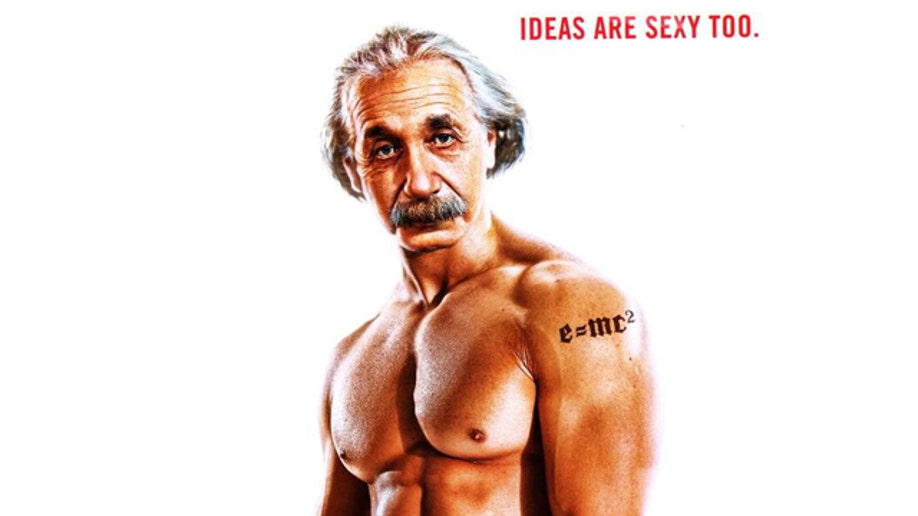 Source: foxnews.com
In 2012, a US court dismissed the lawsuit, concluding that under New Jersey law Einstein’s post-mortem publicity rights would have lasted no longer than 50 years and would therefore have expired in 2005. The parties subsequently reached an out-of-court settlement, however, and in January 2015 the court vacated its original ruling at their request. Its conclusion that the rights lasted for 50 years therefore cannot be regarded as a valid and definitive resolution of the issue.
It is clear that Einstein’s face may not be freely available for use everywhere and under all circumstances. Digital reconstructions require particular caution because they may create the impression that Einstein genuinely delivered a message written by an advertising agency.
Despite all the licensing and legal pitfalls, Einstein remains an exceptionally appealing figure for agencies and creatives. Few historical personalities can convey so many different meanings in a matter of seconds while working equally well in serious, technological and purely comic treatments. This instant recognisability and broad scope for interpretation often outweigh the more complex approval process and greater production demands. Moreover, when Einstein’s legacy is used sensitively and imaginatively, it can lend an advert not only an aura of genius but also a powerful element of surprise that audiences will remember.