

No one today doubts the importance of brand-building for long-term growth, pricing power and profitability. In her presentation, Grace Kite therefore focused on a modern approach to brand-building, in which marketers create something substantial from all the little exposures across all the platforms available in today’s fragmented media environment.
Television is the gold standard…
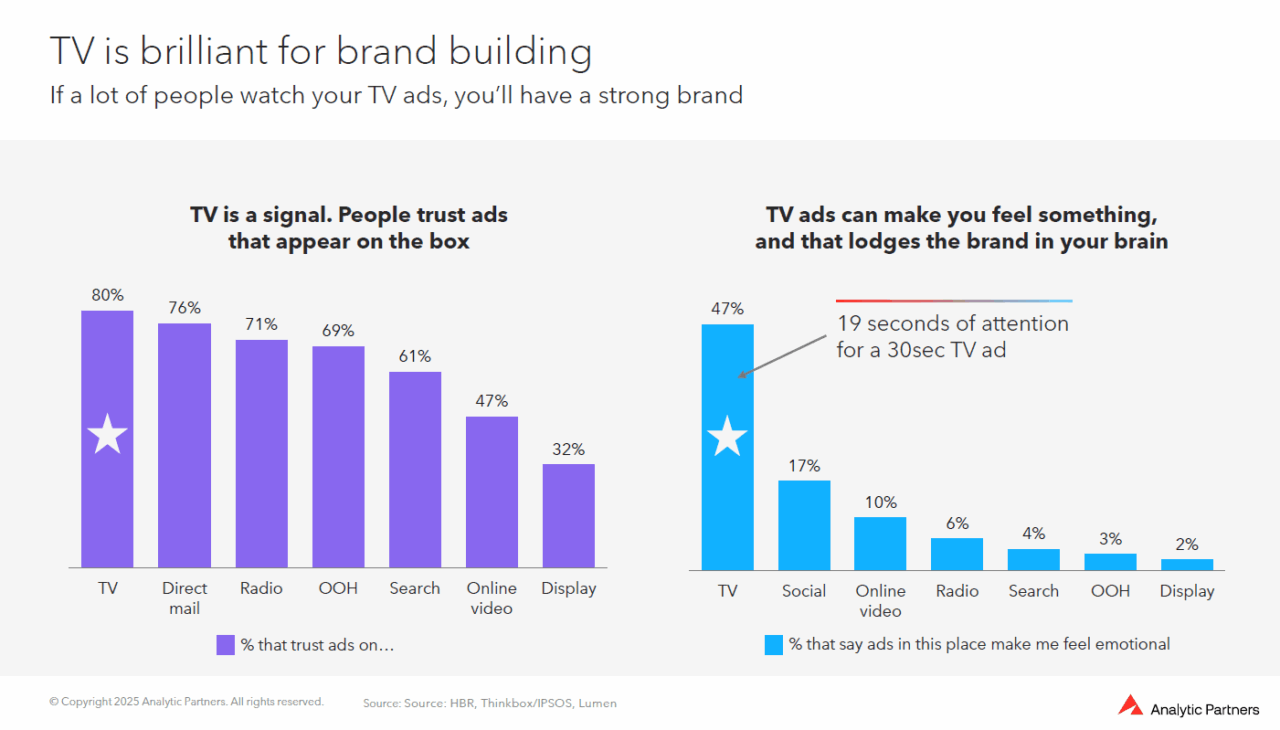
Grace Kite is an expert who has spent the past 20 years evaluating advertising. “TV always had the highest return on investment. It had long-lasting effects. It was genuinely capable of driving growth. And it is because TV is brilliant for brand-building,” she said. According to Kite, this is because television is trusted and encourages shared viewing, as people watch it with family or friends. Crucially, it also attracts enough attention to tell a story, convey something human and evoke feelings in viewers.
For brand-building, TV genuinely is the best media channel there is.
Grace Kite
Television advertising is trusted by 47% of people, compared with just 17% for advertising on social media. Television commercials are also capable of eliciting emotion: a 30-second advertisement holds viewers’ attention for an average of 19 seconds, significantly longer than digital formats.
 Source: Analytic Partners
…but it is becoming increasingly expensive
Increasingly, however, parents watch television while their children use their own devices—sometimes two at once. They skip anything they find boring and are unlikely ever to take an interest in the content their father is watching, such as a crime drama on ITV or something similar.
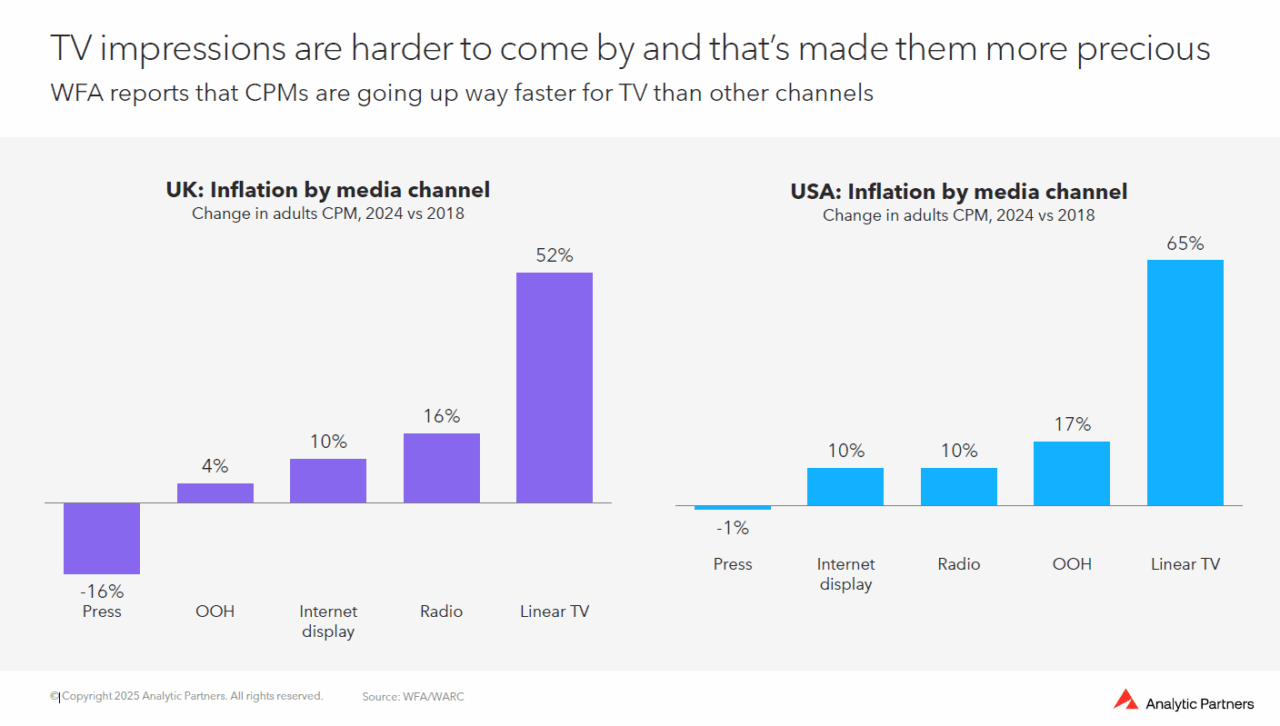
Young people are gradually turning away from television, and the consequences can no longer be overlooked. The number of available television impressions, for example, has been declining rapidly since 2018. Advertisers still want to build brands on television, but cost is becoming a problem. According to WFA/WARC data, linear television CPMs have risen since 2018 by 52% in the UK and 65% in the US. Other channels, including print and online media, have either remained stable or become less expensive. This places greater pressure on marketers, who are being forced to seek effective combinations of media.
 Source: Analytic Partners
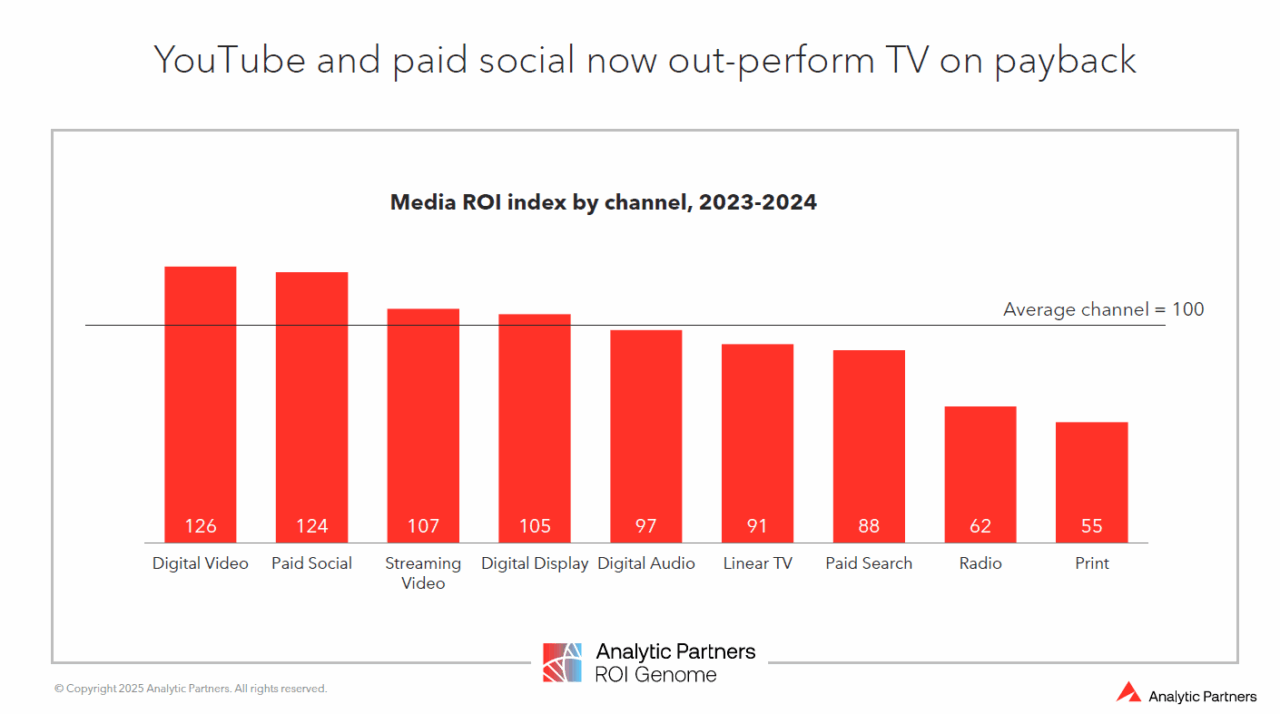
This naturally affects returns and completely changes the overall picture. Data from Analytic Partners’ ROI Genome—covering 750 businesses in 45 countries and hundreds of billions in expenditure—reveals a surprising development: television is no longer the leader in return on investment.
 Source: Analytic Partners
According to Grace Kite, however, this does not mean that television no longer has a role to play. It remains extremely important within the media mix.
If we all believe—which we all do—that brand-building is important, we have to think about new routes. Because popping all your money into TV and then sitting back to enjoy the long-term benefits of having a strong brand just isn’t going to work anymore because it’s not going to reach everyone.
Grace Kite
A new brand-building plan
A different plan is therefore required. The first step is to look at where people spend their time when they are not watching television and to appear alongside content they genuinely enjoy.
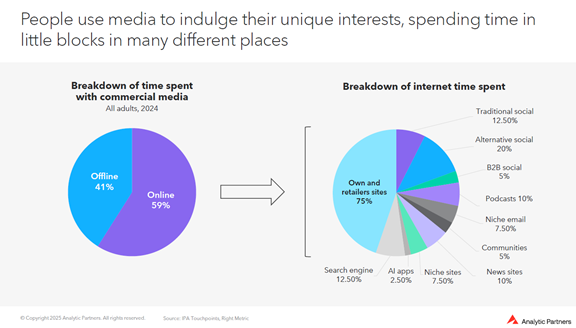
Today’s consumers spend their time in small blocks across a range of platforms. According to IPA TouchPoints data, their media mix includes traditional social media platforms (12.5%), alternative social platforms (20%), podcasts (10%), community forums (5%), specialist websites (7.5%) and even AI applications (2.5%). Overall, people devote 59% of their media time to online channels and 41% to offline media.
 Source: Analytic Partners
Grace Kite stressed that this fragmentation should be seen as an advantage rather than a problem. It enables brands to move closer to the things people love. When a brand appears in the right context, its return on investment can increase by between 20% and 150%.
The trouble: lack of attention
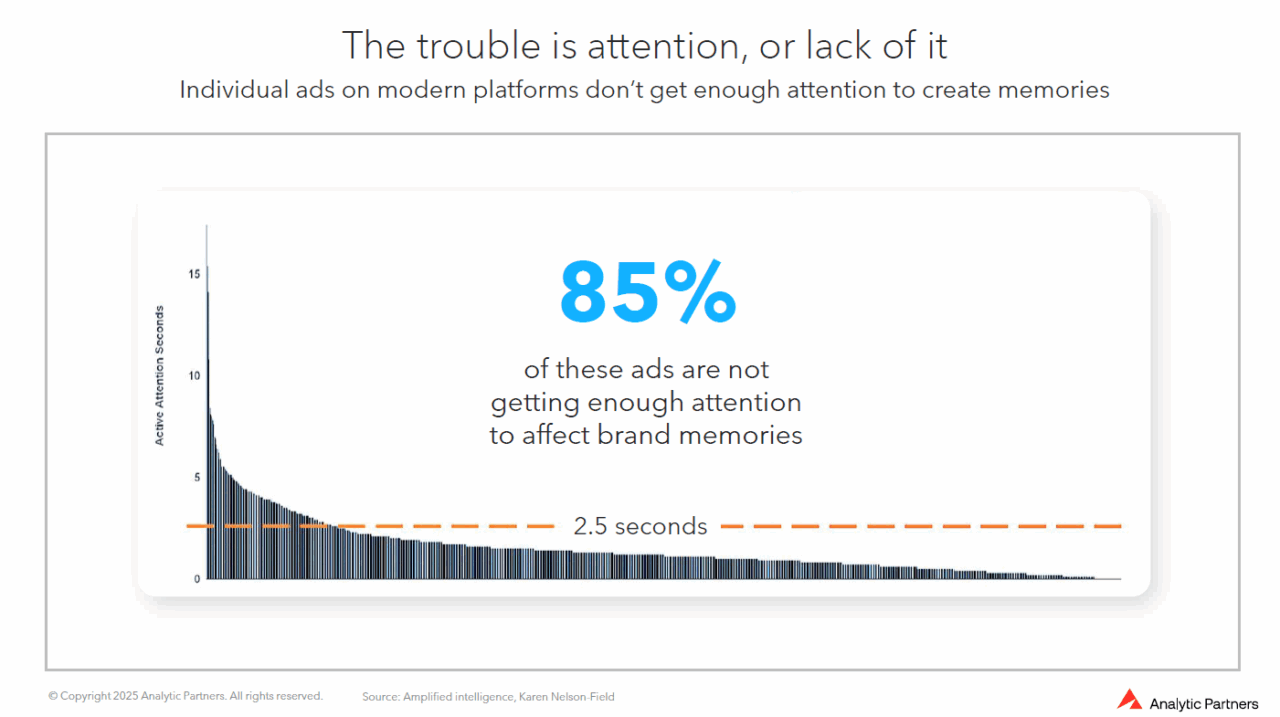
There is, however, one small problem, as demonstrated by Karen Nelson-Field’s research. She analysed 130,000 advertising impressions to determine how many seconds of attention they received. She also researched how many seconds were necessary to achieve a brand-memory effect. The threshold proved to be 2.5 seconds.
 Source: Analytic Partners
It emerged that 85% of online advertisements fail to attract this level of attention. This means that most advertising in the places where people currently direct their attention does not receive enough of it to achieve memorability and contribute to brand-building.
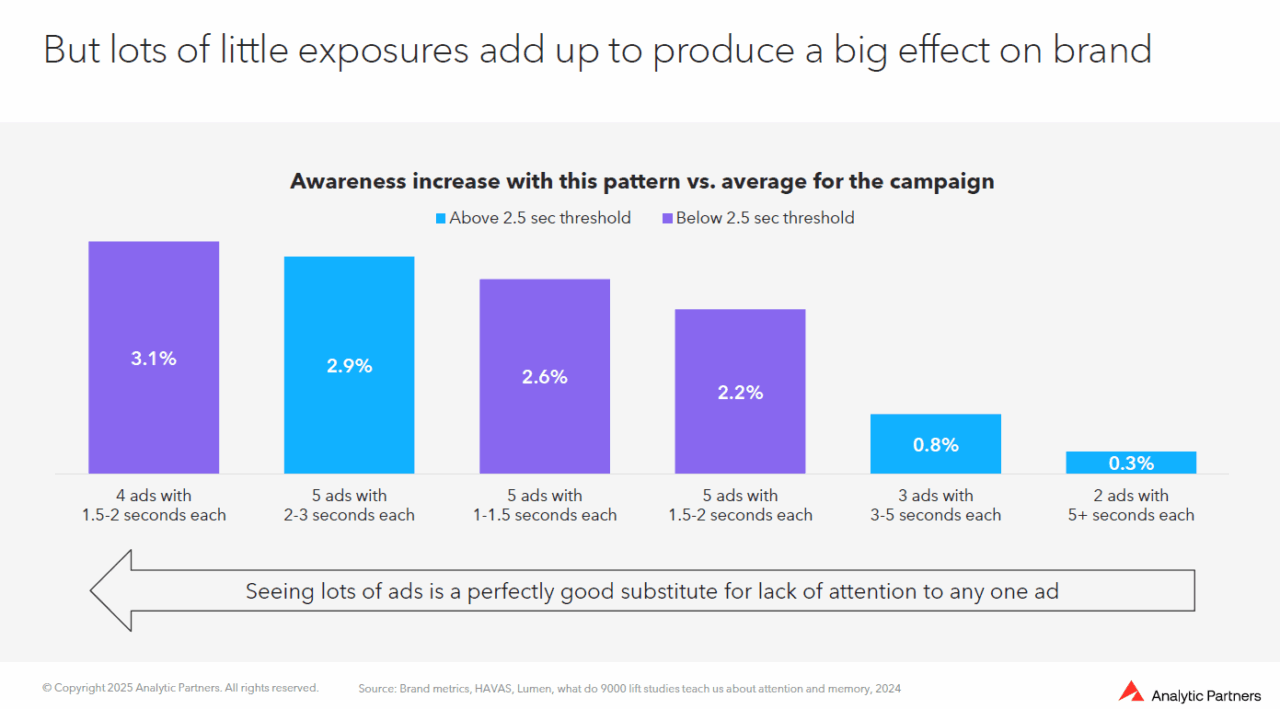
Nelson-Field is not the only researcher studying attention. Last year, Havas and Lumen published a highly interesting study entitled Aggregated Attention. It compared exposure to different numbers of advertisements within the same campaign and the attention they attracted, with the aim of increasing awareness—an important part of brand-building.
At first sight, insufficient attention might therefore appear to be a stumbling block for the “Lots of Littles” strategy proposed by Grace Kite. She takes a different view, however. “Karen Nelson-Field is a really serious researcher. The work she did is very good. So I 100% believe this finding. But I’m not sure I believe the conclusion saying that ‘Lots of Littles’ doesn’t work,” she said, immediately explaining why. “This chart shows the findings. Blue is where the ads get more than Karen’s threshold—more than 2.5 seconds of attention—and purple is where they don’t. And what you see is that seeing lots of ads with a little bit of attention is a perfectly good substitute for lack of attention to any one ad.”
 Source: Analytic Partners
Grace Kite emphasised that lots of little exposures add up. Even exposure lasting only a few seconds can, if repeated, increase brand awareness just as effectively as a longer commercial. She compared the situation to a beehive: “What’s happening is a bit like honeybees here. Each bee has his own job: fetching pollen, stashing it in the hive, working on the honey and on its own, each honeybee can’t do much, but there are lot of them, and they are co-ordinated, working together for the same outcome. Together, they can achieve a lot. So the co-ordination, the act of working together, the synergy between the bees is what makes it all so effective and so useful. And the same is true in media—and it’s not just on the platforms, it’s across all media channels.”
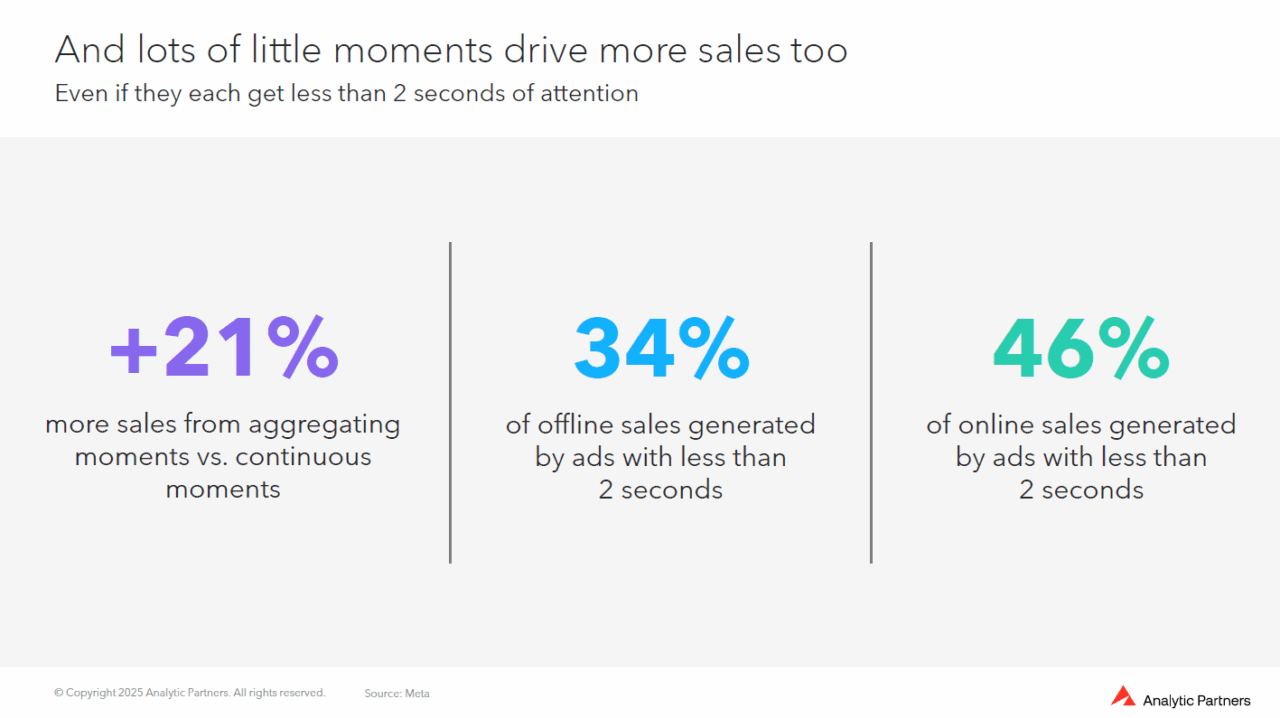
The data shows that as much as 46% of online sales and 34% of offline sales come from advertisements that viewers watched for less than two seconds.
 Source: Analytic Partners
The power of cross-channel synergies
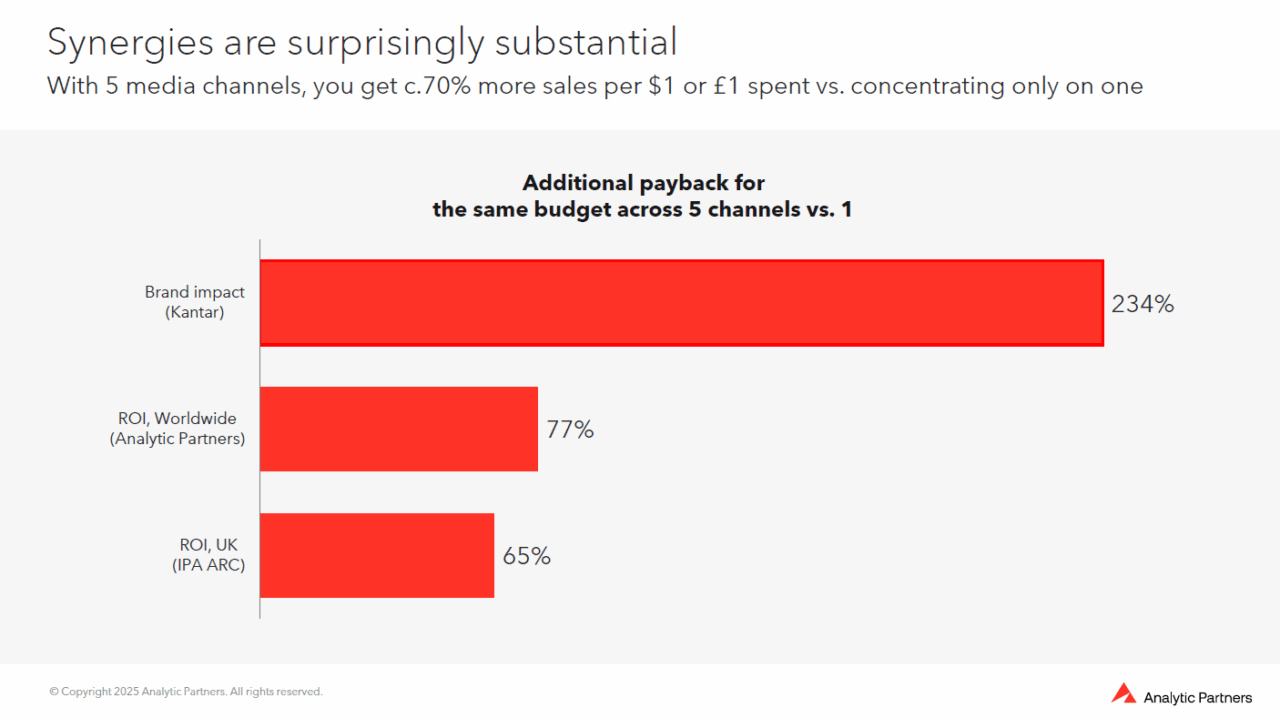
Another important consideration is the combination of different media. Grace Kite demonstrated that campaigns using several channels achieve substantially better results than those relying on only one. When five media channels are combined—such as television, radio, online video, social media and print—the resulting sales and brand metrics can be up to 70% better for every unit invested.
 Source: Analytic Partners
The data shows that combining five channels increases return on investment by 65% in the UK and 77% globally. The impact on the brand is as much as 234% greater than when a single medium is used. Managing synergies effectively can therefore deliver considerable gains.
The bottom line
Fragmentation is not a new phenomenon, but it requires a new approach. Grace Kite proposed three key principles that brands should follow:
- Reach the target audience in the environments they enjoy – Brands should be present where people spend time with content and activities that genuinely interest them.
- Build the brand through lots of little interactions – Little exposures add up and can compensate for the absence of longer interactions.
- Spread the budget across multiple channels – Synergies between media multiply the impact and deliver a higher return on investment.
Grace Kite’s presentation offered a reassuring and inspiring message: a great brand can be built even from little bits of attention. At a time when the media landscape is becoming increasingly fragmented and traditional television is more expensive than ever, this strategy appears to offer a realistic route to brand growth.
Source: warc.com