

The third period, the score is level, and then comes the ad break. At that moment, hundreds of thousands of people are sitting in front of their screens, not switching channels and paying close attention. For a small brand, these are the most expensive few seconds of the year. Can such exposure actually be turned into real brand awareness, or is it just an overpriced blink of an eye? The research agency Behavio tested three campaigns that ran during the 2026 World Championship to find out what viewers actually take away from the adverts.
The Ice Hockey World Championship still manages to draw a large part of the country to their screens at once.
At least one match this year was watched by 47% of Czechs, and a quarter of the population didn’t miss a single match involving the national team. For advertisers, however, it is even more interesting to know where and how people watch. The vast majority (97%) watched at home, and 62% cheered on the team together with friends or family. This often involves beer (36%) and savoury snacks (33%).
Hockey moves the audience: for 62% of them, it affects their mood at least a little, and for 14% of Czechs, a win or a loss can leave them feeling unsettled even the next day. Only a quarter of us remain unfazed by the result.
For a brand, strong emotions are a goldmine – they act as an amplifier, helping the advert to stick in people’s minds. One question remains: can advertisers capitalise on this?
Why it pays to be on TV during the hockey season
Live sport is one of the last things people watch at the same time, together, and with their attention fully focused. Whilst regular broadcasting is fragmenting into on-demand viewing and ad-skipping, the Ice Hockey World Championship keeps viewers glued to their screens in real time. This is exactly the situation marketers crave: a massive reach all at once, coupled with shared emotion that multiplies how well people remember the advert.
“We also know from marketing science that brands grow mainly when they reach as many people as possible, not when they reward a few loyal customers,” explains Vojtěch Prokeš, Head of Research at Behaviu. “Most customers in every category only shop occasionally, so it pays to build brand awareness across the board. Hockey broadcasts make this possible even for smaller players who would otherwise struggle to reach a mass audience. For a small brand, it’s a rare opportunity to step onto the same playing field as the big players for a moment.”
The catch is that reach alone isn’t enough. If the viewer doesn’t associate the advert with the right brand, you’ll be paying for people to have seen a nice video, but they won’t remember who was behind it.
And this is precisely where the three tested campaigns differed the most.
Three campaigns, three different results
All three adverts belong to smaller brands, for which we focus on one thing above all else: how much the advert boosts brand awareness. We measure this as the difference between people who saw the advert and those who didn’t. The bigger the difference, the better the advert is doing its job.
 Source: Behavio
1. HET: a textbook example of effective advertising
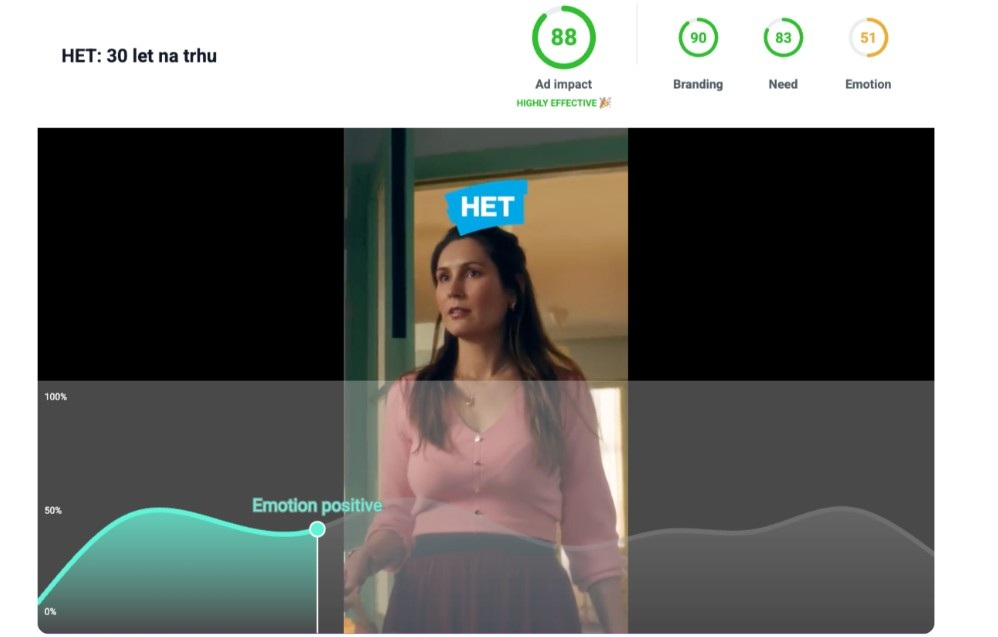
HET performed the best out of all three. Among viewers who saw the advert, 45% are familiar with the brand, whereas among those who did not see it, only 21% are. The advert therefore increased brand awareness by 24 percentage points. “That is an above-average result and the main reason why we rank the campaign in first place,” explains Prokeš.
The key to success is branding. 74% of viewers correctly identify the brand in the advert (the average is 50%), and 74% recognise it within the first five seconds, where the average is just 47%. Moreover, HET keeps the brand present throughout the entire spot, particularly at moments when the advert evokes emotion. This is aided by the visible logo and the product itself in the packshot.
At the same time, the advert is entertaining: it evokes positive emotions in 52% of viewers and is understood by 96% of them.
A weaker point is the delivery of individual messages. Specific messages such as “beautifying your home” or “easy to apply” are picked up by only around 36 to 48% of viewers, which is below the average of 53%. The campaign would benefit from selecting a single key message in future and presenting it more prominently. Even so, HET demonstrates what an advertisement that strengthens a brand should look like: it captures attention, is recognisable from the very first second, and carries the brand throughout the entire story.
Data: Behavio quantitative research, 29–31 May 2026, sample of 900 respondents representative of the online population. Full results here.
 Source: Behavio
2. Stavmat: promising foundations that failed to be built upon
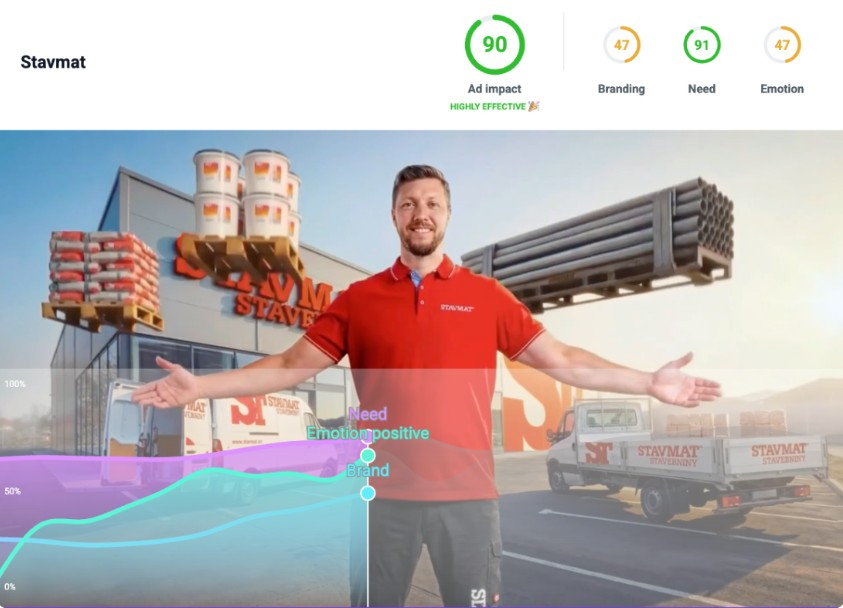
Stavmat is an interesting case. It actually increased brand awareness among viewers by 26 percentage points (from 17% among non-viewers to 43% among viewers), which is the highest increase of all three in absolute terms. So why only second place? Because this excellent result failed to translate into a larger audience.
The advert reached only 22% of the target population – on average, campaigns manage to reach 39%. “Although the campaign resonated with viewers themselves, the impact on the brand is somewhat lost when viewed across the entire population. A big impact on a small sample of people simply isn’t enough,” explains Prokeš.
What Stavmat did succeed in, however, was linking the creative to the category.
An above-average 67% of viewers understand that it is a building materials retailer, thanks to the construction site setting and mentions in the voiceover.
The campaign would benefit most from strengthening the branding right at the start. In the first part, the brand appears mainly on employees’ T-shirts, but this is not where viewers’ attention is focused. “We recommend placing the logo on the products, enlarging it and reinforcing it with the voiceover. Then a strong impact on memory would be combined with sufficient reach,” advises Prokeš to the brand.
Data: Behavio quantitative research, 29 May–1 June 2026, sample of 1,000 respondents representative of the online population. Full data here.
 Source: Behavio
3. INGCO: a good idea, a wasted brand
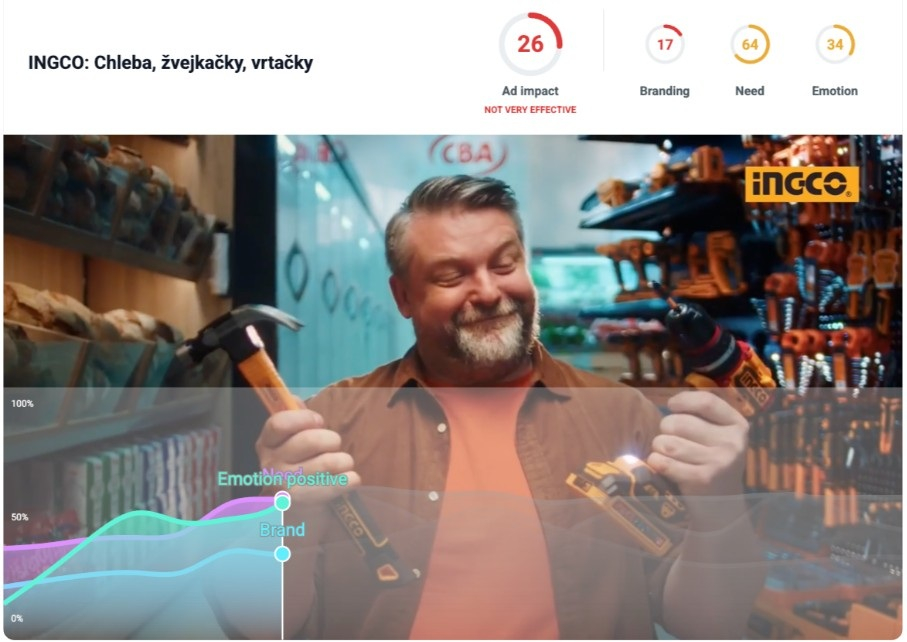
INGCO shows just how easily a funny advert can miss the mark. People quite like the advert; they enjoy the enthusiasm for the tools and the story about the forgotten bread. However, brand awareness rose by just 3 percentage points (from 1% to 4%); on average, adverts manage to increase awareness by 11 points. On the key metric, this is the weakest result of the three, and the brand has made virtually no headway in the public’s memory.
One reason for this is the lacklustre branding. Only 32% of viewers correctly identify the brand in the advert (average 50%), and only a quarter do so within the first five seconds. Branding only gains strength around the middle of the advert, and the brand is completely absent during most of the emotional peaks. “Unfortunately, this is compounded by two obstacles the brand has created for itself: the name INGCO is harder for viewers to read and remember, and mentions of the CBA brand further complicate the situation, so that some people take away the brand of this advertising partner from the spot,” Prokeš points out the pitfalls.
That said, the advert conveys the category reasonably well – 57% of viewers recognise that it is about tools (slightly above the average of 53%). However, that alone is not enough if people do not remember who is offering the tools. It would help the advert to place the brand right at the very beginning and give it prominence throughout.
All in all
Hockey broadcasts offer small brands something they can hardly buy elsewhere: a wide reach and an attentive audience at the same time. The three campaigns tested show what lessons can be learned from their approach:
- Reach and branding go hand in hand. A significant increase in brand awareness among viewers (Stavmat) is lost if the advert reaches few people and, on top of that, fails to clearly display the brand.
- Rely on distinctive symbols. A logo, product or slogan that people recognise even without the name. “HETčí” works; a less recognisable name without other support does not.
- Don’t divide attention. One clear message and one brand. Viewers often don’t take away what’s obscured by other logos and messages (see CBA at INGCO).
A logo in the corner of the screen isn’t enough, as viewers mainly focus on the centre and faces. For a new brand with a less legible name, it’s also worth supporting it with text and highlighting it during emotionally powerful moments when attention is at its peak.
Data: quantitative research by Behavio, 29–31 May 2026, sample of 1,000 respondents representative of the online population. Full data here.
Source: mediaguru.cz